
Ford Tri-Motor: Promotional Use
Share
share
Early American airlines embraced the Ford Tri-Motor. It was rugged, built of metal rather than wood and fabric. It was reliable, able to land safely with just one of its three engines. And it was versatile. Tri-Motors flew passengers and freight for public carriers, and served as executive transports, traveling showrooms and aerial delivery vans for private companies. Ford built nearly 200 Tri-Motors from 1926 to 1933.
THF717393
Ralph Schugar's Aerial Hearse, a Ford Tri-Motor 4-AT-52 Airplane, Curtiss-Bettis Airport, Pittsburgh, Pennsylvania, 1931
Operators adapted Ford Tri-Motor airplanes for every imaginable use. Pittsburgh mortician Ralph Schugar earned a pilot's license and turned his Tri-Motor into an aerial hearse. The death of a loved one is never easy, particularly when it occurs far from home. Schugar's unusual service reduced wait time and worry for the survivors, at a cost comparable to railroad transport.
View ArtifactPilot V. N. Johns with Ford Tri-Motor Plane at Ford Airport, Dearborn, Michigan, 1931
Vernon N. Johns operated Independence Air Tours in connection with the Dearborn Inn, the hotel adjacent to Ford Airport in Dearborn, Michigan. Note the headphones hanging above each seat. They allowed passengers to hear the tour narrator's commentary. Three engines, combined with an uninsulated cabin, made a flight in a Ford Tri-Motor a noisy experience.
View ArtifactEben G. Tileston and Charles E. Graham with the "Dearborn Inn" Ford Tri-Motor 4-AT-48 Airplane, July 1931
Independence Air Tours, in connection with the Dearborn Inn, operated an aerial tour service from Ford Airport in Dearborn, Michigan. Note the headphones hanging above each seat. They allowed passengers to hear the tour narrator's commentary. Three engines, combined with an uninsulated cabin, made a flight in a Ford Tri-Motor a noisy experience.
View ArtifactWilliam Mayo, Edsel Ford and Others with Ford Tri-Motor 4-AT-48 Used to Deliver Monarch Foods, circa 1928
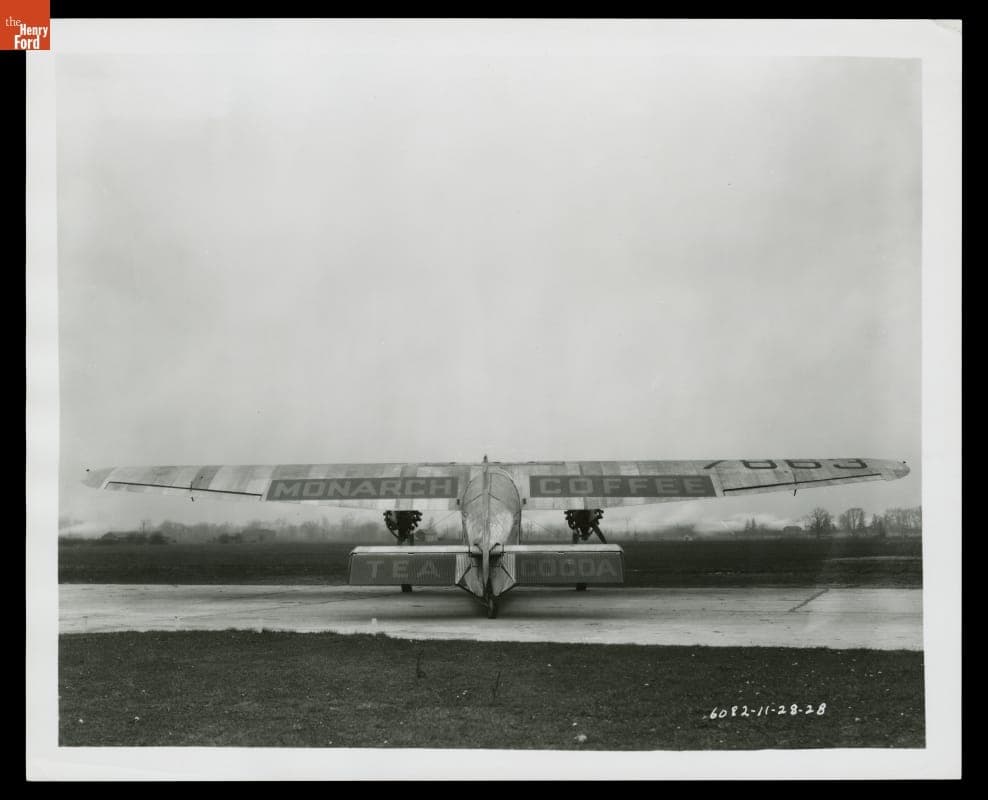
From 1928 to 1931, Reid, Murdoch & Company of Chicago used a Ford Tri-Motor to advertise its Monarch Foods brand. Named Independence, the modified plane served as a flying salesroom and carried samples of over 200 different food products to airports throughout the country. On occasion, Monarch's pint-sized advertising characters, "The Teenie Weenies," also accompanied the plane on its stops.
View ArtifactFord Tri-Motor 4-AT-48 Used as a "Flying Grocery Store" for Reid, Murdoch and Company's Monarch Foods, 1928
From 1928 to 1931, Reid, Murdoch & Company of Chicago used a Ford Tri-Motor to advertise its Monarch Foods brand. Named Independence, the modified plane served as a flying salesroom and carried samples of over 200 different food products to airports throughout the country. On occasion, Monarch's pint-sized advertising characters, "The Teenie Weenies," also accompanied the plane on its stops.
View ArtifactFord Tri-Motor 4-AT-48 Used as a "Flying Grocery Store" for Reid, Murdoch and Company's Monarch Foods, 1928
From 1928 to 1931, Reid, Murdoch & Company of Chicago used a Ford Tri-Motor to advertise its Monarch Foods brand. Named Independence, the modified plane served as a flying salesroom and carried samples of over 200 different food products to airports throughout the country. On occasion, Monarch's pint-sized advertising characters, "The Teenie Weenies," also accompanied the plane on its stops.
View ArtifactEdsel B. Ford, Richard E. Byrd and William B. Stout with Royal Typewriter's Ford Tri-Motor 4-AT-8, 1927
One of the most unusual uses of a Tri-Motor was by Royal Typewriter Company of Hartford, Connecticut. Royal purchased its plane in 1927 to deliver typewriters to the company's distributors. To avoid time-consuming landings, Royal dropped the typewriters, three at a time, by parachute. Royal ended the experimental program and sold its Tri-Motor before year's end.
View ArtifactCargo Door with Crate in Royal Typewriter's Ford Tri-Motor 4AT-8 Airplane, 1927
One of the most unusual uses of a Tri-Motor was by Royal Typewriter Company of Hartford, Connecticut. Royal purchased its plane in 1927 to deliver typewriters to the company's distributors. To avoid time-consuming landings, Royal dropped the typewriters, three at a time, by parachute. Royal ended the experimental program and sold its Tri-Motor before year's end.
View ArtifactCrate and Parachute used in a Royal Typewriter Experimental Delivery from a Ford Tri-Motor, Ford Airport, Dearborn, Michigan, 1927
One of the most unusual uses of a Tri-Motor was by Royal Typewriter Company of Hartford, Connecticut. Royal purchased its plane in 1927 to deliver typewriters to the company's distributors. To avoid time-consuming landings, Royal dropped the typewriters, three at a time, by parachute. Royal ended the experimental program and sold its Tri-Motor before year's end.
View ArtifactRoyal Standard Typewriter, Model No. 10, 1914
A Royal Typewriter Company machine, like this one, was the focus of an unusual use of a Ford Tri-Motor airplane. Royal purchased a plane in 1927 to deliver typewriters to the company's distributors. To avoid time-consuming landings, Royal dropped the typewriters, three at a time, by parachute. Royal ended the experimental program and sold its Tri-Motor before year's end.
View Artifact

