
Horse-drawn Deliveries
Share
share
Horse-drawn delivery wagons remained in use well into the automobile age. Even in the 1920s, it wasn't unusual to see milk, ice, or produce delivered by horse--especially in smaller towns. Horses were well suited to the frequent stops and starts along a route and could negotiate poor roads better than early motorized vehicles. As roads improved and trucks became less expensive to operate and maintain, the horse-drawn delivery wagon faded away.
THF87333
Butcher's Wagon, circa 1875
Before mechanical refrigeration, many Americans bought their perishable goods on a daily basis. In larger cities, enterprising vendors delivered food door-to-door in wagons like this. Inside the butcher's wagon are shelves for meat storage, slots to hold knives, and a cutting board. The vehicle was built in Connecticut by A.U. Elliott & Sons Carriage Manufacturers.
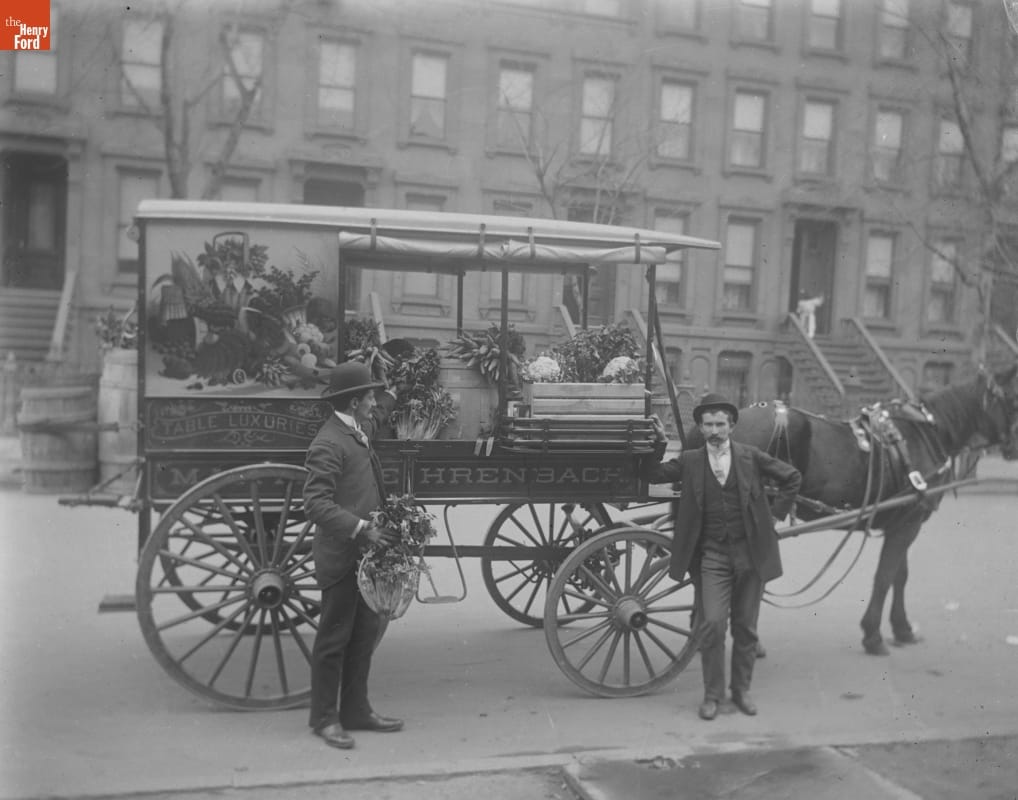
View ArtifactDelivery Wagon, Fehrenbach Table Luxuries, 1890-1915
Enterprising merchants found a ready market for fresh fruits and vegetables in American cities at the turn of the 20th century. This horse-drawn wagon brought produce to neighborhoods in Brooklyn, New York. Swift transportation via railroad, electric interurban, and wagon made everyday fare of "table luxuries" like fresh celery and cauliflower.
View ArtifactOil Tank Wagon for Standard Oil Company, circa 1892
This Standard Oil Company tank wagon delivered petroleum products to communities in southern Michigan from the 1890s to the early 1920s. Its three separate compartments held kerosene, oil, and gasoline. People used kerosene for heating and lighting, and oil to lubricate engines on farms and in factories. And, by the 1910s, gasoline powered a fast-growing number of automobiles on the road.
View ArtifactH. J. Heinz Co. Wagon with Painted Advertising, 1888-1896
Henry J. Heinz rarely missed an opportunity to raise customer awareness for his line of packaged foods. His promotional schemes were innovative and often flamboyant. This brightly-painted wagon, used for deliveries or sales calls, featured the keystone shape that consumers came to associate with Heinz. Paired with a handsome team of Heinz draft horses, this commercial vehicle doubled as a remarkable moving advertisement.
View ArtifactBeer Wagon, circa 1900
During the late 19th and early 20th centuries, horse-drawn vehicles, like this one, were used to deliver kegs of draft beer to bars and taverns. The vehicle's racks hold the kegs in an inward sloping position, so they can’t roll off. More kegs could be loaded on top of the first level, with a few additional kegs hung from hooks underneath.
View ArtifactIce Man and Delivery Wagon, 1890-1915
Electric refrigerators weren't commonplace in American homes until the 1930s. Before that time, consumers relied on regular deliveries of ice to cool their perishable foods. By the turn of the 20th century, ice was harvested from frozen lakes and rivers or commercially manufactured in ice plants. Companies stored the ice in insulated sheds and delivered frozen blocks to customers via horse-drawn insulated wagons.
View ArtifactO.O. Ott, Meadow Brook Dairy Farm Delivery Wagon, 1912-1913
Door-to-door delivery of milk and other dairy products began in the late 1800s. Milk spoiled quickly. Before mechanical home refrigerators, fresh bottles were delivered daily. Horse-drawn dairy delivery wagons were used well into the 20th century. Horses knew their routes and could follow as their drivers walked alongside and dropped off bottles on doorsteps.
View ArtifactMail Wagon Used for Rural Delivery in Missouri, 1902-1925
In 1902, rural farmers became more connected with the rest of the nation when Congress made rural postal routes--operated in only a few areas since 1896--a permanent part of the postal service. August Edinger of Kimmswick, Missouri, bought this light-weight mail wagon for use on his route. Many other rural carriers used similar wagons. Edinger replaced his wagon in 1925 with a Ford Model T automobile.
View ArtifactRural Free Delivery in a Horse-Drawn Mail Delivery Wagon, 1895-1920
Officially adopted by the Post Office Department in 1896, Rural Free Delivery was a boon to residents who were previously required to personally collect their mail in the nearest town. Rural routes were long and served hundreds of customers. To facilitate their perennial labor, carriers often purchased horse-drawn wagons like this, with a cash box, foot-warmer, and small sorting desk.
View ArtifactHorse-Drawn Delivery Wagon Outside a Grocery Store, circa 1900
Before automobiles became practical, America relied on horses and horse-drawn vehicles to move people, freight, money, and information to places railroads and waterways didn't go. This photograph, taken at the turn of the twentieth century, shows a horse-drawn wagon used to deliver groceries.
View Artifact1919 General Motors Truck Company Advertisement, "1 GMC; 1 Driver, Displace 16 Horses; 4 Drivers; 4 Wagons"
Horse-drawn delivery wagons remained in use well into the 1920s -- particularly in smaller towns and rural areas. But this advertisement for GMC trucks explains why they ultimately disappeared. Once roads were sufficiently improved, horse-drawn wagons simply could not compete with motorized trucks. While they might cost more up front, trucks were significantly less expensive to operate and maintain over time.
View Artifact

