
Oliver Evans (1755-1819)
Share
share
Remembered for developing an automated production line for milling flour and building the first high-pressure steam engine in the United States, Oliver Evans was early America’s foremost technological innovator.
THF203701
Steel Engraving, Portrait of Oliver Evans. The Watt of America, circa 1860
A visionary inventor and engineer, Oliver Evans (1755-1819) helped shape American manufacturing. In the late 1700s, Evans developed a continuous conveyor system for milling flour that revolutionized the industry and influenced the design of future automated factories. In 1804, he patented America's first high-pressure steam engine. Evans' new engine was reliable and versatile -- it was adapted for use in both manufacturing and steamboat propulsion.
View ArtifactLicense Granting the Marrietta Steam Mill Company Use of an Oliver Evans Patented Steam Engine, 1812
In 1804, Oliver Evans received a patent for a high-pressure steam engine -- a radical departure from the early low-pressure engines operating in the United States at the time. Evans found commercial applications in the flour-milling industry, where some of his other innovations had already been influential. One of Evans's patented engines was installed in a steam flour mill in Marietta, Ohio, in 1811.
View Artifact"The Young Mill-Wright and Miller's Guide," 1836
This instructional handbook was originally written and published by Oliver Evans (1755-1819). In the late 1700s, Evans developed a continuous conveyor system for milling flour. The Young Mill-Wright and Miller's Guide explained his labor-saving innovations through text and technical illustrations. Published in fifteen editions between 1795 and 1860, the influential book helped revolutionize the flour-milling industry.
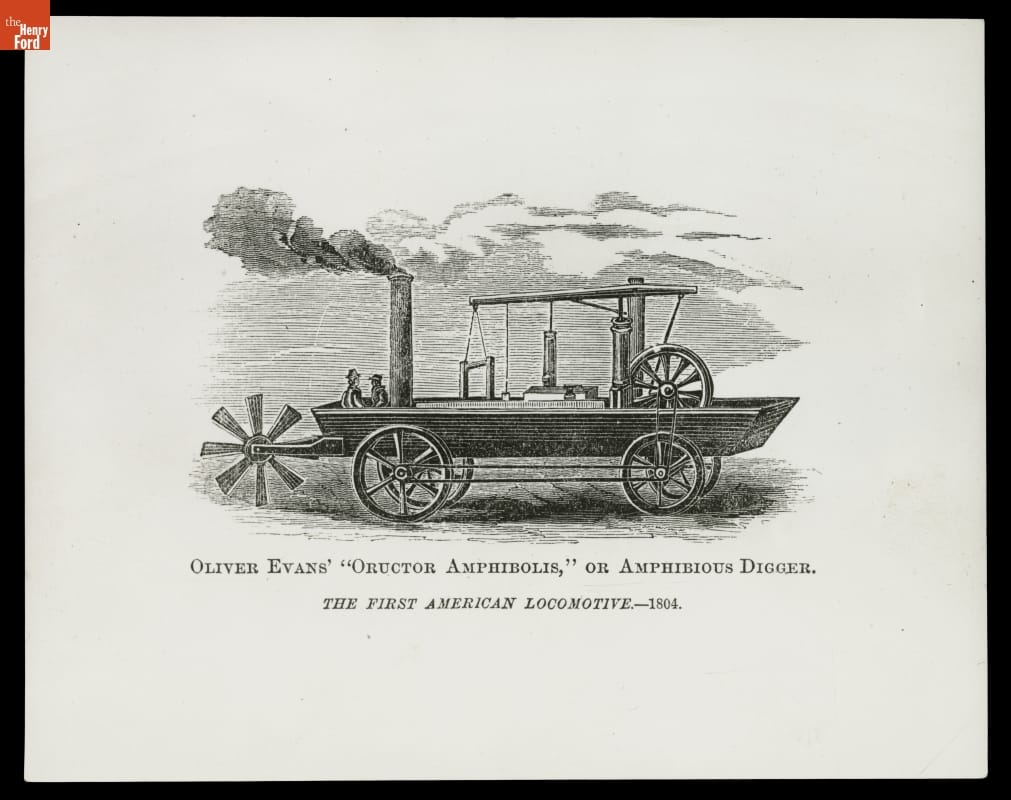
View Artifact"Oliver Evans' 'Oructor Amphibolis,' or, Amphibious Digger, the First American Locomotive--1804"
Inventor and engineer Oliver Evans believed that steam engines, used to power mills and steamboats, could also propel land vehicles. An opportunity to experiment came with a commission from the Philadelphia Board of Health for a steam dredge. Evans designed a 30-foot-long, 17-ton amphibious digger that moved successfully over land in 1805. This one-time stunt proved the viability of steam-powered carriages.
View ArtifactInterior View of Loranger Gristmill in Greenfield Village, 1930
Loranger Gristmill, originally located in Monroe, Michigan, was set up to grind corn and wheat harvested by local farmers into flour or animal feed. It incorporates a sophisticated conveyor system developed by Oliver Evans in the late 1700s. The vertical columns in this photograph conceal cup elevators that lift grain through the building to undergo a variety of processes.
View Artifact

