
Selections from the Stewart Collection
Share
share
In August 2024, The Henry Ford welcomed the donation of hundreds of objects, an archive, and library from the Stewart Program for Modern Design in Montreal, Canada. Acquired over decades through the careful selections of founder Liliane Stewart and her staff, the Stewart Collection spans over 140 years of design history and represents the work of hundreds of designers. The following selection offers a glimpse into this seminal collection.
THF802467
"Cobra" Table Lamp, circa 1946
Industrial designer Jean Otis Reinecke is not very well known today, but the products he designed certainly are. He designed numerous iconic products of the 20th century, including the 3M Scotch tape dispenser, McGraw Electric Company's Toastmaster model 19B, which became the model for all other toasters for decades to follow, as well as this "Cobra" Table Lamp for Faries Manufacturing Company.
View Artifact"Julian" Child Chair, 2004
Spanish artist and designer Javier Mariscal created this Julian chair for the renowned Italian design company Magic s.P.a, which exports products to over 80 countries and reflects the growing globalization of industrial design in the 21st century. This chair is included in Magis' "Me Too" collection, which showcases the work of numerous leading designers creating whimsical works for children.
View Artifact"Julian" Child Chair, 2004
Founder of the Stewart Program for Modern Design, Liliane Stewart, loved cats. Her staff reports that she was enamored with Javier Mariscal's "Julian" chairs and bought one for the Stewart Collection and another for her home. When she passed in 2014, both versions of the chair were reunited in the Stewart Collection, and continue to remain together in their new home at The Henry Ford.
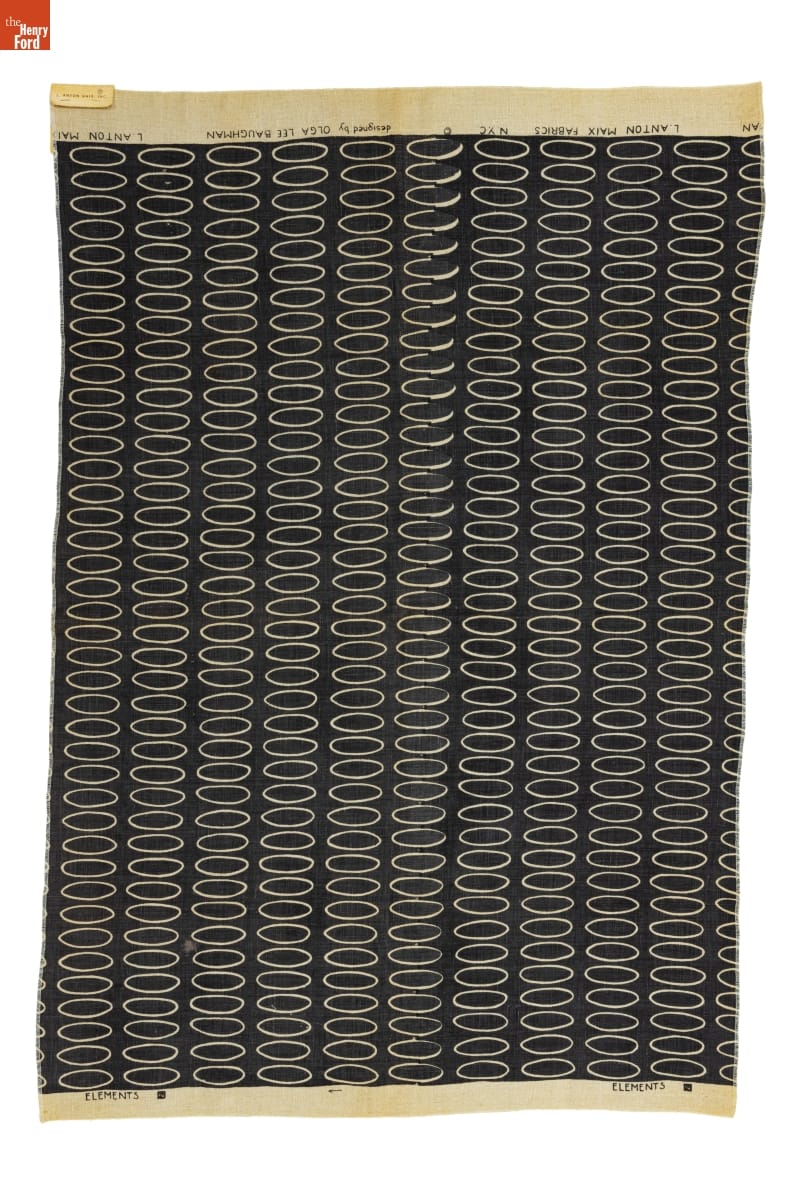
View Artifact"Elements" Textile, 1952
Olga Lee studied interior and industrial design at the prestigious Chouinard Art Institute in Los Angeles, where she met furniture designer Milo Baughman. They married in 1949 and divorced in 1954. She established herself as a leading designer and her designs for New York-based textile studio L. Anton Maix were especially successful. This variation of her "Elements" design features repeating, irregular ovals on linen.
View Artifact"Blade to the Heat," 1994
This poster was created by influential graphic designer, Paula Scher. Her compositions are dynamic, colorful, and playful. Scher famously pushed the boundaries of typography by using text as a form of illustration. In 1994, she formed a 25-year relationship with the New York Public Theatre, designing a new brand identity and poster series--which is among her best-known work.
View ArtifactModel 4706 Electric Clock, 1933-1934
Designer Gilbert Rohde persuaded his new client, the Herman Miller Furniture Company, to participate in the 1933-34 Chicago Century of Progress World's Fair. Rohde designed a suite of furniture and accessories which were exhibited in the "Design for Living" House at the Fair and then manufactured by the company. This clock, the Model 4706 Electric, was shown in the house's primary bedroom.
View ArtifactExecutive Side Chair, 1948
Finnish-American architect and designer Eero Saarinen grew up at the Cranbrook Academy of Art in nearby Bloomfield Hills, after his father designed the campus and became its first president. The relationships Saarinen cultivated at Cranbrook had lasting influence. This chair was produced by Knoll furniture company, then headed by a Cranbrook friend and classmate, Florence Schust Knoll, alongside her husband.
View Artifact"Alaska" Vase, 1982
Italian architect and designer Ettore Sottsass founded the Memphis Group in 1980. "Memphis Group" is often used interchangeably with the style it epitomized--Postmodernism. Purposefully outrageous, the Postmodern works that Sotsass and his Memphis Group co-members designed challenged conventions of "good" taste. Their designs were colorful and loud, sometimes referential to earlier eras, geometric, and often humorous.
View ArtifactIBM Selectric Typewriter, 1961
The 1961 IBM Selectric typewriter was one of the most popular electric typewriters ever produced. On a technological level, the Selectric anticipated computer desktop publication with its interchangeable "type balls." Industrial designer Eliot Noyes created the Selectric’s sleek, die-cast case in eight color options. Now considered a legendary design, this machine visually modernized the office landscape.
View ArtifactGillette "Sensor for Women" Razor, 1992
Industrial designer Jill Shurtleff studied how, where, and why women shaved before creating the Sensor for Women, the first razor designed specifically for women, in 1992. Instead of a traditional thin T-shaped body, the Sensor had a wide handle for users to maintain their grip, and the blade-head was at a 46-degree angle to prevent cuts in hard-to-see areas like underarms.
View Artifact"Town & Country" Teapot, Teacups and Saucers, circa 1945
Designer Eva Zeisel's ceramic forms are sculptural yet unwaveringly functional. Born in Budapest, her education and earliest employment took place in Hungary, Germany, and Russia. She immigrated to America in 1937 and developed a fruitful career as a professor and designer. In 1946, her work was exhibited at the Museum of Modern Art, and she became the first woman to receive a solo exhibition there.
View Artifact"A Lot of People are Waiting for Martin Luther King... We Are It. It is Up to Us. It is Up to You. Marian Wright Edelman," 2018
Celebrated African American graphic designer Gail Anderson created this poster. It features a quote by Marian Wright Endelman, an organizer for Martin Luther King Jr.'s Poor People's Campaign and founder of the Children's Defense Fund. Anderson thoughtfully chose Tré Seals' "Martin" typeface, which was inspired by wood type used to print the iconic protest signs of 1968's Memphis Sanitation Strike.
View Artifact

