
The Evolution of Luggage: From Trunks to Roller Bags
Share
share
Leisure travel has changed a lot over the past 150 years, from something exclusively for the wealthy to something for everyone. Here are some highlights in the relationship between luggage and methods of transportation, from stagecoaches to airplanes.
THF206455
Concord Coach Hitched to Four Horses in Front of Post Office, circa 1885
In the 19th century, travel was uncommon and usually uncomfortable. People who did travel used heavy trunks to carry a great number of possessions, usually by stagecoach, rail or via ship. The traveler didn't usually handle his or her luggage, porters did all the work.
View ArtifactHorse-Drawn Delivery Wagon, "Express Trunks Transferred & Delivered, We Meet All Trains," 1939
As late as 1939, railway express companies transferred heavy trunks to and from the railway depot.
View ArtifactTrunk Used by Captain Milton Russell during the Civil War
Captain Milton Russell used this typical 19th century American trunk during the Civil War. Officers like Russell were allotted baggage space on military wagons – but they had to supply their own trunk, labeled with their name, rank, and unit. It would have carried Russell’s important papers, a medical kit, and other necessary items for use in the battlefield.
View ArtifactCarpet Bag, 1870-1890
People used valises or other types of lighter bags in the 19th century to access objects that they needed frequently. This is a bag made of remnants of wool "ingrain" carpet, a woven, reversible carpet common in middle class American homes of the 19th century.
View ArtifactTrunk Used for File Storage By Harvey S. Firestone, circa 1930
In the 19th and 20th centuries, passengers on ocean-going vessels used "steamer trunks" to hold just about everything they needed during the trip. It was literally a closet in a box. Wealthier passengers like Harvey Firestone, president of Firestone Rubber Company, brought several steamer trunks on board for specific purposes, including this example used to hold important papers.
View ArtifactLoading Luggage into the Trunk of 1939 Ford V-8 Automobile
With the rise of automobile travel, more people had access to travel and suitcases (as we know them) were mass produced in a variety of qualities and prices. Much easier to manage than steamer trunks, they were made to fit into a car trunk.
View ArtifactOshkosh "Chief" Trunk, Used by Elizabeth Parke Firestone, 1920-1955
Made by the Oshkosh Suitcase Co. of Oshkosh, Wisconsin, the Chief Oshkosh brand suitcase was the quintessential mid-level suitcase made during the early 20th century. This example was part of a larger set of luggage that belonged to Elizabeth Parke Firestone.
View ArtifactPassengers Entering Ford Tri-Motor 4-AT Airplane, 1927
During the early years of passenger air travel, flying was expensive, limited to the wealthy, and considered an adventure. Also, passengers were limited to lighter-weight bags due to weight restrictions – note the stylishly-dressed passengers with simple, yet elegant luggage in this photograph.
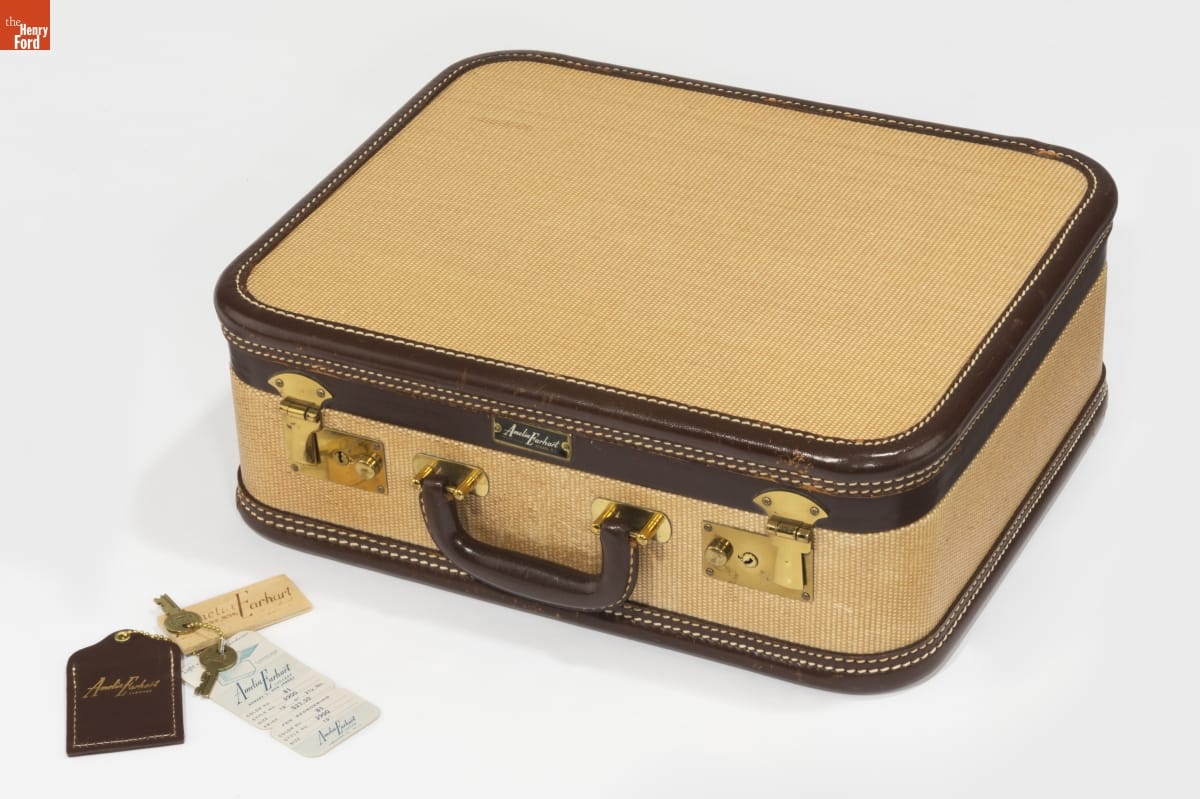
View ArtifactOrenstein Trunk Company Amelia Earhart Brand Luggage Overnight Case, 1943-1950
Famed aviator Amelia Earhart licensed her own line of luggage beginning in 1933. Marketed as "real 'aeroplane' luggage," it was lightweight and made to last, appealing to those who aspired to fly. The luggage sold well for decades – long after her 1937 disappearance attempting an around-the-world flight.
View ArtifactPostcard, Plymouth Savoy 4-Door Sedan, 1961-1962
By the 1960s, Americans bought luggage in colorful sets mass produced by companies like American Tourister and Samsonite. These companies touted their product’s fashion and durability. The stylish lady in this advertisement sits on an old-fashioned trunk while an array of contemporary luggage is at her feet, waiting for the porters to remove it.
View ArtifactTravelpro Rolling Carry-On Suitcase, 1997
Airline deregulation in the 1980s and 1990s created an explosive growth in air travel. As airports grew in size to accommodate more flights, most travelers raced through expansive concourses carrying their own luggage. Roller bags created in the late 1980s provided relief.
View ArtifactAmerican Airlines Duffel Bag, circa 1991
Today, flight crews are in constant motion, moving from plane to plane. In addition to roller bags, flight attendants carry extremely light bags containing personal and readily accessible items. This American Airlines tote bag was used by a flight attendant in the 1990s.
View Artifact

