
Rear Engines
Share
share
Most cars have their engines up front. This layout strikes a good balance between space, weight distribution and handling -- particularly with front-wheel drive. But it’s not the only option. Early automobiles, like the Oldsmobile Curved Dash, placed engines under their seats. This mid-engine design is still favored in racing and high-performance vehicles. The rear-engine format, ideal for air-cooled motors, was used by Volkswagen and Corvair.
Working Model of First Automobile Built by Karl Benz, Presented to Henry Ford in 1938
The automobile's invention cannot be traced to any one person, place or moment in time. However, historians generally credit the Benz Patent-Motorwagen, built in Germany by engineer Karl Benz in 1885, with being the first self-propelled vehicle designed around an internal combustion engine. This one-fifth-scale replica was given to Henry Ford by Daimler-Benz Company on Ford's 75th birthday.
View Artifact1896 Ford Quadricycle Runabout, First Car Built by Henry Ford - 12
The Quadricycle was Henry Ford's first attempt to build a gasoline-powered automobile. It utilized commonly available materials: angle iron for the frame, a leather belt and chain drive for the transmission, and a buggy seat. Ford had to devise his own ignition system. He sold his Quadricycle for $200, then used the money to build his second car.
View Artifact1900 Winton Touring Car
Industry pioneer Alexander Winton formed his Cleveland-based automobile company in 1897. Winton made national headlines driving one of his single-cylinder vehicles from Cleveland to New York City in 47 hours -- a record time for 1899. Declining sales prompted Winton to refocus his efforts on manufacturing diesel engines in 1924. He sold his engine company to General Motors in 1930.
View Artifact1903 Oldsmobile Curved Dash Runabout - 7
When it inspires a song, you know it's popular. This Olds was the bestselling car in America from 1902 to 1905. Automobiles had an emotional appeal. A driver in 1901 said that controlling a car satisfied "an almost universal sense, the love of power." Despite the attraction, cars were not a significant player in the transportation world. In 1903 some 4,000 people bought Oldsmobiles, but more than 900,000 bought buggies and carriages.
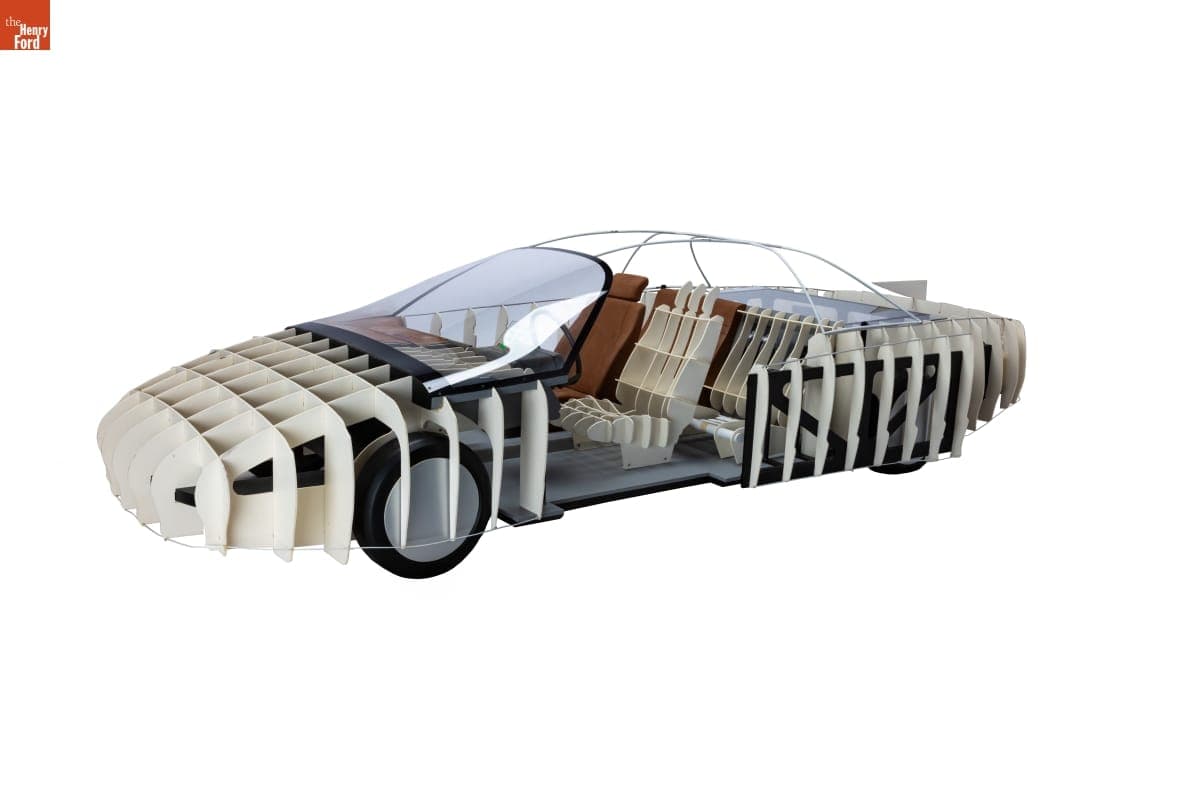
View ArtifactModel of a 1940 Ford XP Rear Engine Automobile
This photograph shows a model of a Ford concept car that never made it to production. The model suggests that the car would have used unit-body construction similar to the Lincoln Zephyr. The XP's proposed rear-engine layout was unusual for the time, as was the transverse engine oriented with its crankshaft parallel to the rear axle.
View Artifact1948 Tucker 48 Sedan - 4
Swooping fenders and six exhaust pipes make the Tucker look like a rocket ship. But Preston Tucker's car mixes fantasy with practicality. The center light turns with the front wheels to cast light around corners. Taillights are visible from the side for safety. Doors curve into the roof for easier entry and exit, while grilles on the rear fenders feed cooling air to the rear-mounted engine.
View Artifact1949 Volkswagen Sedan - 5
The Volkswagen Beetle was different from any American car. It looked like an insect, its engine was where the trunk should be, and it didn't have a radiator. But it recalled the spirit of Henry Ford's legendary Model T. Both cars were simple, reliable, economical, and never deviated from their basic original design. The VW would go on to break the Ford's all-time sales record.
View Artifact1959 Volkswagen Westfalia Camper - 5
Volkswagen introduced its "box on wheels," the VW Type 2 Bus, in 1949. A few years later, VW contracted with Westfalia and introduced converted campers. First exported to the U.S. in 1956, Westfalia campers provided home-like camping comfort and created a postwar recreational-vehicle lifestyle. This soon-to-be cultural icon transported Americans down highways and byways and into the great outdoors.
View Artifact1960 Chevrolet Corvair Sedan - 5
With its rear-mounted, air-cooled engine, the Corvair was conceived as an American answer to the rear-engined, air-cooled Volkswagen Beetle. Corvairs sold well, although not as well as the more conventional Ford Falcon. But sales slipped after Ralph Nader's book, Unsafe at Any Speed, raised questions about the Corvair's handling. Production ceased in 1969.
View Artifact1960 Chevrolet Corvair Brochure, "Custom Features for the Corvair"
Car brochures have evolved from straightforward product catalogues into polished creative sales tools. Their quality paper, rich color, inventive formats, and sophisticated graphic design all contribute to a buyer's developing impression of a car in a showroom. Advertising might entice people to a dealership, but brochures extend and deepen the relationship between vehicle and potential buyer.
View Artifact1960 Chevrolet Corvair Sales Brochure, "The Prestige Car in Its Class" - 1
A dramatically styled compact car with a rear-mounted engine, the 1960 Chevrolet Corvair was something different from Detroit's Big Three automakers. This sales brochure shows the ins and outs of what General Motors called "The Prestige Car in its Class."
View ArtifactReport on Chevrolet's Thrift Models, Featuring the Corvair, Named "Car of the Year," 1960
This General Motors publication highlights the company's successful entrance into compact-car manufacturing. Motor Trend named the Chevrolet Corvair its "Car of the Year" for 1960.
View Artifact1962 Mustang I Roadster - 3
This sharp looking little two-seater created a great "buzz" when racing driver Dan Gurney introduced it at the United States Grand Prix in Watkins Glen, New York, in 1962. Featuring a rear-mounted V-4 engine, it was unlike any Ford ever seen before. The Mustang name later appeared on a sporty four-seater that created its own buzz in 1964.
View Artifact1965 Lotus-Ford Race Car - 6
Scotsman Jim Clark won the Indianapolis 500 with this rear-engine car in 1965. After his victory, a traditional front-engine car never won that race again. The Lotus-Ford combined a European Formula One-inspired lightweight chassis with a big Ford V-8 engine. The Lotus-Ford's success effectively killed the traditional Indy roadster and established a new design for American race cars.
View Artifact1965 Ford Econoline Van
Ford introduced its Econoline van in 1961 to challenge Volkswagen’s Type 2 Transporter. The light-duty van was an instant hit as companies like Bell Telephone System purchased Econolines for their fleets. Ford used a “cab-over” design that placed the engine under the front seats. The layout allowed for maximum cargo space while keeping the van’s overall length relatively compact.
View Artifact"Unsafe at Any Speed," 1965 - 1
Unsafe at Any Speed, Ralph Nader's bestselling 1965 book, exposed potential driving dangers with American cars and shed light on the auto manufacturers' resistance to improving safety. The book sparked consumer advocates to work on government legislation to regulate the industry and provide safer vehicles. It also helped convince many Americans about the importance of vehicle safety.
View Artifact1966 Chevrolet Corvair Corsa Advertisement, "Youth Movement-Corvair"
The automobile is a paradox -- a practical tool that plays host to both human needs and fantasies. Like car consumers, automotive ads seem to land somewhere between fantasy and reality, emotions and rationality. Many ads incorporate apparent opposites: fantasy can sell practicality, and vice versa. Sometimes the car has disappeared completely -- an emotional appeal prompts us to complete the ad.
View Artifact"Unsafe at Any Speed," 1966
Unsafe at Any Speed, Ralph Nader's bestselling 1965 book, exposed potential driving dangers with American cars and shed light on the auto manufacturers' resistance to improving safety. The book sparked consumer advocates to work on government legislation to regulate the industry and provide safer vehicles. It also helped convince many Americans about the importance of vehicle safety.
View Artifact1974 Warrior Concept Car - 1
When McKinley Thompson, Jr., joined Ford Motor Company in 1956, he was one of the automotive industry's first African American designers. In 1974 he completed a rugged, easy-to-build vehicle designed for developing countries: the Warrior. Thompson's prototype, built on a Renault 10 chassis, featured a buoyant plastic body and a removable top. Thompson couldn't interest automakers or investors in his bold idea.
View ArtifactFord Probe V Scale Model, 1987
The "Probe" name had a long history at Ford Motor Company. It appeared on a series of five advanced concept cars from 1979 to 1984, including the mid-engine Probe V represented by this model. "Probe" then appeared on a production vehicle from 1989 to 1997 -- a sporty front-engine, front-wheel-drive car initially designed as the fourth-generation Mustang.
View Artifact

