
Personification and Anthropomorphism
Share
share
Attributing human characteristics to animals and objects is a natural tendency, and a technique that artists and writers have used for centuries. Personification ascribes human emotions and values to inanimate beings. Anthropomorphism gives things human agency. Depictions appear in a variety of media, and the messages conveyed can be amusing, persuasive, and thought-provoking.
Dog "Driving" a Fordson Tractor, circa 1919
Human fixation with personified or anthropomorphized animals is nothing new. A hundred years ago, a playful photographer snapped a shot of this farm dog behind the wheel of a Fordson tractor. Today, dogs bound into the driver's seat and seem to enjoy the experience as much as their handlers.
View ArtifactDog Posing in Sprint Car, circa 1940
Dogs seem to tolerate the human clothing often used to complete the anthropomorphism look. This photograph captured a dog wearing goggles and a helmet posed in a sprint car’s driver’s seat. A humorous caption -- "racing gone to the dogs" -- rounds out the joke.
View ArtifactCircus Poster, Barnum and Bailey Present "Marvelous Performances of the Troupe of Trained Cats and Pigs," circa 1895
Showmen took advantage of their audiences' attraction to animals depicted in unnatural situations. Amusements at the children's circus advertised here included pigs trained to dance and cats trained to box.
View ArtifactCircus Poster, Barnum & Bailey Circus Presents Mooney's "Giants," The Famous Elephant Base-Ball Team, 1913
During the 1910s and 1920s, organized baseball clubs staged popular barnstorming tours, playing exhibition games against local teams. Imagine the excitement when the "famous elephant base-ball team," Mooney's Giants, came to town!
View ArtifactPostcard, Girl and Dog Playing Cards, "A Card Sharp," 1908
Manufacturers also capitalized on consumers' fascination with animals doing things people do, mass-producing goods with anthropomorphic themes. People could choose from a variety of staged messages. The recipient of this postcard, which depicts a card-playing dog as a young girl's opponent, may have wondered, "who’s fleecing whom?"
View ArtifactCat with Pipe Bank, 1880-1900
This inexpensive bank helped teach children the virtue of saving money, while also decorating a middle class Victorian home. Its form -- an endearing cat smoking a pipe -- was a whimsical device meant to serve as a conversation piece on a mantel or book shelf.
View ArtifactToy Cardboard Cats, 1880-1900
Children often played with toys designed to teach lessons. These cats conveyed the reality of domestic labor, as well as professional potential, in colorful detail. Girls, who were responsible for housecleaning, could aspire to paying positions symbolized by glasses (for reading) and a purse (to hold the paycheck), while boys might dream of becoming a pro boxer.
View ArtifactTrade Card for Sewing Thread, J. & P. Coats, 1887
Manufacturers often magnified the impossible in advertising to capture consumers’ attention and stir their imaginations. The brightly-colored clothing worn by these parading polar bears demonstrates the potential of J. and P. Coats sewing thread, depicted in the image as a spool-turned-drum.
View ArtifactTrade Card for Sewing Thread, J. & P. Coats, 1880-1895
Human mothers could identify with the dog on this trade card, whose puppies vie for her attention while she tries to mend some cloth. Advertisers targeted the emotional connection between consumers and their pets, knowing that a dog or cat might soften a potential buyer’s association with tedious chores.
View ArtifactTrade Card for Lewando's Cleaners, 1890-1905
Bright red, green, and yellow clothes and a blue sock, all hung on the clothes line with care by Tabby, conveyed the merits of Lewando's Magic Dyes. The poem on the back of the card explained how Lewando's made Tabby’s food- and milk-stained silks look new and bright again.
View ArtifactTrade Card for Swift & Company "Silver Leaf Lard," circa 1900
Clever graphic artists created packaged food advertisements with anthropomorphized plants and animals -- food sources that sold themselves. In this trade card, a group of piglets promote "Silver Leaf Lard," a popular brand of pig fat used for cooking or as a spread.
View Artifact"Mr. Peanut" Whistle, 1940-1960
Planters Peanuts created its "spokesperson," Mr. Peanut, in 1916. A commercial artist started with a schoolboy's sketch -- submitted as part of a contest -- and added gentlemanly accessories, including a cane, monocle, top hat, gloves, and spats. The iconic illustrated character, depicted in this whistle figurine, has changed little over more than 100 years.
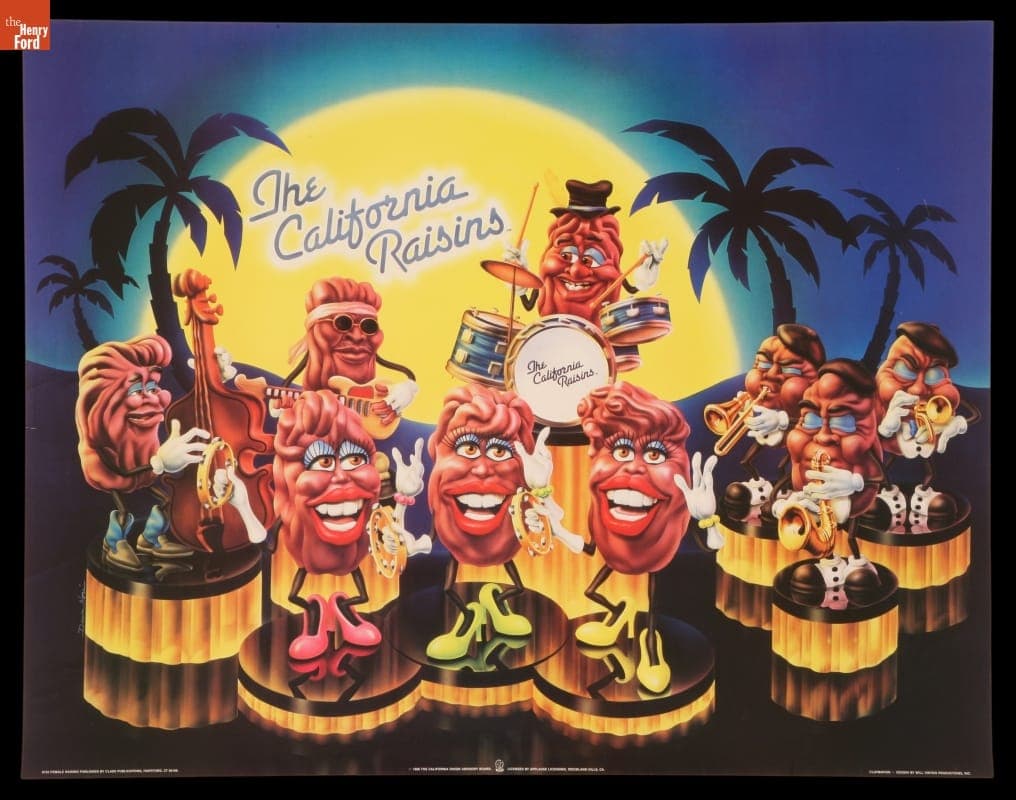
View ArtifactAdvertising Poster, "The California Raisins," 1988
The California Raisin Advisory Board brought their product to life as an animated rhythm and blues band. The group's rendition of Marvin Gaye's "I Heard It Through the Grapevine" aired on a 1986 TV commercial and left the public wanting more. By 1988, The California Raisins had four albums, a Billboard Hot 100 hit, and a mockumentary about their origins.
View ArtifactPolitical Cartoon, "The Old Bull Dog on the Right Track," 1864
Political cartoonists use anthropomorphism to communicate ideas about public figures and current events. In this Civil War-era cartoon, President Lincoln encourages Ulysses S. Grant (depicted as an aggressive and capable bulldog) to attack Richmond (the doghouse) and its kennel of Confederate military and political leaders, including Robert E. Lee, Jefferson Davis and Pierre G.T. Beauregard.
View ArtifactWorld War I Poster, "War Gardens Victorious," circa 1919
Graphic artists imbued inanimate objects with human characteristics to add symbolism to recruitment posters and other colorful propaganda during World War I. Here, vegetables fall in line behind the young cultivator of a war garden.
View ArtifactHalloween Postcard, "The Halloween Lantern," 1914
Artist John Winsch designed this card to include traditional Halloween symbols and a bit of magic. A pickle has already tumbled out of a joyride with a witch driver and vegetable passengers in a car with a personality of its own.
View ArtifactEaster Greeting Card, "For Grandpa on Easter," circa 1955
Along with faces and body positioning, clothing and props can add character to illustrated animals. A water-loving duckling was a natural choice for the artist of this Easter greeting, who amplified the message with a sailor's suit and eggshell boat.
View ArtifactLunchbox, Huckleberry Hound and His Friends, 1961
Animators create animal characters with memorable personalities for television and film. This lunchbox depicts Huckleberry Hound and his "friends" -- those troublemaking bears, Yogi Bear and Boo Boo, and two mice, Pixie and Dixie, who were always trying to outwit the cat, Mr. Jinks.
View ArtifactPizza Hut "Beauty and the Beast" Hand Puppets, 1992
Anthropomorphism abounds in Disney's Beauty and the Beast (1991), the first animated film to receive an Academy Award nomination for Best Picture. As the story progresses, changes in clothing, voice, and posture humanize the Beast. Animators enlivened other characters, castle servants who had been turned into household objects, with creative faces and life-like movements.
View Artifact"Monkey Bar" Diorama, Made by Prisoner Patrick J. Culhane and Presented to Henry Ford, 1914-1915
Anthropomorphism can offer a useful lens on human nature, helping us examine the good and bad in ourselves. In this diorama, monkeys are depicted engaging in activities, such as gambling and drinking alcohol, that the maker -- an inmate at the Massachusetts State Prison -- believed caused the downfall of many prisoners.
View ArtifactTrade Card for the 1901 Pan-American Exposition, Pearlicross Coffee and York's Favorite Coffee, 1899
North and South America grasp hands on this trade card, which advertised coffee and the 1901 Pan-American Exposition. This was the official logo of the event, staged to promote "commercial well-being and good understanding among the American Republics."
View ArtifactModel of "Pico - The Projector Camera," 2010
Sometimes, products themselves are anthropomorphized. This portable projector featured a face comprised of projector and camera lens "eyes" and a smile-shaped microphone. It was designed to record presentations for easy upload to the internet -- where anthropomorphism thrives in memes, emojis, and other expressions of digital culture.
View Artifact

