
Spinning Highlights from the Collections of The Henry Ford
Share
share
Humans have been twisting fiber into yarn forever--a process called spinning. The spinning-related tools and machinery shown in this expert set illustrate the continual quest for improved reliability, quality, and speed in processing the fibers that create the clothing and other textiles that fill our lives.
THF188584
Pair of Hand Cards, circa 1800
Before wool is spun into yarn, the fibers are untangled and aligned, making it easier to produce a smooth, consistent yarn. In this process, called carding, clean wool fleece is passed between small, bent wire teeth to align the fibers. Hand cards, like this pair, were used in 18th and 19th century American homes to card wool prior to spinning. Younger children were often given this necessary, but monotonous, task.
View ArtifactTHF91504
Wool Wheel, 1800-1820
Spinning fibers into yarn for weaving into cloth was an important task in many 17th and 18th century households. Spinning, often the work of young or unmarried women, was a skilled -- but often tedious -- task. The woman who operated this large wool wheel spent countless hours walking to and fro, alternately spinning the wool fibers into yarn and then winding it onto the spindle.
View ArtifactTHF171115
Wool Wheel, Made in the Shaker Community in Canterbury, New Hampshire, 1807-1847
This wool wheel, made in the Canterbury, New Hampshire, Shaker community, incorporates an innovative spinning head patented by Amos Miner in 1810. The Miner’s head -- which increased spindle speed and decreased yarn production time -- was widely adopted.
View ArtifactTHF91530
Carding Machine, 1850-1880
For much of the nineteenth century, the American textile industry was at the forefront of processing and precision machine technology. Carding is a crucial step in the processing of raw cotton or wool; machines like this were used singly in tiny rural mills or in multiple in the largest textile factories. Mechanized carding machines made the process much faster than laboriously doing it by hand.
View ArtifactTHF126237
Spinning Jenny, circa 1825
Innovations in weaving technology created an ever-greater demand for yarn. Spinning wheels that produced one or two yarns at a time could not keep up with this demand, leading to the development of multiple-spindle machines. This hand-operated spinning jenny produces multiple yarns simultaneously. Designed to allow home workers to compete with factory production, it was notoriously difficult to operate successfully and never came into wide use.
View ArtifactTHF126738
Brown's Patent Vertical Spinner, 1821
This 1821 advertisement for an innovative spinning wheel comes with a testimonial from Samuel Slater, David Wilkinson, and Benjamin Walcott, three prominent pioneers of the American textile industry. Brown's patent vertical spinner could spin six yarns simultaneously, but it was never widely adopted by home workers and never challenged the growth of the factory system.
View ArtifactTHF172287
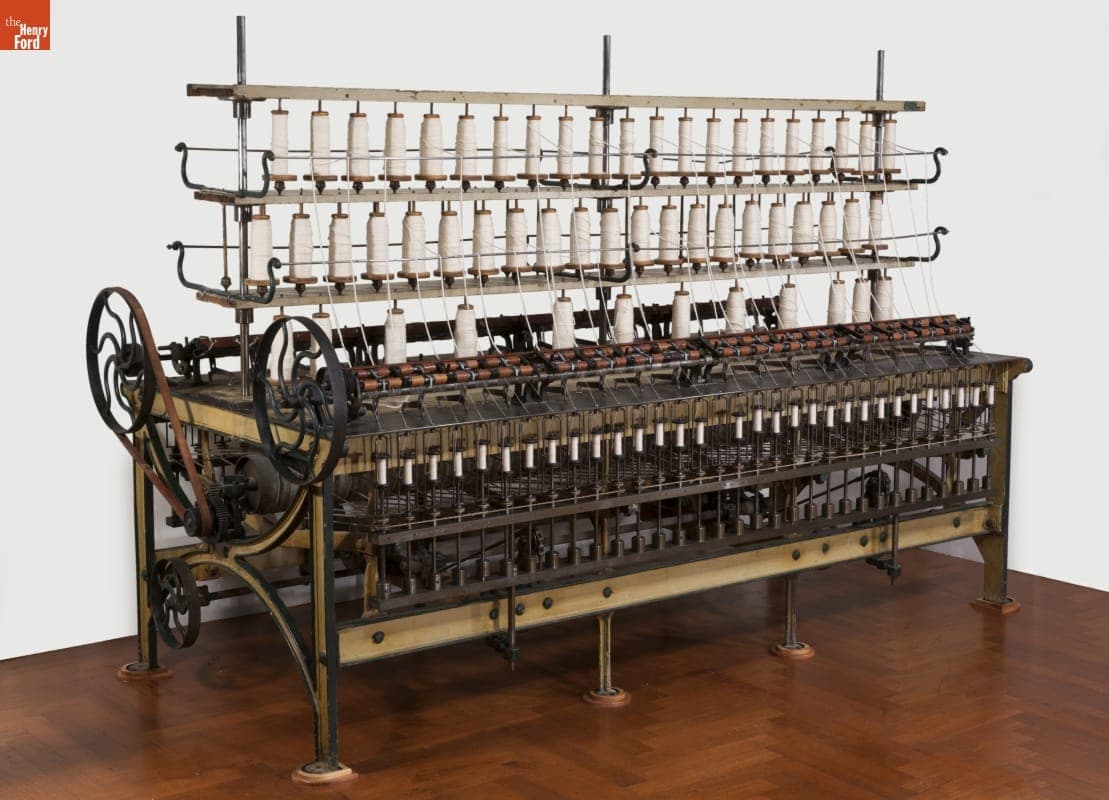
Throstle Spinning Frame, circa 1835
Spinning frames spin cotton fiber into yarn and then wind it onto a bobbin. This throstle spinning frame could simultaneously spin 64 strands of yarn. (Throstle -- an old name for a song thrush -- refers to the bird-like sounds the machine made.) Machines like this helped produce the large quantities of yarn that growing industrial weaving operations needed in the early and mid-1800s.
View ArtifactTHF174781
Model of a Flax Brake, circa 1900
Producing linen yarn from the flax plant is a labor-intensive, time-consuming process. The hard outer coating of flax stems is removed by rotting, drying and breaking to extract the useable fibers within. A flax brake is the tool used to "break" or remove that outer coating. Bundles of flax stems are repeatedly pounded between the hinged upper and lower bars of the tool. This model represents one of the flax brake designs developed in America.
View ArtifactTHF171107
Pair of Hackles
After the hard outer coating of flax stems is removed, the fibers are drawn through a series of hackles -- boards with sharp metal spikes -- to align the long fibers and remove debris and short fibers. For convenience, this double hackle bench combines a coarse hackle at one end with a finer hackle at the other end.
View ArtifactTHF171098
Flax Wheel, Made by James Gregg, 1800-1819
Spinning wheels come in a rich diversity of sizes and shapes depending on where and when they were made and the fibers they were intended to spin. This Saxony-style wheel, as its name suggests, was developed in northern Europe but was widely used in America. Intended for spinning flax fiber into linen yarn, these wheels often featured a built-in upright distaff to conveniently hold the raw flax fibers for the spinner.
View ArtifactTHF171045
Flax Wheel, Made by Silas Barnum,1800-1828
This upright wheel, made by Silas Barnum in Fairfield County, Connecticut, is an example of a compact, popular style of wheel for spinning flax fiber into linen yarn. It also features an innovative improvement called a double flyer, which allows the spinner to produce two yarns simultaneously.
View ArtifactTHF171009
Quilling Wheel, Made by Jedediah Davis Browning, 1808-1832
A quilling wheel is used to wind yarn onto a quill or bobbin for use in weaving cloth. It often resembles a small wool wheel, but usually has a peg or handle on one of the wheel's spokes to facilitate rapid turning. Farmer and cabinetmaker Jedediah Browning made this quilling wheel in Woodstock, Connecticut. It features the addition of an innovative accelerating wheel to increase its speed.
View ArtifactTHF171065
Clock Reel, circa 1875
A clock reel is a device used to wind spun yarn into measured skeins. The mechanism is similar to a mechanical clock. The dial's hand is attached to gears that count off the number of times the reel revolves. The dial kept track automatically, making it easy to know how many yards had been spun--without having to keep track in one's head.
View ArtifactTHF91501
Cotton Ginning, Carding, & Spinning Machine, 1835-1840
Called a "plantation spinner" or "spinster", this small machine combined the three processes required to convert raw cotton to yarn -- ginning, carding and spinning. Its small size and human-powered design was made for enslaved plantation laborers. By the time of the Civil War, there were 3,000 in use across the south. After emancipation they were no longer economically viable.
View ArtifactTHF621736
In the Great Spinning Room - 104,000 Spindles - Olympian Cotton Mills, Columbia, South Carolina, 1903
Mill owners used the most up-to-date machines in their factories to increase production and cut labor costs, hiring children to tend some of them. A typical child's job was that of spinner, tending 6 or 7 rows of rotating bobbins and watching for breaks in the cotton--then quickly mending them. By 1900, laws in the North limited child labor to an extent, but the practice was widespread in the South, where much of the textile industry had moved.
View ArtifactTHF93135
Folding Portable Spinning Wheel Used by Mahatma M. K. Gandhi
In the 1930s, Indian nationalist Mahatma Gandhi used a spinning wheel, or charkha, as a unifying call-to-action in the nonviolent struggle against British colonial rule. Britain had long used India as a market for its factory-made textiles--overwhelming local Indian production. Gandhi encouraged people to spin as a simple act of protest. The charkha proved a highly visible symbol in India's struggle for independence and economic self-sufficiency.
View Artifact

