
Jeep
Share
share
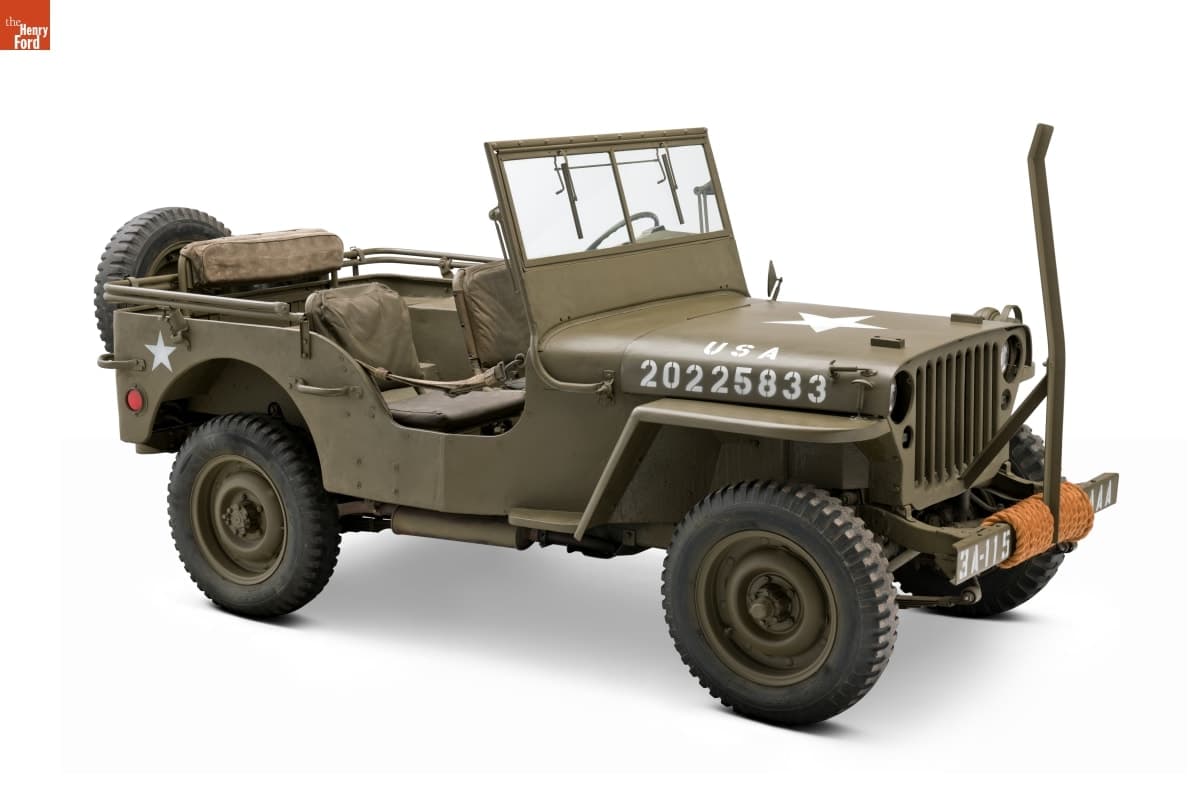
From wartime, to worktime, to playtime, the Jeep has done it all. It's been dressed up, stripped down, reimagined, and retro-styled, but it's never lost its appeal. Yet the Jeep is also an automotive paradox. It’s a timeless design that’s routinely updated, a rugged off-road vehicle refined for highway cruising, and a free-spirited brand coveted and controlled by corporate owners. Above all else, the Jeep is an American original.
THF98169
Brochure, "Keep America Out of War," 1939
The threat of world war grew throughout the 1930s. While many Americans hoped to avoid involvement, military planners prepared for the worst. They realized the need for a small, four-wheel-drive vehicle for reconnaissance and message delivery. In 1940, the Army's Quartermaster Corps requested designs from three manufacturers: American Bantam, Willys-Overland, and Ford Motor Company.
View ArtifactTHF103911
American Austin Automobile Emblem, circa 1930
American Bantam submitted the winning bid. The company was incorporated in Butler, Pennsylvania, in 1936 from the remains of bankrupt American Austin, which built licensed British Austin automobiles for the U.S. market. Struggling Bantam relished the thought of a big Army contract, and the company proposed a squat little car unlike anything else on the battlefield -- or on the highway.
View ArtifactTHF210938
"No Longer a Car Widow, Now I Do Go to Town!" Willys Advertisement, 1940
Willys-Overland traced its roots to 1903. John North Willys bought the struggling Indiana firm in 1908, relocated it to Toledo, Ohio, and turned its Overland cars into strong-selling alternatives to Ford's Model T. Willys's bid was costlier than Bantam's, but Army officials were concerned about Bantam's limited manufacturing facilities. The larger Willys company offered greater production capacity.
View ArtifactTHF133433
"Ford" Sign on the Press Shop at the Ford Rouge Plant, 1939
Ford Motor Company was much larger than either Bantam or Willys, which appealed to the Army. Ford had invented modern mass production techniques with its Model T and moving assembly line, and the company had multiple assembly plants throughout the United States. Military planners knew Ford could build large numbers of vehicles on short notice.
View ArtifactTHF708717
"Meet the Jeep" Article from The Autocar Magazine, 1942
Bantam delivered its prototype in September 1940. Willys and Ford prepared prototypes of their own -- aided considerably by the Army's willingness to share Bantam’s blueprints. Insistent on a single, standardized design, Quartermaster Corps officials selected the best components from each manufacturer’s prototype to create the final version of the new vehicle.
View ArtifactTHF90487
1943 Willys-Overland Jeep Runabout
The Army formally designated the car a General Purpose, or GP, vehicle. In its final form, it measured 132 inches long, by 62 inches wide, by 72 inches high. Its wheelbase measured 80 inches, and it weighed in at 2,450 pounds. The GP's four-cylinder, 134-cubic-inch engine -- nicknamed "Go Devil" -- produced 54 horsepower and an impressive 104 pound-feet of torque.
View ArtifactTHF131637
Edsel Ford and General Charles H. Bonesteel Testing the Ford GP Military Vehicle, February 1941
After building 2,675 GP vehicles, Bantam was cut from further orders. Military planners simply did not have confidence in the little company's ability to manufacture on a massive scale. Bantam created the GP's basic design, but that design was now the Army's property. Willys-Overland and Ford would build the GP, while Bantam was left to manufacture trailers and accessories.
View ArtifactTHF145076
Ford GPW Military Jeeps on Assembly Line, Dallas, Texas, October 1944
Fair to Bantam or not, the Army's decision was sound. Initially modest military orders grew throughout 1941, and then soared after the attack on Pearl Harbor that December. Altogether, Willys-Overland manufactured 362,872 GP vehicles (most designated Willys MB) at its Toledo plant, while Ford produced 282,354 units (most designated Ford GPW) at six different factories around the country.
View ArtifactTHF234728
Popeye the Sailor Man Birthday Card, Given July 31, 1939
Troops in the field took to calling the little GP car a "jeep." There are two popular theories about the nickname's origin. Some people contend that it simply came from the phonetic pronunciation of the initials GP. Others believe it was inspired by Eugene the Jeep, a magical creature introduced in the popular Popeye comic strip in 1936.
View ArtifactTHF705740
Crossing a Stream in a Willys Military Jeep, circa 1943
The jeep proved itself in World War II, doing far more than its intended scouting work. Soldiers used it to tow artillery, carry the wounded, and deliver ammunition. When fitted with a machine gun, the jeep became a weapon itself. War correspondent Ernie Pyle said it was "faithful as a dog, strong as a mule, and agile as a goat."
View ArtifactTHF205059
Music Sheet, "Little Bo-Peep Has Lost Her Jeep," 1942
The jeep quickly earned a place in popular culture. Songwriters Jerry Bowne and Frank De Vol parodied a favorite nursey rhyme with "Little Bo-Peep Has Lost Her Jeep" in 1942, and 20th Century Fox released the movie Four Jills in a Jeep two years later. Jeeps also appeared in movie newsreels that kept Americans informed on the war's progress.
View ArtifactTHF93698
1943 Advertisement for Ford Motor Company Featuring Ford-Made Jeeps, "Sweethearts of the A.E.F.!"
Willys and Ford, like all American automakers, couldn't build cars for civilian customers during World War II. But that didn't mean the companies couldn't advertise to them. This 1943 ad from Ford boasts about the strength and reliability of the Ford-built jeeps used by the Allied Expeditionary Force. "They're sweethearts, say the soldiers!"
View ArtifactTHF211060
"Like a Bat Out of Hell!, Jeep from Willys-Overland," 1942
Willys-Overland took a similar approach in this advertisement from 1942. The ad characterized the jeep as a "bat out of hell" that couldn't be stopped -- and it reminded readers that the same Willys engineers behind the jeep would someday be back at work on reliable civilian cars. Willys recognized the enormous value in the jeep's name and service record.
View ArtifactTHF708651
"The All-Purpose Vehicle for the Farm: The Universal Jeep," 1946-1949
When the war ended in September 1945, Willys-Overland staked a formal claim to the little runabout and changed the generic "jeep" to the proper name "Jeep." After a brief legal battle with American Bantam, Willys trademarked "Jeep" in 1950. Bantam, the company that originated the design, built trailers for a few more years before shutting down in 1956.
View ArtifactTHF708715
"A Revolutionary Vehicle for a Thousand Jobs," Universal Jeep Advertisement, 1945
Willys marketed its civilian Jeep as a functional, flexible vehicle suited for many different jobs. This 1945 advertisement shows the Jeep pulling farm equipment, plowing snow, powering an auxiliary saw, and hauling equipment and personnel for a fire department. Willys officially designated the model CJ – for "Civilian Jeep" – but it also marketed it under the "Universal" name.
View ArtifactTHF208635
"Meet the Jeepster" Sales Brochure for 1948 Willys-Overland Car Company, 1948
Jeep's military heritage was a strength, yet designers occasionally tried to move away from it with more civilized models. The two-wheel-drive Jeepster, built from 1948-1951, was marketed as a sports phaeton. It wasn't quite a replacement for the family car, but it served well as a second "fun" car -- ideal for country drives but easy to maneuver through city traffic.
View ArtifactTHF705714
1951 Willys Jeepster
Some 20,000 Jeepsters were built over its three model years. Weak sales were due in part to the vehicle's comparatively high price. The 1951 Jeepster started around $1,500. Customers wanting a no-frills "fun" car could buy a Crosley Hotshot for $1,000, while buyers looking for a more comfortable convertible could choose a Chevrolet or Ford for $2,000.
View ArtifactTHF6629
Roy Rogers and Dale Evans Cut-Out Dolls, 1954
For baby boomers born after the war, their first mass-media exposure to Jeep likely came courtesy of Roy Rogers and Dale Evans. "Nellybelle," a 1946 Willys CJ, featured prominently on The Roy Rogers Show, broadcast on NBC from 1951-1957. In the decades to come, Jeeps appeared regularly in hit television shows like M*A*S*H, MacGyver, and Gilmore Girls.
View ArtifactTHF155097
Kaiser Motors Neon Sign, 1947-1953
Willys celebrated 50 years in business in 1953. Between Korean War military orders and steady civilian sales, Jeep kept the company in good health. It came as a surprise when struggling, family-owned Kaiser Motors purchased Willys-Overland for $60 million in April 1953. Production of Kaiser automobiles ended in 1955 as the newly merged firm focused on the successful Jeep brand.
View ArtifactTHF708673
1956 Willys Jeep
The two-wheel-drive Jeep DJ debuted for 1956. Its roomy cargo bay and convenient sliding doors made it popular with small businesses that provided delivery service -- everyone from florists to pharmacists. Special right-hand-drive versions were operated by the U.S. Post Office. For decades, the rugged and reliable DJ was ubiquitous on American mail routes.
View ArtifactTHF708831
"Jeep Tuxedo Park Mark IV," 1965
Kaiser dressed up the Jeep's appearance with the Tuxedo Park trim package for 1961. Four model years later, Tuxedo Park became a separate series. Chrome-plated bumpers and mirrors, along with fashionably bright exterior colors and interior trims, gave a touch of glamour to the utilitarian Universal. It was advertised as a sports car in the Jeepster tradition -- a vehicle for fun.
View ArtifactTHF708667
Prototype of the Jeep Super Wagoneer at the Detroit Auto Show, 1966
The most important Jeep of the Kaiser era debuted for 1963. Designed by Brooks Stevens, the Jeep Wagoneer was the first four-door, four-wheel-drive family wagon, and customers loved it. Three years later, the luxury Super Wagoneer joined Jeep's growing lineup. Though redesignated as Grand Wagoneer for 1984, the first-generation Wagoneer remained in production through 1991.
View ArtifactTHF708838
"You Get Twice the Safety of Ordinary Pickups," Jeep Gladiator Advertisement, 1966
The first pickups manufactured under the Jeep brand appeared for 1947. In time, these trucks evolved into a distinct series of vehicles. The Gladiator pickup debuted for 1963. Its body resembled other light trucks on the market, but the grille was distinctively Jeep. At the time, Gladiator was the only four-wheel-drive pickup available with an automatic transmission.
View ArtifactTHF150753
American Motors Emblem, 1970-1971
The Kaiser family grew weary of the automotive business and quietly searched for a buyer. At the same time, American Motors Corporation (AMC) looked to broaden its product lineup to better compete against Chrysler, Ford, and General Motors. After nearly a year of discussions, AMC purchased Kaiser Jeep for $70 million in February 1970.
View ArtifactTHF708701
"1976 Jeep CJ-7"
Jeep introduced the CJ-7 for the 1976 model year. With a wheelbase ten inches longer than earlier models, CJ-7 offered a more comfortable ride and improved handling. The available three-speed automatic transmission further broadened the model's appeal. The CJ-7 still had Jeep's classic form and function, but it was now practical enough to serve as a family car.
View ArtifactTHF107813
"Body. Soul. Only in a Jeep Cherokee," 1985
Jeep's popularity soared with an all-new generation of Cherokee and Wagoneer models for 1984. The compact, unibody designs represented the most thoroughly reimagined Jeeps in 20 years, and they were immediate hits. These Jeeps, designated XJ-series, combined the flexibility of four-wheel drive with the comfort of a sedan. They also pioneered the modern concept of the sport utility vehicle.
View ArtifactTHF107938
"New Jeep Wrangler is Ready for Anything. Even the Environment Jeep Drivers Dread Most. Civilization." 1987
The long-running CJ series was retired for 1987 with the introduction of the Wrangler. While it was a completely new vehicle and more refined than its predecessors, Wrangler clearly had DNA from the original military vehicles. Few complained about Wrangler's improved ride, but Jeep purists scoffed at its rectangular headlamps -- a clear and controversial break with 45 years of tradition.
View ArtifactTHF150742
Chrysler Emblem, 1984-1986
There was bigger news for Jeep that year. After lengthy negotiations, Chrysler Corporation reached a deal in August 1987 to purchase American Motors Corporation for $1.1 billion. Lee Iacocca, who'd turned ailing Chrysler around in the early 1980s, had little interest in AMC or its automobiles. Iacocca wanted Jeep, which he described as "the best-known automotive brand in the world."
View ArtifactTHF89357
Press Kit for 1997 Jeep Wrangler
After a ten-year run, Wrangler was completely redesigned for 1997. While it retained its off-road capabilities, the vehicle grew more refined with coil-spring suspension and an integrated heating-ventilation-air conditioning system. Fans cheered loudest for the return to round headlamps. Though thoroughly modern, the newest Wrangler looked more like its beloved ancestors.
View Artifact

