
Farm Animals at Work
Share
share
Farming is strenuous, tedious, and repetitive, and chronic labor shortages intensify the demands of farm work. Throughout history, farmers have looked for ways to get the job done with less manpower. By the nineteenth century, animals working in many capacities provided most of the power on American farms.
THF702417
Postcard with a Farmer Guiding Oxen, circa 1910
For hundreds of years, farmers around the world used draft animals for transportation and field work. These typically included horses, mules, or oxen, as depicted in this postcard printed in Germany.
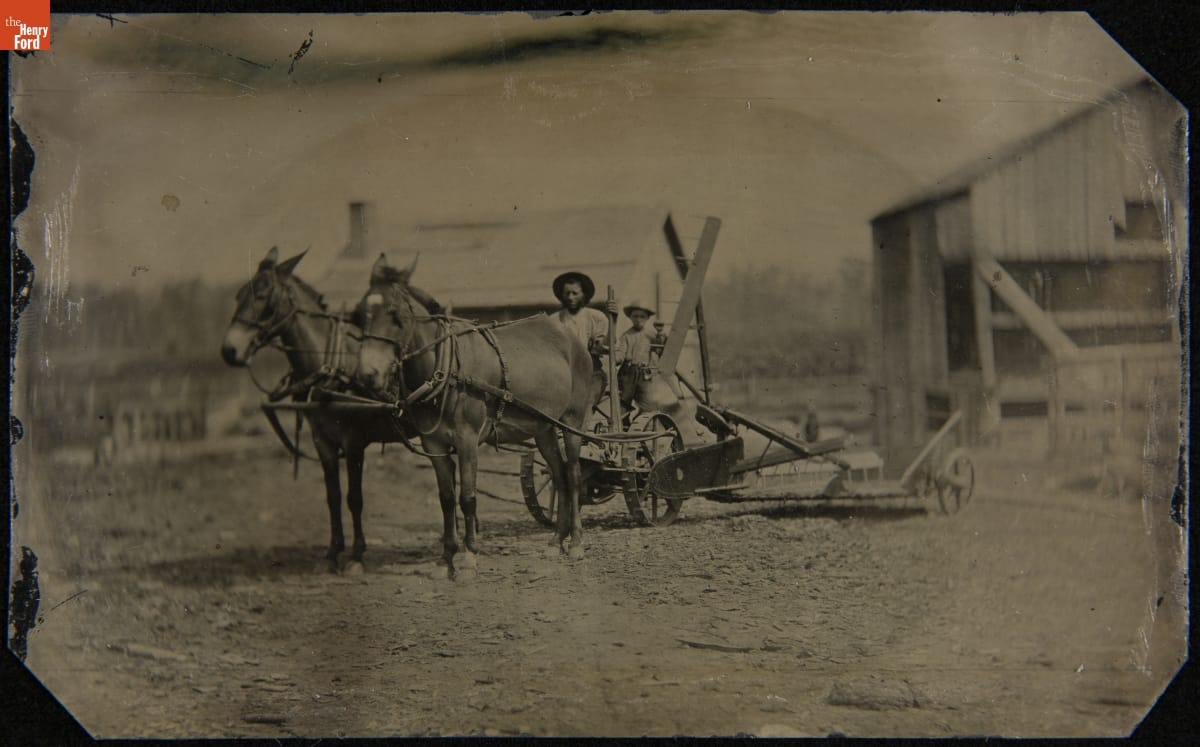
View ArtifactMan and Child Using a Mule-Drawn Reaper, 1875-1900
Draft animals reduced the need for human labor, and when teamed up -- like the pair of mules shown here -- they could haul more and work faster. But these animals required care. They needed food and water, exercise and rest, regular grooming, and clean, comfortable lodging.
View ArtifactOx Yoke with Two Bows, 1836
Draft animals had to be fitted with special gear that, among other things, converted their forward, pushing motion into pulling power. Farmers typically used harnesses for horses, mules, and sometimes donkeys. Oxen were often fitted with yokes--wooden devices, such as this one, placed on and around the animals' necks.
View ArtifactPlowing for Horseradish, H. J. Heinz Company, circa 1905
As agricultural practices changed in the 1800s, some farmers began combining teams of draft animals -- like the two teams of horses hitched to the plow in this photograph -- to increase their hauling power. This helped meet growing demand for agricultural production. It was also easier on the individual animals.
View ArtifactHolt Side-Hill Combine in the Palouse Hills, Washington, circa 1907
Combining many teams of draft animals further increased their power. This enabled specialized production on an industrial scale. It took at least two dozen mules to haul this early combine on large “bonanza” farms in the American Northwest.
View ArtifactHaying on the Meadows, Northfield, Massachusetts, circa 1900
In addition to hauling agricultural equipment across fields, draft animals moved vehicles carrying goods, people, and anything else that needed to be transported to, from, or around farms. This team, or "yoke," of oxen hauled a heaping wagon of hay on a Massachusetts farm.
View ArtifactWood Engraving, "October," 1854
This engraving depicts animals hauling crops and powering agricultural machinery. On the right, a yoke of oxen arrives with a cart of apples. The horse at center drives a crusher to prepare apples for pressing into cider.
View ArtifactMan with Horse-Powered Grinder, Southwestern United States, circa 1950
Animals could directly power a range of agricultural machinery. Through rotational motion, a team of horses drove this grinder on a farm in the American Southwest.
View ArtifactWheeler's Horse-Power and Thrasher, July 1847
Farmers began to use stationary power sources in the nineteenth century as they mechanized barn or farmyard work like threshing, winnowing, corn shelling and corn grinding. Some invested in devices called "powers," which used the motion of animals to drive agricultural machinery. This advertisement depicts treadmill-type powers designed to be run by horses.
View ArtifactTwo-Horse Treadmill-Type Horse Power, circa 1900
Treadmill-type powers, also called "tread powers" or "treadmills," may no longer be in common use, but the form is familiar. Animals walked on an "endless belt," a device similar to those on modern exercise treadmills. A wheel and belt converted the animals' movement to drive a variety of agricultural machinery.
View ArtifactTreadmill Operated by Oxen on the Perkins Farm, Bethany, Connecticut, circa 1880
Most treadmill-type powers were designed for horses, but other animals could use them too. A treadmill run by two oxen drove machinery in this Connecticut family's barn.
View ArtifactTread Power, circa 1885
Scaled down treadmills, like this one, could be used by dogs, goats, or sheep. They drove small machines, such as butter churns or cream separators on dairy farms.
View ArtifactTread Power, circa 1890
People introduced variations on the treadmill-type animal power. This "turntable" version, patented in 1882, employed a circular platform to drive a butter churn.
View ArtifactHorse-Powered Threshing at Ford Homestead, circa 1930
Sweep-type powers, also called "sweeps," used rotational motion to run heavy machines, such as saws or grain threshers. As many as 16 horses could be hitched to a sweep's arms. They walked in a circle to generate energy.
View ArtifactHorse-Powered Machine Used to Run Separator at the Ford Homestead Barn, 1924
Sweeps were cumbersome and worked horses hard. It was impractical for most farmers to own one, so they might hire someone to bring in and operate a sweep for special jobs.
View ArtifactGray's Latest Improved Horse Powers Threshing Machines and Wood Sawing Machines, 1891
A number of enterprising nineteenth-century manufacturers specialized in producing and selling both animal powers and the machines they were designed to drive.
View ArtifactTrade Card for the Ohio Special Ensilage Cutter, Silver & Deming, 1874-1890
Engines eventually replaced animals as the main stationary power source for agricultural machinery. The transition began with large portable steam engines like the one visible just outside the barn door in this image. Gasoline engines, introduced in the first decade of the twentieth century, ultimately supplanted small animal treadmills.
View ArtifactFordson Tractor Pulling Hay Wagon at Henry Ford Farms, 1917
Trucks and tractors driven by internal combustion engines offered farmers more horsepower than horses (or any other animal) could. These vehicles eventually displaced draft animals on most American farms during the early twentieth century.
View ArtifactBrochure, "The Amish Farm and House, Lancaster County, Pennsylvania," 1967
The shift was gradual, and working animals retained active roles on many farms long after internal combustion engines became available. Today, working animals provide power in a variety of ways across America and around the world, especially on organic farms and farms operated among certain cultural groups.
View Artifact

