
From the Jacquard Loom
Share
share
Joseph-Marie Jacquard’s programmable loom created new possibilities for woven goods with complex patterns and intricate, print-like designs.
THF96280
Floral Patterned Coverlet with Rooster Border, 1830-1870
A coverlet is a decorative bedcovering--usually made of cotton and wool--woven on a loom. Fancy coverlets were made to order, offering their clients a choice of patterns and colors. This coverlet's exuberant design features tulips, hearts, stars, eagles, fruit trees, grape clusters, and roosters, all woven in the classic colors of blue and cream.
View ArtifactCentral New York Coverlet, 1853
A coverlet is a decorative bedcovering--usually made of cotton and wool--woven on a loom. Most fancy coverlets were woven in two panels and joined at the middle with a sewn seam. However, this coverlet has no seam, indicating that its weaver had a very wide loom capable of producing a fabric with a width of almost 87 inches.
View ArtifactHillsboro County Agricultural and Mechanical Fair Badge, 1852
Beginning in the early 1800s, communities throughout the United States held fairs to showcase local agricultural products and mechanical inventions. These fairs promoted new crop varieties and animal breeds and spread news about innovative farming techniques and machinery. Citizens looked forward to the festive atmosphere of these harvest-time exhibitions. A fair official in Hillsborough County, New Hampshire, probably wore this printed silk badge.
View ArtifactPeace and Plenty Coverlet, 1846
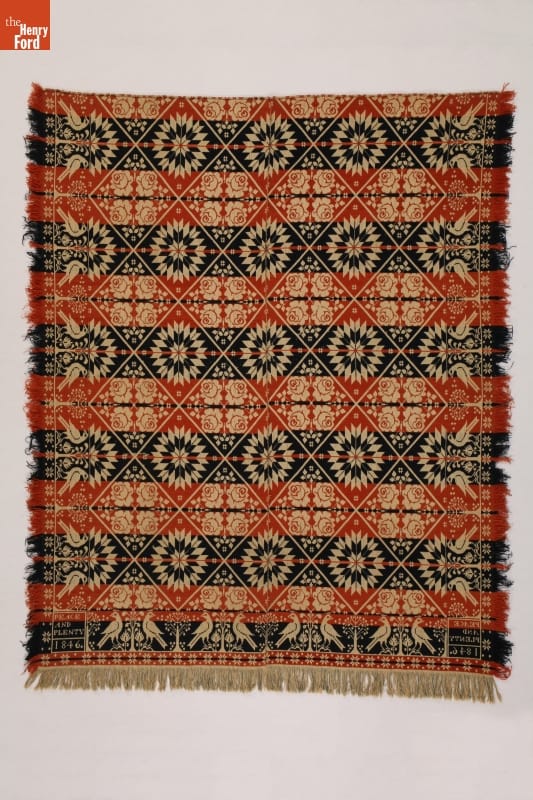
A coverlet is a decorative bedcovering--usually made of cotton and wool--woven on a loom. This "Peace and Plenty" coverlet expresses the optimism of a young America. This popular sentiment and the bird-and-bush Pennsylvania German border motif were used by a number of coverlet weavers, but were combined with different centerfield designs.
View ArtifactChristian Van Nortwick Coverlet Woven for Andrew Miller, 1837
A coverlet is a decorative bedcovering--usually made of cotton and wool--woven on a loom. This one was woven for Andrew Miller by Christian Van Nortwick, a weaver who worked in Asbury, New Jersey, in the 1830s and 1840s. It wasn't often that a man was named as the client for a coverlet--most coverlets were woven for women.
View ArtifactMen's Jacket Made from Automotive Upholstery Fabric, 1976
Chevrolet commemorated the United States Bicentennial by offering a special interior trim package on its 1976 Chevette, Monza and Vega models. The Heritage Trim option -- order code #1776 -- included upholstery covered in a red, white and blue eagle pattern, and accenting seat belts in firethorn red. This men's jacket is made from Chevy's Heritage Trim material.
View Artifact"Pine Trees and Snowballs" Geometric Coverlet, 1800-1880
A coverlet is a decorative bedcovering--usually made of cotton and wool--woven on a loom. Geometric designs like the stylized pine trees and snowballs seen on this coverlet were popular until the 1830s when the Jacquard loom's innovative technology made weaving "figured and fancy" coverlets easier and cheaper. The Jacquard loom was patented in France in 1804 and arrived in America in the mid-1820s.
View ArtifactCoverlet Woven by George Engel, 1855
A coverlet is a decorative bedcovering--usually made of cotton and wool--woven on a loom. This coverlet's multiple colors were popular with weavers and clients of German heritage as were the distelfinks (thistle finches) seen in the borders. And, indeed, the weaver of this coverlet, immigrant George Engel, was born in Oldenburg, Germany in about 1810.
View ArtifactCoverlet Woven by Philip H. Anshutz, 1842-1845
A coverlet is a decorative bedcovering--usually made of cotton and wool--woven on a loom. Philip Anshutz, an immigrant from Germany, wove this coverlet in Carrollton, Ohio, in the 1840s. Many coverlet weavers were immigrants, often bringing weaving techniques and designs with them from their native lands.
View ArtifactCoverlet Woven by L. Hesse, 1845
A coverlet is a decorative bedcovering--usually made of cotton and wool--woven on a loom. This coverlet's multiple colors were popular with weavers and clients of German heritage as were the distelfinks (thistle finches) seen in the borders. And, indeed, the weaver of this coverlet, immigrant Leberecht Hesse, was born in Saxony, Germany in about 1809.
View ArtifactStevengraph Picture, "The First Innings," circa 1880
Portrait of Joseph-Marie Jacquard, 1839
This portrait of French inventor Joseph-Marie Jacquard (1752 - 1834) was woven of fine silk using the mechanism that he developed and patented in 1804. Jacquard's device employs punched cards to store the intricate pattern design and to control the loom. These loom cards eventually led to the data cards used in early digital computers.
View ArtifactCentennial Souvenir Bookmark, 1876
America's first official World's Fair celebrated the 100th anniversary of the signing of the Declaration of Independence. Around ten million people visited Philadelphia during the Centennial International Exhibition of 1876. Many returned home with mementos of the exposition, such as this woven silk bookmark depicting the Liberty Bell--an icon of American independence.
View ArtifactCoverlet Woven by David D. Haring for Margaret Ann Cole, 1833
Weavers made coverlets to order, offering their clients a choice of patterns and colors. When Margaret Ann Cole ordered this coverlet, she didn't have to travel very far. Its weaver, David D. Haring, lived nearby. The rooster design is a popular symbol in the Dutch-influenced folk art of Bergen County, New Jersey, where this coverlet was woven.
View ArtifactColumbian Exposition Souvenir Ribbon, 1893
The World's Columbian Exposition celebrated the 400th anniversary of Christopher Columbus's landing in America. More than 25 million visitors attended the Chicago fair in 1893. Many fairgoers returned home with souvenirs, such as this commemorative silk bookmark.
View ArtifactStevengraph Bookmark, "The Late, Lamented President Lincoln," 1865
In 1865, Thomas Stevens created this woven silk bookmark to memorialize the recently assassinated American president. Admirers of President Lincoln collected materials such as this as a way to remember their martyred hero. A quote from Lincoln appears at the top, "I have said nothing but what I am willing to live by and, if it be the pleasure of Almighty God, to die by."
View ArtifactSouvenir Silk Picture, "Birth of Our Nation's Flag," from Panama-Pacific International Exposition, 1915
The Panama-Pacific International Exposition celebrated the 1914 completion of the Panama Canal and the 400th anniversary of the discovery of the Pacific Ocean. Nearly nineteen million people visited San Francisco, recently recovered from a devastating 1906 earthquake, during the fair in 1915. Many returned home with mementos of the exhibition, such as this patriotic souvenir.
View ArtifactSouvenir Bookmark from the 1893 Columbian Exposition
George Washington (1732-1799) was a revered celebrity in life. In death, he became an enduring symbol of the American struggle for liberty and a reminder of what one person can achieve. This souvenir bookmark from the 1893 World's Columbian Exposition in Chicago celebrated Washington--"the father of his country"--nearly 100 years after he died.
View Artifact

