
Henry Ford and Hydropower
Share
share
Childhood visits to the local mill sparked a young Henry Ford’s lifelong fascination with water power.
THF101449
Young Henry Ford, circa 1876, with Waterwheel, by Irving R. Bacon, 1935
Henry Ford had his favorite artist Irving Bacon paint several scenes Henry remembered from his childhood. This painting depicts a dam and a waterwheel Henry and a group of friends installed in a small stream. Behind them is the Miller School building, which a grown up Henry had replicated at Greenfield Village.
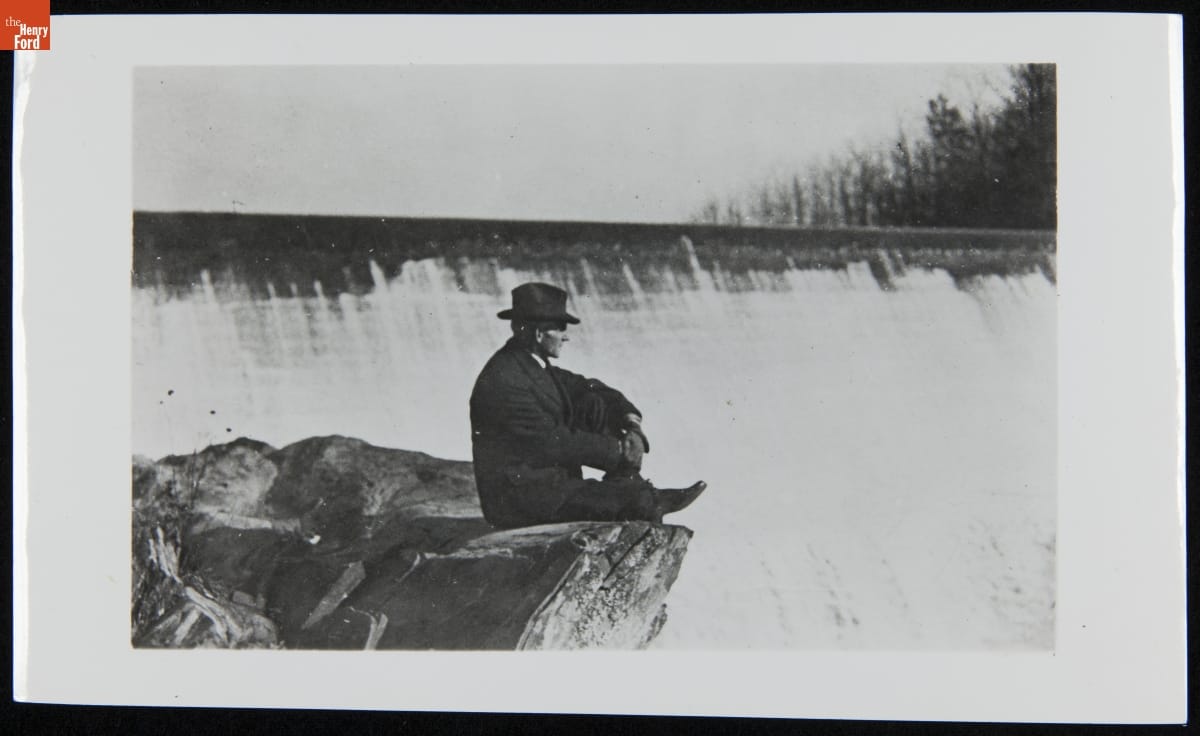
View ArtifactHenry Ford, Clara Ford and Milton Bryant on the Rouge River Dam at Fair Lane Estate, 1915-1920
Henry and Clara Ford's estate along the Rouge River reflected the couple's dual interest in nature and industry. They hired celebrated landscape architect Jens Jensen to camouflage the hydroelectric dam that powered Fair Lane. His completed design appeared as natural rapids. Jensen's stepping stone bridge and cascades are the most extensive of his renowned river-edge rock creations.
View ArtifactHenry Ford Building a Dam with Leonard and Raymond Firestone and Others, Columbiana County, Ohio, August 1918
Henry Ford watched as Leonard and Raymond Firestone, sons of tire magnate and Ford confidant Harvey Firestone, built a dam of stones with their friends. No doubt the boys' project reminded Ford of his own youthful exploits. As a schoolboy, Ford once dammed a small stream -- to the dismay of the farmer whose potato field he flooded.
View ArtifactThe "Vagabonds" on a Camping Trip, Lead Mine, West Virginia, 1918
Thomas Edison, John Burroughs, Henry Ford, and Harvey Firestone pose on a waterwheel at old Evans Mill near Lead Mine, West Virginia. The photograph was taken in August 1918. The group called themselves Vagabonds and made a series of trips between 1916 and 1924. On these trips they communed with nature, explored their personal interests and acted like boys again.
View ArtifactHenry Ford at Wilson Dam, near Muscle Shoals, Alabama, 1921
In 1921, Henry Ford conceived a project on the Tennessee River near Muscle Shoals, Alabama. He proposed to lease two federally owned fertilizer plants and a hydroelectric dam for 99 years at a cost of $5 million, modernizing the facilities while they were under his management. Objectors voiced concerns about private control over public resources. Ford withdrew his proposal in 1924.
View ArtifactHenry Ford and Party in Washington to Discuss the Muscle Shoals Project with Secretary John Weeks, 1923
For all his success, Henry Ford sometimes overreached himself. Such was the case with his 1921 proposal to lease a hydroelectric plant near Muscle Shoals, Alabama, from the federal government. Ford promised to modernize the facility to spur economic development, but federal officials worried about a public resource in private hands. Ford withdrew his controversial proposal in 1924.
View Artifact1924 Ford Motor Company Institutional Message Advertising Campaign, "Vital Resources that Cannot Fail"
In 1924-25 the Ford Motor Company ran a series of sixteen dramatic advertisements in the Saturday Evening Post and Country Gentleman magazines. Rather than promoting the Model T specifically, the ads aimed to convey the company's scale and philosophy. This ad is a reminder that Henry Ford pursued many technologies and production methods that we would now recognize as renewable or sustainable.
View ArtifactGristmill near the Wayside Inn, Sudbury, Massachusetts, circa 1928
Henry Ford purchased the Wayside Inn, the setting for the poems in Henry Wadsworth Longfellow's Tales of a Wayside Inn, in 1923. Over six years, Ford spent more than $2 million restoring the inn and several adjacent buildings, including this gristmill. In retrospect, the project was something of a dry run for Ford's Greenfield Village complex a few years later.
View ArtifactFord Village Industries Dundee Hydro Plant, 1937
In the early 1920s, Henry Ford began locating small hydroelectrically powered plants in rural southeast Michigan. These "Village Industries" employed local people who could maintain farms while working at the factory. This plant in Dundee operated from 1936 until 1954. During World War II, workers here manufactured parts for Pratt & Whitney engines, tanks, vehicles, and gun directors.
View ArtifactFord Motor Company Twin Cities Plant and Dam, St. Paul, Minnesota, 1938
Ford Motor Company opened its Twin Cities Assembly Plant at St. Paul, Minnesota, in 1925. Situated on the Mississippi River, the factory generated its own power through an adjacent hydroelectric dam. After building a mix of vehicles, the plant converted to all-truck production in 1978. The facility was producing Ranger pickup trucks when it closed in 2011.
View ArtifactInside Willow Run Ford Village Industry Plant Powerhouse, February 1940
In the 1920s and '30s, Henry Ford located small hydroelectrically powered factories throughout rural southeast Michigan. Built in 1939, the Willow Run plant differed from other "Village Industries." Instead of local residents, boys from Ford's nearby Camp Willow Run -- which provided income and life-skills training for underprivileged teenagers -- worked here, supplying door and ignition locks and keys for Ford's passenger cars.
View ArtifactFord Institutional Advertisement, "A Boy, a Water Wheel, and a Dream," 1944
Henry Ford had a lifelong fascination with water power. In his mind, a flowing river was energy free for the taking -- wasted if it wasn't somehow put to use. This advertisement depicts one of Ford's favorite boyhood memories. He and his fellow students dammed a small stream near their school, and then built a working waterwheel with planks and fenceposts.
View Artifact

