
Henry Ford’s Steam Engines
Share
share
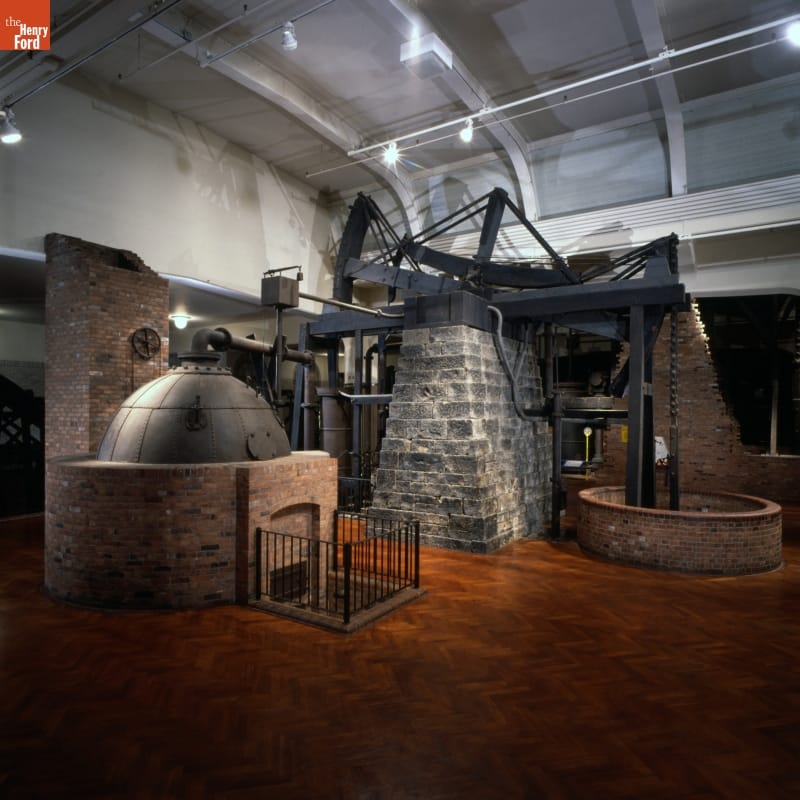
Henry Ford documented the evolution of steam power with a large collection of historically and personally significant steam engines. Here is a selection—from the oldest known steam engine to one Ford had operated as a teenager—from The Henry Ford.
THF93025
Avery Steam Traction Engine, circa 1916
Massive steam engines like the Avery were generally used on the large farms of the Great Plains, though this engine was used on Ford Farms in Dearborn, Michigan. It generated 30 horsepower, but weighed 23 tons! More efficient tractors, like the Fordson, which could generate 20 horsepower but weighed just over one ton, soon replaced these dinosaurs of the farm.
View ArtifactNewcomen Engine, circa 1750
This is the oldest known surviving steam engine in the world. Named for its inventor Thomas Newcomen, the engine converted chemical energy in the fuel into useful mechanical work. Its early history is not known, but it was used to pump water out of the Cannel mine in the Lancashire coalfields of England in about 1765. The engine was presented to Henry Ford in 1929.
View ArtifactPort Huron Steam Traction Engine, "Longfellow," 1916
The late 19th to early 20th centuries saw huge steam engines like this used for threshing grain. They could move over the roads under their own power. Individual farmers generally did not own such machines. Rather, men made a business of moving from farm to farm, threshing grain during harvest time. Joseph Freund of Westphalia, Michigan, bought this machine in 1917 and used it to power a Port Huron "Rusher" thresher-separator in Clinton and Ionia Counties, Michigan.
View ArtifactCorliss Steam Engine, 1859
George Corliss was one of the United States' most highly regarded steam engine designers. His valve innovations made his engines particularly important to the textile industry--where a combination of high power output and quick response to changes in load were greatly valued. He designed many of the machines used to manufacture his engines and was a pioneer in standardized manufacturing techniques.
View ArtifactPortable Steam Engine, circa 1857
Portable agricultural steam engines, such as this very early example, introduced American farmers to mechanical power. These engines were pulled out to the field by horses, and then used to power threshers and separators for the grain harvest. This 10-horsepower Owens, Lane & Dyer engine consists of a side-crank engine mounted on the side of a locomotive-type boiler.
View ArtifactHighland Park Plant Engine- Generator, 1915-1916
Ford's Model T mass production system would not have been practical without electricity; by 1919 nine of these Ford-designed hybrid internal combustion/steam engines generated the power needed by the Highland Park plant's assembly lines and associated machinery. By 1926 the engines were rendered obsolete when electricity was fed from the power plant at Ford's River Rouge plant ten miles away.
View ArtifactStationary Steam Engine, 1848
Steam power initially spread in the United States via its adoption and adaptation in ships and boats. This early mill engine's layout and dimensions are firmly rooted in Mississippi riverboat practice, while its applied decorative detail and vibrant color scheme speak to the increasingly elevated status of steam technology as it found a firm footing in mills and factories.
View ArtifactGothic Revival Beam Engine, circa 1855
By the mid-1800s steam power had become widely adopted throughout settled areas of the United States. While refinements continued, the basic technology was accepted fully enough that it began to host contemporary decorative fashions. This engine's pronounced Gothic styling -- thoroughly digested into its (fairly advanced) engineering -- suggests the significance steam power had assumed both practically and philosophically.
View ArtifactWestinghouse Portable Steam Engine No. 345, Used by Henry Ford
Portable steam engines like this powered grain threshers, sawmills, or corn shellers. Horses pulled them from farm to farm. In 1882, 19-year-old Henry Ford was able to make this engine run well when an older man could not; his first accomplishment in the adult world. Thirty years later Ford tracked down the engine, bought it, and returned it to operating condition.
View Artifact

