
Motor Mascots
Share
share
Hood ornaments -- formally called mascots -- are among the most prominent decorative elements on an automobile's exterior. Manufacturers designed mascots that communicated speed, power, or prestige. Some motorists replaced factory ornaments with aftermarket pieces that conveyed wealth and taste. More practical drivers capped their radiators with functional motometers to measure engine temperature. In any form, mascots made a statement.
THF152948
Rolls-Royce "Spirit of Ecstasy" Hood Ornament
Fittingly, the "best car in the world" had one of the most memorable mascots. The "Spirt of Ecstasy" first appeared on Rolls-Royce cars in 1911. It shows a woman bending forward while her robe billows from her arms, giving the appearance of wings. Some enthusiasts call the mascot "Eleanor" -- for Eleanor Thornton, who modeled for the sculpture.
View ArtifactMinerva Hood Ornament, circa 1925
Minerva of Belgium produced luxury automobiles from 1902 to 1938. Minerva's cars were high in quality and few in number, though the company operated some sales offices in the United States in addition to its European outlets. The firm's namesake was Minerva, the Roman goddess of wisdom, arts and industry. Her head appears in somewhat stylized form on this mascot.
View Artifact1929 Packard Model 626 Speedster Roadster
Packard buyers could accessorize their cars with the "Goddess of Speed." The winged woman, who holds a wheel in her outstretched arms, appeared on various Packard models from 1926 through 1950. (Less reverent fans dubbed her the "Donut Chaser.") Lovely though the goddess was, a Packard was more easily recognized by the tombstone-shaped radiator on which she perched.
View ArtifactPierce-Arrow Archer Hood Ornament, 1931-1938
Pierce-Arrow of Buffalo, New York, was one of the "Three Ps" -- alongside Packard and Peerless -- at the pinnacle of American luxury motoring. "The Archer," created by American sculptor W.N. Schnell and formally known as Tireur d'Arc, was a particularly apt mascot. The words "Pierce" and "Arrow" certainly both have archery-related connotations.
View Artifact1931 Bugatti Royale Elephant Radiator Ornament, 1968
Some mascots were genuine works of art. The radiator on the magnificent Bugatti Royale, produced from 1927-33, was capped by a dancing elephant. The ornament was cast from a sculpture by Rembrandt Bugatti, younger brother of Royale builder Ettore Bugatti. Rembrandt had died in 1916 and the Royale's mascot honored his memory.
View ArtifactLalique "Grande Libellule" Dragonfly Hood Ornament, 1928-1930
For pure beauty, few aftermarket mascots could match those from French glassmaker René Lalique. During the late 1920s, Lalique produced 29 different designs ranging from birds to animals to human figures. The graceful "Libellule Grande" -- French for "large dragonfly" -- was among his more ornate creations. Lalique's mascots are highly prized by collectors today.
View ArtifactContinental Mark II Hood Ornament, 1956-1957
The striking Continental Mark II of 1956-57 was built under its own Continental Division of Ford Motor Company. Continental chose a four-pointed star as its emblem -- adapted from a crest-style logo Lincoln first used in 1942. When the unsuccessful Continental Division was closed, its star became -- and remains -- the logo for the entire Lincoln line.
View ArtifactDrawing, "Radiator Cap Assembly (Quail)," Ford Model A, May 23, 1938
Elegant mascots weren't limited to expensive luxury cars. Ford Motor Company offered a tasteful hood ornament, in the form of a quail, for its Model A cars of 1928-31. It was an extra-cost option, but a popular one. Henry and Clara Ford were avid bird watchers, so a flying quail on a Ford car was most appropriate.
View ArtifactMasonic Emblem Radiator Cap, circa 1920
Drivers might select aftermarket mascots that represented themselves more than their cars. That was clearly the case with this radiator cap, which prominently features Freemasonry's Square and Compasses symbol. No doubt the cap's original owner was a proud member of his local Masonic lodge -- and eager for others to know it.
View Artifact"Victory" Dancing Figure Hood Ornament, 1916-1920
Animated hood ornaments leaned more toward tacky than tasteful, but they were fun. Wind and vibrations caused them to move around as the car drove down the road. This one, manufactured by Wheat Bros. & Elder of Los Angeles, is in the shape of the allegorical "Victory" figure -- a direct response to American involvement in World War I.
View Artifact"Keep Coolidge" Hood Ornament, 1924
Like bumper stickers, hood ornaments could carry political messages. This one supported Calvin Coolidge in his successful 1924 presidential campaign. (Coolidge had been elevated from Vice President to President following the death of Warren Harding in 1923.) The "Keep Coolidge" slogan is a clever pun on the radiator's primary function -- helping the engine keep cool.
View ArtifactHood Ornament, "Votes for Women," 1900-1920
That 1924 U.S. presidential election was only the second in which all American women could vote. The 19th amendment, granting women's suffrage, was ratified in 1920 after decades of hard work. Automobiles helped in the last years of the fight -- increasing activists' reach and providing mobile platforms for signs, banners, and pro-suffrage hood ornaments like this one.
View ArtifactRadiator Cap, circa 1925
Drivers who didn't care for showy mascots had several aftermarket alternatives. Simpler options ranged from basic to downright practical. This radiator cap came complete with a lock and key to prevent a vandal from either stealing the cap itself or tampering with the engine coolant.
View ArtifactOverland Whippet Motometer, 1920-1930
Other radiator caps shunned fashion in favor of function. Motometers (a category of hood ornaments unto themselves) measured and showed engine coolant temperature. Early motorists depended on the aftermarket -- or, in the case of this Overland Whippet motometer, dealer accessory catalogs -- to provide some of the gauges we take for granted today.
View ArtifactMoore Motor Semaphore Motometer, circa 1925
This aftermarket motometer, produced by the Semaphoric Indicator Company of Chicago, was easier to read than some. It used railroad-inspired semaphore signals to indicate radiator temperature. If the green disc showed, all was well. But when the red disc appeared, your engine was in danger of overheating.
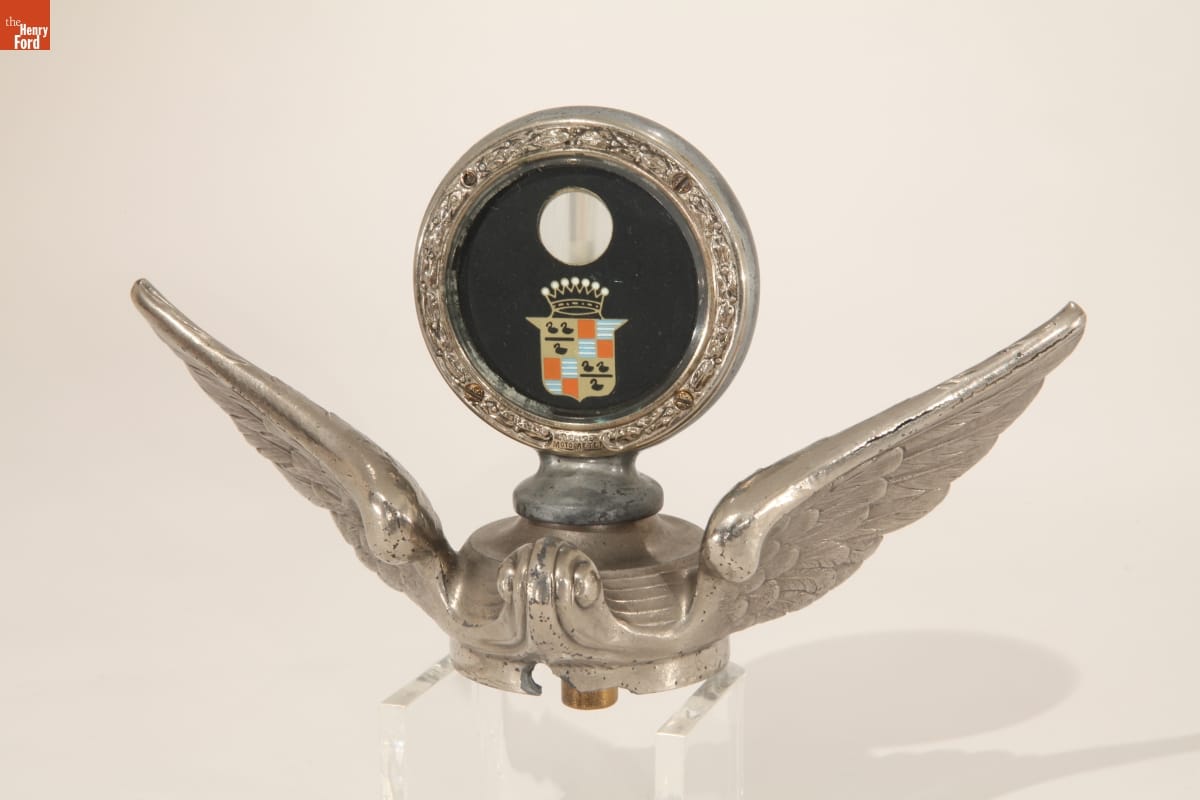
View ArtifactCadillac Motometer, circa 1925
This motometer, made for General Motors' Cadillac line, neatly tied form with function. The spreading wings recalled similar shapes on Rolls-Royce's "Spirit of Ecstasy" and Packard's "Goddess of Speed." But the working temperature gauge offered practical peace of mind. The Cadillac crest ensured that the company's actual logo appeared alongside the more abstract mascot.
View Artifact1957 Cornell-Liberty Safety Car
Whatever their artistic or functional merits, by the 1950s researchers recognized that mascots were a safety concern. If a pedestrian was struck by a car and rolled onto its hood, a protruding ornament could cause bruises, cuts, or more serious injuries. The 1957 Cornell-Liberty Safety Car lacked a hood ornament precisely for this reason.
View Artifact1984 Plymouth Voyager Minivan
Hood ornaments became rarer on American cars after 1968, when federal safety regulations prohibited rigidly mounted pieces. The new rules mandated that all mascots be flexible so they could fold out of the way in a collision. The "pentastar" ornament on this 1984 Plymouth Voyager is spring-loaded to meet this requirement.
View Artifact

