
Signals and Signs – Ground Communication
Share
share
A beacon is most simply defined as something that signals—as a warning or as a guide. This collection of artifacts shows a range of signaling devices at play within the history of transportation by land, sea, and air. They take the form of flags, lights, smoke, telegraphs, and digital devices linked to satellites.
THF130203
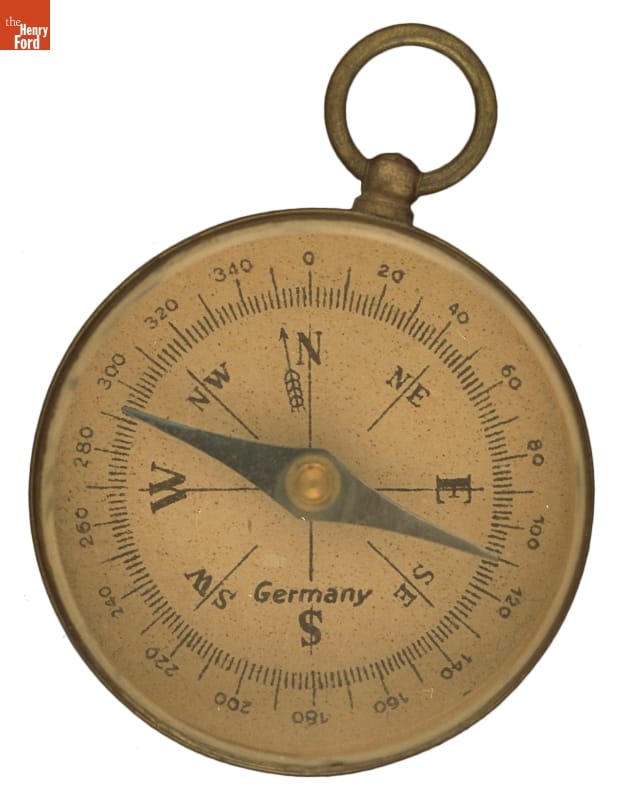
Compass, 1900-1950
This early 20th-century compass uses a magnetized steel needle that rotates to align with the Earth's magnetic field. With the needle indicating north, users can reference markings around the dial to gain precise bearings. Despite modern GPS technology, compasses remain important navigational instruments for airplanes and ships and for casual use on small boats or recreational hikes.
View ArtifactiPhone, 2007
The iPhone was the apotheosis of the cellphone as pocket computer--powerful technology in a sleek package. This handheld is a music player, a mobile phone, and an internet-enabled device in one, with a trendsetting touchscreen interface. The iPhone's release in 2007 was a well-choreographed media event, with potential buyers waiting in lines for hours at Apple stores across the country.
View ArtifactPatent Model of Marine Signal Lantern, 1863
This marine lantern was designed to burn oil. An opaque metal shade could be moved to expose and block its glow. Moveable red and green glass shades are its most innovative feature, which served two purposes. They allowed the lantern to act as a communications device, to send messages between ships--and as an anchor light, to avoid collisions between vessels.
View ArtifactRadio Headphones Used by Theodore Haubner While Transmitting the First "SOS" Distress Signal, August 11, 1909
In 1909, telegraph operator Theodore Haubner sent the first American ship-to-shore wireless distress signal -- SOS. These headphones were part of his wireless equipment. Haubner was aboard the SS Arapahoe off Cape Hatteras, North Carolina, when it became disabled.
View ArtifactPulling Down the Dirigible Mooring Mast at Ford Airport, 1946
Signals communicate messages from far away. They may take the form of a bonfire sending smoke signals, lanterns or maritime flags on a ship, or the tapped out sounds of Morse code. In this image, signaling flags are being used by men on the ground to guide a safe demolition of the airship mast at Ford Airport.
View ArtifactTelegraph Key Used by Theodore Haubner to Send One of the First "SOS" Distress Signal on August 11, 1909
In 1909, telegraph operator Theodore Haubner sent the first American ship-to-shore wireless distress signal -- SOS -- using this telegraph key. Haubner was aboard the SS Arapahoe off Cape Hatteras, North Carolina, when it became disabled.
View ArtifactTrade Card for Acorn Stoves and Ranges, Rathbone, Sard & Co., 1887-1908
In the last third of the nineteenth century, an unprecedented variety of consumer goods and services flooded the American market. Advertisers bombarded potential customers with trade cards. Americans enjoyed and saved the often illustrated little advertisements found in product packages or distributed by local merchants. Many survive as historical records of commercialism in the United States.
View ArtifactTravel Poster, "Los Angeles, American Airlines," circa 1954
Through the 1950s, air travel retained its aura of glamour and sophistication. Some of that continued excitement was due to sleek travel posters advertising fashionable destinations. What city in the United States was more alluring than Los Angeles with its movie stars and endless summers? American Airlines captured the City of Angels in this glitzy poster from about 1954.
View ArtifactTomTom Personal GPS System, 2009
Today's travelers have new tools for getting from here to there. Global positioning system (GPS) devices, like this 2009 Tom Tom, let drivers navigate American roads without fumbling with foldout maps or automobile guides.
View ArtifactBeacon Light at Sherman Hill, Wyoming, to Guide Transcontinental Air Mail Pilots, 1924
Early pilots depended on visual landmarks, preventing reliable nighttime navigation. When the postal service took to the skies with transcontinental mail delivery, a lighted pathway was formed to guide pilots at night. Throughout the 1920s, a series of powerful light beacons was built, eventually stretching from New York to San Francisco. This Wyoming beacon is the mid-point of the route.
View Artifact"Cleveland Greets the First Night Mail Plane," July 1, 1924
Early pilots depended on visual landmarks, preventing reliable nighttime navigation. When the postal service took to the skies with transcontinental mail delivery, a lighted pathway was formed to guide pilots at night. Throughout the 1920s, a series of powerful light beacons was built, eventually stretching from New York to San Francisco. This image celebrates Cleveland's first night mail flight.
View ArtifactEdsel Ford at the National Air Tour, Atop the Hangar at Ford Airport, October 3, 1925
In this image, Edsel Ford waits on top of the Ford Airport hangar for the returning planes of the 1925 National Air Tour. The searchlight behind him is a Sperry Beacon, used to guide the landing of aircraft at night. The beacon was capable of blasting a powerful beam of light as bright as the headlights of 9 million automobiles.
View ArtifactPoster, "The First 'Wireless,'" "Compliments of Miller Bros. & Arlington 101 Ranch Real Wild West," 1914
This poster shows a romanticized view of Native American culture: two people separated by nature and distance, using smoke signals to communicate. Dense black smoke produced by burning damp leaves was confined under a wet blanket--then allowed to escape in bursts. In this way, smoke transformed into a beacon, visible for miles across the vast expanse of early America.
View ArtifactTrade Card for Ayer's Products, Weather and Medicine Signals for Daily Reference, 1886
These weather signal flags are in the company of a dancing troupe of anthropomorphic Ayer's cherry cough syrup bottles. The flags signal "cold wave coming," "storm approaching," and temperature changes as patterns that are similar to the common cold and flu. The reverse tells us that our body, like the weather, can be read by its warning systems.
View Artifact

