
The Long March to Voting Rights
Share
share
In 1965, all eyes turned to Selma, Alabama, as the next stage in the fight for civil rights. Dr. Martin Luther King, Jr., the Student Nonviolent Coordinating Committee, the Southern Christian Leadership Conference, and other activists planned a series of marches from Selma to Montgomery to draw attention to the continued struggle for voting rights for Black Americans.
THF8263
"The S.C.L.C. Story in Words and Pictures," 1964
Founded in 1957, the Southern Christian Leadership Conference (SCLC) utilized nonviolent direct action during the Civil Rights Movement to challenge segregationist laws and shift public opinion. SCLC often partnered with local organizers to bring attention to their causes. The leaders of SCLC, including Dr. Martin Luther King, Jr., came to Selma in January 1965.
View Artifact"Jet" Magazine, February 25, 1965
Dr. King had a history of campaigning for civil rights in Alabama, including the 1955-56 Montgomery Bus Boycott and 1963 campaign in Birmingham. In 1965, King and others decided to shift their efforts toward voting rights in Selma, where only two percent of the eligible population were registered to vote. Organizers expected a strong response from Dallas County Sheriff Jim Clark but hoped that it would draw attention to their cause.
View ArtifactButton, "One Man SNCC One Vote," 1960-1967
The Student Nonviolent Coordinating Committee (SNCC) and SCLC collaborated, employed similar nonviolent tactics, but acted independently of each other. Formed in 1960, SNCC consisted of mostly college-aged activists who focused on long-term community engagement. SNCC field officers first came to Selma in 1963 to help Black Alabamans get registered to vote.
View ArtifactTemporary Restraining Order to Stop Interference with Voter Registration in Selma, Alabama, Filed January 1965
Despite an injunction that prohibited civil rights meetings in Selma, residents partnered with SCLC and SNCC workers to organize voter registration marches to the Dallas County courthouse in early 1965. Sheriff Clark and his deputies harassed and assaulted protesters as they went to register, while county judges hindered their efforts. Activists appealed to a federal judge for a temporary restraining order against those impeding their rights.
View Artifact"Under Arrest in Alabama Racial Incident," Demonstrators in Selma, Alabama, February 3, 1965
Those who marched also risked dismissal from their jobs, harassment from white residents, and, notably, arrest. Black Selmanians remained undeterred. Even Selma's youth took to the streets to protest on behalf of adults. Police forces arrested hundreds of marchers, including approximately four hundred children, for "unlawful parading." Over seven hundred people went to jail in the first five days of February 1965 alone.
View ArtifactGood Samaritan Hospital, Selma, Alabama, December 1964
Violence against the protestors escalated. On February 18, Jimmie Lee Jackson — a 26-year-old resident of nearby Marion, Alabama — participated in a nighttime march in Marion with his family. Near the town center, state troopers ambushed and beat demonstrators with batons. As Jackson attempted to shield his mother from the police, an officer shot him in the stomach. Jackson was taken to Good Samaritan Hospital in Selma where he died a week later.
View Artifact"Jet" Magazine, March 18, 1965
Thousands came to pay their respects to Jimmie Lee Jackson at his March 3 funeral, covered in this issue of Jet magazine. Multiple ministers involved in the movement, including pastors from the Southern Christian Leadership Council, eulogized him. In response to Jackson's murder, local activists and SCLC strategist, James Bevel, planned a march from Selma to the Alabama state capital of Montgomery.
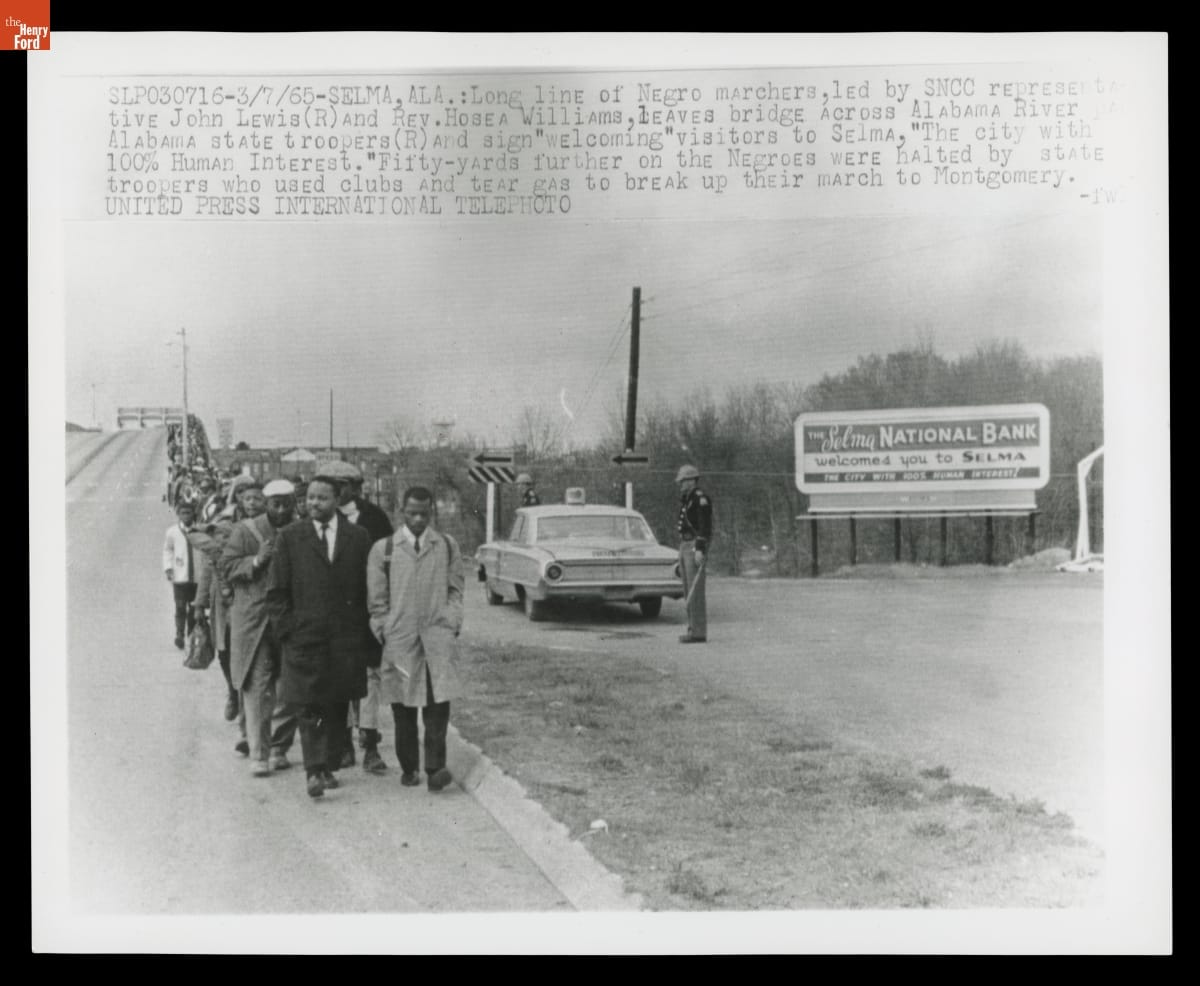
View ArtifactJohn Lewis and Rev. Hosea Williams Lead a Long Line of Marchers over the Edmund Pettis Bridge, March 7, 1965
On March 7, 1965, activists John Lewis from the Student Nonviolent Coordinating Committee and Reverend Hosea Williams from SCLC led approximately 600 marchers on the route from Selma to Montgomery. As the group uniformly crossed the Edmund Pettus Bridge — located on the outskirts of Selma — they encountered a mass of state troopers, highway patrolmen, and newly-deputized civilians, armed and ready to turn the marchers back.
View ArtifactHot Shot Model B12 Cattle Prod, 1960
Fifty yards past the bridge, the marchers were brought to a halt. Williams tried to speak to Major John Cloud, who was in charge, but Cloud said there was nothing to discuss. Law enforcement advanced, armed with billy clubs and improvised weapons, including cattle prods capable of delivering 9,000 volts of electricity. They began shoving marchers to the ground, beating them and deploying tear gas. Horse-mounted troopers also charged in.
View ArtifactState Trooper Swings Club at the Head of SNCC Leader John Lewis during Attempted March from Selma to Montgomery, March 7, 1965
Scores of peaceful marchers were injured in the ensuing violence at the bridge and as they were chased back through Selma. Television cameras and newspapers reporters captured the brutality. That night, Americans tuning in to the television premiere of the film Judgment at Nuremburg were confronted with the horrific images from Selma when the news report broke in. The country was outraged at the event, which became known as "Bloody Sunday. ''
View Artifact"King Leads Selma March, Defy U.S. Court & LBJ," Chicago's American Newspaper, Section 1, Tuesday, March 9, 1965
Dr. King issued a call for a march on Tuesday, March 9, days after "Bloody Sunday." U.S. Government officials, however, issued a temporary injunction to postpone the march, and President Johnson encouraged King to delay. King proceeded, defying the court order and the President. King led the marchers over the bridge activists had crossed a few days earlier, stopped in front of the police force, prayed, then turned around and returned to Selma.
View ArtifactButton, "Practice Nonviolence," circa 1965"
However, the peaceful march, dubbed "Turnaround Tuesday", had made its point. Over the next ten days, Dr. King's actions gained support despite some criticism. Protests sprang up around the country. The temporary injunction was lifted. President Johnson acted to protect the marchers, nationalized the Alabama Guard, and most significantly, called for the passage of a Voting Rights Act.
View Artifact"Life" Magazine, March 26, 1965
Violence, however, did not stop. On the evening of the "Turnaround Tuesday" march, James Reeb, a white Unitarian Universalist minister, and others were severely beaten by a group of white men in Selma. Reeb was one of many religious leaders from throughout the country to answer King's call for aid in social justice. Reeb would die from his injuries a few days later. This cover of Life shows King and other leaders attending Reeb's funeral.
View ArtifactArmchair Used by Martin Luther King, Jr. in the Jackson Home, Selma, Alabama
On March 15, 1965, Rev. Dr. Martin Luther King Jr. and several of his lieutenants gathered in the Selma, Alabama, home of Dr. Sullivan and Richie Jean Sherrod Jackson to watch President Lyndon Johnson address the nation. Dr. King sat in this chair as President Johnson declared federal protection for Black voters. That support would become the Voting Rights Act of 1965.
View ArtifactCivil Rights Marchers, Walking from Selma to Montgomery, Cross the Alabama River Bridge, March 22, 1965
On March 16, a federal court judge removed the injunction that blocked the march from Selma to Montgomery. Over the next few days, President Johnson would nationalize the Alabama state guard and provide additional federal troops to protect the marchers. Voting rights demonstrators left Selma on March 21 for the 54-mile trek to the state capital.
View Artifact"Newspaper, Selma Times-Journal, March 22, 1965
A court order limited the number of marchers to make the full five-day march to 300. Marchers covered between 7 and 17 miles a day, camping at night on the property of local supporters. The numbers fluctuated each day, however, as voting rights advocates walked along in support before returning home.
View Artifact"Voting Rights Marchers Walking toward the Alabama Capitol Building, Montgomery, Alabama, March 25, 1965
Thirty-two hundred marchers set out from Selma that first day. On March 25, twenty-five thousand supporters, including civil rights leaders, clergy, celebrities, and ordinary citizens, gathered in the shadow of the Alabama statehouse in Montgomery, demanding voting justice.
View ArtifactMartin Luther King, Jr. and Coretta Scott King with the Voting Rights Marchers, Montgomery, Alabama, March 25, 1965
On the steps of the statehouse, Dr. King delivered a speech. He acknowledged the marchers' exhaustion and the challenges they'd overcome. Calling back to the Montgomery Bus Boycott, he noted how fitting it was that another moment in history had come to the city. Regarding the question of "how long" until the fight was won, King asserted "Not long, because the arc of the moral universe is long, but it bends toward justice."
View ArtifactViola Liuzzo Button
The march did not end the violence. After seeing footage of Bloody Sunday, Viola Liuzzo drove from her home in Detroit, Michigan to Selma to take part in the third march and volunteered to shuttle participants back to Selma after. While driving with activist Leroy Moton, a vehicle with four members of the Ku Klux Klan inside pulled up. Seeing a white woman and a black man together, the Klansmen pursued Viola’s car before shooting and killing her.
View Artifact"Jet" Magazine, April 1, 1965
This edition of Jet magazine, published April 1, 1965, highlights the turbulent events of March 1965 in Selma, Alabama. From the headline "How LBJ's Voter Bill Can Change Alabama" to the article "Mongomery Marches Unifies Warring SCLC, SNCC Units" this popular publication informed a national audience of the ;significant events in the fight for voting rights.
View ArtifactBallot Box
The Voting Rights Act of 1965 had an immediate and substantial impact. By the end of 1965, a quarter of a million new African American voters were registered. In 1964 in Alabama, only 19.3% of adult African Americans were registered to vote but by 1969 that number rose to 61.3%. New voters would encounter ballot boxes — a physical manifestation of the American political system and icon of democracy — for the first time.
View ArtifactVoter Registration Certificate for Jawana Virginia Jackson, Dallas County, Alabama, May 18, 1979
Dr. Sullivan and Richie Jean Sherrod Jackson were heavily involved in the fight in Selma for voting rights for African Americans and their future generations. Their only child, Jawana, was present in the home as Dr. King and other prominent activists and politicians organized marches and made important decisions. Jawana's voting registration certificate represents a culmination of the blood, sweat, and tears of the struggle.
View Artifact"Still Fighting For Voting Rights," Sign Used at Selma "Bloody Sunday" 60th Anniversary, March 9, 2025
The fight for voting rights continues. Challenges to the Voting Rights Act over the last 60 years have weakened enforcement of the law. In 2013, the Supreme Court, in Shelby County v. Holder, found section 4B unconstitutional — knocking down coverage formulas that applied to states that had limited voter registration in the past, leading to voter registration purges.
"Protect Our Vote," Sign Used at Selma "Bloody Sunday" 60th Anniversary, March 9, 2025
Commemorative marches have taken place to mark important anniversaries of the historic 1965 marches. In 2015, President Obama took part in the 50th anniversary march. In 2025, attendees held signs like this one highlighting John Lewis, the late congressman and leader of the "Bloody Sunday" march. The John Lewis Voting Right Act — legislation currently stalled in the U.S. Senate — proposes to restore and strengthen the 1965 Voting Rights Act.
View Artifact

