
Featured on The Henry Ford's Innovation Nation: Season 4
Share
share
These key artifacts appeared on the fourth season of The Henry Ford’s Innovation Nation. For episode information, please visit https://www.thehenryford.org/explore/innovation-nation/episodes.
THF67890
Ingersoll-Rand Number 90 Diesel-Electric Locomotive, 1926
This is one of the earliest diesel-electric locomotives used on American railroads. Diesel-electrics offered many advantages over steam locomotives. They required less maintenance, were more fuel efficient, and could be operated by smaller crews. This locomotive's body houses an Ingersoll-Rand diesel engine that drives a General Electric generator, which in turn powers electric motors on the axles.
View ArtifactReplica of the 1903 Wright Flyer
This copy of the 1903 Wright Flyer faithfully replicates the original aircraft. On December 17, 2003, the replica attempted to duplicate the Wright brothers' first flight at Kill Devil Hills, North Carolina, exactly one hundred years after that historic feat. The attempt was foiled by bad weather, though the replica flew successfully in earlier tests.
View Artifact1920 Dayton-Wright RB-1 Monoplane
Designer Milton Baumann and pilot Howard Rinehart hoped to win the 1920 Gordon Bennett Air Race with their Dayton-Wright RB-1. Years ahead of its time, the airplane featured a single cantilevered wing, movable wing flaps for adjustable camber settings, an enclosed cockpit, and retractable landing gear. But a failed control cable knocked Rinehart out of contention. The RB-1 never raced again.
View ArtifactGeneral Electric Diesel-Electric Locomotive, 1942
Lightweight 44-, 45- and 50-ton diesel-electric locomotives proved popular in industrial and yard switching duties. They were less expensive to operate than steam locomotives and could run on lightly built track. This 50-ton unit served a U.S. Navy ammunition depot in Charleston, South Carolina, during World War II. It later operated at a scrapyard in Ecorse, Michigan.
View ArtifactMenlo Park Laboratory
When Edison moved to Menlo Park, New Jersey, in spring of 1876 the laboratory building contained his entire operation -- a handful of collaborators, office, library, and machine shop as well as laboratory. As the scale of Edison's investigations grew so did the complex, but this building -- dedicated to experimental activities -- was always understood to be the heart of the enterprise.
View ArtifactThomas Edison and Employees in Menlo Park Laboratory, Edison, New Jersey, February 22, 1880
The names of "star" designers might lodge in our minds, just as the names of innovators like Thomas Edison do. But while the essential vision for a design might arise from an individual, it is typically collaboration that drives design ideas through to results. At the Menlo Park laboratory many experimenters undertook the research that made Edison's vision a reality.
View ArtifactWright Cycle Shop
Wilbur and Orville Wright operated their bicycle business in this building from 1897 to 1908 in Dayton, Ohio. The brothers sold and repaired bikes, and they even produced models under their own brands. It was also in this shop that the Wright brothers built their earliest flying machines, including the 1903 Flyer that became the first successful heavier-than-air, powered, controlled aircraft.
View ArtifactBergmann & Company Edison Chemical Meter, circa 1882
To make money selling electricity, Thomas Edison had to know how much his customers used. This meter used electricity to plate zinc onto electrodes. By weighing the electrodes to see how much zinc had accumulated, Edison's company could calculate how much electricity was being used. This is one of the earliest surviving electrical meters. It was part of Edison's pioneering September 1882 Pearl street system.
View ArtifactEdison's Autographic Press and Electric Pen, 1875-1880
Thomas Edison's electric pen, an ancestor of both the mimeograph and the tattoo needle, was a successful product in the mid-1870s. Users would write normally with the pen, which, instead of a nib, had a needle powered by an electric motor. The needle poked holes into a stencil, which was then used to copy the document. Many businesses found document duplication an attractive possibility.
View ArtifactWilliam Holmes McGuffey Birthplace
This log home is typical of Scots-Irish log structures built in the densely forested area of southwestern Pennsylvania during the late 1700s. Anna and Alexander McGuffey lived here for five years and had three children before moving west to Ohio. Their second child, William Holmes (1800-1873), went on to create the popular Eclectic Readers for frontier schoolchildren.
View ArtifactOrenstein Trunk Company Amelia Earhart Brand Luggage Overnight Case, 1943-1950
Famed aviator Amelia Earhart needed money to finance her flying--product endorsements provided a way. Introduced in 1933, the Amelia Earhart luggage line--marketed as "real aeroplane" luggage--was sturdy and lightweight. It sold well for decades--long after her 1937 disappearance attempting an around-the-world flight. Amelia Earhart's "brand" remained strong. Her name could still sell.
View Artifact1962 Mustang I Roadster
This sharp looking little two-seater created a great "buzz" when racing driver Dan Gurney introduced it at the United States Grand Prix in Watkins Glen, New York, in 1962. Featuring a rear-mounted V-4 engine, it was unlike any Ford ever seen before. The Mustang name later appeared on a sporty four-seater that created its own buzz in 1964.
View ArtifactWilliam Holmes McGuffey School
The McGuffey School was built in Greenfield Village in 1934, created out of barn logs from the 1790s southwestern Pennsylvania farmstead where textbook author William Holmes McGuffey was born. Children living in frontier communities learned to read in rustic schoolhouses like this one. McGuffey's Eclectic Readers gave them an easy, standardized way to do it.
View ArtifactSarah Jordan Boarding House
The Menlo Park complex was an all-male environment; the closest workaday involvement of women -- not forgetting that Edison and several of his personnel were married -- was at the Sarah Jordan boardinghouse. Offering room and board for unmarried employees at the complex, it was operated by Sarah Jordan, a distant relative of Edison's. The house also played host to the experimental lighting system installed throughout Menlo Park in December 1879.
View Artifact1965 Ford Mustang Convertible, Serial Number One
It's an old auto industry cliche -- "you can't sell a young man an old man's car, but you can sell an old man a young man's car." It's also true. The sporty Mustang was a young man's -- and woman's -- car. The under-30 crowd loved it. But older people also bought them, often as a second car. The Mustang hit a sweet spot in the market, appealing to a wide range of buyers.
View ArtifactRadio Receiver Used in the Piccards' Stratospheric Balloon Ascension, 1934
The Piccard stratosphere flight departed Ford Airport field on October 23, 1934. Spouses Jean and Jeannette Piccard ascended 10.9 miles in a metal gondola carried by a hydrogen balloon. To maintain ground communication, William Duckwitz built this radio transceiver, installing it in the "radio car" that trailed the flight. Duckwitz's call sign, W8CJT, is burned into its base.
View ArtifactXerox Photocopier Model 914, Introduced in 1959
The Xerox 914 was the first commercially successful automatic office copier. Using Chester Carlson's xerography process, documents were produced electrostatically, using powdered toner. This copier weighed 650 pounds and made one copy every 26 seconds on paper up to 9 x 14 inches. The 914 also came with a "scorch eliminator" -- a small fire extinguisher for taming fires caused by overheating.
View Artifact1968 Mercury Cougar Coupe
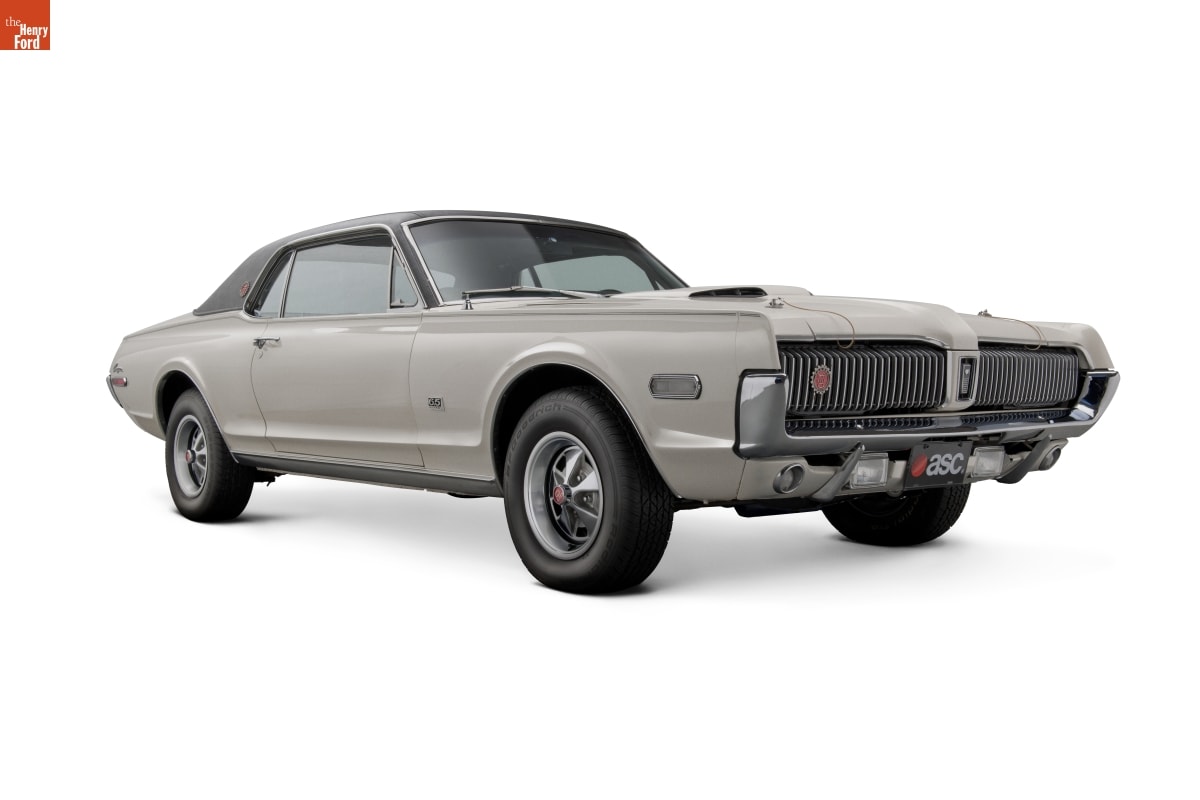
Ford Motor Company's Mustang, introduced in 1964, was such a success that other car makers soon copied it, including Ford itself. Mercury's Cougar was based on the Mustang, but with more upscale styling and interior appointments that made it something of a "poor man's Jaguar." This Cougar has the rare XR7-G package with a hood scoop, sun roof, and other special trim features.
View ArtifactTourist Cabin from Irish Hills Area of Michigan, circa 1935
Motorists weary of roughing it in tents found that homey little cabins like this one offered a convenient, economical alternative. By the 1930s, tourist cabins were popping up everywhere. This cabin, once part of a cluster along U.S. Route 12 in Michigan's Irish Hills, featured a double bed, a small potbellied stove for year-round use, and a chamber pot -- a portable commode.
View Artifact1948 Tucker 48 Sedan
Swooping fenders and six exhaust pipes make the Tucker look like a rocket ship. But Preston Tucker's car mixes fantasy with practicality. The center light turns with the front wheels to cast light around corners. Taillights are visible from the side for safety. Doors curve into the roof for easier entry and exit, while grilles on the rear fenders feed cooling air to the rear-mounted engine.
View ArtifactHoliday Inn "Great" Sign, circa 1960
When the first Holiday Inns opened in 1952, guests at roadside hotels were mostly traveling families who couldn't always plan their stops ahead of time. This sign -- taller and flashier than some but not radically different from other blinking neon highway signs -- was designed to be spotted from the new interstates. As Holiday Inns multiplied, the sign became a message: "Turn here for a predictable, quality experience."
View ArtifactMaudslay Production Lathe, circa 1800
The work of Henry Maudslay (1771-1831) is fundamental to the development of industrial precision. This is the oldest industrial capacity precision machine tool in the world. Capable of machining to an accuracy of several thousandths of an inch, it enabled Maudslay's company to manufacture tools and engines to unprecedented standards -- and set the stage for even higher levels of precision.
View Artifact"Celestial Mechanics" from Mathematica: A World of Numbers and Beyond Exhibition, 1960-1961
Mathematica was the first exhibition to be designed by the Eames Office, produced through sponsorship by IBM. One of the first immersive exhibits dedicated to mathematics, its mechanical and static displays teach people about the abstract qualities of mathematics in a non-mathematical way--through direct interaction and visual storytelling. This interactive demonstrates Kepler and Newton's planetary and gravitational theories.
View Artifact1967 Ford Mark IV Race Car
This car was built to win the 24 Hours of Le Mans. Driven by Dan Gurney and A.J. Foyt, it accomplished that goal in 1967, beating the second-place Ferrari by 32 miles at a record-breaking average speed of 135.48 miles per hour. The Mark IV combined a sophisticated chassis with a big engine based on Ford's V-8 for stock car racing.
View ArtifactSide Lever Glass Press, Used by Fostoria Glass Company, 1890-1920
As early as the 1820s, American glass manufacturers mass-produced pressed glassware to meet the demands of a rapidly growing population. Using presses to shape molten glass in intricately engraved molds, workers could churn out highly decorative -- yet affordable -- pieces that looked like expensive cut or etched glass. By the late 19th century most Americans owned a set of pressed glass tableware.
View Artifact"TOWTMTEWP" Computer, circa 1972
In 1936, Alan Turing wrote about a theoretical universal computer now referred to as a "Turing Machine." In 1972, Washington University professors Wesley Clark and Bob Arnzen likely made the first physical version of Turing's machine. Clark used the TOWTMTEWP ("The Only Working Turing Machine There Ever Was Probably") as an educational tool, demonstrating basic computer theory for his students.
View Artifact

