
Taxicabs
Share
share
The taxicab is a fixture in American cities. Unlike buses, subways, and streetcars that run on pre-determined routes and schedules, the cab operates on the rider's terms -- it takes you where you want to go, when you want to go. From horse-drawn cabriolet carriages to specially built sedans, the taxi itself has evolved. But its convenient point-to-point transportation remains unchanged, even as newer ridesharing services compete for customers.
THF204288
Cartoon of a Cabbie Soliciting Trade, 1846
Horse-drawn carriages for hire appeared on city streets in Europe by the early 1600s. In Great Britain they came to be known as hackney carriages, for the Hackney area of London where many harness horses were sourced. Our modern term “hack” -- slang for a taxi or its driver -- originates from this name.
View ArtifactTHF74930
Joseph Thatcher Torrence's Hansom Cab, 1880-1890
British architect James Hansom patented the two-wheel hansom cab design in 1846. His small, lightweight vehicle was easy to maneuver through crowded urban streets, and the style spread quickly through Europe and North America. Hansom's design is a modification of a two-wheel carriage type known as a cabriolet -- readily shortened to "cab."
View ArtifactTHF91321
1901 Columbia Victoria
Motorized taxis began to replace horse-drawn cabs in the 1890s. Operators initially favored clean, quiet electric cars for taxicab service. Entrepreneurs formed the Electric Vehicle Company in 1897, intent on monopolizing American taxicab manufacture and operation. But their "Lead Cab Trust" scheme failed. Although this particular Columbia Victoria was privately owned, it is similar to Electric Vehicle Company's taxis.
View ArtifactTHF188144
Jones Taximeter, 1903
The term "taxi" comes from "taximetre" – a French word for a meter that measures distance and calculates a fare. Invented in 1891, these meters were widely used in Europe by 1900. They became common in the United States soon after that.
View ArtifactTHF200560
First Ford Taxi in New York City and Ford Factory Branch at Toronto, circa 1910
Some horse-drawn taxis remained in New York City into the 20th century. This article from Ford Times, Ford Motor Company's magazine, profiles Manhattan taxi driver Max Eller. In 1908 he replaced his horse with a Model T. With no animal to stable or feed, Eller's income soared more than 200 percent. Not surprisingly, other horse-driving hacks followed his lead.
View ArtifactTHF188018
1917 Ford Model T Taxicab
Taxi drivers appreciated the same qualities that made the Model T so popular with private owners: its low price and modest operating costs. This Model T cab features a landaulet body. It has a fixed roof for the driver and a convertible roof for the passengers.
View ArtifactTHF204968
Livery and Feed Barn Converted to Taxi and Service Garage, circa 1915
As horse-drawn taxis gave way to motorized cabs, wise livery stable operators changed with the times. This livery and feed barn converted into a taxi operator and automobile service garage. The sign out front advertises "Day & Night Service."
View ArtifactTHF188014
1925 Yellow Cab Taxicab
John D. Hertz founded Chicago's Yellow Cab Manufacturing Company in 1915. While taxi operators could order their cabs in any color, yellow was popular because it so easily caught the attention of potential customers. General Motors bought Yellow Cab in 1925 and discontinued taxicab production in 1929. Hertz went on to form the rental car company that bore his name.
View ArtifactTHF701174
Taxi Driver Assisting Woman out of Model D Checker Cab, 1923
Morris Markin merged his taxi body company with a chassis manufacturer in 1922 and established Checker Motors Corporation in Kalamazoo, Michigan. The city was conveniently located halfway between Chicago, where Markin operated a cab fleet, and Detroit, home to most of America's automotive industry.
View ArtifactTHF205227
Motorcycle Taxis in Newark, New Jersey, 1926
Taxicabs weren't always automobiles. These motorcycle taxis, based in Newark, New Jersey, offered convenient point-to-point transportation in the mid-1920s. Banners advertised the motorcycle cabs' low rate. Typically, customers paid a base fee for use of a cab and then a per-mile rate on top of that. In some cities, fares were based on zone systems rather than mileage.
View ArtifactTHF138898
Toy Taxicab, 1930-1940
Taxicabs inspired this toy from Louis Marx & Company. When its clockwork spring was wound with a key, the "Tricky Taxi" scooted around a tabletop or a floor in random directions. The toy car's look mirrored the streamlined designs in vogue for real cars of the 1930s.
View ArtifactTHF701168
Checker Cabs--"Thirty Years of Continuous Taxicab Development," circa 1952
Checker Motors billed itself as the "Builders of America's Finest Taxicabs." This image featured taxi models produced during the company's first 30 years in business. Checker's cabs were spacious, durable, and found everywhere in the United States. At the company's peak, Checker produced some 5,000 taxicabs each year.
View ArtifactTHF701166
Model A-6 Checker Taxicab, 1952
Checker announced its first postwar model, the A-2, in December 1946. The Model A-6, introduced for 1953, featured additional headroom for rear-seat passengers. Checker also offered a longer limousine version, the Model A-7. With the Model A-8, introduced for 1956, Checker arrived at a basic design that would remain in production for 25 years.
View ArtifactTHF204543
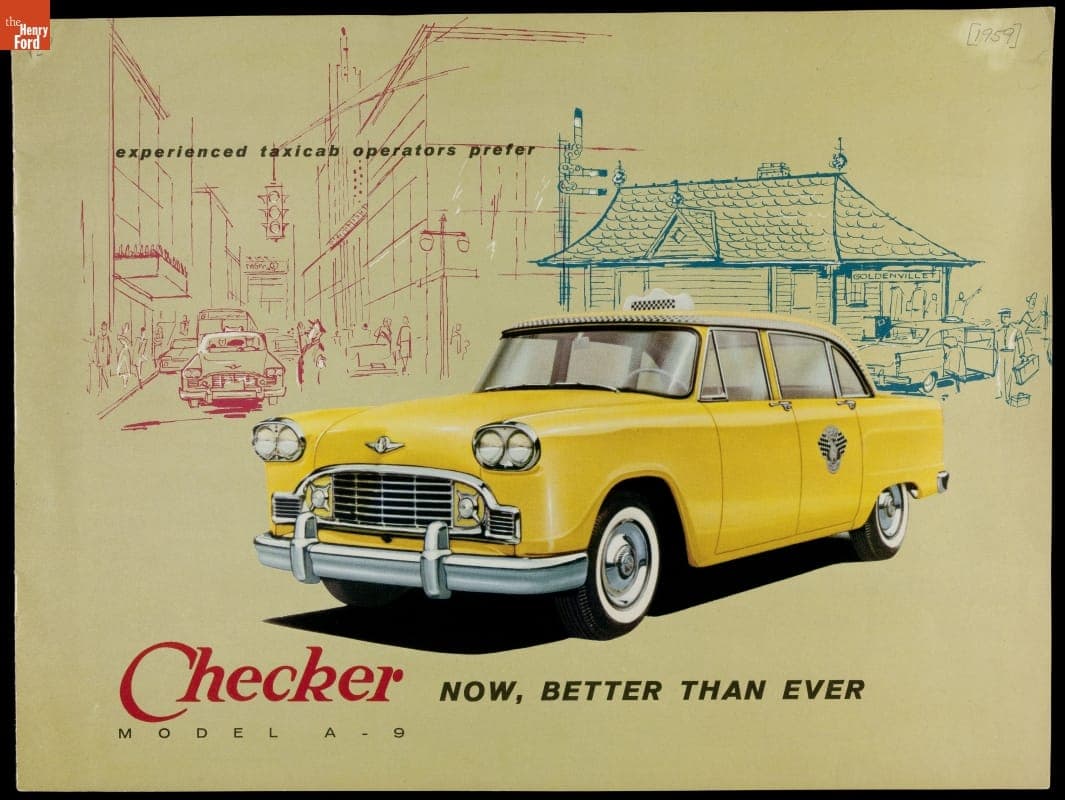
"Checker - Now, Better Than Ever," 1959
This brochure spotlights Checker's Model A-9 taxicab of 1959. The following model year brought bigger news from the company. Checker made a serious play for the consumer market with a passenger car for private owners: the 1960 Checker Superba. Though based on the company's taxicabs, the Superba featured extra trim and a more refined interior. Prices started around $2500.
View ArtifactTHF105851
"Use the Only Real Taxicab, Checker," 1961
Checker stressed the purpose-built nature of its vehicles in this 1961 brochure. Unlike other cabs modified from standard passenger cars, Checker's cars were designed and manufactured specifically for taxi service -- "the only real taxicab."
View ArtifactTHF105853
"Checker, The Only Real Taxicab!," 1967
Checker's cabs were built to last. Frames were heavily reinforced, body panels were easily removed and replaced, and front and rear bumpers were interchangeable. Likewise, the company's styling was conservative and practical. Checker did not implement the annual appearance changes favored by other automakers.
View ArtifactTHF204538
1980 Checker Catalog, "Some Straight Talk About Taxicabs"
Checker acknowledged its cabs' unchanging appearance in this 1980 catalog, stating that "Only Checker looks like a taxicab." But the next year's "straight talk" was disheartening -- for the first time in nearly 50 years, Checker lost money. Two oil crises, increased competition from Detroit automakers, and a growing market for used taxis all cut into Checker's sales.
View ArtifactTHF90395
1981 Checker Marathon Taxicab
Checker ended taxicab production in 1982. The company continued to build parts in Kalamazoo -- primarily as a supplier to General Motors -- until the Great Recession shuttered it permanently in 2009. But Checker's legacy was secure. Its cabs were preserved in popular culture through movies and television series, and "Checker" remained synonymous with "taxi" in the American popular imagination.
View ArtifactTHF188359
Lyft Glowstache, 2014-2015
In the 2010s, the taxi industry faced a serious challenge with the arrival of ridesharing services like Uber and Lyft. These companies use mobile apps to connect passengers with drivers. Generally, the drivers are independent contractors using their own vehicles, and the services are not licensed or regulated as closely as traditional taxicabs.
View Artifact

