
Gas Stations
Share
share
Gasoline is a competitive business. Brand loyalty is fleeting, and customers often choose a station simply based on which side of the road it occupies. Early retailers attracted customers with courteous service, clever architecture, clean restrooms and, above all, convenience. Gas pumps changed along with motorists' needs, evolving from simple hand-cranked mechanisms to sophisticated electric pumps that calculated quantity and cost.
THF101917
Conoco Gasoline Filling Station, 1915
Samuel W. Raymond built this filling station in 1915. It serviced automobiles in Adrian, Michigan, providing gas, oil, and water. Raymond used a glass tank to show drivers the amount of gasoline they purchased and claimed to be the first visible-delivery gasoline station. Cars lined the street for service. In 1930, when the street was widened, the station was donated to The Henry Ford.
View ArtifactVisible Gasoline Pump and Service Station outside S.W. Raymond Auto Sales, Adrian, Michigan, 1915-1929
This 1920s photograph shows Samuel Raymond's gasoline station on Main Street in Adrian, Michigan. Drivers stopped along the curb to use this street side station. Gas, oil, and water were available. At times, cars lined the street waiting for service. The station was moved to The Henry Ford in 1930 when the street was widened.
View ArtifactManual Crank Gasoline Pump, circa 1915
Gas pumps provide drivers with an easy way to put gasoline in their cars. This gas pump, made by Gilbert and Barker Manufacturing Company, dates from about 1915. Gilbert and Barker introduced the first measuring gas pump in 1911. Customers, however, could not see the gasoline. They had to rely on the pump's accuracy and the gas station owner's honesty.
View ArtifactW. H. Flessel's Auto Station Garage, Huntington, Long Island, New York, 1916
Drivers on Long Island, New York, in 1916 could stop at W. H. Flessel's Auto Station to buy tires and auto supplies and then fill up at the curb. The pump was a "blind" pump. Buyers didn't see the amount of gasoline being put into their car. Drivers relied on the accuracy of pump and the honesty of the station owner.
View ArtifactVisible Gas Pump, Birch Tree, Missouri, 1979
Gasoline jumped in price due to World War I shortages, and motorists grew suspicious of "blind" pumps. Who could be sure they were getting all they paid for? "Visible" gas pumps first fed gasoline into a clear glass tank. The motorist could then watch confidently as each gallon of fuel drained into his or her car.
View ArtifactStandard Crown Visible Delivery Gasoline Pump, circa 1920
Before visible gasoline pumps, drivers relied on the accuracy of the pump and the honesty of station owners. Visible pumps, like this circa 1920 example, used a graduated glass cylinder to show customers the quality and quantity of gas being purchased. Glass globes, like the Standard Oil red crown, usually topped the pumps and advertised a company's brand and name.
View ArtifactAdvertising Poster, "Butler Paper is a Gas," circa 1987
Gas pump globes -- lighted glass spheres perched atop pumps -- first appeared in 1912. They evolved over time from simple ball or pill shapes to elaborate crowns, clover leafs, shells, and other forms. These globes not only attracted customers, they also provided light for pump attendants working at night. Globes disappeared in the 1950s as pump designs and marketing strategies changed.
View ArtifactHill & Tibbit Super Service Station, Washington, D.C., 1934
By 1920, gasoline retailers determined that "island" gas pumps, which drivers could approach from either side, provided the most efficient station layout. They also realized that profits weren't made on the gasoline itself. Retailers instead made money by servicing and repairing cars, or by offering amenities like the "auto laundry" car wash at this station in Washington, D.C.
View Artifact"Treasure Island Itself - The Selling Equipment for Filling Stations," 1925
This "Treasure Island" isn't from Robert Louis Stevenson's classic pirate tale. By 1920, gasoline retailers determined that placing gas pumps on an "island" in front of the station, where drivers could approach from either side, was more efficient than mounting them on the station's wall. This equipment trade catalog features everything from air pumps to underground storage tanks.
View ArtifactA.F. Steiner Super Service Station at Harper and Harvard, Detroit, Michigan, August 1934
As gasoline stations spread from downtowns to residential areas in the mid-1910s, oil companies were sensitive to residents' concerns about unsightly commercial buildings invading their neighborhoods. After all, the companies counted on those residents to become regular customers. Architects designed charming buildings, like this Spanish Mission style station, that were pleasing to the eye and complementary to a neighborhood's character.
View ArtifactCitrin-Kolb Oil Service Station, 1936
Canopy roofs were common on gas stations by 1920 but fell out of favor in the mid-1930s. They added to the construction cost of a new station and, unless they were sufficiently high, prevented tall trucks from reaching the pumps. The transition to self-service pumps in the 1970s, and the need to attract customers even in bad weather, made canopies popular again.
View ArtifactFord Gas Station Attendant at Gasoline Pumps, December 1934
The first uniformed gas station attendants appeared around 1914. Attendants worked long hours in all weather, possessed a thorough knowledge of service requirements for various automobile makes and models, improvised quick repairs on the spot, provided directions to lost travelers, and did it all with a smile. Attendants disappeared with the widespread adoption of self-service pumps in the 1970s.
View ArtifactFord V-8 Automobile by a Gas Station Pump, February 1935
The dial on this gas pump measured the quantity of gasoline dispensed into an automobile. The pump attendant was responsible for determining the total cost to the customer. The first calculating pumps, capable of measuring both quantity and price, appeared in 1933. Their reeled number displays eventually replaced the clock face dial.
View ArtifactBrochure Advertising the Xacto Sentry Pump Outfit with Type "C" Tank and Fittings, 1929
S.F. Bowser & Company's Xacto Sentry gas pump brought a new level of accuracy to fuel measurement when it debuted in 1928. The pump's positive displacement meter measured gas by pumping it against a series of pistons that, in turn, moved the clock face gauge. The gauge only measured the quantity of fuel pumped. The attendant calculated the total sale price.
View ArtifactMobil Pegasus Sign, circa 1940
Eye-catching logos helped oil companies to attract and keep customers. Texaco had its big star evocative of the Lone Star State. Shell had its bright yellow shell. Exxon featured a tiger in its ads, encouraging motorists to "put a tiger in your tank." Mobil suggested speed and performance with its Pegasus winged horse introduced in 1934.
View ArtifactTexaco "Fire-Chief" Gasoline Pump, circa 1940
By the 1940s, drivers watched "computing" pumps like this Texaco Fire-Chief pump automatically calculate the amount of gasoline and the price. This type of pump did away with price charts used by service station attendants. Internal, calibrated gear sets turned numbered wheels allowing quick and easy fill ups and payments.
View ArtifactWayne Showcase Gasoline Pump, circa 1940
Do you want something to do while you wait for the gas station attendant to fill up your vehicle? This circa 1940 gasoline pump has a display case. Station owners could show off various car care products available to waiting drivers.
View Artifact"Quality Tokheim Service Instructions for Electric Meter Pumps," 1949
The first calculating gasoline pumps, capable of measuring the quantity of fuel dispensed as well as calculating the sale price, appeared in 1933. These service instructions from pump manufacturer Tokheim include directions for both clock face dials and reeled number displays. The pumps, particularly the Model 36 on page 44, show strong art deco design influences.
View ArtifactTeepee Amoco Station, Lawrence, Kansas, 1977
Any brand of gasoline will make your car go, so some retailers devised novel ways to set themselves apart from the competition. This gas station in Lawrence, Kansas, was built in the shape of a giant Native American tepee. Other stations throughout the United States were shaped like airplanes, windmills, lighthouses, Chinese pagodas, and even Egyptian temples.
View ArtifactHull-Dobbs Ford Super Service Station, Memphis, Tennessee, 1935
For those who operated gas stations, the profits were never in the gasoline itself. Most of those sales went back to the oil companies. Instead, operators first made their money by servicing and repairing automobiles. When stricter car warranties ended that revenue stream in the 1970s, station operators turned to snacks, beverages, and convenience groceries for their profits.
View ArtifactTexaco "Ask Attendant for Key" Restroom Sign, 1940-1960
Service stations provided restrooms for the traveling public. Patrons wanted clean and safe facilities. This sign from a Texaco station assured the traveler that the restrooms were well maintained.
View ArtifactUnion 76 Gas Pump, San Luis Obispo, California, 1977
“Panorama” gas pumps, with narrow bases and wide, easy-to-read displays, first appeared in the early 1960s. Double-nozzle designs like this one allowed the pump to dispense two different gasoline blends at two different prices, or allowed two motorists to fill up simultaneously on both sides of the island.
View ArtifactTexaco Service Station, circa 1960
A combination of several design disciplines (styling, package design, product design, and graphic design), Walter Dorwin Teague's Texaco station suggested consistency, simplicity, and cleanliness -- a strong corporate identity that enabled Texaco to stand out in a highly competitive marketplace.
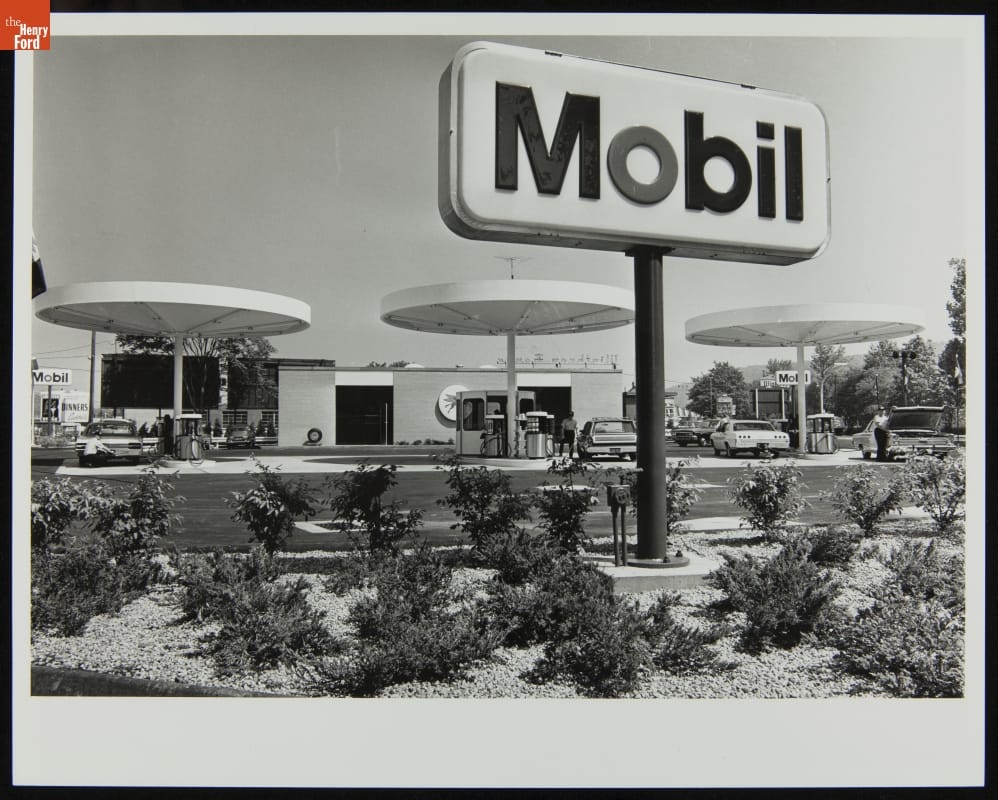
View ArtifactMobil Gasoline Station, circa 1965
After falling from favor in the mid-1930s due to their cost and complexity, canopy roofs reappeared over American gas stations three decades later. The transition to self-service pumps required that customers be protected from inclement weather. The mushroom-style canopies at this Mobil station also provided plenty of light for motorists filling up their cars at night.
View ArtifactTexaco Gas Station, Santa Fe, New Mexico, 2003
Self-service pumps were common at American gas stations by the end of the 1980s, and pay-at-the-pump credit card readers meant that customers didn't even need to enter the store. Instead, retailers attracted them inside with convenience items and basic groceries. Service garages, like the one at this Texaco station, became rare as car warranties required repairs at the dealership.
View Artifact

