
Henry Ford and the Detroit, Toledo & Ironton Railroad
Share
share
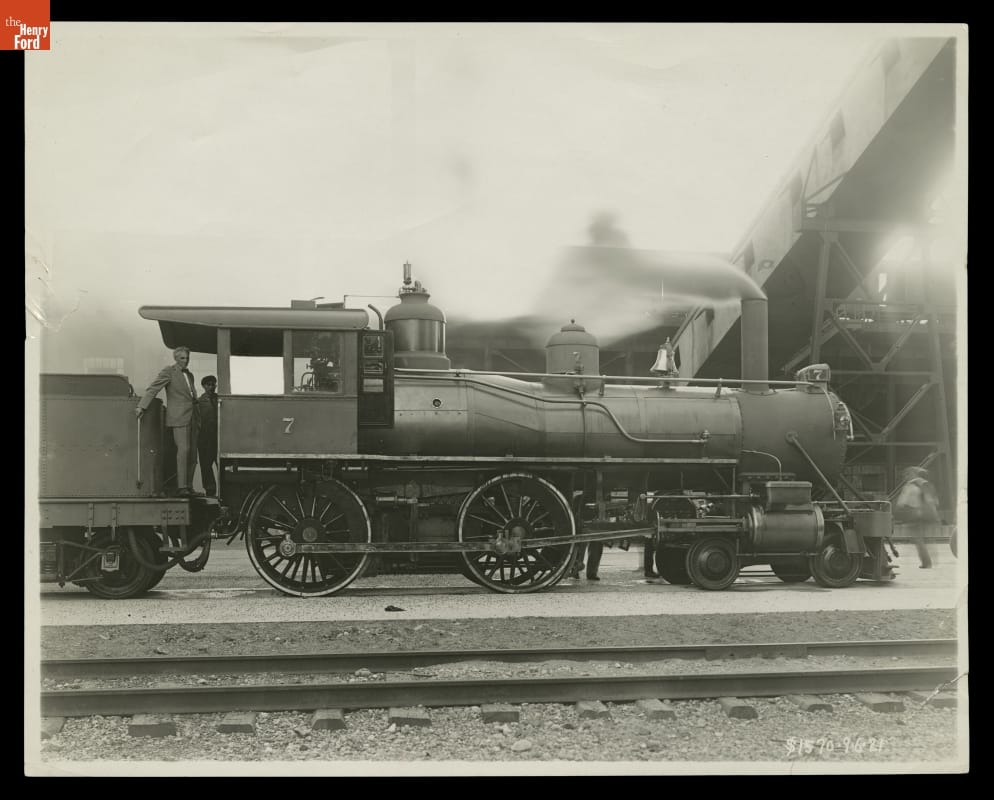
Henry Ford bought the Detroit, Toledo & Ironton Railroad in 1920. He used its 378-mile mainline -- between Detroit and Ironton, Ohio -- as a giant conveyor belt, hauling coal from Ford-owned mines to the Rouge in Dearborn. Ford spent $15 million improving DT&I's track and equipment but grew tired of burdensome railroad regulations. He sold the line in 1929.
THF91570
Baldwin Locomotive Works Steam Locomotive, 1897
The Detroit, Toledo & Ironton's core was formed by a 1901 merger of the Detroit & Lima Northern -- which purchased this locomotive in 1897 -- and the Ohio Southern. (The DT&I name itself first appeared in 1905.) The merger was intended to strengthen the two struggling railroads. But problems continued. DT&I suffered from bad track, a shortage of cars and equipment, and generally poor management.
View ArtifactDetroit, Toledo & Ironton Railroad Train in Ironton, Ohio, 1923
The railroad's mainline ended at Ironton, Ohio, on the north bank of the Ohio River. DT&I ferried railcars to and from Kentucky by barge before a 1917 agreement with another railroad shifted DT&I traffic to a bridge. Among other commodities, DT&I carried coal from southern Ohio and eastern Kentucky to factories in northwest Ohio and southeast Michigan.
View ArtifactFreighter "Frontenac" Unloading Ore at Ford Motor Company Rouge Plant, Dearborn, Michigan, 1923
Henry Ford entered DT&I's story in 1920 thanks to his grand plans for Ford Motor Company's Rouge plant. The Army Corps of Engineers intended to dredge the Rouge River so that large freighters could reach Ford's factory. Railroad bridges in the area would have to be replaced with new spans. DT&I's bridge was marked for replacement.
View ArtifactDetroit, Toledo & Ironton Railroad Bridge over Rouge River, circa 1925
DT&I pleaded poverty and claimed that it couldn't afford to build the new $350,000 drawbridge. Railroad officials approached Mr. Ford about backing a loan to cover the cost. Intrigued by DT&I's potential, Ford not only agreed to the request -- he bought a controlling interest in the railroad for $5 million in July 1920.
View ArtifactOld Iron Rails at Detroit, Toledo & Ironton Railroad Roundhouse, Ironton, Ohio, 1923
DT&I's poor financial health caused its physical plant to suffer -- and heavy use during World War I further stressed track, equipment and structures. Ford's first task was to catch up on deferred maintenance. He rebuilt track with heavier rail, repaired or replaced bridges, and improved buildings and maintenance facilities up and down the line.
View ArtifactManufacturing Parts for Detroit, Toledo & Ironton Railroad at Ford Motor Company Rouge Plant, circa 1926
Henry Ford -- not Ford Motor Company -- owned DT&I. Nevertheless, Mr. Ford used many of Ford Motor Company's facilities to service his railroad. The Rouge and Highland Park factories fabricated locomotive parts. The Rouge's concrete plant cast bridge girders, signposts and railroad ties. Slag from the Rouge's blast furnaces served as ballast under sections of DT&I track.
View ArtifactFord Executives at the Opening of Detroit, Toledo & Ironton Railroad's Flat Rock Cut-Off, December 1923
Mr. Ford used Ford Motor Company's executive talent on DT&I too. Early on, he replaced the railroad's management team with officers from Ford Motor Company, along with other business and personal associates. Longtime Ford Motor Company employee Fred Rockelman became DT&I's operations manager. Clara Ford and Edsel Ford -- Henry Ford's wife and son -- became DT&I directors.
View Artifact1902 American Locomotive Company Steam Locomotive as D. T. & I. Railroad No. 45, November 1926
DT&I's locomotives received special attention. Each unit went to Ford's Rouge plant for rebuilding. Iron pipes were replaced with copper. Boilers were jacketed with attractive Russia iron. Wheels received white stripes. Many parts were plated in nickel, and everything was polished to a high shine. DT&I's spotless engines stood out in the gritty world of early 20th century railroading.
View ArtifactHenry Ford aboard the Detroit, Toledo & Ironton Railroad #7 Locomotive at Ford Rouge Plant, 1921
DT&I's locomotives fascinated Henry Ford — a person taken with machinery since childhood. He rode in locomotive cabs and talked face-to-face with engineers about the operation of each unit. Ford adopted locomotive #7 as his personal favorite. The engine pulled his special train on inspection trips, and it later found a home in his museum.
Detroit, Toledo & Ironton Railroad Yard, Jackson, Ohio, 1924
Freight traffic grew under Mr. Ford's ownership, and busy railyards helped make DT&I profitable again. Ford Motor Company provided plenty of business by itself, but Mr. Ford's insistence on customer service also attracted other shippers. DT&I's many connections were an important advantage -- it crossed every New York-Chicago trunk line on its way from Detroit to Ironton.
View ArtifactDetroit, Toledo, and Ironton Railroad Station, Wyandotte, Michigan, June 1926
Mr. Ford assigned carpenters from the Rouge to remodel many of DT&I's passenger stations. Most of these buildings included not only passenger waiting rooms, but railroad offices as well. Damage was repaired, furnishings were replaced, and file cabinets and desk drawers were painted white -- to encourage tidy housekeeping. Each station was given a coat of standardized gray paint.
View ArtifactDetroit, Toledo and Ironton Railroad Passenger Depot, Detroit, Michigan, 1923
DT&I passenger trains received attention too. Ford rebuilt passenger cars, rearranged schedules, and generally made the trains run on time. He even experimented with self-propelled passenger cars, though results were disappointing. Despite the improvements, DT&I passenger revenue continued to fall under Ford's ownership. People, it seemed, preferred to travel by automobile. Henry Ford largely had himself to blame for that!
View ArtifactDetroit, Toledo & Ironton Railroad Overpass, 1926
Mr. Ford's most ambitious project was the Malinta Cut-Off. This more direct route over the Ohio-Michigan border cut some 20 miles off of DT&I's older circuitous alignment. Crews built the Cut-Off to high standards, with gentle grades and few curves. Several of the new route's crossings -- of roadways and railways -- were eliminated with overpasses like this one.
View ArtifactRailroad Crossing Warning Signal, Detroit, Toledo & Ironton Railroad, July 1926
Other road crossings on DT&I were improved with automatic signals. Lights and bells, activated when an approaching train tripped an electrical relay, provided greater protection than simple "Railroad Crossing" signs. Mr. Ford took a keen interest in driver safety at railroad crossings -- fitting for a man who put so many automobiles on the road.
View ArtifactFord News, January 1, 1924
Closer to home, Mr. Ford completed a 15-mile branch connecting DT&I's mainline at Flat Rock, Michigan, directly with the Rouge in 1923. Previously, DT&I freight movements to Ford's factory relied on other railroads in a process that took up to 24 hours. With the new line, railcars moved from Flat Rock to the Rouge in as little as one hour.
View ArtifactTracks Used by Detroit, Toledo & Ironton Railroad Electric Locomotives, 1927
Mr. Ford electrified the Flat Rock-Rouge branch in 1926. Electricity generated at the Rouge powered the line via overhead wires. Rouge workers cast the concrete arches that supported the wires. Electric operation ended in 1930, but many of the sturdy arches remained -- it wasn't worth the time, money, or effort to remove them.
View ArtifactDetroit, Toledo & Ironton Railroad Electric Locomotives at Ford Motor Company Highland Park Plant, 1925
Mr. Ford built two electric locomotives for the Rouge branch at the Highland Park plant in 1925-1926. Designed to operate as a pair, the combined locomotives produced around 3,800 horsepower. Ford considered electrifying more DT&I track, perhaps all the way to Ironton, but those plans never materialized. The two electric locomotives shuttled between the Rouge and Flat Rock until 1930.
View ArtifactFord Model A Tudor on Assembly Line, Ford Rouge Plant, Dearborn, Michigan, October 21, 1927
Mr. Ford couldn't concentrate his efforts on DT&I forever. He refocused on automobiles as Model T sales collapsed in the mid-1920s. Ford and his team designed the replacement Model A and temporarily closed the Rouge for conversion to the new car. DT&I traffic fell sharply during this 1927 changeover -- the only year the Ford-owned railroad lost money after Mr. Ford's improvements.
View ArtifactIllustrated and Annotated Map of the Detroit, Toledo & Ironton Railroad, 1955-1959
Just as suddenly as he bought it, Henry Ford sold DT&I in June 1929. What ended Ford’s ownership? In a word: regulations. Government agencies administered almost everything on American railroads, from freight rates to employee wages to passenger service. The bureaucracy frustrated Mr. Ford -- a man used to getting his own way in the automotive business.
View ArtifactDetroit Toledo & Ironton Railroad Caboose, 1925
Mr. Ford sold DT&I to Pennsylvania Railroad interests for $36 million. From then on DT&I's story mirrored other American railroads. Passenger service ended, diesel replaced steam, and abandonments reduced track mileage. Canada's Grand Trunk Western Railroad purchased DT&I in 1980 and, within three years, fully merged it. After 78 years, the familiar "DT&I" initials disappeared from locomotives and railcars.
View Artifact

