
Henry J. Heinz: Master of Marketing
Share
share
Henry J. Heinz was a talented promoter who knew the power of advertising. He put the Heinz name on everything from trade cards to streetcars, created large grocery store displays, and mounted exhibitions at world’s fairs and regional expositions.
THF1112
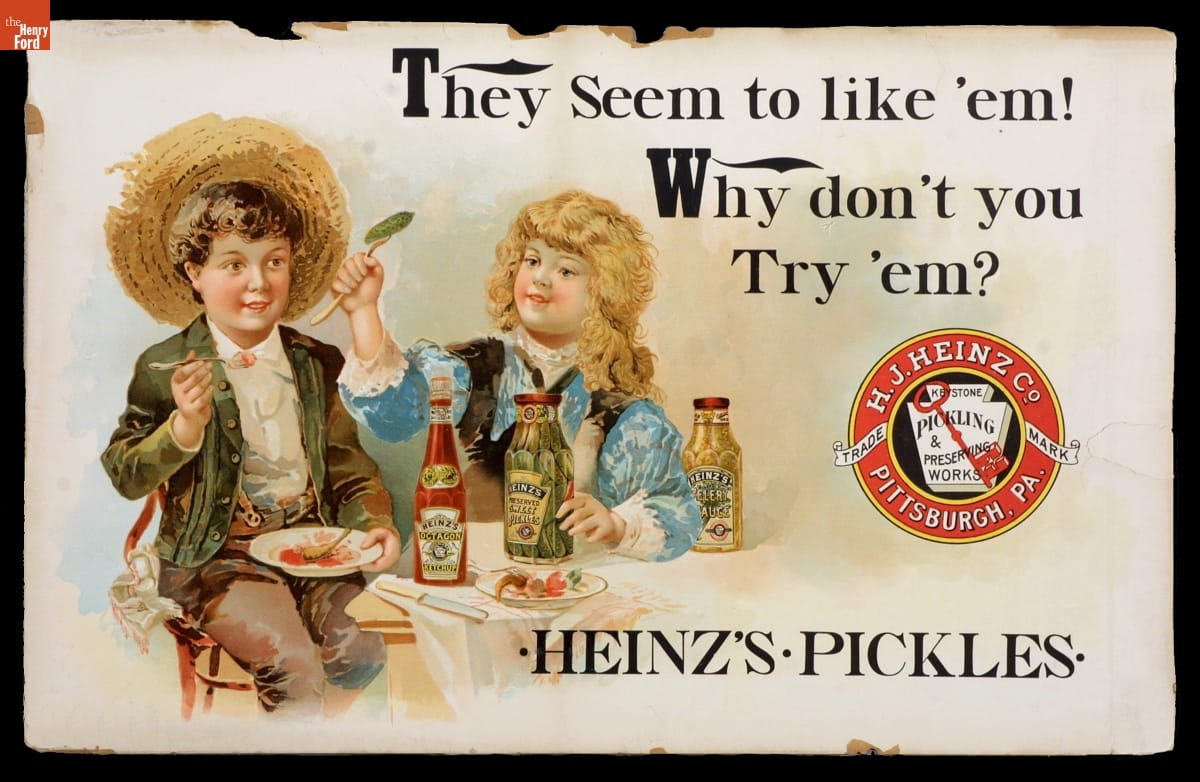
Advertising Poster for Heinz's Pickles, "They Seem to Like 'Em! Why Don't You Try 'Em!," circa 1895
This illustrated poster advertising "Heinz's Pickles" features some of the H.J. Heinz Company's distinctive product packaging. Eye-catching labels attracted customers, and clear glass bottles revealed consistent, high quality products. The keystone label endured as a Heinz company hallmark.
View ArtifactF. & J. Heinz Wagon with Celery Sauce Advertising Display, 1879
Henry J. Heinz rarely missed an opportunity to raise customer awareness for his line of packaged foods. He was a prolific promoter whose schemes were innovative and often flamboyant. During parades and other promotional events, Heinz paired handsome teams of company draft horses with festooned delivery wagons. These moving billboards charmed crowds as they advertised Heinz products.
View ArtifactH. J. Heinz Co. Booth at an Exhibition, circa 1910
In addition to the great World's Fair exhibits, the H. J. Heinz Company displayed their products at regional fairs and expositions. These exhibits generally included product displays, free product samples, promotional pamphlets, slide shows of the Heinz plant in Pittsburgh, and pickle-pin souvenirs--all set in a refined drawing-room atmosphere.
View ArtifactH. J. Heinz Co. Booth at the World's Columbian Exposition, Chicago, Illinois, 1893
The H.J. Heinz Company boasted the largest of the commercial food exhibits at the 1893 World's Columbian Exposition in Chicago. The company's exhibit included product displays; free product samples; an assortment of art objects, antiquities, and curiosities; and -- most popular -- green watch-chain charms in the shape of pickles. These would soon after be made as pins.
View ArtifactH. J. Heinz Co. Wagon with Painted Advertising, 1888-1896
Henry J. Heinz rarely missed an opportunity to raise customer awareness for his line of packaged foods. His promotional schemes were innovative and often flamboyant. This brightly painted wagon, used for deliveries or sales calls, featured the keystone shape that consumers came to associate with Heinz. Paired with a handsome team of Heinz draft horses, this commercial vehicle doubled as a remarkable moving advertisement.
View ArtifactHeinz Foods in O.H. Bailey Store Window Display, Lansing, Michigan, circa 1930
The H.J. Heinz Company employed a robust, well-trained sales force to work directly with grocery stores throughout the country. After securing a store's business, Heinz salesmen visited regularly to introduce new products, clear expired or otherwise unsaleable merchandise, and create product displays. These neat, orderly presentations caught shoppers' attention and helped reinforce the notion that Heinz products were of consistent, high quality.
View ArtifactHeinz Ketchup Bottles and Marketing Displays, circa 1930
Henry J. Heinz introduced tomato ketchup as one of his first bottled condiments in the 1870s. To ensure his success among competing ketchup manufacturers, Heinz relied on distinctive packaging and a consistent, high-quality product. By the early 1900s, Heinz ketchup--with its hallmark octagon glass bottle and keystone label--was well-established as the "largest selling ketchup in the world."
View ArtifactHeinz Products in Hamady Brothers Store Display, Flint, Michigan, 1930
The H.J. Heinz Company employed a robust, well-trained sales force to work directly with grocery stores throughout the country. After securing a store's business, Heinz salesmen visited regularly to introduce new products, clear expired or otherwise unsaleable merchandise, and create product displays. These neat, orderly presentations caught shoppers' attention and helped reinforce the notion that Heinz products were of consistent, high quality.
View ArtifactHeinz Products in Manhattan Food Store Display, Boston, Massachusetts, circa 1930
The H.J. Heinz Company employed a robust, well-trained sales force to work directly with grocery stores throughout the country. After securing a store's business, Heinz salesmen visited regularly to introduce new products, clear expired or otherwise unsaleable merchandise, and create product displays. These neat, orderly presentations caught shoppers' attention and helped reinforce the notion that Heinz products were of consistent, high quality.
View ArtifactInside the Heinz Ocean Pier, Atlantic City, New Jersey, 1904
The Heinz Ocean Pier, opened 1898, was the Heinz Company's costliest and most ambitious venture. It is here that the "57 Varieties" slogan became synonymous with the company. Open year-round, the Pier included product displays, free samples, slide lectures of the company's Pittsburgh plant, an impressive art collection, and free pickle pins. A hurricane destroyed the building in 1944.
View ArtifactStreetcar Advertising Poster for Heinz Tomato Ketchup, "One of the 57," circa 1900
Henry J. Heinz rarely missed an opportunity to market his "57 Varieties" -- a catchy slogan he created despite offering a line of more than 60 packaged food products. A prolific promoter, Heinz aimed to reach consumers in stores, at home, and everywhere in-between. This colorful poster advertised Heinz Tomato Ketchup to passengers riding a streetcar.
View ArtifactTrade Card for H.J. Heinz Company Apple Butter & Table Delicacies, circa 1900
Trade cards were one of the methods H. J. Heinz employed to promote his pickled foods and condiments. Customers enjoyed and often saved these vibrant little advertisements found in product packages or distributed by local merchants.
View ArtifactHeinz Products in Grocery Store Display, Milwaukee, Wisconsin, 1930
The H.J. Heinz Company employed a robust, well-trained sales force to work directly with grocery stores throughout the country. After securing a store's business, Heinz salesmen visited regularly to introduce new products, clear expired or otherwise unsaleable merchandise, and create product displays. These neat, orderly presentations caught shoppers' attention and helped reinforce the notion that Heinz products were of consistent, high quality.
View ArtifactTrade Card for H.J. Heinz Company Condiments, circa 1895
As color printing gained momentum in the late 19th century, trade cards became a major means for advertising goods and services. Americans enjoyed and often saved these little advertisements found in product packages or distributed by local merchants. Trade cards for the H.J. Heinz Company, like the one seen here, promoted its pickled foods, preserves and condiments.
View ArtifactTrade Card for H.J. Heinz Company, "Going Mamma's Errands," circa 1905
As color printing gained momentum in the late 19th century, trade cards became a major means for advertising goods and services. Americans enjoyed and often saved these little advertisements found in product packages or distributed by local merchants. Trade cards for the H.J. Heinz Company, like the one seen here, promoted its pickled foods, preserves and condiments.
View ArtifactTrade Card for Heinz Keystone Pickles, H.J. Heinz Company, circa 1885
In the last third of the nineteenth century, an unprecedented variety of consumer goods and services flooded the American market. Advertisers, armed with new methods of color printing, bombarded potential customers with trade cards. Americans enjoyed and often saved the vibrant little advertisements found in product packages or distributed by local merchants. Many survive as historical records of commercialism in the United States.
View ArtifactStreetcar Advertising Poster for H. J. Heinz Company, "A Clean Spot in Pittsburgh, Visitors Welcome," circa 1920
The H.J. Heinz Company factory in Pittsburgh's North Side became well known for cleanliness and efficiency, and founder Henry J. Heinz quickly recognized its marketing potential. In 1899, the innovative promoter opened his factory complex to the public. Visitors could tour several buildings to observe plant operations, taste complimentary samples of Heinz products, and take home a souvenir pickle pin.
View ArtifactHeinz Products in Grocery Store Display, possibly Rowes Run, Pennsylvania, circa 1925
The H.J. Heinz Company employed a robust, well-trained sales force to work directly with grocery stores throughout the country. After securing a store's business, Heinz salesmen visited regularly to introduce new products, clear expired or otherwise unsaleable merchandise, and create product displays. These neat, orderly presentations caught shoppers' attention and helped reinforce the notion that Heinz products were of consistent, high quality.
View ArtifactH. J. Heinz Co. Electric Advertising Sign, New York City, circa 1902
Henry J. Heinz rarely missed an opportunity to raise customer awareness for his line of packaged foods. He was a prolific promoter whose schemes were innovative and often flamboyant. Built in 1900, this was the first electric display of its kind. The massive sign stood six stories, used 1,200 incandescent lights, and was topped with a 43-foot-long flashing Heinz pickle.
View Artifact

