
Pennsylvania German Aesthetics
Share
share
The Pennsylvania Germans, popularly known as the Pennsylvania "Dutch," were a vibrant immigrant community active in southeastern Pennsylvania in the late 18th and early 19th centuries. The Henry Ford has a rich collection of objects that show the Pennsylvania Germans' flamboyant, whimsical, playful, and highly imaginative artistic style. These pieces are a few of the highlights.
THF237524
Birth and Baptismal Certificate for Elisabeth Catharina Schneider, circa 1800
Early German immigrants created decorative keepsakes to commemorate important family events. These documents, known as Fraktur, usually incorporated intricate lettering, elaborate borders and colorful drawings of birds, flowers, hearts or other stylized figures. This hand-colored Fraktur records the birth and baptism of Elisabeth Catharina Schneider in 1774. This document -- made perhaps some 25 years later -- was embellished with flying angels.
View ArtifactBirth and Baptismal Certificate for Maria Heimbach, 1784
Inside the heart-shaped center of this Fraktur is information about the birth and baptism of Maria Heimbach. The artist decorated the remaining areas with colorful, hand-painted flowers and other foliage. Even the handwriting on this document shows a decorative flair.
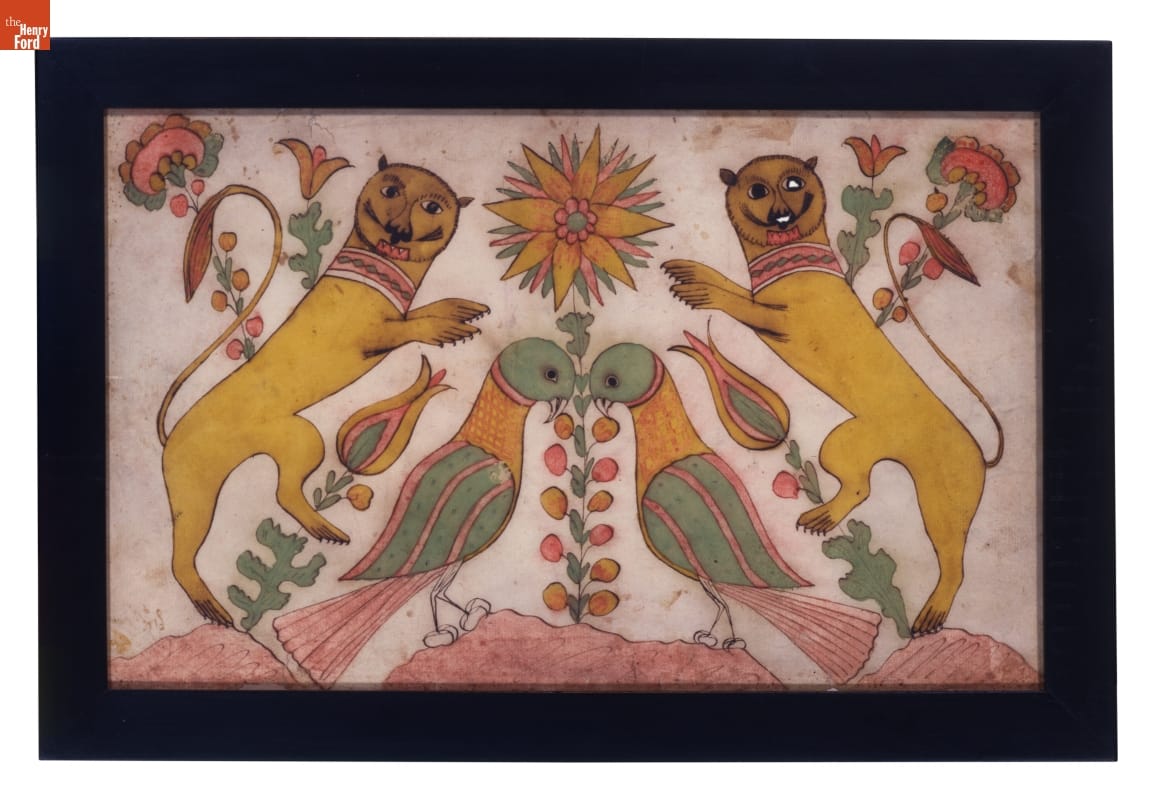
View ArtifactDrawing of Confronted Lions and Birds, 1800-1820
This Fraktur was likely created as a practice piece. "Confronted" in this description refers to how the animals face each other in a symmetrical design -- a feature common to Pennsylvania German decoration.
View ArtifactFamily Record for Robert Pedrick, circa 1812
The aesthetic of the Pennsylvania Germans became immensely popular, so much so that its influenced extended to other regions. This family record, documenting the life events of the Pedrick family, was created in New Jersey but imitates the style of Pennsylvania German Fraktur. The image of the house became emblematic of the style.
View ArtifactLion Figurine by John Bell, 1840-1865
The soil in southeastern Pennsylvania consisted of two layers: a high-quality topsoil suitable for farming, and a rich clay subsoil. Numerous potteries developed in the area, creating pieces that utilized the same decorative aesthetics as Pennsylvania German Fraktur. This whimsical lion is one such example.
View ArtifactBarber Basin, 1791
This barber basin is an important early example of Pennsylvania German pottery. It features techniques common to the Pennsylvania German style, including sgraffito (a term used to describe incised decoration) and the use of colorful red slip.
View ArtifactPlate, 1785-1796
This plate was created by notable artist George Hubener. As a farmer, Hubener likely created pieces when the agricultural calendar allowed it. At one point in his career, Hubener was able to establish his own pottery. Surviving pieces of his work range in dates from 1786 to 1793, and showcase traditional Pennsylvania German motifs.
View ArtifactGerman American Wardrobe, 1790-1800
In the German immigrant areas of Pennsylvania, painted wardrobes with floral scenes were commissioned by prosperous farmers and merchants to show off their wealth and sophistication. This wardrobe is larger and more elaborately decorated than most, retaining much original paint, including extensive faux finishes on the drawer fronts.
View ArtifactChest, Made for Elisabeth Mockersen, 1794
Young women used chests like this one to store linens and other household goods in anticipation of their wedding day. The carnations painted on the front symbolized faithfulness and loyalty.
View ArtifactSettee, 1830-1860
Pennsylvania Germans during the first half of the 19th century – like other Americans of the time -- prized exuberantly painted furniture and other "fancy" things. This brightly colored settee with its gilded accents and hand-painted floral forms was part of a set that included six chairs.
View ArtifactQuilt, 1840-1870
This quilt is emblematic of the Pennsylvania German style of quilt making. It features appliqued design elements – the border and roses – and colorways common to the aesthetic.
View ArtifactAlbum Quilt, circa 1850
By the middle of the nineteenth century, the Pennsylvania German aesthetic had spread outside the community, to other groups in the region. This "album" quilt was used by Anne Dawson Morrison, a prosperous Philadelphia Quaker.
View Artifact

