
Windmills: Extracting Power from the Air
Share
share
For many centuries windmills have been used as gristmills, to grind grain, or windpumps, to pump water from the ground. Modern windmills can even generate electricity.
THF211318
Windmill, circa 1885
Since the early 1600s, Americans have built windmills to grind grain, pump water, drive machinery and generate power. The European-style windmill seen in this photograph was probably located along the Massachusetts seashore. Wind power drove the grain grinding machinery inside. Mill owners could position the mill's sails to catch the ocean breeze by moving the tail pole to turn the rotating cap.
View ArtifactWindmill at Bass River, Cape Cod, Massachusetts, circa 1885
Since the early 1600s, Americans have built windmills to grind grain, pump water, drive machinery and generate power. This photograph from the late 1800s shows an early European-style windmill on Cape Cod, Massachusetts. Wind power drove the grain grinding machinery inside. Mill owners could position the mill's sails to catch the ocean breeze by moving the tail pole to turn the rotating cap.
View ArtifactRiverside Stock Farm, Huron, South Dakota, circa 1905
Riverside Stock Farm was part of a thriving livestock industry in Huron, South Dakota. In the early 1880s, the Chicago and Northwestern Railway chose this east-central South Dakota site on the west bank of the St. James River for its division headquarters. Huron, and its surrounding farms, quickly sprang to life. Nearby railroad transportation made raising livestock a profitable venture.
View Artifact"T. Smits Vly in Early Times" (New Amsterdam, later New York City), Lithograph from 1861
Immigrants from the Netherlands settled present-day New York City in the early 1600s. The Dutch settlement, christened New Amsterdam, flourished as colonists bartered with Indigenous communities, farmed and plied various trades. This 19th-century print depicts boat builders working along the river and a prosperous farm with a windmill where colonists ground their grain.
View ArtifactWindmills in Eckartsberga, Germany, circa 1935
In 1913, Henry Ford established Ford Motor Company's photographic department. Though few internal records describe company photography, remaining photographs reveal a wide range of departmental activity. Over nearly 100 years, Ford photographers documented company ventures, personal affairs, and daily life around the world. This photograph shows a couple of windmills near a dirt road in an unidentified location.
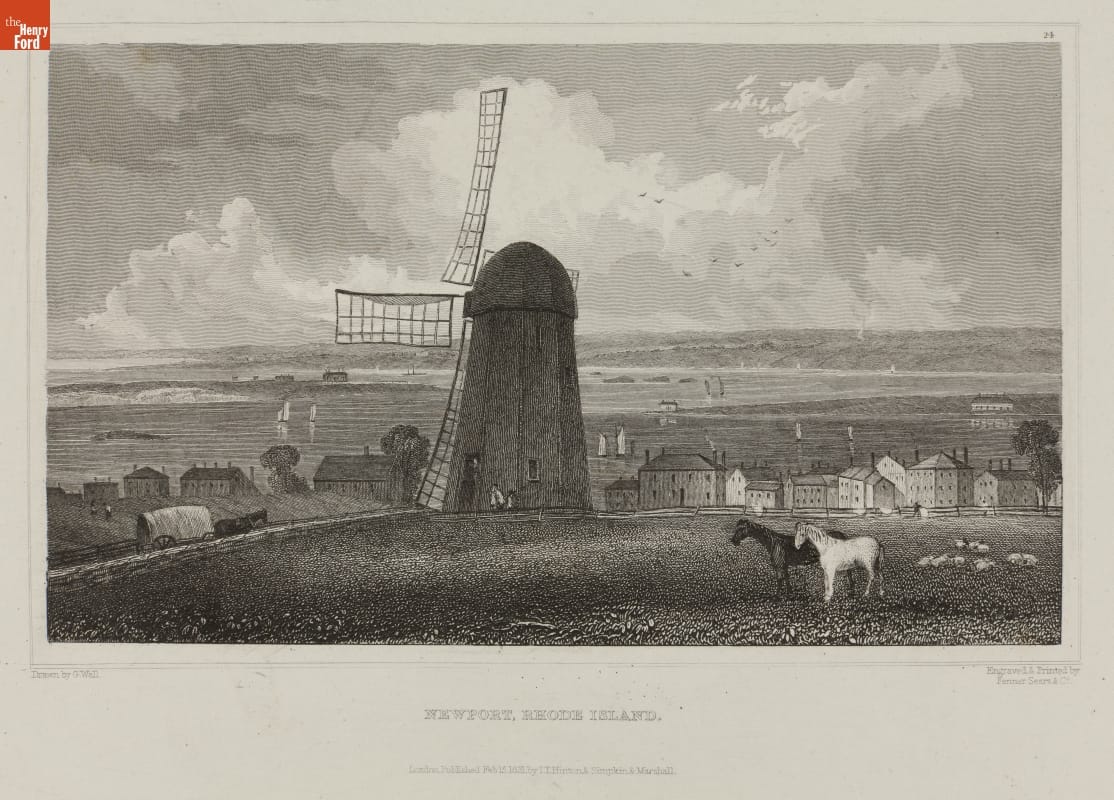
View ArtifactSteel Engraving, "Newport, Rhode Island," 1831
This engraving of Newport, Rhode Island, was published in London in 1831. The engraving features a picturesque view of the town, the shore, and a windmill. Newport was an early whaling town and played a pivotal role in the "Triangle Trade" of slaves, sugar, and rum. By the mid-19th century Newport was becoming a resort town for the wealthiest Americans.
View ArtifactEnertech Wind Turbine, 1984
In the 1980s Enertech grew to be a leading producer of wind turbines--in an industry fast becoming dominated by European companies. This particular unit was one of 8 installed in Princeton, Massachusetts. The Princeton wind farm, which began operation in September 1984, grew from the community's eagerness to explore alternatives to buying power generated by the Seabrook, New Hampshire, nuclear facility.
View ArtifactFord Home (Henry Ford's Birthplace) at Its Original Location, Dearborn, Michigan, 1923-1926
Henry Ford began restoration of his Dearborn, Michigan, birthplace in 1919. He repaired or replaced the farm buildings and filled the small, white clapboard house with original or similar furnishings he remembered from his boyhood. He dedicated the restoration to the memory of his beloved mother, Mary Litogot Ford, who died in 1876. In 1944, the house and outbuildings were moved to Greenfield Village.
View ArtifactThomas Flyer in Front of Windmills in Russia, New York to Paris Race, 1908
In February 1908, six automobiles began an around-the-world race from New York City to Paris, France. The contest took 169 days, covered 22,000 miles and spanned three continents. In May, the three remaining teams left Vladivostok, Russia. For the next two to three months the teams made their way west across the Russian countryside.
View ArtifactAerial View of Ford Home (Henry Ford's Birthplace) at Its Original Location, Dearborn, Michigan, circa 1931
Henry Ford began restoration of his Dearborn, Michigan, birthplace in 1919. He repaired or replaced the farm buildings and filled the small, white clapboard house with original or similar furnishings he remembered from his boyhood. He dedicated the restoration to the memory of his beloved mother, Mary Litogot Ford, who died in 1876. In 1944, the house and outbuildings were moved to Greenfield Village.
View ArtifactMenlo Park Library, Sarah Jordan Boarding House, and Edison's Home, Original Site, Edison, New Jersey, circa 1880
Zenith Radio Wincharger, 1935-1937
Radio connected Americans to the larger world in many ways. However, most rural Americans were not on the limited power grid of the 1930s so could not use radios. Portable wind generators, like this Wincharger, were developed to power radios, continuing a long tradition of local power production on farms--by horse, steam and wind power.
View ArtifactStover Windmill, circa 1883
This windmill is similar to one purchased by William Ford, Henry Ford's father, and used on his Dearborn, Michigan, farm. Farmers throughout the United States in the late 1800s could purchase American prairie-style windmills like this one from scores of manufacturers. These labor-saving devices provided power for farm machinery and pumped well water used by the farmer's family and livestock.
View ArtifactTrade Card for Halladay Windmills, U.S. Wind Engine & Pump Co., 1870-1900
In the last third of the nineteenth century, an unprecedented variety of consumer goods and services flooded the American market. Advertisers bombarded potential customers with trade cards. Americans enjoyed and saved the often illustrated little advertisements found in product packages or distributed by local merchants. Many survive as historical records of commercialism in the United States.
View ArtifactFarris Windmill
The Farris windmill is said to be the oldest windmill in the United States. It was built in the mid-1600s and operated in Cape Cod, Massachusetts. The Farris family ran it for three generations, starting in 1782. The wind moved the sails of this windmill to operate the grain milling machinery inside. The stone first floor was added at Greenfield Village.
View ArtifactStover's Automatic Wind Engine for Pumping Water, Grinding, &c., 1876
Many American farmers in the late 1800s bought windmills to pump water and power machinery. The Stover Wind Engine Company -- one of several companies that used the Stover name -- manufactured windmills for a brief period around the late 1870s. With pages of testimonials, this Stover catalog touted the durable construction and labor- and money-saving qualities of its windmills.
View Artifact

