
Lincoln - Birth and Rebirth
Share
share
Lincoln Motor Company was born in 1917 out of Henry Leland's patriotic desire to build airplane engines for the allied forces in World War I. After the armistice, Leland and his son Wilfred refashioned Lincoln into a high-end automaker. But a postwar recession forced the Lelands to sell to another father-son duo, Henry and Edsel Ford. Over the next 20 years, Lincoln grew into one of America's most admired luxury marques.
THF128003
Henry Leland in His Office with Wilfred Leland, Jr., Detroit, Michigan, circa 1922
Henry Leland (1843-1932) grew up in Vermont and learned the importance of precision manufacturing in New England's state-of-the-art factories. He relocated to Detroit and produced Oldsmobile engines and gears before founding Cadillac Motor Car Company in 1902. Following a dispute with Billy Durant, whose General Motors corporation acquired Cadillac in 1909, Leland resigned and founded Lincoln Motor Company in 1917.
View Artifact1903 Cadillac Runabout
Henry Leland formed Cadillac Motor Car Company in 1902 from the remains of the Henry Ford Company, Ford's second failed attempt at automobile manufacturing. At $750, the first Cadillacs were inexpensive for their time. These early cars had little in common with the brand's later luxury vehicles, apart from the precision engineering and assembly that became Leland's trademarks.
View ArtifactHenry and Wilfred Leland with a Liberty Engine, Detroit, Michigan, circa 1917
As the United States prepared to enter World War I, Henry Leland wanted his Cadillac Motor Car Company to build Liberty V-12 aircraft engines for the military. But Billy Durant, head of corporate parent General Motors and a dedicated pacifist, refused Leland's request. Leland quit in protest and, at age 74, formed a new company to manufacture the motors.
View ArtifactYoung Women at the Abraham Lincoln Statue outside the Ford Motor Company Lincoln Plant, 1944
In keeping with his patriotic motives behind the new company, Henry Leland named it after the first man for whom he cast a presidential ballot: Abraham Lincoln. Leland's earlier firm, Cadillac, was named for the French explorer who founded Detroit. Henry Leland was a genuine rarity in the industry -- he founded two successful car companies and named neither after himself.
View ArtifactLiberty V-12 Model A Airplane Engine, Lincoln Motor Company, circa 1917
The United States government drew on automotive industry expertise to design and mass-produce the 400-horsepower Liberty V-12 aircraft engine. Too heavy for single-seat planes, the Liberty engines powered larger aircraft. Lincoln built roughly half of the 13,000 Liberty V-12s manufactured by war's end. The rest came from Packard, Ford, Marmon, Buick, and -- after a change of heart by Billy Durant -- Cadillac.
View ArtifactLincoln Radiator Emblem, 1922
After the armistice, Henry Leland returned to what he knew best and converted Lincoln into a maker of luxury motorcars. Leland wisely traded on his reputation as the "master of precision." The first models, introduced in 1920, proudly carried the designation "Leland-built" on their radiator badges. The phrase was synonymous with skilled engineering and assembly.
View Artifact1922 Lincoln Four Passenger Sedan Parked on Street
Leland-built Lincolns had just one fault, but it was significant. The cars looked stodgy and old fashioned at a time when automobile styling was becoming increasingly important in driving sales. The Lelands recognized the problem and turned to experienced coachbuilders like Brunn, Fleetwood and Judkins for new body designs. Lincoln styling improved, but there was another problem beyond the Lelands' control.
View ArtifactHenry Ford, Henry Leland, Edsel Ford, and Wilfred Leland at the Acquisition of Lincoln Motor Co. by Ford Motor Co., 1922
Unfortunately, the Lincoln automobile debuted during an economic recession. Forced into receivership, Henry and Wilfred Leland sold their company to Henry Ford in 1922. The Lelands intended to stay on and manage Lincoln for the new owner. It was not a happy marriage, and the Lelands left within months. Nevertheless, the quality of the Ford-built Lincoln motorcar remained high.
View ArtifactEleanor Ford and Edsel Ford on the Day of Ford's Purchase of Lincoln Motor Company, February 4, 1922
With the Lelands' departure, Henry Ford left Lincoln's day-to-day management to his son, Edsel. For the younger Ford, Lincoln was a professional haven. Henry never fully relinquished control of Ford Motor despite appointing Edsel president in 1919. But at Lincoln, Edsel Ford was free to experiment, and to develop his natural talents for automotive design.
View ArtifactLincoln V-8 Automobile Engine, 1923
Henry Leland's Lincoln automobile may have lacked style, but its engine was outstanding. Ford Motor Company, which acquired Lincoln in 1922, initially made few modifications to the V-8. For 1923, its cylinder head water capacity was increased to assist in cooling, and its iron pistons were replaced with aluminum units. The 90-horsepower engine had a displacement of 357.8 cubic inches.
View Artifact1929 Lincoln Convertible Victoria
Lincoln styling flourished under Edsel Ford's leadership. He worked with some of the industry's best coachbuilders to produce appealing designs that improved Lincoln's sales and stature. This 1929 Model L convertible, with a body by Dietrich, is a prime example.
View ArtifactHenry Ford and Edsel Ford Introducing the 1928 Ford Model A at the Ford Industrial Exposition in New York City
Some of Lincoln Motor Company's elegance found its way into the Ford line. The 1928-1931 Ford Model A was not only more technically sophisticated than its predecessor Model T, it was more fashionable. Edsel Ford borrowed heavily from Lincoln's fenders and radiator shell when styling the Model A. Customers noticed, nicknaming the handsome new Ford car a "baby Lincoln."
View ArtifactLincoln Motor Company Advertisement Showing Greyhound Hood Ornament, circa 1930
Lincoln Motor Company adopted the greyhound as its corporate mascot in 1925. The swift, graceful animal was a fitting symbol for a company that prided itself on speedy and stylish motor cars. Gorham Manufacturing Company, a silversmithing firm based in New York City, designed the regal hood ornament that crowned Lincoln automobiles through the 1930s.
View ArtifactLincoln Brougham Sedan, 1934
Lincoln, like all upmarket automakers, suffered during the Great Depression. The company went from an annual production of 7,641 for 1929 to just 2,411 for 1934 -- and it would fall farther. A four-door, seven-passenger V-12 Brougham like this one started at $6,800. Many customers couldn't even afford $585 for a new four-door Ford, much less a pricey Lincoln.
View Artifact1937 Lincoln Brunn Touring Car
This Lincoln Model K is one of ten 1937 cabriolets with a body built by Brunn & Company of Buffalo, New York. It is distinguished by the tinted glass skylights above the windshield, and the convertible rear roof section that folds down to expose the rear passengers to the sun. Inside, a hand-cranked divider window separates driver from passengers.
View ArtifactJohn Tjaarda, Automotive Designer, circa 1935
As head of the design engineering division of the Briggs Manufacturing Company, John Tjaarda designed automotive bodies for Ford, Packard, and Chrysler. Ford exhibited one of his mockups, a frame for a rear-engine automobile, at the 1934 Chicago World's Fair. The frame became the basis of his most notable design: the popular 1936 Lincoln-Zephyr.
View ArtifactSales Brochure for the 1936 Lincoln Zephyr V-12 Automobile
Lincoln introduced the Zephyr for 1936 in response to the Great Depression. Sales of the $4,000+ Model K had fallen sharply, and the $1,300 Zephyr was intended to bring customers back into Lincoln showrooms. The Zephyr quickly became Lincoln's most important product, accounting for more than 90 percent of the company's production in the 1936 model year.
View ArtifactDrawing, Cutaway View of 1936 Lincoln Zephyr Automobile
The Lincoln Zephyr, produced from 1936 to 1942, was distinguished from other contemporary cars by its streamlined shape, its rear-hinged "alligator" hood and its horizontal-bar grille. Less visible, but just as advanced, was the Zephyr's "unit body" construction. The car's frame and body were integrated into a single, stronger unit, as seen in this cutaway view.
1936 Lincoln Zephyr Sedan Parked near a Locomotive
Aerodynamics -- the science of air flow around moving objects -- influenced the design of planes, trains, and cars in the 1930s. In this publicity photo, the teardrop-shaped 1936 Lincoln Zephyr is paired with its railway namesake, the 1934 Burlington Zephyr. The original 1934 Zephyr with its stainless steel, streamlined design and diesel engine set many speed records.
View Artifact"Long Hood Elegance" Clip from Interview with Bob Gregorie, 1985
Bob Gregorie began his career in yacht design. After the 1929 crash, Gregorie came to Michigan hoping to find work as an automotive designer. In 1932 Edsel Ford hired him and he became the chief of Ford Motor Company's new design department in 1935. The 1936 Lincoln Zephyr, the 1939 Lincoln Continental, and the 1949 Mercury were among Gregorie's best known designs.
View Artifact1939 Lincoln Continental Prototype, Designed and Built by E. T. Gregorie for Edsel Ford
Inspired by his 1938 trip to Europe, Edsel Ford and designer Bob Gregorie created a custom car with a sophisticated "continental" look. When Ford drove the car in Florida the following spring, friends were so enthusiastic that he put the design into production. The Lincoln Continental remained in production through 1948, but the prototype was destroyed.
View Artifact1941 Lincoln Continental Convertible, Owned by Edsel B. Ford
The beautiful first-generation Lincoln Continentals were perhaps Edsel Ford's greatest contribution to the field of automotive design. This 1941 model was his personal car. Mr. Ford died in 1943, having lived long enough to see Lincoln survive the Great Depression. Of the many American luxury carmakers in business before the collapse, only Cadillac and Packard could claim the same.
View ArtifactPictorial History of the Lincoln Car Poster, 1952
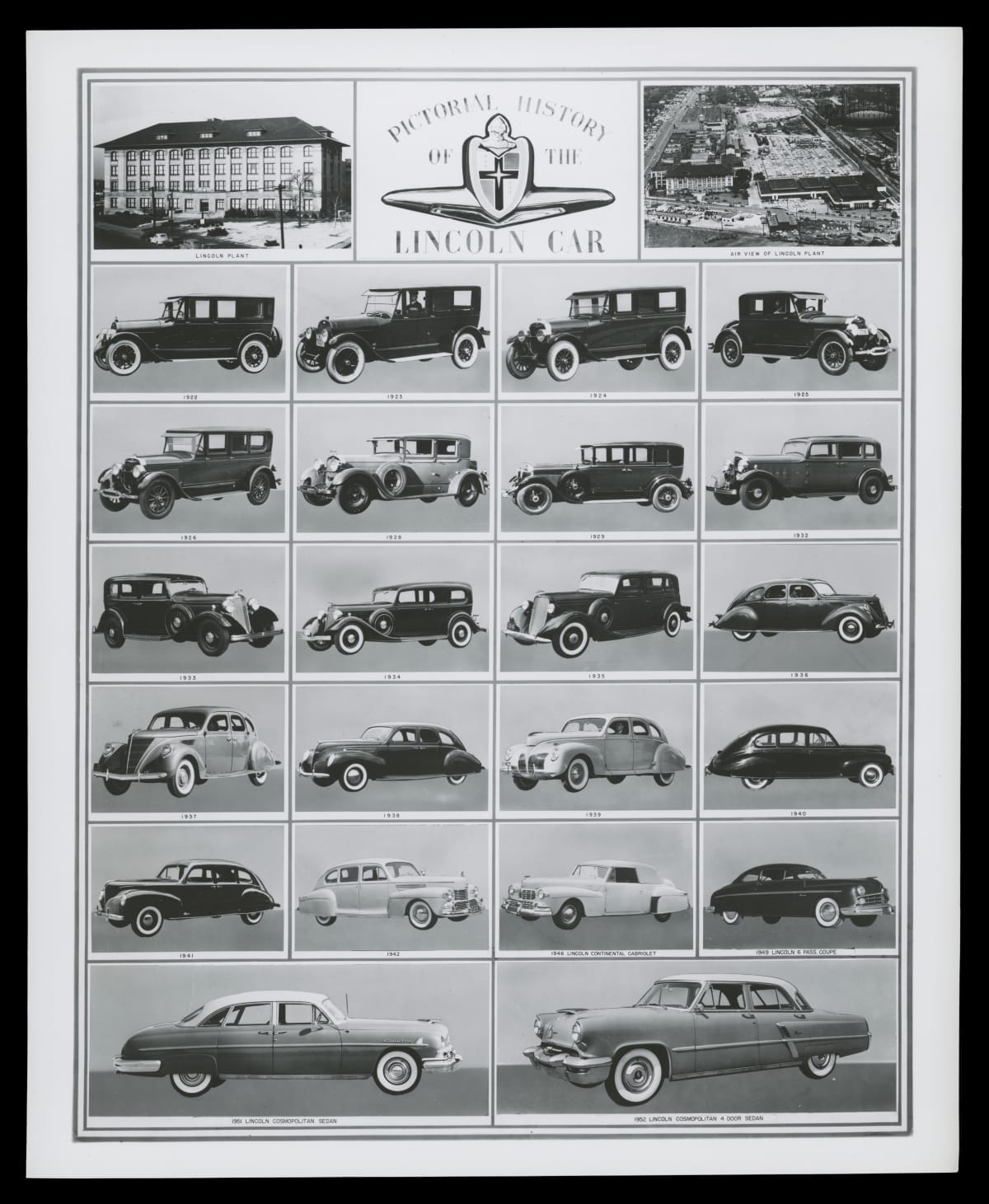
Thirty years of Lincoln styling are presented in this poster, from the company's early designs under Henry Leland and Wilfred Leland, to the marque's renaissance under Edsel Ford, to its first post-World War II models. Lincoln endured bankruptcy, depression and two world wars in those first decades. But it also built automobiles that still inspire enthusiasts today.
View Artifact

