
Safety
Share
share
Early automobile safety efforts often focused more on creating better drivers than on building better cars. Though manufacturers introduced safety improvements, buyers generally weren’t interested in paying for them. Gradually, Americans began to accept increasing safety regulations, and today’s consumers demand safe vehicles.
THF103564
Traffic Policeman Standing in Intersection with Stop Sign, Detroit, Michigan, circa 1920
Before traffic lights, policemen used hand-operated devices called semaphores to regulate traffic. Officers blew a warning whistle before changing signals. The officer in this circa 1920 photograph controls traffic near the Hotel Pontchartrain in Detroit, Michigan.
View ArtifactTHF205600
Bound Volume of Magazine, "Motor," October-December 1920
Motor magazine was filled with useful information for car owners. Inside is an ad for a device that fit over a car's rear tail lamp to let drivers indicate whether they were going to turn left or right, drive forward -- or stop. Most drivers depended on hand signals in 1920 -- hard to see at night. This device made nighttime driving safer.
View ArtifactTHF151126
First Tri-Color, Four-Directional Traffic Signal, 1920
Detroit traffic officer William Potts created this three-color, four-way traffic signal in 1920. Previous illuminated signals used only red and green lights. The addition of an amber "caution" light made driving safer and the three-color signal became the standard by the mid-1930s. This first traffic light was installed at Woodward Avenue and Fort Street in Detroit, Michigan.
View ArtifactTHF151486
First Prize Float Trophy Presented to Ford Motor Company, 1924
Automobiles made city streets more dangerous to pedestrians and playing children. In the 1910s and 20s, urban safety committees sponsored "Safety Week" events to promote accident-free streets. These educational campaigns included speeches, slogans, banners and parades. Ford Motor Company won this trophy -- first prize -- for their entry in Detroit's 1924 Safety parade.
View ArtifactTHF207416
Magazine, "Motor," January 1924
Motor magazine was filled with useful information for car owners. In this issue is an ad for the "Safe-T-Arm," a device to help drivers indicate whether they were going to turn left or right, drive forward -- or stop. It was one of many signaling systems on the market. In the early 1920s, hand or mechanical signals were not legally required of drivers!
View ArtifactTHF102570
Child's Car Seat, 1925-1935
Children usually roamed free in moving vehicles in the early years of the automobile travel. Restraints, if any, were for the convenience of the parent. This child car seat from around 1930 kept the child seated and within view of mother or father. It offered little protection during an accident.
View ArtifactTHF207354
Advertisement for 1926 Stutz, "Safety, Comfort, Performance Assured as Never Before"
The 1926 Stutz sedan was much lower to the ground than previous models, giving the car a lower center of gravity that helped prevent skidding and tipping over. The "Safety Stutz" also had a wire-glass windshield, an early kind of safety glass, and hydraulic brakes that made stopping easier.
View ArtifactTHF136471
Ford Model A with Broken Windshield, 1931
An early safety feature adopted by car manufacturers was laminated safety glass. Introduced in the late 1920s, laminated safety glass kept glass shards in place after impact. This 1931 photograph shows the shattered laminated windshield of a Ford Model A.
View ArtifactTHF106483
1935 Chrysler Airflow Advertisement, "Yes, Son, You're Safe in a Bridgework of Steel"
Ways of protecting child passengers have changed. In this 1935 Chrysler ad, children and passenger are not restrained with seatbelts or safety seats. Protection, according to the ad, comes from "a bridgework of steel." Today, children travel securely strapped into well-anchored and cushioned car seats and are much safer -- even when daddy speeds smoothly along at sixty miles per hour.
View ArtifactTHF103529
Ford Good Drivers League Publication, "How to Become a Skilled Driver," 1940
Ford Motor Company promoted safe driving skills by sponsoring the Ford Good Drivers League. The League, established in 1940, initially invited high school-aged boys throughout the country to participate--the League extended its invitation to girls the following year. After contestants signed up, they received a copy of How to Become a Skilled Driver.
View ArtifactTHF103531
Edsel Ford Presenting a Good Drivers League Award at the New York World's Fair, 1940
In 1940, Ford Motor Company sponsored a Good Drivers League program for high school boys. Members received the book, "How to Become a Skilled Driver." Some participated in safe driving competitions at the state and national level. Here, Edsel Ford presents Jimmie Hymer, Arizona's champ, with a trophy and a $2000 scholarship. In 1941, girls were among the League's 172,000 drivers.
View ArtifactTHF205530
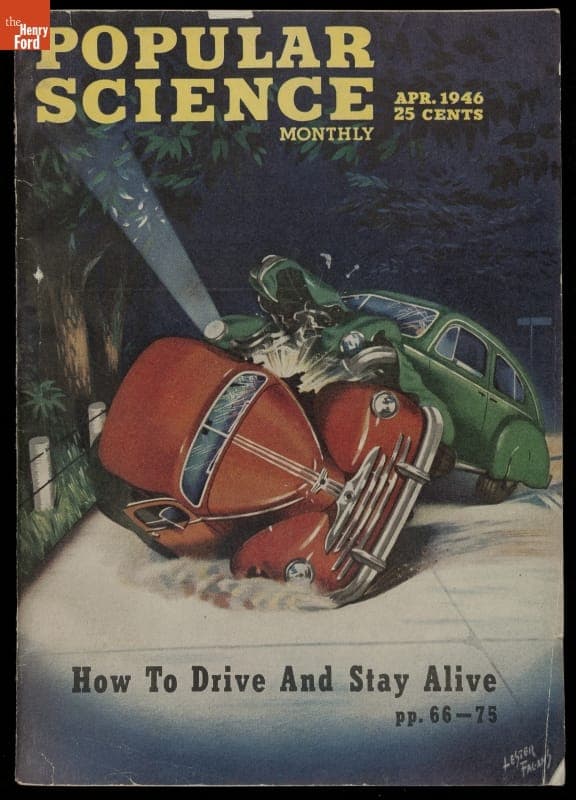
"Popular Science," April 1946
Popular Science provided information about scientific and technological advancements. In the early 1900s articles about the automobile -- and its driver -- became commonplace in the monthly's pages. Editors included a series of articles on automobile safety in this April 1946 issue. In one article, readers could test their knowledge of safe driving.
View ArtifactTHF208051
Emily Post's "Motor Manners, the Bluebooklet of Traffic Etiquette," 1949
Can good manners make safe drivers? The National Highway Users Conference, an industry-based organization supporting good roads and highways, hoped so. In 1949, the organization called on Emily Post to provide etiquette tips to automobile users. Motor Manners provided guidelines for the courteous and safe driver as well as respectful passengers.
View ArtifactTHF153485
Automobile Club of Michigan Safety Patrol Armband, 1950-1960
In 1920, the American Automobile Association (AAA) launched a safety program to protect school children from traffic dangers. School-aged patrollers, under adult supervision, wear belts and badges and help their classmates make it safely to school. In the decades after the Second World War, Michigan student patrollers wore armbands similar to this one.
View ArtifactTHF130332
"Automobile Crash Safety Research," 1953
The Cornell Aeronautical Laboratory did some of the earliest crash testing in the country -- first with airplanes during World War II, then cars. It collected data using electronic instruments and high-speed movie cameras and analyzed the crashes in slow motion. This 1953 report sponsored by Liberty Mutual Insurance Company illustrates some of their findings.
View ArtifactTHF200893
Jane Russell Demonstrating Use of Car Safety Belts, 1953
In the early 1950s, crash testing proved that seat belt use could prevent injury or death during automobile accidents. Indiana State Police officers used this photograph of actress Jane Russell in a presentation to persuade drivers and passengers to use safety belts. But Americans were stubborn. Even after seat belts became standard equipment in automobiles in the mid-1960s, most Americans refused to use them.
View ArtifactTHF729605
1956 Ford Ad, "You'll Be Safer in a '56 Ford!"
The Ford Motor Company drew on testing data to develop innovative safety features on its 1956 models. This advertisement illustrates the "Lifeguard designs" available in the new Fords. However, selling safety in 1956 did not mean increased car sales. Many in the auto industry concluded that "Safety doesn't sell."
View ArtifactTHF90867
1957 Cornell-Liberty Safety Car
Cornell Aeronautical Labs did some of the first crash testing of automobiles. In 1957 Cornell teamed with Liberty Mutual Insurance to build this unusual looking concept car that incorporated the lessons learned in testing. The car did not actually run, but it featured ideas like seat belts, head rests, and padded interiors that are incorporated into today's cars.
View ArtifactTHF103560
Young Boy Sitting in a Car Seat Equipped with a Toy Steering Wheel, Pittsburgh, Pennsylvania, 1961
The child in this car seat has his own steering wheel to occupy his time while on the road. This unanchored car seat from the early 1960s, however, offered little protection in case of an accident.
View ArtifactTHF103437
Automobile Seat Belt, 1964
Until the mid-1960s seat belts were not standard equipment in American cars. Owners could purchase aftermarket safety belts like this one and have them installed. Continued education and growing acceptance for car occupants' safety have led most states to adopt seat belt laws.
View ArtifactTHF206426
"Unsafe at Any Speed," 1965
Unsafe at Any Speed, Ralph Nader's bestselling 1965 book, exposed potential driving dangers with American cars and shed light on the auto manufacturers' resistance to improving safety. The book sparked consumer advocates to work on government legislation to regulate the industry and provide safer vehicles. It also helped convince many Americans about the importance of vehicle safety.
View ArtifactTHF207350
Children's Safety Village, Tampa, Florida, 1966
Tampa's "Safety Village" was a unique experiment in preventive safety for children. Long before they were old enough to ask for the keys to the family car, these children practiced traffic safety by driving small electric-powered cars on child-sized streets. Hopefully, they would remember these lessons a few years later, as teens at the wheel of their own cars.
View ArtifactTHF201739
"We Can't be There to Close Your Door... But We Can Do the Next Best Thing..." Ford Motor Company Advertising Proof, 1967
For years it was a common belief among automakers that "safety didn't sell." Customers were more interested in performance and comfort than protection. In the 1960s, attitudes were changing. This 1967 ad from Ford promotes a warning light that alerts drivers when a car door isn't closed. It was one of several features designed to keep the vehicle's occupants safe.
View ArtifactTHF202166
"Bring 'em Back Alive!" Display Sign, Automobile Association of Michigan, circa 1970
Concerned about the increasing number of highway accidents, the American Automobile Club of Michigan began its "Bring 'em Back Alive" campaign in 1961 aimed at driver safety during the summer holidays. The Automobile Club produced bumper stickers and posters with the slogan, then expanded to billboards, newspaper ads, radio jingles, and a Holiday News Service that broadcasted up-to-the-minute traffic reports.
View ArtifactTHF140492
Ford Motor Company's Tot-Guard Car Seat, 1973
American car manufacturers developed child restraints designed for crash protection in the late 1960s. One of the first was Ford's Tot-Guard, seen in this photograph. The seatbelt secured the padded shield and seat. This early and effective restraint was not widely used, however. Only with more stringent regulations, public education, and mandated use would children safely ride in automobiles.
View ArtifactTHF207352
1984 General Motors Advertisement, "Safety is a Full-Time Job"
General Motors workers like Mary Ann Sanford spent each day making over 20 critical checks on seat belt systems in GM cars after they rolled off the line. Yet many Americans still didn't use these lifesaving devices -- "buckling up" wasn't yet mandatory in most states.
View ArtifactTHF150709
Mothers Against Drunk Driving Key Ring, 1980-1995
Mothers Against Drunk Driving (MADD) helped change American attitudes about drunk driving. Formed in 1980, MADD advocates for traffic safety and victim's rights legislation. Their efforts helped push down drunk driving-related traffic deaths. Backers of MADD show their support by using materials, like this keychain, promoting the organization and its mission.
View ArtifactTHF102581
Fisher-Price Infant Car Seat, 1991
Fisher-Price produced this infant safety seat in 1991. It provided security for the infant while in the car, but also provided convenience for the parent. The seat doubled as an infant carrier. The baby could be transported comfortably and securely in or out of a car with this seat.
View ArtifactTHF103535
1992 Buick LeSabre Ad, "Safety is Standard Equipment"
When safety sells, auto manufacturers incorporate new safety feature and trumpet their successes. This ad for the 1993 Buick LeSabre highlighted the car's standard equipment that keeps drivers and passengers safe.
View ArtifactTHF103430
Continental Teves' Five-millionth Electronic Stability Control Module, 2002
Modern cars contain electronic devices and microprocessors to help drivers safely operate their vehicles. One such device is an electronic stability program unit. The unit uses computers, sensors and other car safety features to help control the car though sudden turns and stops, and to help prevent rollovers. Continental Teves, Inc., manufactured this five-millionth module in 2002.
View ArtifactTHF92108
Timeline, "45+ Years of Highway Safety," 2011
In 1966, America got serious about highway safety. Congress held a series of highly publicized hearings, made seat belts mandatory, and created the Department of Transportation. In 1970, the National Highway Traffic Safety Administration (NHTSA) was born. NHTSA's timeline banner provides a look at the highway safety milestones achieved by federal and state agencies -- and grassroots America -- since the mid-1960s.
View Artifact

