
Henry Ford: Soybeans
Share
share
This Expert Set was compiled in 2013 to commemorate the 150th anniversary of Henry Ford’s birth.
THF728456
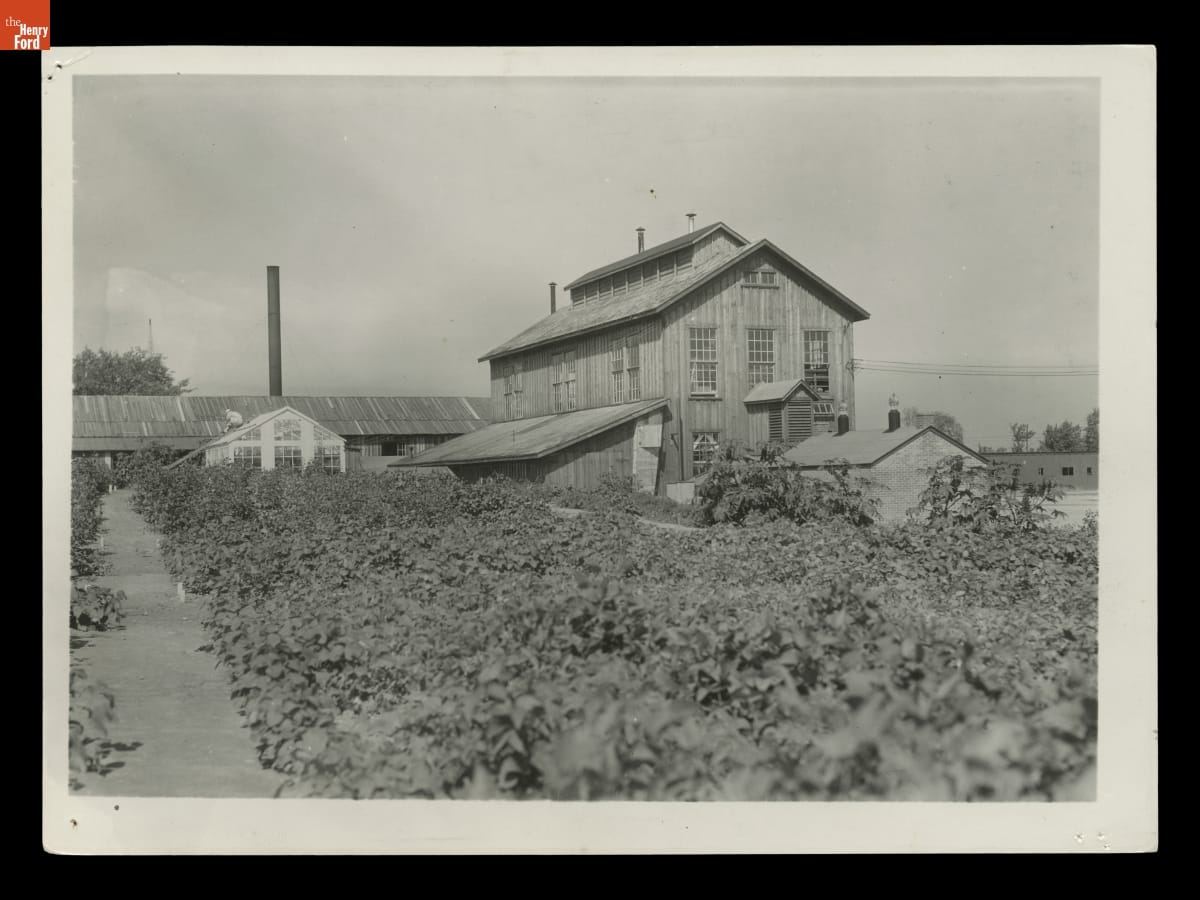
Soybean Experimental Laboratory in Greenfield Village, circa 1933
Henry Ford believed that industry and agriculture should complement one another. In the 1930s, he pursued soybeans as a crop that might unite the two. Ford built a soybean laboratory in Greenfield Village. Experiments there led to the use of some soy-based oils and plastics in Ford Motor Company vehicles.
View ArtifactHenry Ford Hitting Soybean Plastic Trunk with an Axe, 1940
Henry Ford hoped that plastic made from soybeans might be developed into a strong, safe substitute for traditional metals. He established a laboratory where scientists molded ground soybean meal into small plastic car parts. Here, Ford swings an ax at a plastic trunk lid -- mounted to his personal car -- to demonstrate the material's strength.
View ArtifactAdvertisement for Ford Motor Company, "1st to 'Grow' Automobile Parts on the Farm," 1946
Featuring company founder Henry Ford, this national advertising campaign includes views that he promoted beginning in early 1928: "Transforming Crops into Motor Car Materials, to Benefit Car Owner and Farmer Alike." In 1931, Henry Ford decided to experiment with soybeans, and by 1933 produced oil for paints and molded ground meal into small plastic car parts, like gear shift knobs.
View ArtifactModel of Soybean Oil Extractor, circa 1935
Henry Ford had a vision of farmers being part of the industrial process -- an idea he called "chemurgy." This idea was most completely played out in his experimentation with soybeans, a versatile crop that could be used for industrial products as well as food. This model demonstrates how oil could be extracted from soybeans and converted into many plastic-like products.
View ArtifactSoybean Lab Agricultural Gallery
Constructed in Greenfield Village, this building was an experimental soybean research laboratory during the 1930s. Henry Ford was looking for ways that farmers could use crops for industrial purposes, especially in the manufacture of car parts. Special equipment was designed here to process soybeans into oil and meal. Today, this building houses agricultural implements from the museum's collections.
View ArtifactCentury of Progress Souvenir Specimen Box of Materials Used in Ford Automobile Manufacture, 1934
Ford Motor Company mounted the most talked-about exhibition in Chicago during the World's Fair in 1934. One highlight of the Ford Exposition building was "Out of the Earth" -- a series of dioramas showing the major resources used in automotive production. Visitors could return home with souvenir boxes that contained samples of some of these natural materials.
View ArtifactFord Souvenir Salt & Pepper Set From Texas Centennial Exposition, 1936
Scientists at Ford's Soybean Laboratory developed a variety of plastic products made from soybean solids left when the oil was extracted, including gear shift knobs. These soybean gear shift knobs were converted into a set of souvenir salt and pepper shakers for the 1936 Texas Centennial Exposition.
View ArtifactSoybean Farm Diorama, Ford Exhibition Building, Century of Progress International Exposition, Chicago, Illinois, 1934
Chicago's 1933-34 Century of Progress Exposition used the theme of progress to encourage optimism during the Depression. The Ford Exhibition Building, which sat on eleven acres at the fair and featured industrial demonstrations and informative displays like this, became the most talked-about exhibit of 1934.
View ArtifactMenu of Soybean Dinner Served at Ford Exhibit, Century of Progress, August 17, 1934
Ford Motor Company's exhibition at Chicago's 1933-34 Century of Progress Exposition included the industrial barn. Here, exhibitions and demonstrations illustrated Henry Ford's belief that soybeans could unify agriculture and industry, building more profitable farms. A special dinner held on August 17, 1934, showcased the crop's wide-ranging culinary potential.
View ArtifactPresenting the Soybean Extractor, Texas Centennial Central Exposition, Dallas, Texas, 1936
Ford promoted soybeans at the World Fairs and Exposition of the 1930s. In this image, a presenter at the Texas Centennial Exposition demonstrates how the soybean extraction process works with a model of a soybean extractor.
View ArtifactSoybean Laboratory in Greenfield Village, 1930
Henry Ford believed that industry and agriculture should complement one another. In the 1930s, he pursued soybeans as a crop that might unite the two. Ford built a soybean laboratory in Greenfield Village. Experiments there led to the use of some soy-based oils and plastics in Ford Motor Company vehicles.
View ArtifactSouvenir Card, "Industrial Products Made from Soy Beans," circa 1934
Starting in 1931, Henry Ford invested much money and research into soybeans. He viewed the crop as a bridge between agriculture and industry. Based on this work, soy-based materials were incorporated into Ford Motor Company vehicles. Soybean oil was used in body enamels, for example, while soy meal was used in the plastic for gear shift knobs and horn buttons.
View ArtifactRobert Boyer and Henry Ford in the Soybean Laboratory, Greenfield Village, 1936
Chemist Robert Boyer, pictured here with Henry Ford, oversaw a series of experiments at Greenfield Village's Soybean Laboratory. The undertaking resulted in a plastic-bodied car. Henry Ford had a strong interest in plastic automobile parts. Always partial to projects combining industry with agriculture, Ford hoped plastic made from soybeans might be developed into a safe, strong substitute for traditional metals.
View ArtifactBooklet, "The Industrialized American Barn," 1934
Henry Ford moved the William Ford barn from Dearborn to the 1934 Century of Progress Exposition in Chicago to demonstrate how soybeans could be processed for industrial uses in an ordinary American barn. Ford published this booklet to explain the process, and how it could create a better future for the American farmer.
View ArtifactAdvertisement for the 1935 Ford, "We Paint Cars with Soy Beans"
Starting in 1931, Henry Ford invested much money and research into soybeans. He viewed the crop as a bridge between agriculture and industry, and he used soybean oil and soybean-based plastics in Ford Motor Company vehicles. Ford built a concept car with a complete soybean-plastic body in 1941, but World War II halted further development.
View Artifact

