
Curators' Choice: American Democracy & Civil Rights
Share
share
Curators' picks: American Democracy & Civil Rights
THF13451
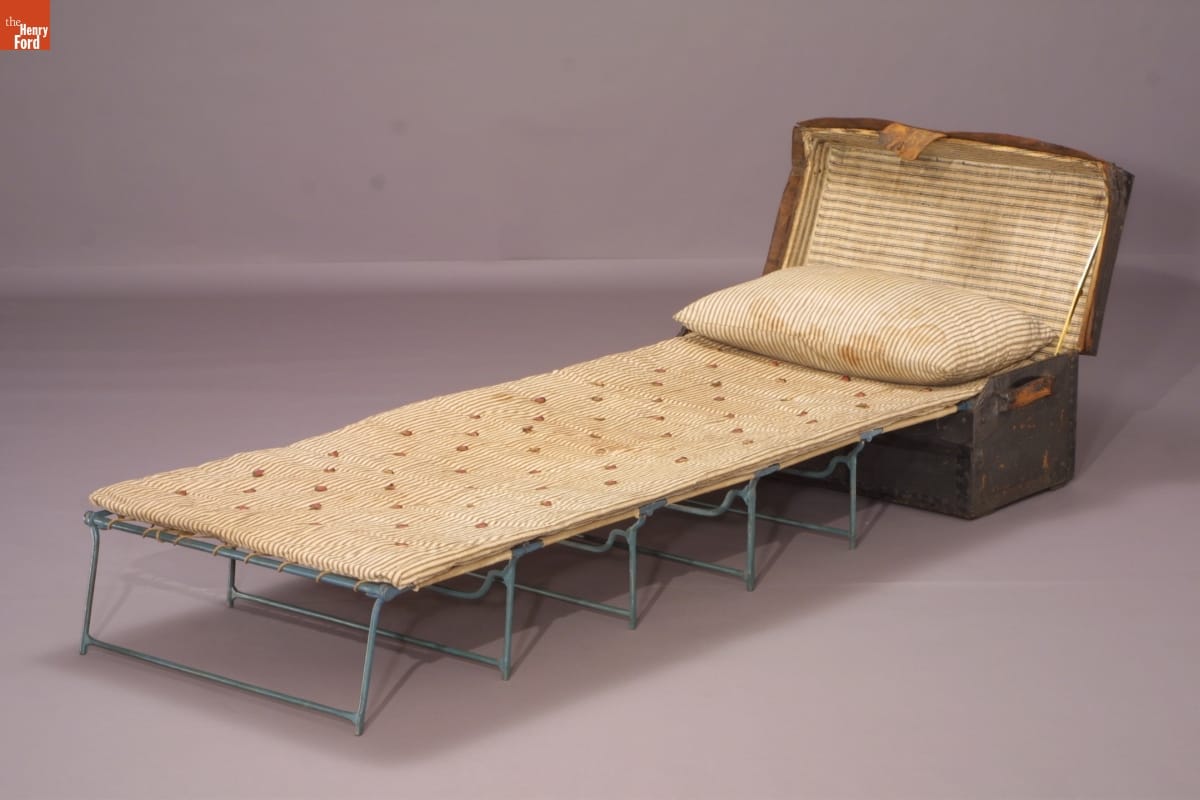
George Washington's Camp Bed, 1775-1780
George Washington carried folding beds, tents, eating utensils, and other equipment to use while encamped on the field with his troops during the Revolutionary War. Washington likely used this bed when he traveled from his Newburgh, New York, headquarters in July 1783 -- as the war was winding down -- to tour upstate New York and the military installations located there.
View ArtifactEngraved Copy of the 1776 Declaration of Independence, Commissioned by John Quincy Adams, Printed 1823
This is an exact, precise facsimile of one of America's greatest documents. It is one of two hundred copies commissioned by Secretary of State John Quincy Adams in 1820. It is an engraving made from the original document. Two copies each were given to the surviving signers and the rest distributed to Congress, state governments and colleges and universities.
View ArtifactRocking Chair Used by Abraham Lincoln at Ford's Theater the Night of His Assassination, April 14, 1865
President Abraham Lincoln was sitting in this rocking chair during a production of Our American Cousin at Ford's Theatre in Washington, D.C., when he was assassinated on April 14, 1865. Henry Ford purchased the chair in 1929 for the Museum, where it remains one of the most revered objects associated with the "man who saved the Union."
View ArtifactJoint Resolution of the United States Congress, Proposing the 13th Amendment to Abolish Slavery, 1865
The 13th Amendment to the Constitution, not the Emancipation Proclamation, formally abolished slavery in the United States, settling the issue which had long plagued the nation. Congress adopted the Amendment in January 1865 and sent it to states, which ratified it in December. The word "Duplicate" at the top of this document indicates the bill had been passed by Congress but had not yet been ratified.
View ArtifactSpeaker's Chair Used in the United States House of Representatives in Philadelphia, 1790-1795
This chair was made in the early 1790s for either the Speaker of the U.S. House of Representatives or the President of the U.S. Senate, both bodies then located in Philadelphia. We believe that it was later used by the U.S. Supreme Court, along with three similar chairs, now at the Independence National Historical Park, Philadelphia.
View ArtifactEngraving, "The Bloody Massacre Perpetrated in King-Street, Boston on March 5th, 1770"
American patriot Paul Revere engraved, printed, and sold this graphic depiction. British troops were sent to Boston to regain control over the rebels. But townspeople resented their presence. One day, mischief-makers hurled insults and snowballs at the soldiers, who panicked and fired into the crowd. Five innocent people were killed, several others wounded. This widely publicized incident made colonists furious.
View Artifact"Credit Sale of Valuable Slaves! by Julian Neville, Auctioneer," New Orleans, Louisiana, circa 1850
The wealth and power of Southern plantation owners depended upon a large labor force of enslaved people -- especially when cotton became "king" in the Deep South during the 1800s. They justified their actions by considering enslaved people to be mere pieces of property. New Orleans became a major slave auction center after about 1820.
View Artifact1961 Lincoln Continental Presidential Limousine Used by John F. Kennedy
President John F. Kennedy was assassinated in this car on November 22, 1963. The midnight blue, un-armored convertible was rebuilt with a permanent roof, titanium armor plating, and more somber black paint. The limousine returned to the White House and remained in service until 1977. The modified car shows the fundamental ways in which presidential security changed after Kennedy's death.
View ArtifactLouisville and Nashville Railroad Restroom Sign, 1929
From the late 19th through the mid-20th centuries, segregation laws in Southern states separated African Americans and whites in almost every aspect of public life -- from railroad cars and schools to restrooms and drinking fountains. Varying from state to state, these laws were supposed to establish facilities that were "separate but equal." In reality, these were almost never equal.
View ArtifactSlave Hire Badge for Mechanic, 1850
Slave hire badges were worn by enslaved African Americans whose owners hired them out to work for other people. Their wages went back to the owner. Badges were used to identify individuals in Savannah, Georgia; Charleston, South Carolina; Mobile, Alabama; and New Orleans, Louisiana. This badge for a mechanic was issued in Charleston.
View ArtifactWorld War II Poster, "United We Win," 1943
During the Second World War, all of the national governments of the warring nations used poster campaigns to encourage civilian and military support of the war effort. The advertising technique of these posters followed the innovative style developed during the First World War. By appealing to the viewer's emotions this poster helped the U.S. to rally the home front workers and consumers.
View ArtifactPortrait of Frederick Douglass, circa 1860
Frederick Douglass, abolitionist and reform journalist, is shown in this portrait about the time that he advised President Lincoln regarding African Americans. Douglass became a leader in the anti-slavery movement when he spontaneously stood up and spoke at an abolitionist meeting in 1841. His gut-wrenching tales about life on the plantation in Maryland turned thousands of skeptical Americans into active abolitionists.
View ArtifactPoster, "The Women's Liberation Movement," 1970
Women had finally won the right to vote by 1919. But they still lacked equal rights with men. In 1923, Alice Paul drafted an Equal Rights Amendment. Revised and updated many times, no official amendment has been approved. For many women in 1970 this poster featuring the female symbol and raised fist conveyed their frustration with inequality.
View ArtifactPiece of Flag Used by the Corps d'Afrique, 79th Regiment, United States Colored Troops, 1861-1865
The Corps d'Afrique was a regiment of African-American soldiers created in June 1863, from three regiments of the recently formed Louisiana Native Guard. Although the men fought bravely, poor treatment by fellow Union soldiers and difficult field conditions contributed to the dissolution of this unit in April 1864. These fragments are said to be pieces of the Corps' regimental flag.
View ArtifactPrint Portfolio, "We Shall Overcome," 1963
More than 250,000 civil rights advocates showed up at the 1963 March on Washington for Jobs and Freedom. This souvenir portfolio held a group of photo collages, each incorporating fragments of disturbing images from the movement. The artist intended these to symbolize man's inhumanity to his fellow man. Civil Rights activists hoped that they would stir people's emotions and incite action.
View ArtifactRosa Parks Bus
Inside this bus on December 1, 1955, Rosa Parks, a soft-spoken African-American seamstress, refused to give up her seat to a white man, breaking existing segregation laws. The flawless character and quiet strength she exhibited successfully ignited action in others. For this, many believe Rosa Parks's act was the event that sparked the Civil Rights movement.
View ArtifactButton, "I Won't Live with Jim Crow: Civil Rights Congress," circa 1948
The term "Jim Crow" implied the systematic practice of discriminating against and segregating African Americans, especially in the American South, from the late 19th to the mid-20th centuries. The Civil Rights Congress (1946-1956) became a brief force in civil rights battles. However, with its ties to the American Communist Party, it became victim to Cold War anticommunism and government repression.
View ArtifactButton, March on Washington for Jobs and Freedom, 1963
More than 250,000 civil rights advocates showed up at this peaceful march to support unity, jobs, and a new Civil Rights bill being proposed by President Kennedy. Television viewers nationwide watched African Americans and whites march together, united behind a common cause. Songs and speeches at this march included Martin Luther King, Jr.'s famous "I Have a Dream" speech.
View ArtifactSigned Handbill, "I am Opposed to Woman's Suffrage," circa 1915
During the struggle for women's voting rights in the early 20th century, many men and some women strongly opposed the notion of women voting. These "anti-suffragists" argued that women were both physically and emotionally incapable of dealing with the strains of politics. The Miss Florence Hoagland who signed this card apparently agreed with these assessments.
View Artifact"American Anti-Slavery Almanac for 1840"
Beginning in the 1830s, some people began to speak out against slavery. Most of these "abolitionists" were white Northerners who had never actually come in contact with enslaved people. The abolitionist press, centered in northern states like New York and Massachusetts, produced and sold many almanacs that featured provocative cover illustrations depicting the brutality of slavery.
View Artifact"Common Sense; Addressed to the Inhabitants of America," February 1776
Thomas Paine had tried many different jobs in England, but jumped at the chance to work in the printing business over in the American colonies. And there he found his voice. Not being a politician, he had nothing to lose with his little pamphlet. Although he made them sound like just "common sense," his arguments for independence were extremely radical at the time.
View ArtifactAmerican Flag, "Mr. President, What Will You Do For Women's Suffrage?" circa 1916
Alice Paul, a woman's suffrage leader during the early 20th century, liked using extremist tactics. Among these was aiming strong messages directly at the President. In the midst of World War I, President Wilson found this negative publicity both distracting and embarrassing. As a war measure he supported an amendment for women's voting rights. Women achieved the vote in 1920.
View ArtifactMan Wearing Ku Klux Klan Robe and Hood, circa 1870
This is one of the earliest known images of members of the Ku Klux Klan, founded in 1866 as one of many Southern vigilante groups intent on maintaining "white supremacy." For a century after the Civil War, African Americans were free but not treated as equals. Some angry white citizens responded with violence.
View ArtifactLeg Shackles, 1840-1880
The wealth and power of Southern plantation owners depended upon a large labor force of enslaved people. They justified their actions by considering enslaved people to be mere pieces of property. These shackles, from a Georgia plantation, attest to the brutal treatment of enslaved African Americans.
View ArtifactButton, "Non-Violence is Our Strength," circa 1970
Cesar Chavez and Dolores Huerta founded the National Farm Workers Association in 1962. The organization later merged with the Agricultural Workers Organizing Committee to form the United Farm Workers (its logo is a stylized eagle seen on this button). Chavez died in 1993, and Huerta continued to serve as the Vice President until 1999.
View Artifact

