
Early Firefighting
Share
share
Fire was a constant menace to American cities well into the 20th century, when most buildings were made of wood and firefighting equipment was underpowered and overmatched. Firefighters risked their own lives to save those of others, to protect property, and to constrain and contain blazes before they grew into uncontrollable conflagrations. Early firefighting relied on mettle, muscle, and machinery that improved slowly but steadily over time.
THF226608
Portrait from a Drawing of Benjamin Franklin, 1860-1890
Benjamin Franklin is credited with establishing the first organized volunteer fire company in what would become the United States. Franklin formed Philadelphia's Union Fire Company in 1736. The company's initial firefighting equipment didn’t include much beyond leather buckets -- which members provided at their own expense.
View ArtifactFire Bucket, Used by Levi Huntington, circa 1795
For centuries, simple fire buckets were firefighters' most important tools. When a fire broke out, organized bucket brigades would pass water, in buckets, along a human chain from the water source to the fire. It required careful coordination to keep the buckets moving smoothly and, even in the best of circumstances, it wasn't terribly efficient.
View ArtifactFire Bucket, 1803
Many home and business owners in colonial and early America kept leather fire buckets in case of emergency. When a fire broke out in the community, owners tossed their buckets into the street, where firefighters and local citizens used them to carry water to put out the fire. Buckets decorated with names, initials and numbers helped owners identify their buckets after the fire had been extinguished.
View ArtifactHunneman Hand-drawn Fire Pumper, 1836
Mobile, hand-operated water pumps first appeared in the mid-1600s. This example is from 200 years later, but the basic technology is the same. The mechanical pump, or "fire engine," forced water under pressure through a hose, allowing firefighters to direct water more accurately and efficiently. Firefighters -- not horses -- pulled the pumper to the scene of a blaze.
View ArtifactMen Demonstrating 1840 Fire Engine and 1830-1880 Hose Carriage, circa 1930
These five firefighters, photographed around 1930, demonstrated the operation of a hand-pumped fire engine from nearly a century earlier. In reality, as many as 20 people would have pushed on the long bars -- called brakes -- to work the pump. Under ideal conditions, the engine might have pumped more than 75 gallons of water per minute.
View ArtifactFire Hose Nozzle with Coupler
Firefighters use hoses fitted with nozzles to douse destructive flames. Early nozzles, like this brass one, created a simple, straight stream of water. Improvements in nozzle design since the mid-1900s have controlled water flow and pressure -- optimizing a water stream's velocity and reach -- and created new dispersal patterns to help put out the fire.
View ArtifactFire Hat, Worn by Lieutenant Frank J. Dewey, circa 1872
No piece of equipment symbolizes a firefighter's dangerous work like the fire helmet. Its hard shell protects from falling debris, and its oversized brim directs water away from the neck. Early helmets were made from leather, while later versions featured metal shells. Modern helmets use lightweight composite materials, but they retain the familiar shape.
View ArtifactFire Trumpet, 1840-1900
Firefighters used trumpets as megaphones to amplify their voices when shouting instructions during a fire. Clear directions were vital to ensure safety and to keep firefighters working efficiently as a team. Over time, trumpets took on a symbolic meaning for fire departments. Special presentation trumpets were created and awarded to honor firefighters' service or achievements.
View ArtifactLithograph, "The American Fireman. Always Ready," 1858
The firefighter became -- and remains -- a heroic symbol of bravery and devotion to duty. Artist Louis Maurer created a series of four prints that celebrated "The American Fireman" in 1858. Maurer's scenes were based on his personal observations of volunteer firefighters at work in New York City.
View ArtifactLithograph, "The American Fireman, Rushing to the Conflict," 1858
In the first half of the 19th century, American fire companies were strictly volunteer outfits. Money for operations and equipment largely came from payouts issued by insurers. In larger cities, fire companies, in effect, competed against each other to be first on the scene of a blaze -- so that they might claim the payout.
View ArtifactLithograph, "The American Fireman, Facing the Enemy" 1858
Cincinnati, Ohio, established the country's first full-time, professional paid fire department in 1853. Other communities followed and, by the close of the 1870s, most American cities had at least one municipally funded fire department staffed by full-time firefighters. Smaller towns continued to rely on volunteer firefighters.
View ArtifactLithograph, "The American Fireman, Prompt to the Rescue," 1858
Even today, the majority of firefighters in the United States are volunteers. They are highly trained professionals, to be sure, but they serve their communities on a volunteer basis. The voluntary nature of the work is as much responsible for the firefighter's heroic image as the danger inherent to the job.
View ArtifactLithograph, Detroit Firemen's Fund Association Membership Certificate Issued to G.W. Kahn, October 17, 1912
Given their dangerous work, firefighters worried about the care of their spouses and children in the event of a fatal accident or a debilitating injury in the line of duty. They formed associations to provide relief funds to affected families. Firefighters' funds were financed by association membership dues, special fundraising activities, and charitable donations.
View ArtifactHorse-Drawn Steam Fire Engine, circa 1876
Steam power brought greater efficiency and power to fire engine water pumps in the mid-19th century. This unit delivered between 550 and 600 gallons of water a minute and needed just four people to operate it. But steam engines were expensive to purchase, and the heavy machines required horses to pull them.
View ArtifactWood Engraving, Suspended Harness, circa 1884
Horses brought their own expenses and complications. In a fire emergency, every second counts. Fire departments and manufacturers of firefighting gear developed systems to harness horses to equipment as quickly as possible. This illustration shows a harness suspended from the ceiling, where it could be lowered onto a horse swiftly when needed.
View Artifact"Lapeer's 2 Minute Fire Department," 1909
Firefighters prided themselves on the fast response times of their departments. In a fire emergency, every second could mean the difference between life and death. This postcard shows firefighters and equipment of the Lapeer, Michigan, fire department. The caption boasted of the department's quick two-minute response time.
View ArtifactThomas Shaw of the Alert Hose Company, Big Rapids, Michigan, 1877
Firefighters tested their skills against other fire departments at various regional, state, and national tournaments. They competed in hose cart races, ladder competitions, and water pumping contests, among other activities. The tournaments were good fun, but they also sharpened critical skills. Thomas Shaw, of the Alert Hose Company of Big Rapids, Michigan, was photographed wearing his competition uniform in 1877.
View Artifact"Phoenix Fire Engine No. 3 of Detroit as it Appeared in the Funeral Procession of the Late President Lincoln," April 25, 1865
Firefighters didn't just represent valor. They were symbols of the very communities they served. Fire departments regularly participated in parades, festivals, and civic events. Some fire departments organized bands that performed regular concerts. Firefighters also participated in more somber ceremonies, like this procession in Detroit to mark the death of President Abraham Lincoln in 1865.
View ArtifactFireman's Dress Parade Uniform, 1890-1925
Firefighters wore protective turnout gear when responding to fires. But, for civic occasions and ceremonies, many departments also issued dress uniforms like this one. Some fire department uniforms took inspiration from military clothing, while others favored durable fabrics with loose cuts. Red was the most popular color choice throughout the 19th century.
View ArtifactFirefighters at Scene of Fire after San Francisco Earthquake, 1906
Many American cities suffered a "Great Fire" in the 19th and early 20th centuries, and some endured more than one. Detroit burned in 1805, New York in 1835, Chicago in 1871, Boston in 1872, and Baltimore in 1904 -- to name only a few. San Francisco experienced massive fires following damage to gas lines in the catastrophic earthquake of 1906.
View ArtifactTrade Card for The World's Inn at the World's Columbian Exposition, Chicago, Illinois, circa 1893
Fireproof buildings of stone, brick, iron, or steel spread through the 19th century. But "fireproof" often only meant that the building would not suffer a total loss in a fire. Interiors could still be damaged and lives could still be lost. Fire alarms, sprinkler systems, and clear fire exits took time to be widely adopted or required by building codes.
View ArtifactFire Extinguisher, circa 1959
Pressurized fire extinguishers, introduced in the mid-19th century, provided additional fire protection. They propelled fire-suppressing chemicals using compressed gas and, when used properly, the extinguishers could stop a small fire before it grew into something more dangerous. Later improved designs, like this one, used less-toxic chemicals, or specific chemicals effective against certain types of fires.
View Artifact"High Pressure in Action," 1911
As buildings grew taller, firefighters faced greater difficulties battling fires on upper floors. By the early 20th century, higher-pressure pumpers, hydrants, and hoses could shoot water 40 or 50 feet into the air. But, as structures climbed beyond that, firefighters increasingly depended on a building's own internal fire protection systems.
View ArtifactMovie Poster, "The Still Alarm," 1926
Firefighters and their dramatic work quickly became popular subjects for motion pictures. In 1926, Universal Pictures released The Still Alarm directed by Edward Laemmle and based on a stage play first produced in 1887. The film adaptation starred Helene Chadwick and William Russell.
View ArtifactMack Model AB Hook and Ladder Fire Truck in Use by the Plainfield New Jersey Fire Department, 1911-1916
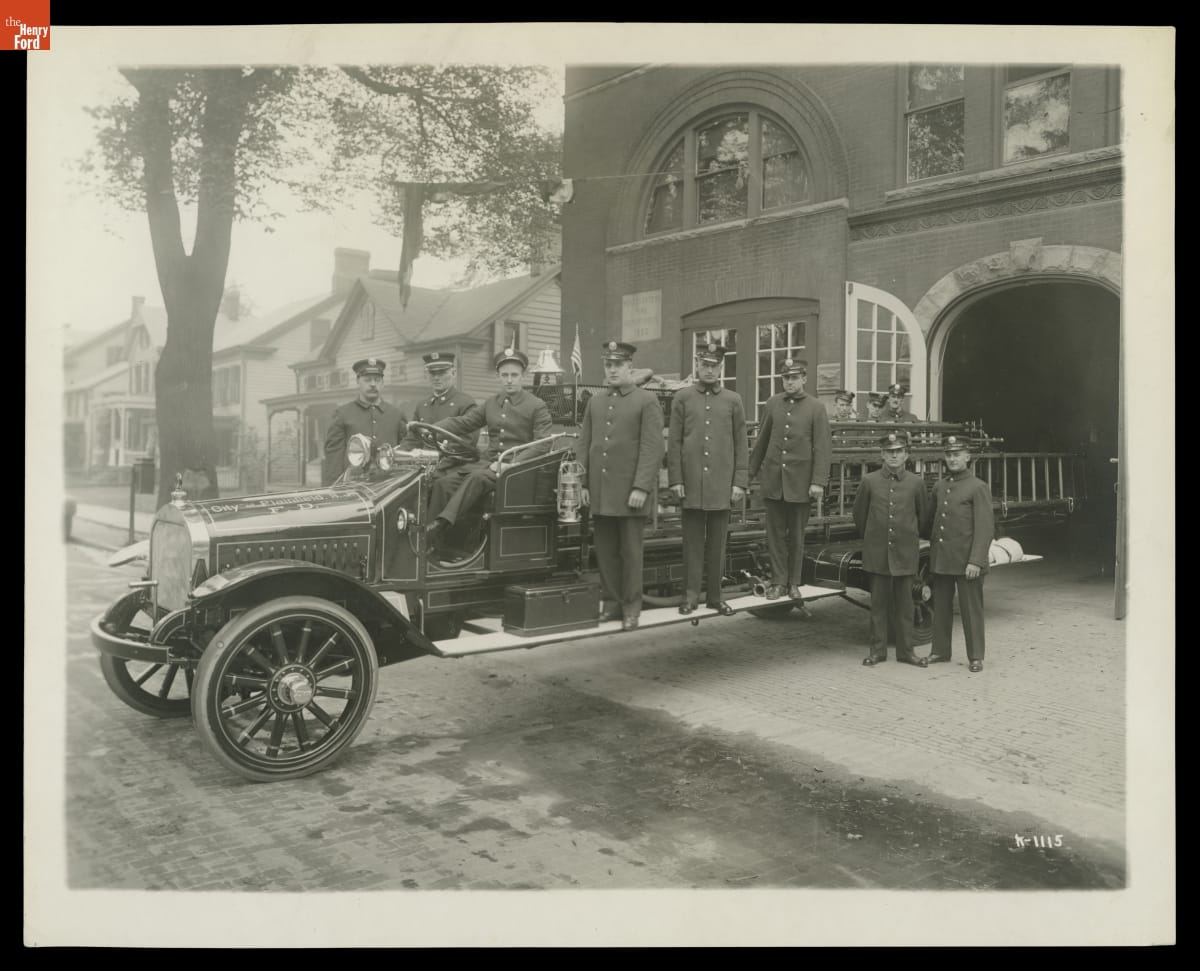
Internal combustion engines and motor vehicles brought greater efficiency to fire departments in the early 20th century. Motorized fire trucks eliminated the cost and difficulty of horses, and they shortened response times. Fire trucks could carry water and pumps powered by the truck's own engine, or they could transport equipment like hoses, axes, hooks, and ladders.
View ArtifactAdvertisement for Mack Trucks, "No Time to Gamble...," 1944
Motorized firefighting equipment was available in multiple forms from many sources. Some manufacturers built the whole truck -- chassis, engine, fire apparatus -- in-house, while others modified basic truck chassis supplied by outside builders. Mack Trucks produced its first firefighting equipment around 1911. Mack stopped building complete trucks in 1990, but the company's chassis continued to be used by other manufacturers.
View ArtifactFord Highland Park Fire Department, October 20, 1919
Fire was a constant threat to factories and industrial facilities. Large plants often operated their own fire departments to protect from the danger. Ford Motor Company maintained a fire department at its Highland Park plant near Detroit, Michigan. Naturally, Ford's department used Model T fire trucks.
View Artifact1924 Seagrave Pumper Fire Engine
Seagrave, a specialty manufacturer in Columbus, Ohio, built this pumper truck. Its 130-horsepower engine not only powered the truck, it powered the integrated water pump. The truck could pump up to 750 gallons of water per minute. The water was drawn from a municipal fire hydrant, a separate tanker truck, or -- if necessary and available -- a nearby pond or lake.
View Artifact1927 Ahrens-Fox Model MX-4 Pumper Fire Engine
Pumper trucks from the Ahrens-Fox Fire Engine Company of Cincinnati, Ohio, were distinguished by front-mounted pumps topped with large chrome balls. Air in that ball-shaped chamber smoothed out the pulses of water delivered by the piston pump. The ball also led to an unusual complaint from some drivers: excessive glare from sunlight glinting off the shiny sphere.
View Artifact1926 Ford Model T Fire Truck
Though they saved money over the long run, motorized fire trucks were expensive to purchase. Fire departments with modest budgets favored fire trucks based on the Ford Model T. Pumpers, tankers, and equipment trucks built on affordable, adaptable Model T and TT chassis were mainstays in small-town fire departments across the United States.
View ArtifactAmerican-LaFrance and Foamite Corporation Catalog, "The Metropolitan: The World's Finest Fire Engine!," 1938
American LaFrance was formed in 1873 to produce hand-powered firefighting equipment. The company built its first motorized fire apparatus in 1907. American LaFrance grew into one of the largest manufacturers of fire engines and emergency vehicles in the United States and -- under the Foamite name -- Canada. After several changes in ownership, American LaFrance ended operations in 2014.
View ArtifactProposed "Fire Hall" Exhibit for Henry Ford Museum, Staged in Ford Motor Company Engineering Laboratory, December 1930
Firefighting equipment was an early focus of collecting efforts at The Henry Ford. This photograph shows a mock-up for a firefighting exhibit tested at Ford Motor Company's Engineering Laboratory -- where Henry Ford stored many of his artifacts before the museum opened. Buckets, helmets, trumpets, and tools are all visible in the display.
View Artifact

