
Henry Ford: Worlds Fair
Share
share
This Expert Set was compiled in 2013 to commemorate the 150th anniversary of Henry Ford’s birth.
THF222343
Menu of Soybean Dinner Served at Ford Exhibit, Century of Progress, August 17, 1934
Ford Motor Company's exhibition at Chicago's 1933-34 Century of Progress Exposition included the industrial barn. Here, exhibitions and demonstrations illustrated Henry Ford's belief that soybeans could unify agriculture and industry, building more profitable farms. A special dinner held on August 17, 1934, showcased the crop's wide-ranging culinary potential.
View ArtifactQuadricycle inside Replica of Henry Ford's Workshop, Century of Progress International Exposition, Chicago, Illinois, 1934
Chicago's 1933-34 Century of Progress Exposition used the theme of progress to encourage optimism during the Depression. Ford Motor Company's popular exhibition at the fair included the century room, where fairgoers found a nineteenth-century machine shop, a replica of Henry Ford's first workshop, and the Quadricyle -- the original Ford automobile.
View ArtifactPresenter inside the Rotunda of the Ford Exhibition Building, Century of Progress International Exposition, Chicago, IL, 1934
Chicago's 1933-34 Century of Progress Exposition used the theme of progress to encourage optimism during the Depression. The Ford Exhibition Building, which sat on eleven acres at the fair and featured industrial demonstrations and informative displays like this, became the most talked-about exhibit of 1934.
View ArtifactProof of Safety Exhibit, Ford Building, Century of Progress International Exposition, Chicago, Illinois, 1934
Chicago's 1933-34 Century of Progress Exposition used the theme of progress to encourage optimism during the Depression. The Ford Exhibition Building, which sat on eleven acres at the fair and featured industrial demonstrations and informative displays like this, became the most talked-about exhibit of 1934.
View ArtifactFord at the Fair, Century of Progress Exposition, 1934
Chicago's 1933-34 Century of Progress Exposition used the theme of progress to encourage optimism during the Depression. The 11-acre Ford Motor Company exposition became the most talked-about exhibit of 1934, featuring a variety of industrial demonstrations and informative displays. Ford produced this booklet as a souvenir for fairgoers who visited the Ford Building.
View ArtifactSales Brochure, "Know the Thrill of Driving the New Ford V-8," 1934
Ford's V-8 engine, introduced in 1932, was an immediate hit, outselling the company's four-cylinder unit from the start. This 1934 brochure promoted the V-8's technical design, its smooth performance, and its accomplishments on the race track. Low price was the engine's greatest feature -- the Ford V-8 started at $510, while the nearest-competing V-8 car started around $2,500.
View ArtifactAerial View of Ford Exhibit Building at California Pacific International Exposition, San Diego, California, 1935
Ford Motor Company poured resources into the 1935 California Pacific International Exposition in San Diego, constructing the fair's largest and most popular exhibition. Ford's massive Exposition building enclosed an open-air courtyard with a V-8 emblem-shaped fountain.
View ArtifactFord Exhibit Building, Texas Centennial Central Exposition, Dallas, Texas, 1936
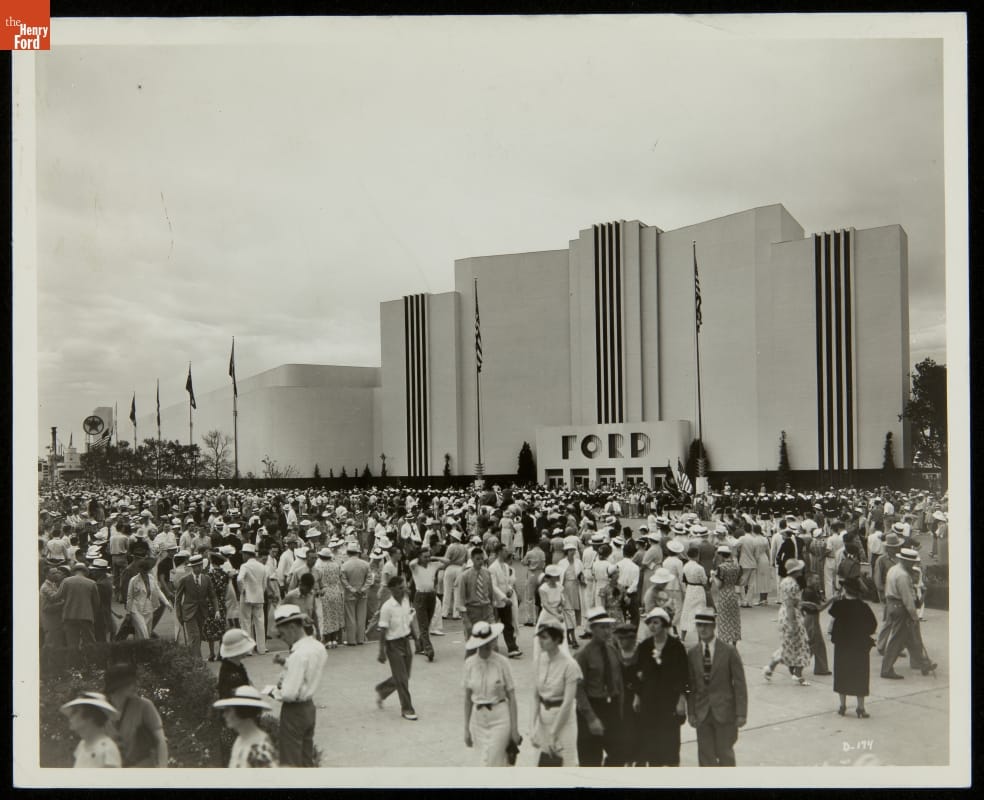
The Texas Centennial Exposition in Dallas celebrated the frontier past of Texas, especially its 1836 victory over Mexico. The Ford Motor Company Pavilion, among the largest of industrial firms' buildings at the fair, was designed by industrial designer Walter Dorwin Teague. Its interior displays focused on how agriculture and natural resources of the Southwest could be transformed into car parts.
View ArtifactPresenting the Soybean Extractor, Texas Centennial Central Exposition, Dallas, Texas, 1936
Ford promoted soybeans at the World Fairs and Exposition of the 1930s. In this image, a presenter at the Texas Centennial Exposition demonstrates how the soybean extraction process works with a model of a soybean extractor.
View ArtifactAerial View of Ford Rotunda, the Rouge Plant and Administration Building, Dearborn, Michigan, 1939
The Rotunda was built for the Ford Motor Company exhibition at the 1934 Chicago World's Fair. It was later rebuilt in Dearborn, Michigan, where it served as a hospitality center for tourists from 1936 to 1962. This photograph shows the Rotunda in its second and final home -- across from the Administration Building at Ford's River Rouge Plant.
View ArtifactModel of Menlo Park Machine Shop Built for the New York World's Fair, Set Up inside Henry Ford Museum, March 31, 1939
Henry Ford firmly believed in the "practical educational value" of World's Fair exhibits. To help accomplish his education mission during the 1939-40 New York World's Fair, he highlighted the work of students attending his experimental schools. Here, boys from Henry Ford's Edison Institute Schools operated miniature machine replicas based on Thomas Edison's Menlo Park Machine Shop.
View ArtifactHenry Ford Trade School Students at Ford Exposition, New York World's Fair, 1939
Henry Ford viewed national expositions as business opportunities and platforms for public education. During the 1939-40 New York World's Fair, Ford Motor Company spent more than $5 million to build and maintain an elaborate exposition space. Informative displays and manufacturing demonstrations inside Ford's massive fair building offered visitors an in-depth, entertaining, and educational look at industrial processes.
View ArtifactHenry Ford Trade School Students "Learn by Doing" at New York World's Fair, 1939-1940
Henry Ford firmly believed in the "practical educational value" of World's Fair exhibits. To help accomplish his education mission during the 1939-40 New York World's Fair, he highlighted the work of students attending his experimental schools. Here, boys from Henry Ford's Edison Institute Schools demonstrate miniature machine replicas based on Thomas Edison's Menlo Park Machine Shop.
View ArtifactSales Brochure, "New Ford V-8 Cars for 1939"
Ford offered models in Standard and DeLuxe series for 1939. The fancier DeLuxe models featured a refreshed, modern appearance with teardrop headlights and a low-set grille. The big news for 1939 was that, for the first time, all Ford cars came equipped with hydraulic brakes.
View ArtifactSouvenir Brochure, "The Ford Exposition, New York World's Fair," 1939-1940
The 1939-40 New York World's Fair encouraged a depression-weary public that the future would be rosy. Ford Motor Company was a major participant in this fair. This brochure highlights the Ford Exposition building's many features, including its stunning architectural design by industrial designer Walter Dorwin Teague, its interior exhibits, new car models, and its outdoor, drivable "Road of Tomorrow."
View ArtifactConceptual Drawing of the Ford Exhibition Building for the New York World's Fair, 1939
Ford Motor Company, a major participant in the 1939-40 New York World's Fair, hired industrial designer Walter Dorwin Teague to create its exhibition building in New York City's Flushing Meadows-Corona Park. This conceptual rendering shows the entrance to Teague's Ford Building. It features a stainless steel sculpture depicting Mercury, whose mythological speed symbolized the swift progress of modern transportation.
View ArtifactFord Exhibit Building Entrance at Golden Gate International Exposition, San Francisco, California, 1939-1940
The 1939 Golden Gate International Exposition reflected American aspirations at the end of the Great Depression. Held on Treasure Island -- a manmade island in San Francisco Bay -- the fair celebrated the completion of the San Francisco-Oakland Bay and Golden Gate bridges. Ford was a major participant at this fair, claiming a large building near the ferry entrance to the fairgrounds.
View ArtifactAdvertisement for the 1940 Ford Deluxe Fordor Sedan, "Watch the Fords Go By"
Ford Motor Company featured its exposition at the 1939-40 New York World's Fair in national advertisements. This print ad depicts the Ford exposition's Road of Tomorrow experience, which suggested forward-looking techniques for safer, quieter, more efficient roadways. Even if they could not attend the fair, readers across the country could imagine themselves in "modern cars" - Fords - "for modern highways."
View ArtifactFord Rotunda by Philip Lyford, 1933-1934
Chicago's 1933-34 Century of Progress Exposition used the theme of progress to encourage optimism during the Depression. The 11-acre Ford Motor Company exhibit became the most talked-about exhibit of 1934, featuring a central Rotunda designed to simulate graduated clusters of gears. After the fair, this building became an attraction at Ford headquarters in Dearborn, Michigan, until it burned down in 1962.
View ArtifactBooklet, "The Industrialized American Barn," 1934
Henry Ford moved the William Ford barn from Dearborn to the 1934 Century of Progress Exposition in Chicago to demonstrate how soybeans could be processed for industrial uses in an ordinary American barn. Ford published this booklet to explain the process, and how it could create a better future for the American farmer.
View ArtifactModel of Soybean Oil Extractor, circa 1935
Henry Ford had a vision of farmers being part of the industrial process -- an idea he called "chemurgy." This idea was most completely played out in his experimentation with soybeans, a versatile crop that could be used for industrial products as well as food. This model demonstrates how oil could be extracted from soybeans and converted into many plastic-like products.
View ArtifactCentury of Progress Souvenir Specimen Box of Materials Used in Ford Automobile Manufacture, 1934
Ford Motor Company mounted the most talked-about exhibition in Chicago during the World's Fair in 1934. One highlight of the Ford Exposition building was "Out of the Earth" -- a series of dioramas showing the major resources used in automotive production. Visitors could return home with souvenir boxes that contained samples of some of these natural materials.
View ArtifactFord Souvenir Salt & Pepper Set From Texas Centennial Exposition, 1936
Scientists at Ford's Soybean Laboratory developed a variety of plastic products made from soybean solids left when the oil was extracted, including gear shift knobs. These soybean gear shift knobs were converted into a set of souvenir salt and pepper shakers for the 1936 Texas Centennial Exposition.
View ArtifactPeople Viewing the Ford Cycle of Production Exhibit, Ford Exposition, New York World's Fair, 1939-1940
The "Ford Cycle of Production," featured at the Ford Exposition building during the 1939-40 New York World's Fair, was a huge revolving wedding-cake turntable with tiers that floated on pontoons in a moat. With 87 working models and 142 animated figures, it illustrated how 27 raw materials (at the bottom) were progressively transformed into parts for automobiles (at the top).
View Artifact

