
Marketing La-Z-Boy
Share
share
La-Z-Boy co-founder Edward Knabusch concentrated his attention on marketing, through both traditional media and his unique approaches. Though the message evolved, advertising remained a central focus throughout the company’s history. These artifacts represent a range of La-Z-Boy's marketing strategies, including showroom displays, advertisements, and special promotions.
THF290021
La-Z-Boy Founders Edwin Shoemaker and Edward Knabusch, 1927-1928
Cousins and business partners Edwin Shoemaker and Edward Knabusch established a successful furniture company through a combination of invention and marketing. The "La-Z-Boy" reclining chair technology they developed--and the creative ways they advertised it to customers--came to define the cousins’ business.
View ArtifactAnnual Lamp Show at Floral City Furniture Company Store, Monroe, Michigan, March 1937
From the start of the partnership, Edward Knabusch developed and implemented innovative marketing strategies. This photograph shows "the world’s largest lamp," created to draw attention to the cousins' Floral City Furniture store in Monroe, Michigan.
View ArtifactEarly La-Z-Boy Chairs Showroom Display, 1940
Showrooms of furniture featured artful displays that presented a variety of styles and fabrics available for La-Z-Boy reclining chairs--the core of the business. Signage emphasized comfort, inviting customers to sit down and test "the world's most comfortable chair" for themselves.
View ArtifactLa-Z-Boy Showroom, circa 1955
By the mid-1950s, showrooms focused on La-Z-Boy's place within the household. Groupings of furniture helped customers envision how a new recliner might fit in their homes.
View ArtifactFloral City Furniture Company Store, Monroe, Michigan, 1965
With the success of the "Reclina-Rocker," introduced in 1961, La-Z-Boy had the resources to expand its reach to a wider range of customers. The company introduced special product lines to suit individual tastes. The "Colonial Shoppe" mentioned in this photograph featured La-Z-Boy furniture in popular early American styles.
View ArtifactLa-Z-Boy Showcase Shoppes, 1980-1988
La-Z-Boy continued to expand in the decades that followed, adding new furniture lines and retail locations. The company's "Showcase Shoppes" built upon a marketing strategy of demonstrating how La-Z-Boy furniture could fit into any lifestyle.
View ArtifactLa-Z-Boy Showroom, 1980-1990
Despite La-Z-Boy's expansion, the reclining rocker remained the core of the company's business. Technological innovations and styling updates kept the chairs relevant--and kept customers returning to the showrooms.
View ArtifactBillboard for Floral City Furniture Company, "Relax with La-Z-Boy Chair," 1940-1949
Beyond its showrooms, La-Z-Boy advertised through traditional media--but almost always in clever ways. This early billboard presented the technological innovation of the La-Z-Boy reclining chair with marketing savvy. An illustration of the chair in use extends from the billboard to capture attention.
View ArtifactLa-Z-Boy, "World's Most Comfortable Chair," circa 1950
This print advertisement suggested the motion of a La-Z-Boy chair, demonstrating how its reclining technology provided a range of comfortable positions.
View ArtifactLa-Z-Boy Advertisement in American Home Magazine, "Comfort Chairs for Leisure Living," November 1965
In the 1960s, advertisements began to reflect La-Z-Boy's expanded product line. This ad showed how La-Z-Boy recliners met customer needs in terms of taste (with a range of styles and colors) and practicality (with Scotchgard-treated upholstery to repel stains).
View ArtifactLa-Z-Boy, "Chairs that Make a House a Home," 1965-1968
By the mid-1960s, La-Z-Boy marketing attempted to persuade consumers that its furniture could fit any lifestyle. This cozy image suggested how La-Z-Boy chairs, combined with other furniture and décor in a specific style, could "make a house a home."
View ArtifactLa-Z-Boy Advertisement in Ebony Magazine, "Give the Gift that Keeps on Giving," May 1976
La-Z-Boy advertised in a variety of publications aimed at many demographics. The timing was often strategic. This 1970s "La-Z-Rocker" ad ran just before Mother’s Day. It asked readers, "Isn't it about time you gave mom the comfort she’s always wanted?"
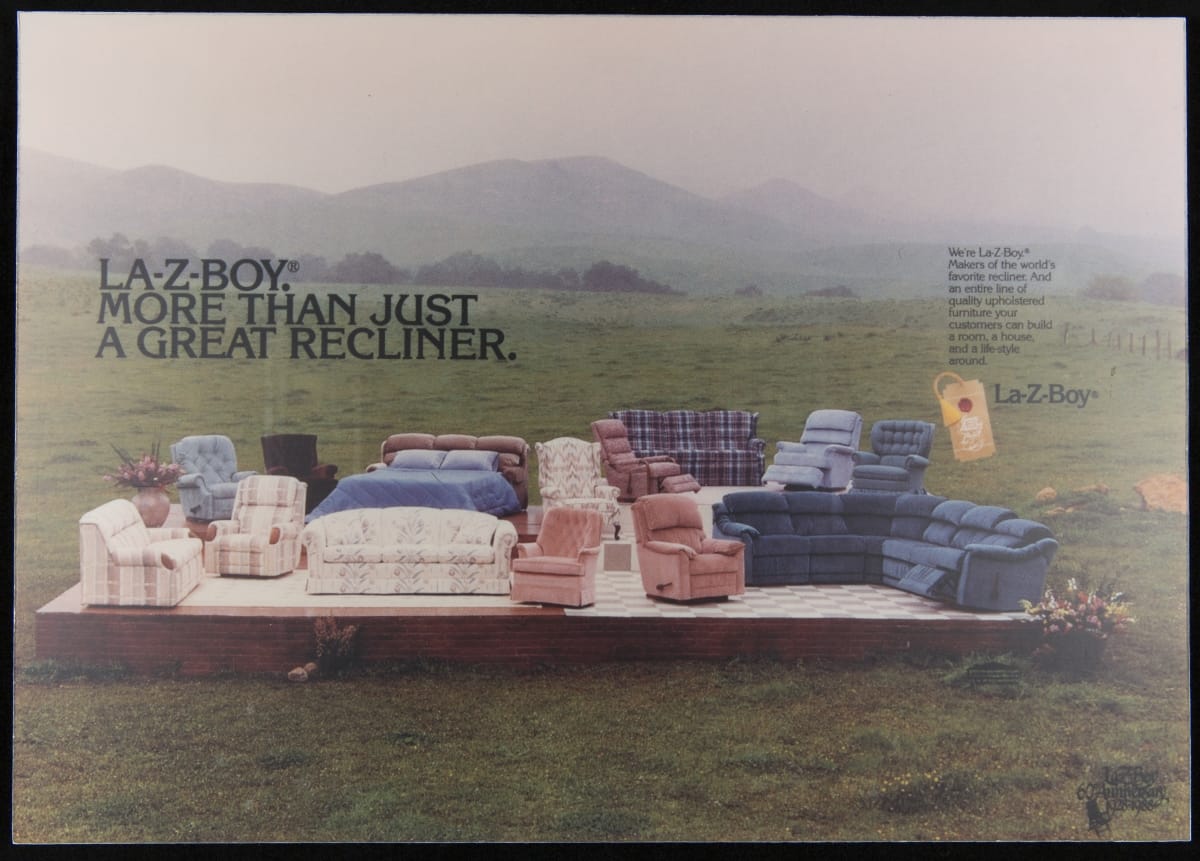
View ArtifactAdvertising Poster, "La-Z-Boy More than Just a Great Recliner," circa 1990
The array of furniture pictured in this advertisement from about 1990 suggested that La-Z-Boy furniture could be part of any household. This marketing strategy continued into the 21st century.
View ArtifactFloral City Furniture Company Delivery Truck and Crew, 1946
La-Z-Boy co-founder and marketing mastermind Edward Knabusch looked for every opportunity to advertise. This delivery truck included standard information alongside an illustration showcasing the company’s signature product--the reclining chair.
View ArtifactProof for Advertising Graphics on La-Z-Boy Trucks and Vans, 1997
Advertising graphics for La-Z-Boy delivery trucks continued to reflect the company's marketing strategy. This 1990s design showed a La-Z-Boy sofa with pillows, an end table, and a lamp to suggest a coordinated interior.
View ArtifactLa-Z-Boy Chair Company Reclining Chair with Ottomatic Footrest, 1955
Clever marketing language made La-Z-Boy's technological improvements memorable to consumers. The adjustable ottoman Edwin Shoemaker attached to La-Z-Boy's recliners became the "Ottomatic" under Edward Knabusch's influence.
View ArtifactLa-Z-Boy Chair Company Monticello Reclining Chair, 1964-1965
Not all of La-Z-Boy's marketing strategies succeeded. The "Americana Collection," which included the "Monticello" recliner, was an attempt to combine early American styles with modern aesthetics. The line fell flat with customers, who preferred either modern or historical styles.
View ArtifactLa-Z-Boy Advertisement in American Home Magazine, "A Family Affair with the Bing Crosbys," October 1967
In 1967, La-Z-Boy hired multimedia star Bing Crosby as the first of a long line of celebrity spokespersons. The company capitalized on Americans’'fascination with Crosby and his young wife Kathryn with advertisements featuring La-Z-Boy chairs as a fixture of their home life.
View ArtifactLa-Z-Boy Advertisement Featuring Johnny Carson, January 1969
With the success of Bing Crosby's advertising campaign for La-Z-Boy, the company hired other major celebrities -- like popular television host Johnny Carson -- to boost sales.
View ArtifactLa-Z-Boy Advertisement Featuring Joe Namath, circa 1972
In the 1970s, La-Z-Boy added sports personalities to its lineup of spokespeople. Football great Joe Namath--the most famous player of his day--starred in a campaign that helped popularize the fitting phrase “armchair quarterback.”
View ArtifactLa-Z-Boy Table-Top Advertisers Featuring Brooke Shields, 2010-2015
Actress Brooke Shields, also a well-known wife and mother, signed on as a celebrity spokesperson for La-Z-Boy in 2010. Her campaign signaled an update of the "lifestyle" marketing concept, which attempted to show customers how La-Z-Boy furniture could be part of any family's home life.
View ArtifactFloral City Furniture Company Showroom with Goldfish Pond, 1934-1941
Edward Knabusch and later La-Z-Boy marketers pushed the company's marketing strategy well beyond the norm. In the 1930s, Knabusch created a goldfish pond at the entrance to his Monroe, Michigan, furniture store to amuse children while their parents shopped. The fishpond became a memorable attraction at Floral City Furniture.
View ArtifactUpholstered La-Z-Boy Reclining Chair Model, 1941-1953
This electrically-powered La-Z-Boy model was a novel sales device. The miniaturized chair reclined automatically, attracting customers while demonstrating a new concept in furniture technology.
View ArtifactHot Air Balloon Advertising La-Z-Boy, 1980-1988
La-Z-Boy had firmly established itself as an icon of popular culture by the 1980s. Promoters counted on the fact that even from a distance, spectators would recognize this recliner-shaped hot air balloon (complete with a protruding footrest) as a La-Z-Boy.
View ArtifactCollectible La-Z-Boy M&M Dispenser, 1999
By the end of the 20th century, thanks in no small part to 70 years of clever marketing, La-Z-Boy stood among the most iconic consumer brands. A crossover promotion for two well-known companies, this candy dispenser depicts a humorous, yet relatable problem -- according to text on the packaging, the peanut M&M has lost some candy in the cushion of his La-Z-Boy.
View Artifact

