
Studio Glass Highlights
Share
share
Modern studio glass—a blend of art, science, and technological innovation—embraces the notion of glass as a medium for creative expression, in contrast to its use in industrial production. With over 300 pieces, the encyclopedic collection of The Henry Ford features works by all major artists.
THF164207
"Bubble Boy" by Richard Marquis 1988
"Fireside Yellow & Red Persian" by Dale Chihuly, 2000
Emergence Series by Dominick Labino, 1980
Dominick Labino along with Harvey Littleton are remembered as the founders of the Studio Glass movement. A research chemist, Labino developed marbles composed of low melting point glass for use at several experimental -- and successful -- workshops organized by Littleton at the Toledo Museum of Art in 1962. Labino emerged as a leader of the first generation of studio glass artists.
View Artifact"Concave Ruby Iteration" by Michael Glancy, 1993
"Parabolic Section" by Harvey K. Littleton, 1980
"Series IGS VII 2000-01 #7" by Marvin B. Lipofsky, 2000-2001
"All-Night-Take-Out" by Emily Brock, 1999
Emily Brock creates intricate sculptures entirely made of glass. She constructs scenes that are often inspired by everyday spaces and pull the viewer into the narrative. An example is her versions of diners that evoke a sense of nostalgia for a bygone era and simpler times. Can you spot the many details she included to make this scene life-like?
View ArtifactGoblet by Lino Tagliapietra, 1996
"Stromboli" by Lino Tagliapietra, 2003
"Dinosaur" by Lino Tagliapietra, 2005
Master studio glass artist Lino Tagliapietra fashioned this sculpture, part of his iconic "Dinosaur" series. Tagliapietra imagines dinosaurs as gentle, docile, yet powerful water-dwelling creatures, depicting them as abstract forms. His work, with its elongated, curving shapes indicative of the graceful necks of prehistoric underwater creatures, suggests the look of a dinosaur.
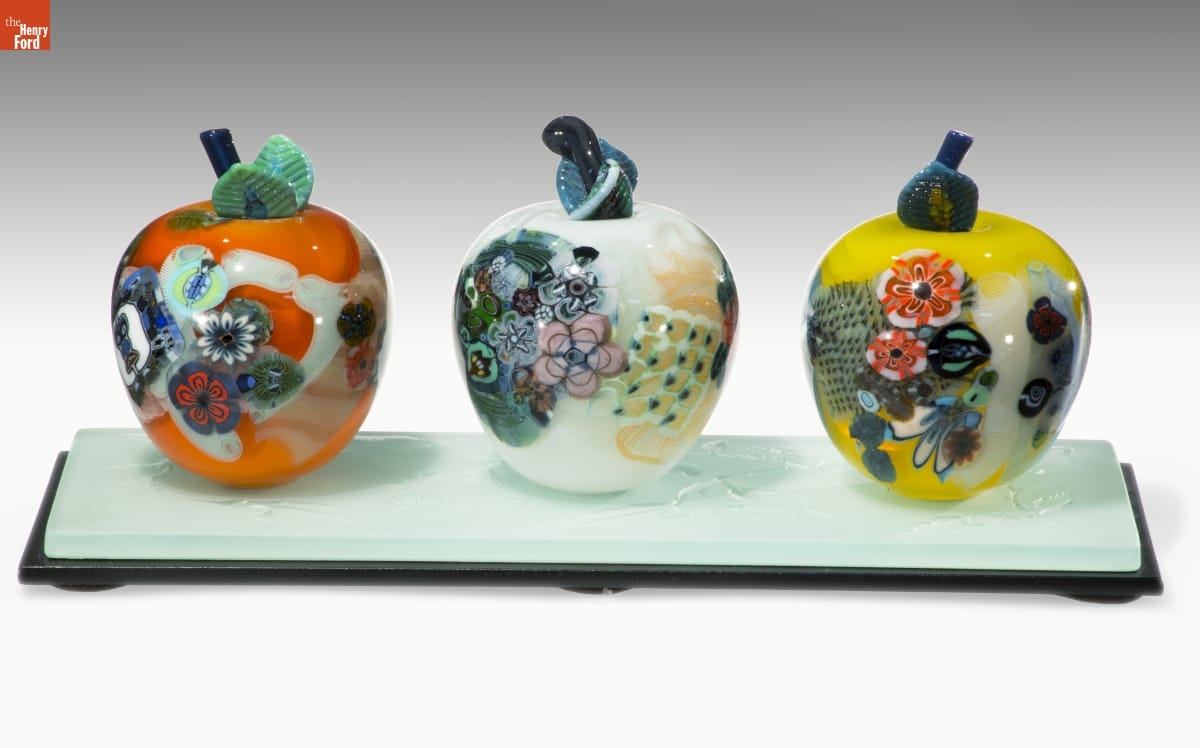
View Artifact"Candy Apples in Green, Red, and White" by Richard Ritter, 2008
"Summer Bouquet with Honeybees" by Paul J. Stankard, 2004
Paul Stankard is one of the founders of the Studio Glass movement of the 1960s and 70s. Most early Studio Glass artists began their careers creating paperweights and moved on to other forms. Stankard concentrated on creating the most technically sophisticated and beautiful paperweights he could imagine. Today, Stankard is acclaimed for his miniature worlds, consisting of imaginary botanicals, bees and sometimes human figures.
View Artifact"Ode to 9/11" by Paul Stankard, 2001-2002
Paul Stankard is one of the founders of the Studio Glass movement of the 1960s and 70s. Most early Studio Glass artists began their careers creating paperweights and moved on to other forms. Stankard concentrated on creating the most technically sophisticated and beautiful paperweights he could imagine. This uncharacteristic work commemorates the agony of the September 11, 2001 events, showing two sobbing faces, with shrapnel behind.
View Artifact"Ocean Floor" Ladder by Therman Statom, 2007
"December Song" by Jon Kuhn, 2000
Jon Kuhn's diamond-like, dazzling glass cubes earned him world-renown. Unlike many other studio artists who work with molten glass, Kuhn works only with cold glass. These complex artworks are extremely labor intensive; each piece is cut, polished, and laminated to create an environment that pulls the viewer into a glittering world of color and light.
View Artifact"Devils Blowing Glass" by Lucio Bubacco, 1997
Lucio Bubacco grew up surrounded by the centuries-old glass culture of the island of Murano, Italy. He invented a glass technique to sculpt bodies that appear in motion. His figures are precariously placed in poses that make for a lively arrangement. He uses a delicate soda-lime glass mixture instead of the sturdier Pyrex to achieve a more vibrant, colorful result.
View Artifact"Standing Columns #12" by Howard Ben Tre, 1983
Howard Ben Tré casts glass sculptures using similar techniques he learned while casting metal sculpture. These solid, monumental works often have a green tinge and appear to glow as light passes through. Architectural elements and archeological remains inspire Ben Tré. Works like this one, which weighs well over 500 pounds, will take over two months to cool after molten glass is poured into a mold.
View ArtifactUntitled from Relationship Series by Richard Royal, 1997
Like many studio glass artists, Richard Royal conceives of his work in series. He views his series in autobiographical terms. This work is part of his "Relationship" series which he started following his marriage in 1989. This work represents the flowering of the series as it shows the abstracted arms of a mother and father holding a child at the center.
View Artifact"Mazorca Con Grillo Y Rana" by William Morris, 2004
"Blue Opal Flowers" by Mark Peiser, 1971
Mark Peiser was nearly thirty years old when he visited Penland School in 1967 to learn glassblowing. After three days at the School, he found that he wanted to pursue glass seriously and requested to apply for a position as an artist in residence. The director appointed him to the position for the winter with little explanation after they had a casual conversation. Blue Opal Flowers is from the earliest phase of Peiser's work.
View Artifact

