
The First Indianapolis 500, 1911
Share
share
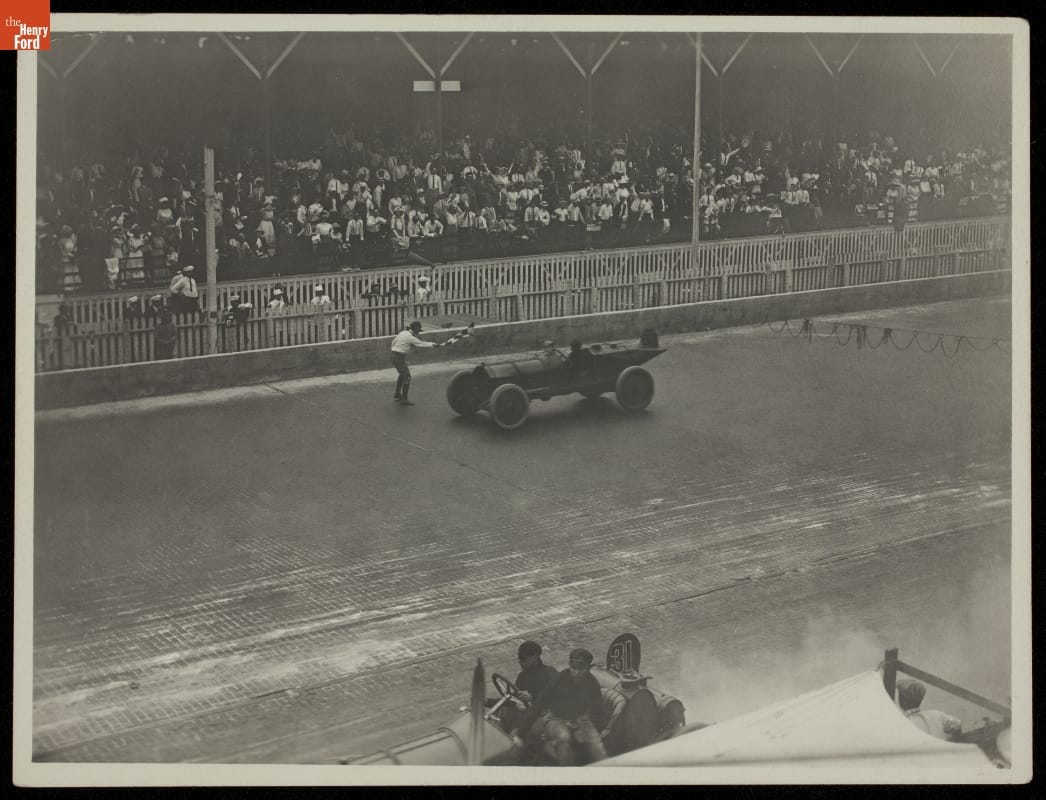
The Indianapolis 500 bills itself today as the "Greatest Spectacle in Racing." That description would have been just as accurate for the first race, held on May 30, 1911. Its 500-mile length and $27,000 prize purse were unlike anything seen in the auto racing world to that point. The first Indy 500 featured 40 qualifying cars. This set includes photos of 23 of them, presented in the order in which they finished the race.
THF152054
Brick from Indianapolis Motor Speedway
When Carl Fisher and his partners opened Indianapolis Motor Speedway in 1909, the 2.5-mile track was perhaps the most advanced racing venue in the world -- except for its crushed stone and tar surface. Before the year was out, Fisher had that dangerous original surface replaced with 3.2 million bricks -- a state-of-the-art track surface at the time.
View ArtifactReproduction of the Official Program for the 1911 Indianapolis Motor Speedway Race
In its first two years, Indianapolis Motor Speedway hosted multiple races each season. Those frequent events caused the track's novelty to fade quickly. For 1911, Fisher scrapped the schedule and instead offered just one spectacular 500-mile race on Memorial Day. He hoped the race's unprecedented length and enormous cash prizes would reignite public interest in the track.
View ArtifactFirst Turn and Pit Area, 1911 Indianapolis 500
Fisher's gambit worked. The first Indianapolis 500-Mile Race, held on May 30, 1911, attracted top drivers and cars from around the world. It also drew an enormous crowd of 80,000 people -- compared to the 15,000 who attended the speedway's last race of 1910. Spectators paid as little as $1.00 to watch the first Indy 500 from the grandstand.
View ArtifactLineup Before Start of 1911 Indianapolis 500
Teams brought 46 race cars to Indianapolis from throughout the United States and Europe, all hoping to compete. Forty cars managed to qualify -- simply by sustaining a speed of 75 miles per hour along the straightaway. Positions in the starting grid were based on the dates when entry forms were filed, rather than being based on qualifying speeds.
View ArtifactRay Harroun, May 1911
Ray Harroun earned a permanent place in motorsport history by winning the first Indianapolis 500. He took home $14,250 in prize money -- not bad at a time when the average American earned less than $600 a year. Harroun retired from competitive driving after his Indy win, but he remained active in the automotive industry for the rest of his life.
View ArtifactThe Marmon Wasp Driven by Ray Harroun, Winner of the 1911 Indianapolis 500
Ray Harroun called his yellow #32 Marmon race car the Wasp. Harroun and relief driver Cyrus Patschke finished the 500 miles in just over 6 hours, 42 minutes, with an average race speed of 74.6 miles per hour. Harroun drove without a riding mechanic, but he had help from a clever device he designed himself: a rear-view mirror.
View ArtifactRalph Mulford, #33 Lozier, 1911 Indianapolis 500
Ralph Mulford took second place in 1911, crossing the finish line 1 minute, 43 seconds after Harroun. Mulford piloted the #33 car, built by Lozier Motor Company of Detroit. Mulford returned to compete in the Indianapolis 500 nine more times through 1922. At his death in 1973, Mulford was the last surviving driver from the first Indy 500.
View ArtifactDavid Bruce-Brown, #28 Fiat, 1911 Indianapolis 500
David Bruce-Brown finished third at the inaugural Indianapolis 500. His Italian-built #28 Fiat averaged 72.7 miles per hour in the race. Bruce-Brown returned to Indy in 1912, where he set the fastest qualifying time but was knocked out of the race by engine valve problems. Bruce-Brown was killed in a crash that October while practicing for the 1912 Vanderbilt Cup.
View ArtifactView at the 1911 Indianapolis 500 Race Taken by Henry Ford
Spencer Wishart co-drove the #11 German-made Mercedes with relief driver Dave Murphy. Wishart and Murphy earned a fourth-place finish. Wishart returned to Indy three more times, and he earned a personal-best second-place finish in 1913. He was killed after a collision in a race at Elgin, Illinois, in August 1914.
View ArtifactRalph DePalma, #2 Simplex, 1911 Indianapolis 500
Italian-American driver Ralph DePalma finished in sixth place with the #2 Simplex. He averaged 71.1 miles per hour during the race. Unlike many competitive drivers of his time, DePalma enjoyed a long career. He won an estimated 2,000 races, including the 1915 Indianapolis 500, before retiring in 1936. DePalma made his last Indy 500 appearance -- as an honorary referee -- in 1954.
View ArtifactNational Race Car Driven by Charlie Merz at the 1911 Indianapolis 500 Race, Photograph Taken by Henry Ford
Charlie Merz drove the #20 car, built by National Motor Vehicle Company of Indianapolis. National's cars generally excelled in early American races, earning 84 victories in 1911 alone, but Merz had to settle for seventh at the first Indy 500. Driver Joe Dawson won the second Indianapolis 500 with a National in 1912.
View ArtifactFred Belcher, #15 Knox, May 1911
Fred Belcher shared driving duties with relief driver John Coffey. They piloted the #15 car, made by the Knox Automobile Company of Springfield, Massachusetts. Belcher and Coffey managed to complete all 200 laps around the 2.5-mile Indianapolis Motor Speedway circuit, and they finished in ninth position. The 1911 race marked Belcher's only appearance in the Indy 500.
View ArtifactGil Andersen, #10 Stutz, May 1911
Norwegian-born Gil Andersen competed in the first six Indianapolis 500 races. For 1911, he drove the #10 Stutz to an 11th-place finish. Andersen likely would have done better if not for tire troubles. Regardless, Stutz Motor Company was pleased. On the strength of the #10 car's performance, Stutz adopted its memorable slogan: "The Car That Made Good in a Day."
View ArtifactNational Race Car Driven by Howdy Wilcox at the 1911 Indianapolis 500 Race, Photograph Taken by Henry Ford
Howdy Wilcox crossed the finish line in 14th place with his #21 National in 1911. He returned to compete in the Indianapolis 500 ten more times. Wilcox won the race in 1919 after leading for 98 of the 200 laps. Wilcox was killed in a crash at Pennsylvania's Altoona Speedway in 1923.
View ArtifactView at the 1911 Indianapolis 500 Race Taken by Henry Ford
Harry Endicott, who drove the #3 Inter-State race car seen here, finished the 1911 Indianapolis 500 in 16th place. Johnny Aitken managed a 27th-place finish with his #4 National. Louis Disbrow, in the #5 Pope, finished in 35th place.
View ArtifactBenz Race Car Driven by Billy Knipper at the 1911 Indianapolis 500 Race, Photograph Taken by Henry Ford
Billy Knipper took his German-made #46 Benz to an 18th-place finish in 1911. He competed again at Indy in 1913 and 1914, finishing in 16th and 13th places respectively. Following his racing career, Knipper owned a car dealership in his hometown of Rochester, New York.
View ArtifactBob Burman, #45 Benz, 1911 Indianapolis 500
Bob Burman set a land speed record of 141.732 miles per hour in April 1911 with his Blitzen Benz. The car boasted a 1,312-cubic-inch engine rated at 200 horsepower. Burman made exhibition runs in the Blitzen Benz before the start of the 1911 Indy 500, but he competed in the more modest 520-cubic-inch #45 Benz. Burman finished in 19th position.
View ArtifactJackson Race Car Driven by Jack Tower at the 1911 Indianapolis 500 Race, Photograph Taken by Henry Ford
Jack Tower and relief driver Robert Evans piloted the #26 race car, built by the Jackson Automobile Company of Jackson, Michigan. One of Jackson's cars had won a race at Indianapolis Motor Speedway in 1909. Tower took 24th place at the 1911 Indy 500, but another Jackson, driven by Harry Cobe, finished the race in tenth position.
View ArtifactWill Jones, #9 Case, 1911 Indianapolis 500
Milwaukee native Will Jones placed 28th at the first Indianapolis 500, having been knocked out by steering problems after 122 laps. Jones's #9 race car was built by Case Corporation. Though Case is better known for its tractors and agricultural equipment, the Wisconsin-based company built passenger cars from 1911 through 1927.
View ArtifactWestcott Race Car Driven by Harry Knight at the 1911 Indianapolis 500 Race, Photograph Taken by Henry Ford
Harry Knight competed in two pre-Indianapolis 500 races at Indianapolis Motor Speedway in 1910, and he raced in the first two Indy 500 contests. For 1911, he drove the #7 car built by the Wescott Motor Car Company of Richmond, Indiana. Knight's race was cut short by an accident on lap 90, leaving him with a 30th-place finish.
View ArtifactHerbert Lytle, #35 Apperson, 1911 Indianapolis 500
Herbert Lytle was a veteran driver in 1911, having raced for close to ten years by that point. He tackled the first Indianapolis 500 at the wheel of the Indiana-built #35 Apperson automobile. An accident in the pits ended Lytle's race early, and he officially finished in 32nd position. The 1911 race was Lytle's only Indy 500 appearance.
View ArtifactAlco Race Car Driven by Harry Grant at the 1911 Indianapolis 500 Race, Photograph Taken by Henry Ford
Harry Grant finished the first Indianapolis 500 in 33rd place, doomed by bad bearings. Grant's #19 car was built by American Locomotive Company (Alco). The company primarily built steam (and, later, diesel-electric) railroad locomotives, but it manufactured its own automobiles from 1909 to 1913. Ironically, Alco never produced a steam-powered car, relying instead on gasoline-fueled internal combustion engines.
View ArtifactBuick Race Car Driven by Charles Basle in the 1911 Indianapolis 500 Race, Photograph Taken by Henry Ford
French racing driver Charles Basle piloted the #17 Buick at the 1911 race. Mechanical problems forced him out after 46 laps, leaving him to finish in 34th place. It was Basle's only appearance at the Indianapolis 500. He largely retired from racing after that, but Basle remained active in the automotive industry.
View ArtifactArthur Chevrolet, May 1911
Mechanical problems with his #16 Buick held Swiss driver Arthur Chevrolet to a 36th-place finish. Arthur bore a strong resemblance to his older brother Louis, who partnered with Billy Durant to form Chevrolet Motor Car Company in November 1911. Durant was the once-and-future head of General Motors, which ultimately became parent to both the Buick and Chevrolet brands.
View ArtifactCaleb Bragg, #39 Fiat, 1911 Indianapolis 500
Caleb Bragg drove the #39 Fiat in the 1911 Indianapolis 500. An accident in the pits ended his race after 24 laps, good enough to finish in 37th place. Bragg returned to Indy in 1913 and 1914, but he never completed all 200 laps. Bragg had more success on water. He won multiple speedboat races in the mid-1920s.
View ArtifactLozier Race Car Driven by Teddy Tetzlaff in the 1911 Indianapolis 500 Race, Photograph Taken by Henry Ford
Teddy Tetzlaff raced in the first Indianapolis 500 behind the wheel of the #34 Lozier. His race was cut short by an accident on the front straightaway after just 20 laps. The crash left Tetzlaff with an official finish in 39th place out of 40 entries. "Terrible Teddy" returned to compete in the next three Indy 500 races, earning a personal-best second-place finish in 1912.
View Artifact

