
The WASP: “An Airplane Knows No Sex”
| Written by | Kimberly Guise |
|---|---|
| Published | 7/16/2025 |
The WASP: “An Airplane Knows No Sex”
| Written by | Kimberly Guise |
|---|---|
| Published | 7/16/2025 |
During World War II, a groundbreaking group of American women defied expectations and gender bias to apply their skill in the air, flying over 60 million miles and 12,650 ferrying missions for their country during the war. Nearly 1,100 women volunteered as pilots with the Women Airforce Service Pilots (WASP). As WASP Bernice “Bee” Haydu said in a 2013 oral history interview for The National WWII Museum, “We showed the world that an airplane knows no sex.” Yet while they flew military aircraft for military purposes and risked their lives in doing so, they remained classified as civilian aviators and as such they received no military status, benefits, or recognition until decades later.
Even prior to the United States' entry into war, two pioneering pilots Jacqueline Cochran and Nancy Harkness Love were pushing for opportunities for American women in military aviation. They lobbied for inclusion and were bolstered by successful efforts abroad, where women were flying in support of the European Allies. Cochran and Love submitted independent proposals to the Army Air Forces for the noncombat employment of women. As a result, the two women were granted leadership of two programs — the Women’s Auxiliary Ferrying Squadron led by Love and the Women’s Flying Training Detachment directed by Cochran. The momentum to use women pilots had some powerful advocates. First Lady Eleanor Roosevelt wrote about the subject in her September 1, 1942, "My Day" column: “We are in a war and we need to fight it with all our ability and every weapon possible. Women pilots, in this particular case, are a weapon waiting to be used.” In August 1943, a year after the inception of the two, they were merged into the Women Airforce Service Pilots under Cochran with Love in an executive role.
The WASP program took off. Trainees were based at Avenger Field near the small town of Sweetwater, Texas. A love of flying drew fierce competition for limited spots. Training on military aircraft was rigorous and difficult even for the experienced pilots accepted into the program. Unlike male fliers, who learned to fly as part of their training, the WASP trainees entered their program knowing how to fly. They were required to have completed 200 to 500 flight hours before being admitted to the program. Still, the washout rate hovered at just under 50 percent. Out of 25,000 applications received, 1,830 women were accepted and of those 1,074 completed their training.
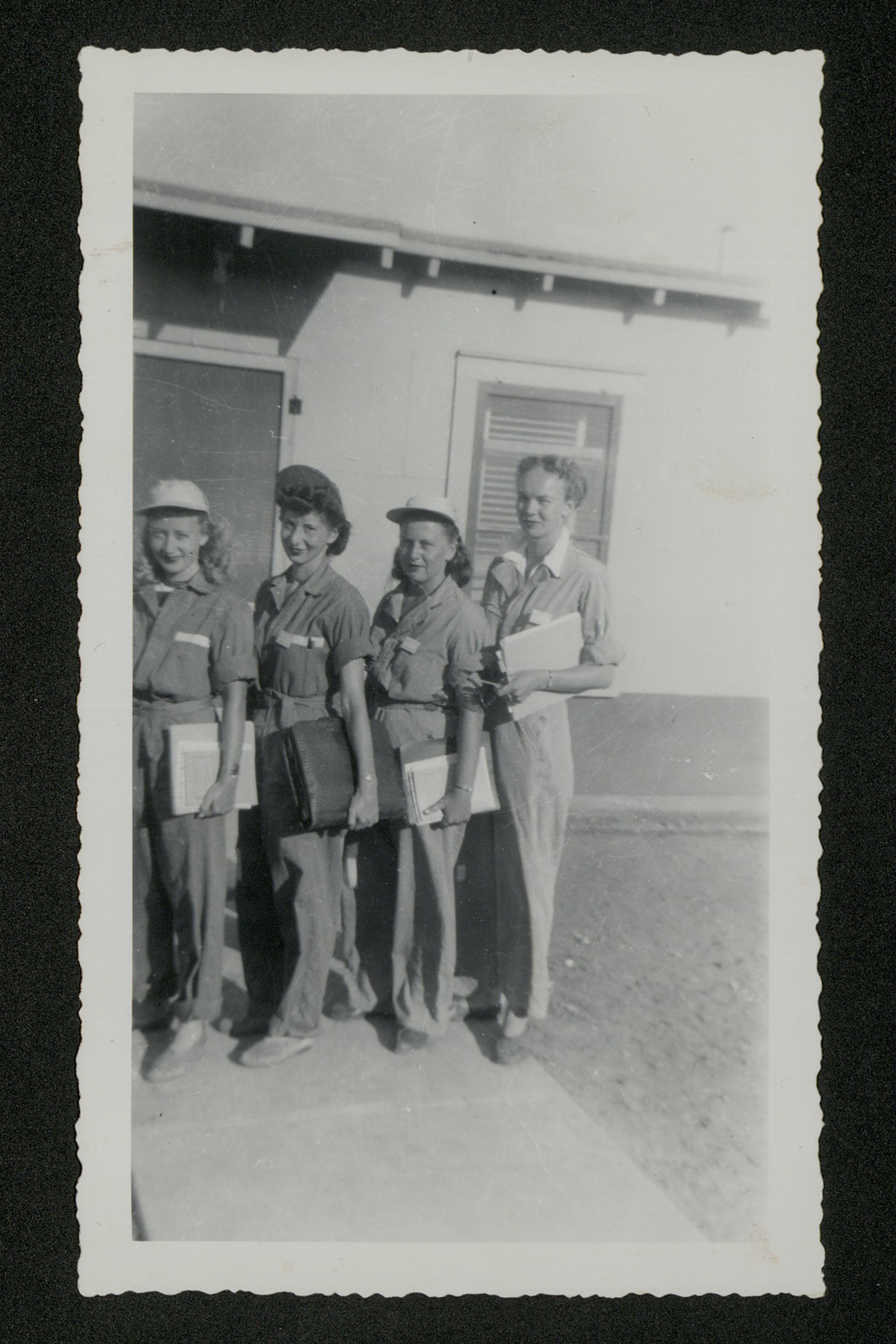
Ruth Westheimer (2nd from left) and fellow trainees at Avenger Field. / Gift in Memory of Ruth Westheimer, 2020.220.155
The 30-week training program at Sweetwater included 210 hours of flying time on a wide variety of military aircraft. The training culminated in a graduation where the pilots received their wings, often pinned on by Cochran herself. Whether the civilian graduates would receive wings like their military pilot counterparts was initially questioned by some. And Cochran personally funded the purchase of the insignia for the first seven graduating classes (43-1 through 43-7).
The WASP went on to their assignments, ferrying planes from factories to airbases, “test-hopping” planes that other pilots had flagged as unreliable, and even towing targets used to train anti-aircraft gunners.
Class 43-6 included 22-year-old Ruth Westheimer. Raised by German Jewish immigrant parents in Jackson, Michigan, Westheimer was fascinated by flying from a young age, watching planes at the airstrip near her home. After graduating from Jackson High School in 1939, she plotted her path to the skies and attended the Civilian Pilot Training Program while studying at Jackson Junior College. She took a job as a secretary at Montgomery Ward & Co. in Chicago until she jumped at the opportunity to fly. Accepted for WASP training in April 1943, Westheimer initially failed the required day-long physical exam due to insufficient lung capacity. Determined to fly, she recognized what was holding her back and brazenly demanded to be tested again after removing her brassiere. She passed and became part of Class 43-6. In Sweetwater, Westheimer flew a variety of planes, but her favorite was the AT-6 “Texan” training aircraft. Westheimer loved ferrying duty.
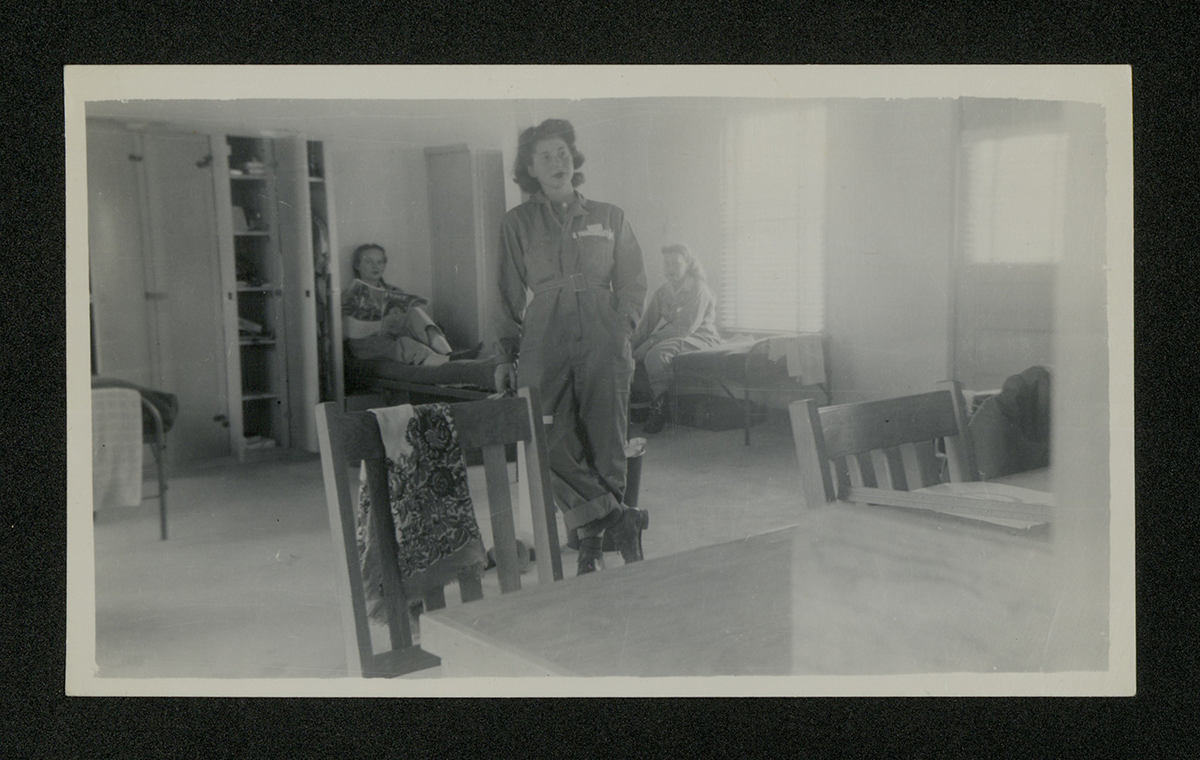
Ruth stands in the foreground with her trainee roommates at Avenger Field. Ruth’s caption reads, “This is half of our bay. The gal with the magazine and pigtails is Mac. Bernie is the other one. Both are kids.” / Gift in Memory of Ruth Westheimer, 2020.220.073
For a time, Westheimer was based not far from home, with the 3rd Ferrying Group at Romulus Army Air Field in Michigan. At the same time, Chinese American Hazel Ying Lee was also flying out of Romulus. Lee is a tragic example of the extreme risks inherent in the WASP’s work. Lee was later transferred to Texas for Pursuit School training. She died on November 25, 1944, two days after a collision while transporting a P-63 Kingcobra fighter aircraft. She was the last of 38 WASP who died in service.
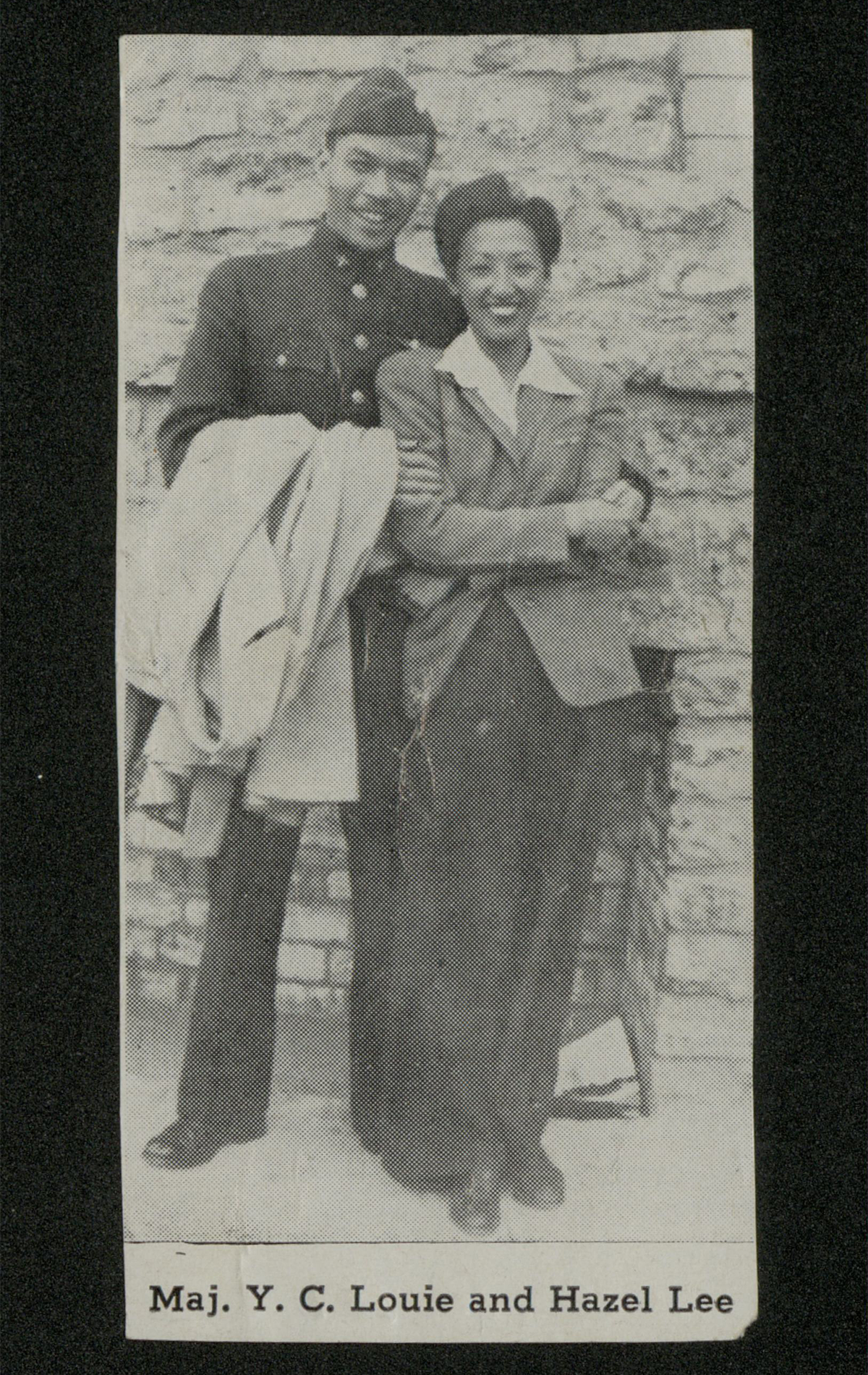
Clipping from Ruth’s scrapbook showing Hazel Lee and her husband. / Gift in Memory of Ruth Westheimer, 2020.220.237
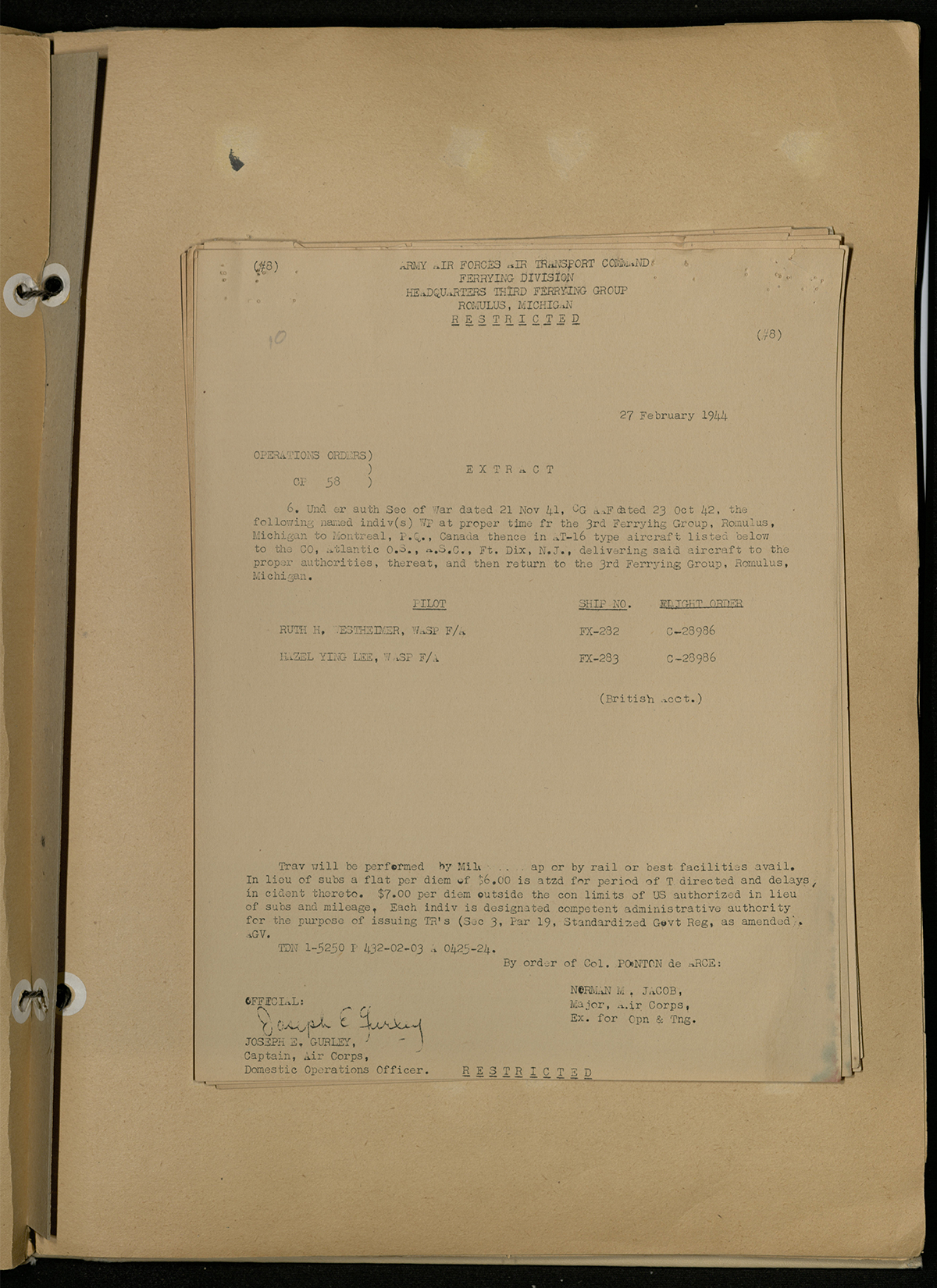
February 1944 travel orders for Westheimer and Hazel Lee from Romulus to Montreal. / Gift in Memory of Ruth Westheimer, 2020.220.244
During one of Westheimer's assignments, flying with a group from Montreal to New Jersey, the WASP ran into weather trouble. Navigating visually, she eventually found an airfield and was assisted in landing by military personnel. Westheimer later said, “You should’ve seen the surprise on their faces when they saw a 120-lb girl in uniform climb out of the cockpit of that large military plane.”
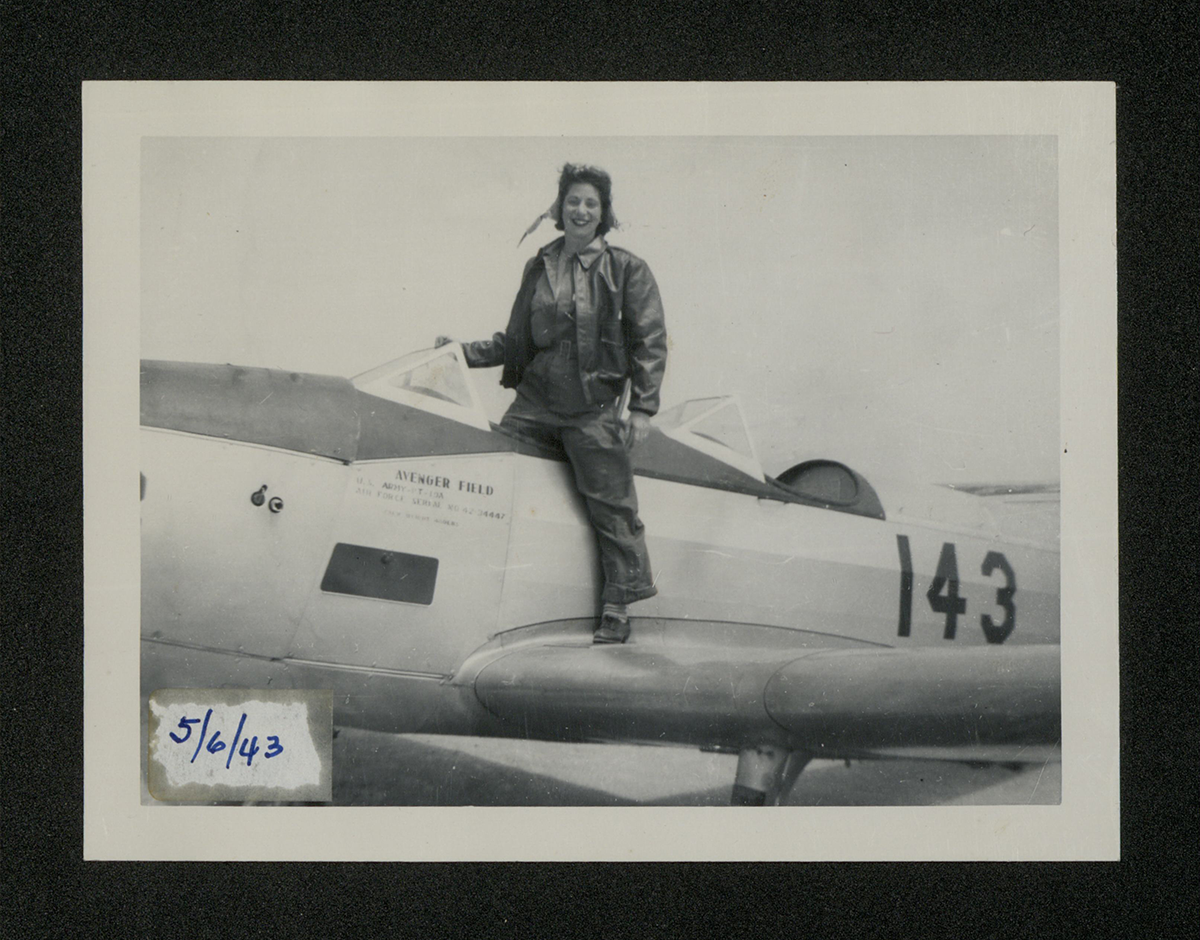
Ruth Westheimer steps out of a Fairchild PT-19A primary trainer aircraft at Avenger Field on May 6, 1943. / Gift in Memory of Ruth Westheimer, 2020.220.017
WASP often carried out their missions in a hostile atmosphere. Despite the shared purpose of American victory, not everyone wanted the women to succeed. There was even some resentment from male pilots who wanted the women’s stateside jobs rather than overseas combat duty.
In March 1944, Cochran and Army Air Forces Commander General “Hap” Arnold presented a strong case for militarization of the WASP before Congress, but the push was unsuccessful. With the war in Europe won and the war in the Pacific winding down, the WASP militarization bill was defeated in the House of Representatives on June 21, 1944. With no active path to service, the WASP were dismissed and their program disbanded, finalized on December 20, 1944. The devastated women even had to pay for their own fares home. Some were able to get contract work with Air Transport Command or flying in other capacities, but many returned to prewar occupations or began new lives.
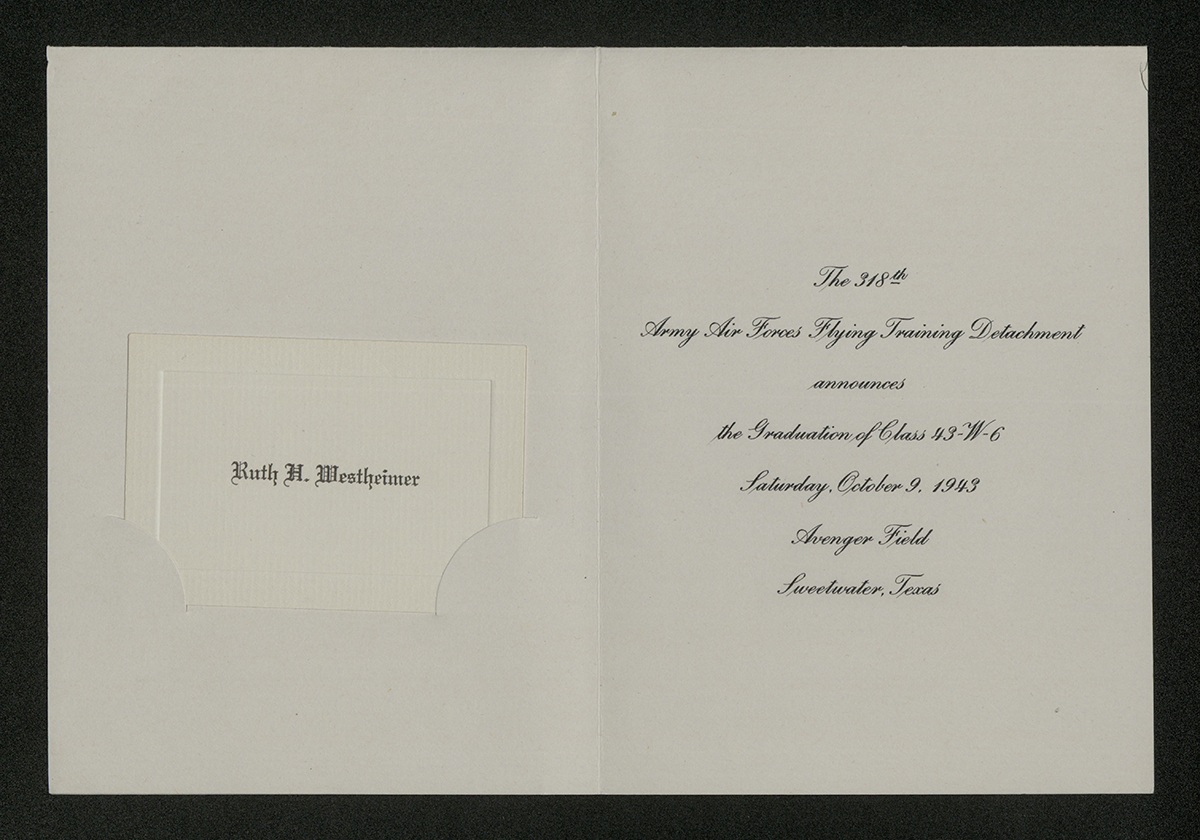
Ruth’s graduation announcement from Class 43-W-6. / Gift in Memory of Ruth Westheimer, 2020.220.207
Ruth Westheimer moved to Boyne City, Michigan, with her husband, 10th Mountain Division Army veteran Marshall Neymark. They raised four children, and she worked at city hall as treasurer. Later in life, Ruth made her way back to flying. Her second marriage to Boyne city manager and pilot Forbes Tompkins returned her to the cockpit. She renewed her pilot's license and began to fly again in their Cessna. After Forbes retired, Ruth stepped into the position of city manager, the first time the position was ever held by a woman.
The WASP were finally recognized for their service in 1977, when they were retroactively granted veteran status. In 2009, a bill passed to award the Congressional Gold Medal to the WASP. At the U.S. Capitol ceremony in March 2010, Ruth was one of the 200 (out of 300 surviving) WASP present to receive her award. She considered herself a “Lucky Lady,” in the right place at the right time. Ruth passed away in 2016 and is buried in Arlington National Cemetery — a right that would not have been afforded during the war.
This guest blog was written by Kimberly Guise, Senior Curator and Director of Curatorial Affairs at The National WWII Museum, and Curator of Our War Too: Women in Service, currently on display at Henry Ford Museum of American Innovation now through September 7.
Series | |
|---|---|
Themes |