
Ford at Le Mans in 1967
Share
share
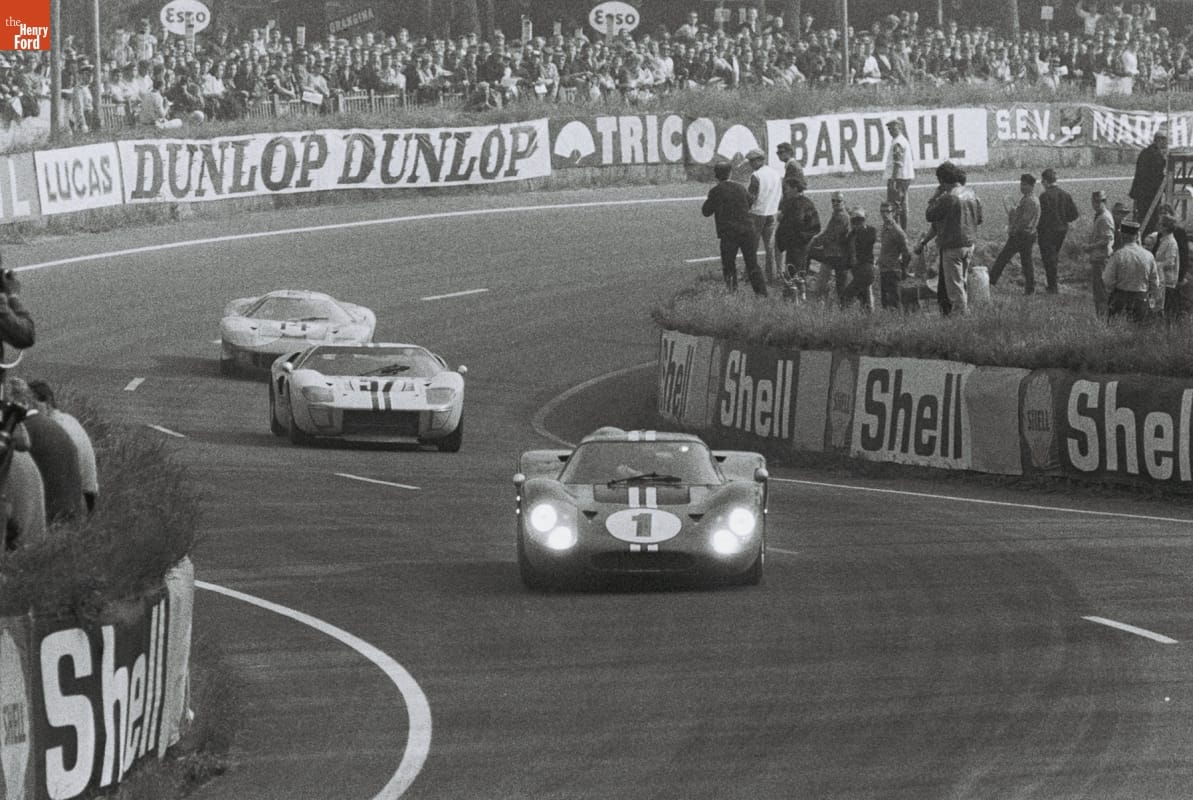
Ford Motor Company returned to Le Mans for a rematch with Ferrari in 1967. While Ford bested the Italians with the GT40 Mark II in 1966, this time it fielded an all-new car. Dan Gurney and A.J. Foyt piloted a Ford Mark IV around the Circuit de la Sarthe for 24 brutal hours. The two drivers, like the crew members and Ford executives there with them, hoped all the while that neither they nor their machine would break under the strain.
LeMans06-66_369
Bruce McLaren, Henry Ford II and Chris Amon at the 24 Hours of Le Mans Race, June 1966
Ford Motor Company launched its effort to beat Ferrari at Le Mans in 1964. After two disappointing years when Fords failed even to finish the race, 1966 brought a thrilling 1-2-3 sweep for the American automaker. Henry Ford II toasted the decisive victory on the podium with winning drivers Bruce McLaren and Chris Amon, both from New Zealand.
View ArtifactBruce McLaren's and Chris Amon's Ford GT40 Mark II at the 24 Hours of Le Mans Race, June 1966
Ford went to Le Mans with the GT40, a British-built race car inspired by designer Eric Broadley's Lola Mark 6 GT. The first GT40s carried Ford's 289-cubic-inch V-8. Subsequent cars, fitted with the bigger 427 V-8, received the designation GT40 Mark II. It was the Mark II that McLaren and Amon drove to victory at Le Mans in 1966.
View ArtifactHenry Ford II and Cristina Ford at the 24 Heures du Mans (24 Hours of Le Mans) Race, June 1967
Ford Motor Company would never have gone to Le Mans without Chairman and CEO Henry Ford II, seen here with wife Cristina Vettore. Ford was set to buy Italian automaker Ferrari in 1963 when, at the last minute, founder Enzo Ferrari backed out of the deal. Mr. Ford took the snub personally and decided to beat Ferrari at Le Mans.
View ArtifactJacque Passino at the 24 Heures du Mans (24 Hours of Le Mans) Race, June 1967
Ford Motor Company's racing operations were guided by Jacque Passino, the automaker's Director of Special Vehicle Activities from 1962 to 1970. Passino was a hands-on manager who kept a close eye on Ford's race cars and teams, whether on site at the track or back at the engineering facilities in Dearborn.
View ArtifactCarroll Shelby at the 24 Hours of Le Mans Race, June 1966
Carroll Shelby joined Ford's Le Mans effort in late 1964, when the program was struggling. Shelby, who'd won the race as a driver in 1959, turned things around. His Shelby American racing team reworked the GT40 into a winning machine, and it managed the car that took the checkered flag in 1966. Shelby and his team returned to France for 1967.
View ArtifactLe Mans Trials, April 1966
Anxious to stay ahead of the competition, Ford planned to compete in 1967 with the "J-Car," designed to comply with Appendix J of the Le Mans rulebook. It was leaner and lighter than the GT40, but aerodynamically the J-Car was a disaster. On August 17, 1966, Ken Miles died in a rollover accident while testing a J-Car at Riverside, California.
View ArtifactKen Miles at the 24 Hours of Le Mans Race, June 1966
Ken Miles's death marked the lowest point in Ford's Le Mans program. Miles was a gifted engineer and driver who got involved with Ford through his work for Carroll Shelby. Miles won the 24 Hours of Daytona and the 12 Hours of Sebring in 1966, and placed second at Le Mans, with Ford's GT40 Mark II.
View ArtifactFord Mk IV Race Car at the Sebring 12 Hours of Endurance Race, 1967
After Miles's death, the J-Car was thoroughly reworked. The resulting new car was dubbed the Mark IV (following two generations of GT40 racers and a Mark III street version). The Mark IV debuted at the 12 Hours of Sebring in April 1967. With drivers Bruce McLaren and Mario Andretti, the car took the checkered flag in its first race.
View ArtifactDan Gurney and Phil Remington at the 24 Hours of Le Mans Race, June 1966
Phil Remington, seen here (at right) with Dan Gurney at Le Mans in 1966, served as Carroll Shelby's director of research and development. Remington led the effort to rework the J-Car into the Mark IV. While the changes were tested in Ford’s wind tunnel, the Mark IV’s shape was as much a product of Remington’s remarkable intuition as it was aerodynamic science.
View ArtifactDan Gurney Celebrating Victory at the 24 Heures du Mans (24 Hours of Le Mans) Race, June 1967
Dan Gurney was no stranger to Le Mans, having competed in the race every year since 1958. Indeed, he was one of the world's best all-around drivers, racing in stock cars and open-wheel racers in addition to sports cars. Gurney's even temper was well suited to endurance racing, where "steady" was often more important than "fast."
View ArtifactA. J. Foyt at the 24 Heures du Mans (24 Hours of Le Mans) Race, June 1967
A.J. Foyt ranked among the best in stock car and open-wheel racing -- particularly at the Indianapolis 500, where he'd won in 1961, 1964 and 1967 (and would win again in 1977) -- but he was a rookie at Le Mans. Foyt was a fast study. He quickly appreciated the delicate balance between speed and caution that distinguishes endurance racing.
View ArtifactFord Mark IV Driven by Dan Gurney and A. J. Foyt in the 24 Heures du Mans (24 Hours of Le Mans) Race, June 1967
Ford entered four Mark IV cars in the 1967 Le Mans, two under the sponsorship of Shelby American and two under Holman & Moody. Gurney and Foyt were assigned the #1 car, campaigned by Shelby American. It was a formidable machine with a 427-cubic-inch V-8 engine that churned out 500 horsepower. A bump in the roof accommodated Gurney's 6'4" height.
View ArtifactFerrari 330 P4 Driven by Gunter "Bobby" Klass and Peter Sutcliffe in the 24 Heures du Mans (24 Hours of Le Mans) Race, June 1967
Ferrari took a new car of its own to Le Mans in 1967. The 330 P4 boasted a 244-cubic-inch V-12 engine capable of 450 horsepower -- not far from the Mark IV's 500 horses. The P4 was also 490 pounds lighter. Furthermore, the Ferrari's V-12 featured fuel injection, more advanced than the twin four-barrel carburetors used by Ford.
View ArtifactFord Mark II B Driven by Ronnie Bucknum and Paul Hawkins Before the 24 Heures du Mans (24 Hours of Le Mans) Race, June 1967
During pre-race practice, a manufacturing defect in the Mark IV windshields caused all four of them to crack. Dow Corning made emergency replacements at its New York factory and rushed them to France within two days. Ford brought in an adhesives expert from Brussels to oversee the installation of the new glass. Here, a defective windshield is removed.
View ArtifactStart of the 24 Heures du Mans (24 Hours of Le Mans) Race, June 1967
The 1967 race began at 4:00 PM, on June 10, with the traditional "Le Mans start." Drivers lined up on their feet, across the track from their cars. When the flag dropped, they ran to their vehicles, scrambled inside and drove off -- often not bothering to buckle in until they were well underway. Safety concerns ended the unusual start after 1969.
View ArtifactSpectators at the 24 Heures du Mans (24 Hours of Le Mans) Race, June 1967
An estimated 310,000 people attended the 1967 race. Few, of course, stayed in the grandstands for the entire 24 hours. Spectators could also sample food and drink from various vendors, enjoy amusement rides in the fairgrounds area, or move around the 8.34-mile circuit in search of the perfect vantage point.
View ArtifactFord Mark IV Driven by Bruce McLaren and Mark Donohue in the 24 Heures du Mans (24 Hours of Le Mans) Race, June 1967
New Zealander Bruce McLaren and American Mark Donohue were teamed in the #2 Mark IV, sponsored by Shelby American. Their car was vexed by problems throughout the race, including a slipping clutch and a body tail that, at one point, blew completely off of the vehicle. Nevertheless, McLaren and Donohue managed to finish the race in fourth place.
View ArtifactFord Mark IV Driven by Lucien Bianchi and Mario Andretti in the 24 Heures du Mans (24 Hours of Le Mans) Race, June 1967
American Mario Andretti teamed with Belgian Lucien Bianchi to drive the #3 Mark IV, fielded by Holman & Moody. Their race ended prematurely in the early morning hours. While Andretti was slowing for a corner, the brakes locked up and sent his Mark IV bouncing off of an embankment. Andretti suffered only bruises, but the car was ruined.
View ArtifactFord Mark IV Driven by Denis Hulme and Lloyd Ruby in the 24 Heures du Mans (24 Hours of Le Mans) Race, June 1967
New Zealander Denny Hulme and American Lloyd Ruby shared driving duties in the #4 Mark IV, sponsored by Holman & Moody. Sometime after 9:15 PM, Ruby hit an oil patch left by a car ahead of him that blew its engine. Ruby slid off the track and into an embankment. The damage to his car couldn't be repaired.
View ArtifactFord Mark IV Driven by Dan Gurney and A. J. Foyt at the 24 Heures du Mans (24 Hours of Le Mans) Race, June 1967
The drivers were only the most visible members of a massive Ford crew at Le Mans. The automaker had more than 125 people at the race including pit crew, mechanics, technicians, machinists, executives and support staff. The duct tape seen here on the Gurney/Foyt car's front end was added as a precaution after the McLaren/Donuhue car lost its tail.
View ArtifactFerrari 330 P4 Driven by Ludovico Scarfiotti and Mike Parkes in the 24 Heures du Mans (24 Hours of Le Mans) Race, June 1967
For most of the race, the Gurney/Foyt car's most serious adversary was the #21 Ferrari 330 P4. Co-drivers Ludovico Scarfiotti of Italy and Mike Parkes of Great Britain were Le Mans veterans. Parkes finished second at the race in 1961, and Scarfiotti won it in 1963. Scarfiotti and Parkes gave everything they had in their fight against the Mark IV.
View ArtifactMike Parkes Celebrating Finish at the 24 Heures du Mans (24 Hours of Le Mans) Race, June 1967
Around 4:00 AM, Mike Parkes pulled up behind Dan Gurney and flashed his headlights aggressively. Unrattled by the provocation, Gurney simply pulled his Mark IV off the track and stopped -- a surreal moment. Parkes stopped behind him for about ten seconds, then gave up and drove off. Gurney, already with a multi-lap lead, caught up to Parkes and passed him again within five laps.
View ArtifactFord and Mirage Cars in the 24 Heures du Mans (24 Hours of Le Mans) Race, June 1967
By early afternoon, the race was all but decided. The #1 Mark IV had a commanding lead that Scarfiotti and Parkes could not overcome, no matter how hard they pushed their Ferrari. Gurney and Foyt only had to keep their car on an even keel and count down the minutes until the checkered flag fell at 4:00 PM.
View ArtifactDan Gurney and A. J. Foyt Celebrating Victory at the 24 Heures du Mans (24 Hours of Le Mans) Race, June 1967
A.J. Foyt was at the wheel when the Mark IV crossed the finish line to victory. Dan Gurney climbed aboard the hood for the ride to the podium -- along with an anonymous spectator who managed to evade security. The Mark IV covered more than 3,250 miles in the race's 24 hours, at an average speed of 135.48 mph.
View ArtifactDan Gurney and A. J. Foyt with Victory Champagne at the 24 Heures du Mans (24 Hours of Le Mans) Race, June 1967
After reaching the winners' podium, Gurney and Foyt were presented with a celebratory bottle of champagne. Gurney, caught up in the excitement, shook the bottle and sprayed its contents over everyone within reach. "It was like a fire hose," he later said, "and they were loving it." Gurney's spontaneous celebration started what is now a victory tradition.
View ArtifactFord Mark IV Driven by A. J. Foyt and Dan Gurney at the 24 Heures du Mans (24 Hours of Le Mans) Race, June 1967
The 1967 win was unlike any other. The Mark IV was built in Michigan. Carroll Shelby’s racing team was based in Los Angeles. A.J. Foyt hailed from Texas, while Dan Gurney called California home. An American car, from an American team, piloted by American drivers -- it added up to an all-American victory in Europe’s most prestigious endurance race.
View Artifact

