
Ford at the Fair Exhibition
Share
share
Select World's Fair Materials from THF Collections
THF152188
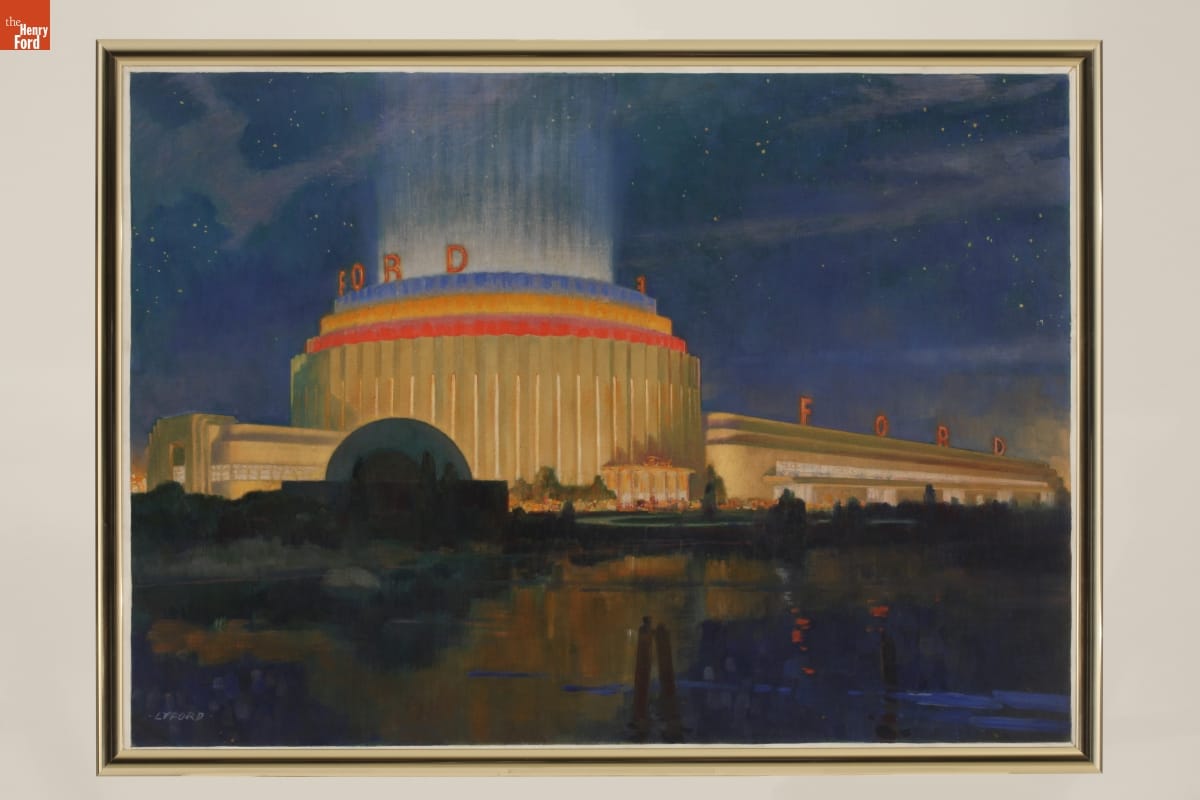
Ford Rotunda by Philip Lyford, 1933-1934
Chicago's 1933-34 Century of Progress Exposition used the theme of progress to encourage optimism during the Depression. The 11-acre Ford Motor Company exhibit became the most talked-about exhibit of 1934, featuring a central Rotunda designed to simulate graduated clusters of gears. After the fair, this building became an attraction at Ford headquarters in Dearborn, Michigan, until it burned down in 1962.
View ArtifactBooklet, "The Industrialized American Barn," 1934
Henry Ford moved the William Ford barn from Dearborn to the 1934 Century of Progress Exposition in Chicago to demonstrate how soybeans could be processed for industrial uses in an ordinary American barn. Ford published this booklet to explain the process, and how it could create a better future for the American farmer.
View ArtifactMiniature Dynamo, Displayed at the New York World's Fair, 1939
Henry Ford firmly believed in the "practical educational value" of World's Fair exhibits. During the 1939-40 New York World's Fair, he highlighted the work of students attending his experimental schools. In a miniature machine shop in the Ford building, boys from Ford's Edison Institute Schools operated quarter-size replicas, including this dynamo, based on machines from Thomas Edison's Menlo Park.
View ArtifactMiniature Lathe, Displayed at the New York World's Fair, 1939
Henry Ford firmly believed in the "practical educational value" of World's Fair exhibits. During the 1939-40 New York World's Fair, he highlighted the work of students attending his experimental schools. In a miniature machine shop in the Ford building, boys from Ford's Edison Institute Schools operated quarter-size replicas, including this lathe, based on machines from Thomas Edison's Menlo Park.
View ArtifactMiniature Milling Machine, Displayed at the New York World Fair, 1939
Henry Ford firmly believed in the "practical educational value" of World's Fair exhibits. During the 1939-40 New York World's Fair, he highlighted the work of students attending his experimental schools. In a miniature machine shop in the Ford building, boys from Ford's Edison Institute Schools operated quarter-size replicas, including this milling machine, based on machines from Thomas Edison's Menlo Park.
View ArtifactAdvertisement for the 1940 Ford Deluxe Fordor Sedan, "Watch the Fords Go By"
Ford Motor Company featured its exposition at the 1939-40 New York World's Fair in national advertisements. This print ad depicts the Ford exposition's Road of Tomorrow experience, which suggested forward-looking techniques for safer, quieter, more efficient roadways. Even if they could not attend the fair, readers across the country could imagine themselves in "modern cars" - Fords - "for modern highways."
View ArtifactBooklet, "100 Reasons Why You Should Own a Ford V-8," 1934
Ford Motor Company's 1934 models featured only minor changes from the previous year. The grille had fewer vertical bars, side hood louvers went from curved to straight, and new painted hubcaps were seen on V-8 cars. Prices started at $585 for a Fordor sedan with the V-8. The four-cylinder Fordor was priced $50 lower. Calendar year production was 563,921 units.
View ArtifactTwo Automobiles Touring Part of the 'Roads of the Pacific' Exhibit, California Pacific International Exposition, San Diego, 1935
The Ford Exhibit--the most popular attraction at the 1935 California Pacific International Exposition--featured "Roads of the Pacific." Visitors rode in brand new Ford V-8s through realistic reproductions of historic and modern routes. In this photograph, two groups of riders round a bend on one of the 14 sections comprising the immersive experience.
View ArtifactVisitors inside Rotunda, Ford Exhibition Building, Century of Progress International Exposition, Chicago, Illinois, 1934
Ford Motor Company mounted the most talked-about exhibition in Chicago during the World's Fair in 1934. One attraction, a revolving globe in the Ford rotunda building's central Court of the World, illustrated Ford's growing industrial presence in mining, logging, and manufacturing operations around the world. This large three-dimensional map exemplified the fair's Century of Progress theme.
View ArtifactRotunda, Ford Exhibition Building, Century of Progress International Exposition, Chicago, Illinois, 1934
Chicago's 1933-34 Century of Progress Exposition used the theme of progress to encourage optimism during the Depression. The Ford Exhibition Building, which sat on eleven acres at the fair and featured industrial demonstrations and informative displays like this, became the most talked-about exhibit of 1934.
View ArtifactQuadricycle inside Replica of Henry Ford's Workshop, Century of Progress International Exposition, Chicago, Illinois, 1934
Chicago's 1933-34 Century of Progress Exposition used the theme of progress to encourage optimism during the Depression. Ford Motor Company's popular exhibition at the fair included the century room, where fairgoers found a nineteenth-century machine shop, a replica of Henry Ford's first workshop, and the Quadricyle -- the original Ford automobile.
View ArtifactFord By-Products Exhibit, Ford Exhibition Building, Century of Progress International Exposition, Chicago, Illinois,1934
Chicago's 1933-34 Century of Progress Exposition used the theme of progress to encourage optimism during the Depression. The Ford Exhibition Building, which sat on eleven acres at the fair and featured industrial demonstrations and informative displays like this, became the most talked-about exhibit of 1934.
View ArtifactFord Automobile Next to Roads of the World Exhibit, Century of Progress International Exposition, Chicago, Illinois, 1934
Ford Motor Company recreated 21 sections of different historic and modern roadways outside the Ford Exhibition Building at Chicago's Century of Progress Exposition in 1934. Fairgoers could tour these reproduction "Roads of the World" in courtesy vehicles.
View ArtifactSoybean Field outside the Ford Exhibition Building, Century of Progress International Exposition, Chicago, Illinois, 1934
Chicago's 1933-34 Century of Progress Exposition used the theme of progress to encourage optimism during the Depression. The 11-acre Ford Motor Company exhibit became the most talked-about exhibit of 1934, featuring a central Rotunda designed to simulate graduated clusters of gears. After the fair, this building became an attraction at Ford headquarters in Dearborn, Michigan, until it burned down in 1962.
View ArtifactReplica of the Vaughan Plank Road, Roads of the World, Century of Progress International Exposition, Chicago, Illinois, 1934
"Roads of the World" was part of the Ford Motor Company's exhibition at Chicago's Century of Progress Exposition in 1934. Fairgoers rode in brand new Ford V-8s over 21 reproductions of famous roadways. This section representing an historic Canadian plank road contributed to the immersive "Roads of the World" experience.
View ArtifactPresenter inside the Rotunda of the Ford Exhibition Building, Century of Progress International Exposition, Chicago, IL, 1934
Chicago's 1933-34 Century of Progress Exposition used the theme of progress to encourage optimism during the Depression. The Ford Exhibition Building, which sat on eleven acres at the fair and featured industrial demonstrations and informative displays like this, became the most talked-about exhibit of 1934.
View ArtifactProof of Safety Exhibit, Ford Building, Century of Progress International Exposition, Chicago, Illinois, 1934
Chicago's 1933-34 Century of Progress Exposition used the theme of progress to encourage optimism during the Depression. The Ford Exhibition Building, which sat on eleven acres at the fair and featured industrial demonstrations and informative displays like this, became the most talked-about exhibit of 1934.
View ArtifactOut of the Earth Exhibit, Ford Exhibition Building, Century of Progress International Exposition, Chicago, Illinois, 1934
Chicago's 1933-34 Century of Progress Exposition used the theme of progress to encourage optimism during the Depression. The Ford Exhibition Building, which sat on eleven acres at the fair and featured industrial demonstrations and informative displays like this, became the most talked-about exhibit of 1934.
View ArtifactSoybean Processing for Fiber and Oil, Ford Exposition, New York World's Fair, 1939
Ford Motor Company poured resources into the 1939-40 New York World's Fair, spending more than $5 million to construct and maintain its elaborate and well-attended exposition space. Ford's massive exhibition building attracted fairgoers with industrial demonstrations and informative displays in two main halls. At the "industrialized farm," visitors could learn about soybeans and watch presenters process them into plastics and fibers.
View ArtifactHenry Ford Trade School Students at Ford Exposition, New York World's Fair, 1939
Henry Ford viewed national expositions as business opportunities and platforms for public education. During the 1939-40 New York World's Fair, Ford Motor Company spent more than $5 million to build and maintain an elaborate exposition space. Informative displays and manufacturing demonstrations inside Ford's massive fair building offered visitors an in-depth, entertaining, and educational look at industrial processes.
View ArtifactEdsel and Henry Ford in front of 27-Millionth Ford Car, Ford Exposition, New York World's Fair, 1939
On February 15, 1939, the twenty-seven millionth Ford automobile rolled off a Richmond, California, assembly line. The green DeLuxe Tudor embarked on a promotional tour from San Francisco to New York City and back -- an 8,854-mile circuit. During this transcontinental journey, the famous sedan -- and a visit from Henry and Edsel Ford -- drew crowds at the New York World's Fair.
View ArtifactHenry Ford Trade School Students "Learn by Doing" at New York World's Fair, 1939-1940
Henry Ford firmly believed in the "practical educational value" of World's Fair exhibits. To help accomplish his education mission during the 1939-40 New York World's Fair, he highlighted the work of students attending his experimental schools. Here, boys from Henry Ford's Edison Institute Schools demonstrate miniature machine replicas based on Thomas Edison's Menlo Park Machine Shop.
View ArtifactBrochure Advertising Ford V-8 Automobiles and the Century of Progress Exposition, 1934
Ford Motor Company's 1934 models featured only minor changes from the previous year. The grille had fewer vertical bars, side hood louvers went from curved to straight, and new painted hubcaps were seen on V-8 cars. Prices started at $585 for a Fordor sedan with the V-8. The four-cylinder Fordor was priced $50 lower. Calendar year production was 563,921 units.
View ArtifactBrochure, "Ford Exposition, A Century of Progress," 1934
Chicago's 1933-34 Century of Progress Exposition highlighted progress to encourage optimism during the Great Depression. The Ford Motor Company exhibit became the most talked-about exhibit of 1934, featuring a central Rotunda building designed to simulate graduated clusters of gears. The phrase "ONE-THIRD OF A CENTURY OF PROGRESS PRODUCED THE FORD V-EIGHT" refers to the 30-year history of Ford Motor Company.
View ArtifactBrochure, "New Ford V-8 Trucks," 1934
Ford Motor Company's 1934 trucks were only slightly changed in appearance from the previous model year, though the blue oval logo was added to the side of the hood. The stake body version was particularly versatile. The racks were removable to ease loading or accommodate oversized cargo. Ford's trucks were powered by the company's flathead V-8 engine.
View ArtifactBrochure, "The Ford Rotunda, Fifty Years Forward on the American Road" 1953
Ford Motor Company brought its central Rotunda building from the 1934 Century of Progress Exposition back to Dearborn and, from 1936 to 1962, recreated the excitement of a World's Fair exposition on its home turf. This souvenir book commemorated Ford's 50th Anniversary in 1953. The Ford Rotunda reopened then, with renovations that included a geodesic dome designed by Buckminster Fuller.
View ArtifactHenry Ford Trade School Information Brochure, 1931-1941
Boys who attended the Henry Ford Trade School learned by doing. The school, the brainchild of Henry Ford, trained teenage boys in a variety of skilled industrial trade work -- machining, metallurgy, drafting, and engine design, among others. Students created useful components for local factories in hands-on lab and shop classes. In addition to the manual training received, academic classes were required.
View ArtifactSketch of the Ford Exhibition Building for the Century of Progress Exposition, 1933-1934
Chicago's 1933-34 Century of Progress Exposition used the theme of progress to encourage optimism during the Great Depression. The Ford Motor Company exhibit became the most talked-about exhibit of 1934, featuring a central Rotunda building designed to simulate graduated clusters of gears. This sketch was created by Albert Kahn Inc., the architects of the building.
View ArtifactSouvenir Brochure, "Roads of the World, Ford Exposition, 'A Century of Progress' Chicago," 1934
Chicago's 1933-34 Century of Progress Exposition highlighted progress to encourage optimism during the Great Depression. The Ford Motor Company exhibit became the most talked-about exhibit of 1934. In its "Roads of the World" feature, guests could walk over, or ride in cars alongside, replicas of 21 world-famous thoroughfares ranging from the earliest Roman types to the most modern highway construction.
View ArtifactPostcard, Ford Motor Company Exhibit Building, California-Pacific International Exposition, San Diego, California, 1935
Ford's steel, concrete, and glass exhibition building towered above more traditional structures at the 1935 California Pacific International Exposition in San Diego. The Ford Building -- created in the "Streamline Moderne" architectural style by industrial design pioneer Walter Dorwin Teague -- combined clean curves and sharp lines with modern materials, reflecting technological progress in the new machine age.
View ArtifactPostcard, Ford Motor Company at Century of Progress International Exposition, Chicago, Illinois, 1934
Chicago's 1933-34 Century of Progress Exposition used the theme of progress to encourage optimism during the Depression. This postcard depicts Ford Motor Company's 1934 exhibition building, which featured a central Rotunda designed to simulate graduated clusters of gears. After the fair, this building became an attraction at Ford headquarters in Dearborn, Michigan, until it burned down in 1962.
View ArtifactProgram of Events, "One Hundred Car Dealers Meeting" at the Golden Gate International Exposition, San Francisco, 1940
The 1939 Golden Gate International Exposition reflected American aspirations at the end of the Great Depression. Held on Treasure Island -- a manmade island in San Francisco Bay -- the fair celebrated the completion of the San Francisco-Oakland Bay and Golden Gate bridges. This program contains the menu for a Ford dealers' meeting at the "beautiful Ford exhibit" on Treasure Island.
View ArtifactBrochure, "Ford Charcoal Briquets, Fuel of a Hundred Uses," 1935-1941
Ford Motor Company sawmills created heaps of wood wastes. Some was used to produce steam for factory operations. The rest was carbonized and compressed into charcoal. Workers mixed charred hardwood chips with starch, forming nearly 100 tons of charcoal briquettes each day. This 1930s brochure suggests the many uses for this Ford byproduct.
View ArtifactSales Brochure, "New Ford V-8 Cars for 1939"
Ford offered models in Standard and DeLuxe series for 1939. The fancier DeLuxe models featured a refreshed, modern appearance with teardrop headlights and a low-set grille. The big news for 1939 was that, for the first time, all Ford cars came equipped with hydraulic brakes.
View ArtifactSales Brochure, "1939 Ford V-8 Trucks"
Ford Motor Company's truck lineup for 1939 included pickups, panel trucks, stake body and platform models, and sedan delivery vehicles. Larger commercial models were available in dump truck and cab-over-engine configurations. Power came from V-8 engines available with displacements of 136 or 221 cubic inches.
View ArtifactSales Brochure, "1939 Ford V-8 Commercial Cars"
Ford Motor Company's truck lineup for 1939 included pickups, panel trucks, stake body and platform models, and sedan delivery vehicles. Larger commercial models were available in dump truck and cab-over-engine configurations. Power came from V-8 engines available with displacements of 136 or 221 cubic inches.
View ArtifactSales Brochure for the 1939 Lincoln Zephyr V-12, "The Modern "12" for the Modern World"
The Lincoln Zephyr's V-12 engine was adapted from Ford's successful flathead V-8. Engineers added four cylinders, narrowed the angle of the V, and made other modifications. Unfortunately, the engine suffered from inadequate ventilation and poor oil flow, which led to overheating and excessive wear. Nevertheless, with 200,000 units sold, the Zephyr engine was the most successful American-built V-12.
View ArtifactSouvenir Brochure, "The Ford Exposition, New York World's Fair," 1939-1940
The 1939-40 New York World's Fair encouraged a depression-weary public that the future would be rosy. Ford Motor Company was a major participant in this fair. This brochure highlights the Ford Exposition building's many features, including its stunning architectural design by industrial designer Walter Dorwin Teague, its interior exhibits, new car models, and its outdoor, drivable "Road of Tomorrow."
View ArtifactSouvenir Brochure, "Ford at the California-Pacific International Exposition, San Diego, 1935"
Ford Motor Company poured resources into the 1935 California Pacific International Exposition in San Diego, constructing the fair's largest and most popular exhibition. This souvenir publication highlights Ford's exhibits there, including its unique car manufacturing methods and materials, displays of new car models, and the outdoor, drivable "Roads of the Pacific."
View ArtifactFord Falcon Automobile and Christmas Tree Inside the Ford Rotunda Building, Dearborn, Michigan, 1959
After the Chicago Century of Progress Exposition ended in 1934, Ford Motor Company brought back its central Rotunda building from that fair to Dearborn, to serve as a visitor center and starting point for Rouge Plant tours. However, its biggest draw between 1953 and 1961 was the annual "Christmas Fantasy," shown here. Unfortunately, the Rotunda burned down in November 1962.
View ArtifactFord Gyron Automobile Displayed at the Ford Rotunda Building, Dearborn, Michigan, 1961
Ford Motor Company brought its central Rotunda building from the 1934 Century of Progress Exposition back to Dearborn and, from 1936 to 1962, recreated the excitement of a World's Fair exposition on its home turf. People flocked to the Dearborn Rotunda when new car models were displayed, like the Ford Gyron, a futuristic two-wheeled gyrocar introduced in 1961.
View ArtifactSanta's Wonderland Castle at the Ford Rotunda Building, Dearborn, Michigan, 1961
After the Chicago Century of Progress Exposition ended in 1934, Ford Motor Company brought back its central Rotunda building from that fair to Dearborn, to serve as a visitor center and starting point for Rouge Plant tours. However, its biggest draw between 1953 and 1961 was the annual "Christmas Fantasy," shown here. Unfortunately, the Rotunda burned down in November 1962.
View ArtifactConceptual Drawing of the Ford Exhibition Building for the New York World's Fair, 1939
Ford Motor Company, a major participant in the 1939-40 New York World's Fair, hired industrial designer Walter Dorwin Teague to create its exhibition building in New York City's Flushing Meadows-Corona Park. This conceptual rendering shows the entrance to Teague's Ford Building. It features a stainless steel sculpture depicting Mercury, whose mythological speed symbolized the swift progress of modern transportation.
View ArtifactSanta Claus Seated on White Ford Tractor, Inside the Ford Rotunda Building, Dearborn, Michigan, 1961
After the Chicago Century of Progress Exposition ended in 1934, Ford Motor Company brought back its central Rotunda building from that fair to Dearborn, to serve as a visitor center and starting point for Rouge Plant tours. However, its biggest draw between 1953 and 1961 was the annual "Christmas Fantasy," shown here. Unfortunately, the Rotunda burned down in November 1962.
View ArtifactFord Thunderbird Display Inside the Ford Rotunda Building, Dearborn, Michigan, 1961
After the Chicago Century of Progress Exposition ended in 1934, Ford Motor Company brought back its central Rotunda building from that fair to Dearborn, to serve as a visitor center and starting point for Rouge Plant tours. However, its biggest draw between 1953 and 1961 was the annual "Christmas Fantasy," shown here. Unfortunately, the Rotunda burned down in November 1962.
View ArtifactPoster, "See, Play, Hear. Chicago 1934 World's Fair: A Century of Progress," 1934
Hungarian-born artist A. Raymond Katz, or Sandor as he often signed his work, captures the liveliness of the 1934 World's Fair in this streamlined poster. A portrait of iconic burlesque "fan dancer" Sally Rand points the viewer towards another highlight -- the architectural showpiece Sky Ride, which shuttled fair goers in rocket-shaped cars more than 200 feet above the ground.
View ArtifactFord at the Fair, Century of Progress Exposition, 1934
Chicago's 1933-34 Century of Progress Exposition used the theme of progress to encourage optimism during the Depression. The 11-acre Ford Motor Company exposition became the most talked-about exhibit of 1934, featuring a variety of industrial demonstrations and informative displays. Ford produced this booklet as a souvenir for fairgoers who visited the Ford Building.
View ArtifactNew York World's Fair Ford Exposition Ashtray, 1939
Coming at the end of a decade of worldwide economic depression, the 1939-40 New York World's Fair placed a distinct emphasis on consumerism as the means to prosperity and social unity. This souvenir ashtray from the Ford Motor Company exhibit advertised a Ford four-door sedan from the company's latest product line.
View ArtifactA Century of Progress World's Fair Ford Rotunda Tray, 1934
Chicago's 1933-34 Century of Progress Exposition used the theme of progress to encourage optimism during the Depression. The Ford Motor Company exhibit became the most talked-about exhibit of 1934, featuring a central Rotunda designed to simulate graduated clusters of gears. After the fair, this building became an attraction at Ford headquarters in Dearborn, Michigan, until it burned down in 1962.
View ArtifactFord V-8 Souvenir Medal from Century of Progress Exposition, 1934
Ford Motor Company produced this commemorative coin for the Ford Exposition at the Century of Progress 1934 Chicago World's Fair. This souvenir reminded visitors of their time at the fair. It also advertised Ford's newest innovation, the V-8 engine. Ford introduced the V-8, the first compact and powerful engine affordable to the general auto-buying public, in 1932.
View ArtifactChildren's Activity Book, "Christmas at the Ford Rotunda," 1958
After the Century of Progress Exposition ended in 1934, Ford Motor Company brought its central Rotunda building from that fair back to Dearborn. From 1936 to 1962, Ford recreated the excitement of a World's Fair exposition on its home turf. This souvenir Christmas book from 1958 was illustrated by noted children's book illustrator Richard Scarry.
View ArtifactSales Brochure, "Know the Thrill of Driving the New Ford V-8," 1934
Ford's V-8 engine, introduced in 1932, was an immediate hit, outselling the company's four-cylinder unit from the start. This 1934 brochure promoted the V-8's technical design, its smooth performance, and its accomplishments on the race track. Low price was the engine's greatest feature -- the Ford V-8 started at $510, while the nearest-competing V-8 car started around $2,500.
View ArtifactFord Rotunda Commemorative Plate, 1957
After the Century of Progress Exposition ended in 1934, Ford Motor Company brought its central Rotunda building from that fair back to Dearborn. From 1936 to 1962, Ford recreated the excitement of a World's Fair exposition on its home turf. This plate, with a transfer print in the center, was used in Ford's corporate dining room.
View ArtifactPoster, "Visit Ford Exposition, Century of Progress, Chicago" 1934
Chicago's 1933-34 Century of Progress Exposition used the theme of progress to encourage optimism during the Great Depression. The Ford Motor Company exhibit became the most talked-about exhibit of 1934, featuring a central Rotunda building designed to simulate graduated clusters of gears. This poster was probably posted at Ford dealerships.
View ArtifactFord Charcoal Briquets Bag, 1929-1947
Ford Motor Company sawmills created heaps of wood wastes. Some was used to produce steam for factory operations. The rest was carbonized and compressed into charcoal. Workers mixed charred hardwood chips with starch, forming nearly 100 tons of charcoal briquettes each day. Dealers sold branded bags of the popular briquettes in Ford dealerships across the country.
View ArtifactCentury of Progress Souvenir Specimen Box of Materials Used in Ford Automobile Manufacture, 1934
Ford Motor Company mounted the most talked-about exhibition in Chicago during the World's Fair in 1934. One highlight of the Ford Exposition building was "Out of the Earth" -- a series of dioramas showing the major resources used in automotive production. Visitors could return home with souvenir boxes that contained samples of some of these natural materials.
View Artifact"Ford at the Fair," Century of Progress Exposition, 1934
Chicago's 1933-34 Century of Progress Exposition used the theme of progress to encourage optimism during the Depression. The 11-acre Ford Motor Company exposition became the most talked-about exhibit of 1934, featuring a variety of industrial demonstrations and informative displays. Ford produced this booklet as a souvenir for fairgoers who visited the Ford Building.
View ArtifactFord Souvenir Salt & Pepper Set From Texas Centennial Exposition, 1936
Scientists at Ford's Soybean Laboratory developed a variety of plastic products made from soybean solids left when the oil was extracted, including gear shift knobs. These soybean gear shift knobs were converted into a set of souvenir salt and pepper shakers for the 1936 Texas Centennial Exposition.
View ArtifactSouvenir Card, "Industrial Products Made from Soy Beans," circa 1934
Starting in 1931, Henry Ford invested much money and research into soybeans. He viewed the crop as a bridge between agriculture and industry. Based on this work, soy-based materials were incorporated into Ford Motor Company vehicles. Soybean oil was used in body enamels, for example, while soy meal was used in the plastic for gear shift knobs and horn buttons.
View ArtifactFord V-8 Medal From Century of Progress International Exposition, 1934
Ford Motor Company produced this commemorative coin for the Ford Exposition at the Century of Progress 1934 Chicago World's Fair. This souvenir reminded visitors of their time at the fair. It also advertised Ford's newest innovation, the V-8 engine. Ford introduced the V-8, the first compact and powerful engine affordable to the general auto-buying public, in 1932.
View Artifact"Ford Rotunda Presents a Glimpse of Your Dearborn Holiday," 1957
Ford Motor Company brought its central Rotunda building from the 1934 Century of Progress Exposition back to Dearborn and, from 1936 to 1962, recreated the excitement of a World's Fair exposition on its home turf. This brochure enticed travelers to visit the Ford Rotunda, Rouge Plant, Ford Research and Engineering Center, Greenfield Village, and even Michigan's "water wonderland."
View Artifact"Herald," Volume VI, February 11, 1939 to January 19, 1940
The students of the Greenfield Village and Associated Schools of the Edison Institute began publishing the Herald in 1934. They took the name from a weekly newspaper printed and sold by Thomas Alva Edison when he worked for the Grand Trunk Railroad in 1862-63. The students' version included articles on academic, social, and recreational activities. The publication continued until 1952.
View ArtifactSouvenir Brochure, "You are Cordially Invited to Visit the Ford Rotunda and Rouge Plant," Dearborn, Michigan, 1938
After the Century of Progress Exposition ended in 1934, Ford Motor Company brought its central Rotunda building from that fair back to Dearborn. From 1936 to 1962, Ford recreated the excitement of a World's Fair exposition on its home turf. This 1938 travel brochure attempted to entice travelers to visit the Ford Rotunda soon after its opening.
View ArtifactModel of Menlo Park Machine Shop Built for the New York World's Fair, Set Up inside Henry Ford Museum, March 31, 1939
Henry Ford firmly believed in the "practical educational value" of World's Fair exhibits. To help accomplish his education mission during the 1939-40 New York World's Fair, he highlighted the work of students attending his experimental schools. Here, boys from Henry Ford's Edison Institute Schools operated miniature machine replicas based on Thomas Edison's Menlo Park Machine Shop.
View ArtifactFord Rotunda Construction Site, Dearborn, Michigan, June 11, 1935
The Rotunda was built for the Ford Motor Company exhibition at the 1934 Chicago World's Fair. It was later rebuilt in Dearborn, Michigan, where it served as a hospitality center for tourists from 1936 to 1962. This photograph shows the Rotunda under construction at its second and final home - across from the Administration Building at Ford's River Rouge Plant.
View ArtifactFord Rotunda Construction Site, Dearborn, Michigan, July 31, 1935
After the Century of Progress Exposition ended in 1934, Ford Motor Company brought its central Rotunda building from that fair back to Dearborn. From 1936 to 1962, Ford recreated the excitement of a World's Fair exposition on its home turf. This photo, from July 31, 1935, shows the Ford Rotunda being constructed in Dearborn.
View ArtifactHenry Ford and Edsel Ford inside Ford Rotunda, Dearborn, Michigan, 1936
After the Century of Progress Exposition ended in 1934, Ford Motor Company brought its central Rotunda building from that fair back to Dearborn. From 1936 to 1962, Ford recreated the excitement of a World's Fair exposition on its home turf. This photo depicts Henry and Edsel Ford at the Ford Rotunda on its opening day, May 16, 1936.
View ArtifactCourtyard inside Ford Rotunda Building, Dearborn, Michigan, 1937
Ford Motor Company brought its central Rotunda building from the 1934 Century of Progress Exposition back to Dearborn and, from 1936 until a devastating fire destroyed the building in 1962, recreated the excitement of a World's Fair exposition on its home turf. This photo shows the central courtyard inside the building soon after it opened in 1937.
View ArtifactAerial View of Ford Rotunda, the Rouge Plant and Administration Building, Dearborn, Michigan, 1939
The Rotunda was built for the Ford Motor Company exhibition at the 1934 Chicago World's Fair. It was later rebuilt in Dearborn, Michigan, where it served as a hospitality center for tourists from 1936 to 1962. This photograph shows the Rotunda in its second and final home -- across from the Administration Building at Ford's River Rouge Plant.
View ArtifactFord Rotunda, 1953
The Rotunda was built for the Ford Motor Company exhibition at the 1933 Chicago World's Fair. It was later rebuilt in Dearborn, Michigan, where it served as a hospitality center for tourists from 1936 to 1962. This photograph shows the renovated Rotunda that reopened in 1953 for Ford Motor Company's 50th anniversary. It housed exhibits featuring progressive research and engineering.
View ArtifactFord Rotunda Fire, Dearborn, Michigan, November 9, 1962
Ford Motor Company brought its central Rotunda building from the 1934 Century of Progress Exposition back to Dearborn and, from 1936 to 1962, recreated the excitement of a World's Fair exposition on its home turf. This photo vividly depicts the Ford Rotunda fire, November 9, 1962, caused when a sealer for the geodesic dome ignited accidentally from a propane heater.
View ArtifactMenu of Soybean Dinner Served at Ford Exhibit, Century of Progress, August 17, 1934
Ford Motor Company's exhibition at Chicago's 1933-34 Century of Progress Exposition included the industrial barn. Here, exhibitions and demonstrations illustrated Henry Ford's belief that soybeans could unify agriculture and industry, building more profitable farms. A special dinner held on August 17, 1934, showcased the crop's wide-ranging culinary potential.
View ArtifactAerial View of Ford Exhibit Building at California Pacific International Exposition, San Diego, California, 1935
Ford Motor Company poured resources into the 1935 California Pacific International Exposition in San Diego, constructing the fair's largest and most popular exhibition. Ford's massive Exposition building enclosed an open-air courtyard with a V-8 emblem-shaped fountain.
View ArtifactFord Exhibit Building, Century of Progress Exposition, Chicago, Illinois, 1934
Chicago's 1933-34 Century of Progress Exposition used the theme of progress to encourage optimism during the Depression. The 11-acre Ford Motor Company exhibit became the most talked-about exhibit of 1934, featuring a central Rotunda designed to simulate graduated clusters of gears. After the fair, this building became an attraction at Ford headquarters in Dearborn, Michigan, until it burned down in 1962.
View ArtifactFord Exhibit Building at Golden Gate International Exposition, San Francisco, California, 1939-1940
The 1939 Golden Gate International Exposition reflected American aspirations at the end of the Great Depression. Held on Treasure Island -- a manmade island in San Francisco Bay -- the fair celebrated the completion of the San Francisco-Oakland Bay and Golden Gate bridges. Ford was a major participant at this fair, claiming a large building near the ferry entrance to the fairgrounds.
View ArtifactFord Industrialized Barn, Century of Progress International Exposition, Chicago, Illinois, 1934
Chicago's 1933-34 Century of Progress Exposition used the theme of progress to encourage optimism during the Depression. Ford Motor Company's popular exhibition at the fair included the industrial barn, where a machine shop and experiments with soybeans demonstrated new possibilities for more profitable farms.
View ArtifactFord Exhibit Building, Texas Centennial Central Exposition, Dallas, Texas, 1936
The Texas Centennial Exposition in Dallas celebrated the frontier past of Texas, especially its 1836 victory over Mexico. The Ford Motor Company Pavilion, among the largest of industrial firms' buildings at the fair, was designed by industrial designer Walter Dorwin Teague. Its interior displays focused on how agriculture and natural resources of the Southwest could be transformed into car parts.
View ArtifactHenry Ford's 1896 Quadricycle on Display at New York World's Fair, 1939-1940
Ford Motor Company poured resources into the 1939-40 New York World's Fair, spending more than $5 million to construct and maintain its elaborate and well-attended exposition space. Ford's massive exhibition building attracted fairgoers with industrial demonstrations and informative displays. In the entrance hall, visitors could view Henry Ford's first automobile, the Quadricycle.
View ArtifactPeople Viewing the Ford Cycle of Production Exhibit, Ford Exposition, New York World's Fair, 1939-1940
The "Ford Cycle of Production," featured at the Ford Exposition building during the 1939-40 New York World's Fair, was a huge revolving wedding-cake turntable with tiers that floated on pontoons in a moat. With 87 working models and 142 animated figures, it illustrated how 27 raw materials (at the bottom) were progressively transformed into parts for automobiles (at the top).
View ArtifactPresenting the Soybean Extractor, Texas Centennial Central Exposition, Dallas, Texas, 1936
Ford promoted soybeans at the World Fairs and Exposition of the 1930s. In this image, a presenter at the Texas Centennial Exposition demonstrates how the soybean extraction process works with a model of a soybean extractor.
View Artifact"Industries Within an Industry, Ford By-Products," Ford Motor Company, 1939
Henry Ford was careful about reducing and reusing waste products from his factories. Wasted materials meant wasted money, which led to higher prices for the customer. Illuminating gas was taken from coke ovens. Portland cement was made from blast furnace slag. Most famously, wood scraps from Ford's Kingsford, Michigan, sawmills were converted into charcoal briquettes.
View Artifact"Industries Within an Industry, Ford By-Products," Ford Motor Company, 1939
Henry Ford was careful about reducing and reusing waste products from his factories. Wasted materials meant wasted money, which led to higher prices for the customer. Illuminating gas was taken from coke ovens. Portland cement was made from blast furnace slag. Most famously, wood scraps from Ford's Kingsford, Michigan, sawmills were converted into charcoal briquettes.
View Artifact"Recipes for Soy Bean Foods," Ford Motor Company, circa 1939
Throughout the 1930s, Henry Ford vigorously promoted soybeans as a versatile crop with industrial and culinary potential. This Ford Motor Company booklet touted soybeans as nutritious, inexpensive substitutes for traditional ingredients. It contains recipes that incorporate cooked soybeans, as well as soy-based milk, butters, and "cheese" (tofu).
View Artifact"Recipes for Soy Bean Foods," Ford Motor Company, circa 1939
Throughout the 1930s, Henry Ford vigorously promoted soybeans as a versatile crop with industrial and culinary potential. This Ford Motor Company booklet touted soybeans as nutritious, inexpensive substitutes for traditional ingredients. It contains recipes that incorporate cooked soybeans, as well as soy-based milk, butters, and "cheese" (tofu).
View Artifact"On Your Way to Two 1939 Fairs, You are Cordially Invited to Visit the Ford Rotunda and Rouge Plant," Dearborn, Michigan, 1939
Ford Motor Company brought its central Rotunda building from the 1934 Century of Progress Exposition back to Dearborn and, from 1936 to 1962, recreated the excitement of a World's Fair exposition on its home turf. This brochure enticed travelers visiting one of the 1939 world's fairs to visit the Ford Rotunda and Rouge Plant in Dearborn.
View Artifact"On Your Way to Two 1939 Fairs, You are Cordially Invited to Visit the Ford Rotunda and Rouge Plant," Dearborn, Michigan, 1939
Ford Motor Company brought its central Rotunda building from the 1934 Century of Progress Exposition back to Dearborn and, from 1936 to 1962, recreated the excitement of a World's Fair exposition on its home turf. This brochure enticed travelers visiting one of the 1939 world's fairs to visit the Ford Rotunda and Rouge Plant in Dearborn.
View Artifact

