
Featured on The Henry Ford's Innovation Nation: Season 2
Share
share
These key artifacts appeared on the second season of The Henry Ford’s Innovation Nation. For episode information, please visit https://www.thehenryford.org/explore/innovation-nation/episodes.
THF1927
Edison Illuminating Company's Station A
This power plant is an edited, scaled-down version of the station in Detroit where Henry Ford became Chief Engineer; it is also a setting for one of Edison's most startling electrical devices -- the only surviving "Jumbo" dynamo from Manhattan's Pearl Street Station. During his time working for the Edison Illuminating Company Henry Ford built his first car -- and had his first meeting with Thomas Edison.
View ArtifactJacquard Loom, 1934
Joseph-Marie Jacquard's loom, first developed in 1801, is programmable. It used a series of punched cards to control the lifting of each individual warp thread to weave a figured fabric. With this loom, weavers could create intricate patterns more easily, faster, and with better accuracy. Punch card technology became the basis for computer data storage during the 20th century.
View ArtifactNew Holland TR70 Axial Flow Combine, 1975
Engineers designed the TR70 as a compact machine suitable for hilly terrain. The twin rotors (TR) shelled corn or threshed grain and moved it through the combine's body. Setting the rotors at an angle (axial) shortened the machine. Farmers changed the front-end attachment to harvest corn, beans, or wheat. Stencils on this prototype, exhibited at trade shows, explained additional features.
View ArtifactLoranger Gristmill
Gristmills -- usually among the earliest businesses established in a community -- ground grain harvested by local farmers. This mill, originally located in Monroe, Michigan, was set up to grind both corn and wheat. It incorporates a sophisticated conveyor system, developed by Oliver Evans in the late 1700s, that moves grain through the building to undergo a variety of processes.
View ArtifactE. & H.T. Anthony & Co. Climax Portrait Camera, Used by the Baker Art Gallery, Columbus, Ohio
1901 Ford "Sweepstakes" Race Car
This is Henry Ford's first race car. After his first auto company failed, Ford turned to racing to restore his reputation. He raced "Sweepstakes" against Alexander Winton on October 10, 1901, and, to everyone's surprise, the novice Ford beat the established Winton. The victory and resulting publicity encouraged financiers to back Ford's second firm.
View ArtifactDeath Mask of Nikola Tesla on Pedestal, 1943
Nikola Tesla (1856-1943) is one of the greatest figures in the history of electrical power and telecommunications. His alternating current induction motor and pioneering work with polyphase electricity were fundamental to the development of today's electric power grid systems. This death mask, made of electroplated copper, was created at the request of Hugo Gernsback -- a publisher, writer, and friend of Tesla.
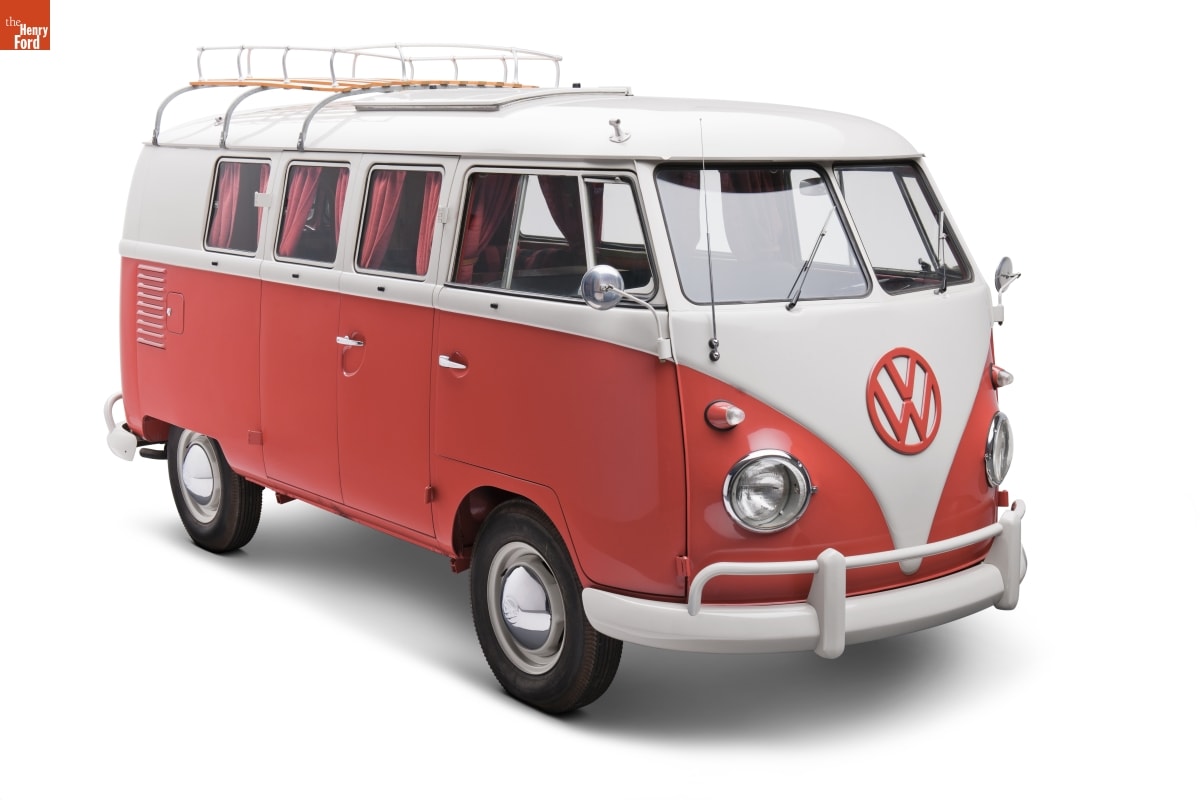
View Artifact1959 Volkswagen Westfalia Camper
Volkswagen introduced its "box on wheels," the VW Type 2 Bus, in 1949. A few years later, VW contracted with Westfalia and introduced converted campers. First exported to the U.S. in 1956, Westfalia campers provided home-like camping comfort and created a postwar recreational-vehicle lifestyle. This soon-to-be cultural icon transported Americans down highways and byways and into the great outdoors.
View ArtifactPortable Writing Desk, Owned by Edgar Allan Poe, 1830-1849
Edgar Allan Poe was an American writer known for poetry and short stories. His mystery stories were innovative in American literature. Poe led an unsettled life traveling up and down the East Coast of the United States, staying in jobs for short periods of time. For someone who earned his living through writing, a portable desk would have been a valued possession.
View ArtifactVideo Game, "E.T. the Extra-Terrestrial," Recovered from Landfill, Alamogordo, New Mexico, April 26, 2014, Site of the Atari Video Game Burial of 1983
In 1983, rumors circulated: Atari was bankrupt, and was dumping truckloads of games into a New Mexico landfill. Victim to the "Video Game Crash," the company buried 700,000 cartridges in the desert. The story became an obscure pop culture legend -- until "The Atari Tomb" was unearthed in 2014. This recovered cartridge is evidence of the world's first video game excavation.
View Artifact1928 Ford 4-AT-B Tri-Motor Airplane, "Floyd Bennett," Flown Over the South Pole by Richard E. Byrd
The Ford Tri-Motor was the most popular airliner of the late 1920s and early 1930s. Its rugged dependability led Richard Byrd to choose a Tri-Motor for his attempt to be the first person to fly over the South Pole. On November 28-29, 1929, Byrd and a crew of three achieved that goal in this plane.
View ArtifactGilkie Tent Trailer, circa 1927
Campers who wanted to get close to nature -- but not too close -- loved fold-out tent trailers. These two-wheelers folded down for easy towing by day and then mushroomed into miniature homes at night. Story has it that Warren and Ray Gilkison designed and built their first tent trailer in their father's machine shop for a family camping trip.
View ArtifactIntellivision: Intelligent Television Game, 1981-1985
Mattel released its home video game console, Intellivision, in 1980. With a 16-bit microprocessor, an industry first, Intellivision outshone its competitors with more advanced graphics and a versatile color palette. The Mattel product also introduced downloadable games and, later, synthesized speech. Intellivision was a hit. By 1982 over two million units had been sold.
View ArtifactEames Molded Plywood Dining Chair, 1947-1983
Highland Park Plant Engine- Generator, 1915-1916
Ford's Model T mass production system would not have been practical without electricity; by 1919 nine of these Ford-designed hybrid internal combustion/steam engines generated the power needed by the Highland Park plant's assembly lines and associated machinery. By 1926 the engines were rendered obsolete when electricity was fed from the power plant at Ford's River Rouge plant ten miles away.
View ArtifactLaboratory Model of Tesla Motor, circa 1889
Nikola Tesla's name is inseparable from the development of alternating current electricity--particularly with regard to polyphase transmission, but especially with regard to the induction motor. His motor, patented in 1888, was the first practical AC motor. George Westinghouse licensed Tesla's motor patents that same year--enabling the Westinghouse AC lighting system to become a real competitor with direct current systems.
View ArtifactThomas Edison's Fort Myers Laboratory
This well-equipped laboratory enabled Edison to carry on his investigations even as he seemed to seek a break from business and other matters. The first building to be completed in Greenfield Village, it had a second experimental life, offering seclusion to a select group of Ford Motor Company engineers tasked with developing the Ford V-8 engine in the early 1930s.
View ArtifactBook, "Our Vacation Days of 1918"
John Burroughs chronicled the Vagabonds' 1918 camping trip through the central Appalachians. The self-named Vagabonds -- Henry Ford, Thomas Edison, Harvey Firestone, and Burroughs -- began taking excursions in 1916 to relax and enjoy each other's company. They were joined by a fifth, Edward Hurley, on this adventure. Firestone later privately published Burroughs's "mock-up" under this title, Our Vacation Days of 1918.
View Artifact1949 Airstream Trailwind Travel Trailer
This familiar riveted, aluminum-skinned trailer was introduced in 1936 by trailer manufacturer Wally Byam. As tourism flourished after World War II, the Airstream gained a reputation as the quality leader in the travel trailer industry. Its popularity spawned well-organized caravans to famous travel destinations across the country.
View ArtifactAeron Chair Production Model, 2005
In the 1980s, Herman Miller furniture company designers Bill Stumpf and Don Chadwick created an easy chair for the elderly--called the Sarah Chair--but it was never commercially manufactured. Stumpf and Chadwick recognized that the modern workplace could benefit from the solutions they developed for the Sarah Chair. They used the lessons learned--and three more years of research--to create the Aeron, a groundbreaking office chair.
View ArtifactFarris Windmill
The Farris windmill is said to be the oldest windmill in the United States. It was built in the mid-1600s and operated in Cape Cod, Massachusetts. The Farris family ran it for three generations, starting in 1782. The wind moved the sails of this windmill to operate the grain milling machinery inside. The stone first floor was added at Greenfield Village.
View ArtifactFirestone Farmhouse
Benjamin and Catherine Firestone raised their three children in this farmhouse, including tire maker Harvey Firestone. Originally located near Columbiana, Ohio, the 1828 house was updated in 1882 to appear more stylish and up-to-date. The traditional Pennsylvania German layout of the Firestone's farmhouse was transformed, with a central foyer, separate dining room and kitchen, a sitting room, closets, wallpaper, and fancy new furniture.
View Artifact1939 Douglas DC-3 Airplane
The Douglas DC-3, introduced in 1936, carried 21 passengers -- enough to fly profitably without relying on subsidies from air mail contracts. While the DC-3's economy appealed to airlines, its rugged construction and comfortable cabin attracted passengers. More than any other aircraft, the DC-3 ushered in the era of dependable, long-distance air travel in the United States.
View ArtifactOwl Night Lunch Wagon Used by Henry Ford, circa 1890
The Henry Ford's Owl Night Lunch wagon is thought to be the last remaining horse-drawn lunch wagon in America. It served food to nighttime workers in downtown Detroit, and attracted such diverse clientele as reporters, politicians, policemen, factory workers, and supposedly even underworld characters! Among its customers was Henry Ford, a young engineer working at Edison Illuminating Company during the 1890s.
View ArtifactRocking Chair Used by Abraham Lincoln at Ford's Theater the Night of His Assassination, April 14, 1865
President Abraham Lincoln was sitting in this rocking chair during a production of Our American Cousin at Ford's Theatre in Washington, D.C., when he was assassinated on April 14, 1865. Henry Ford purchased the chair in 1929 for the Museum, where it remains one of the most revered objects associated with the "man who saved the Union."
View Artifact"Selfie" of Rudy Ruzicska and Mo Rocca in the Henry Ford Museum Photographic Studio, December 11, 2015
In December 2015, the crew of The Henry Ford's Innovation Nation filmed a segment on collections digitization in the museum's photographic studio. During the filming, show host Mo Rocca had the chance to interview Rudy Ruzicska, photographer at The Henry Ford for nearly six decades. While the camera rolled, Rudy snapped this "selfie" of himself and Mo.
View Artifact

