
Henry Ford: Henry Ford's Failures
Share
share
This Expert Set was compiled in 2013 to commemorate the 150th anniversary of Henry Ford’s birth.
THF90374
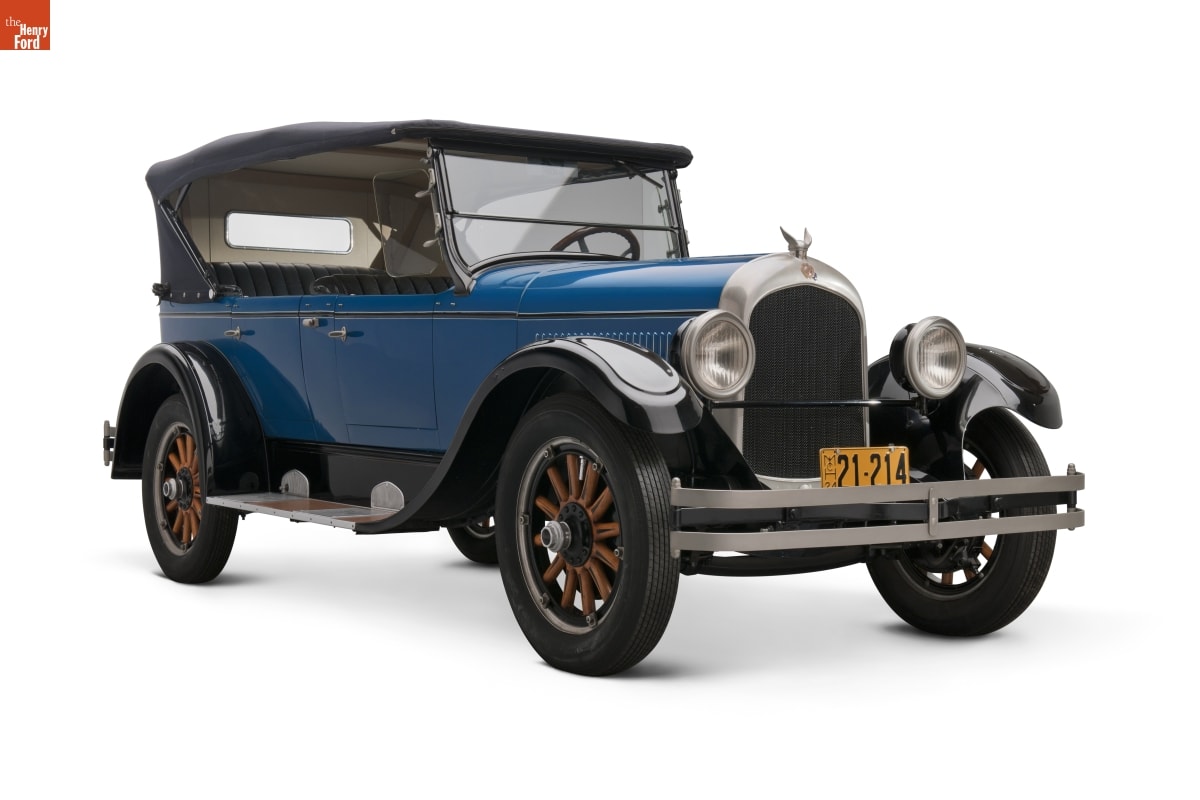
1924 Chrysler Touring Car
The first car to wear the Chrysler nameplate was perfectly suited to the Roaring Twenties. It was a decade of fast profits, fast music, and fast driving. A lightweight chassis and an efficient engine meant Chrysler drivers could out-accelerate Cadillacs costing twice as much. When Chrysler drivers stopped, they used modern hydraulic brakes instead of the Caddy's old-style mechanical brakes. Small wonder that Chrysler sales increased 500 percent from 1925 to 1929.
View ArtifactMemorandum from Ernest Kanzler to Henry Ford regarding Replacing the Model T, 1926
In January 1926, Ernest Kanzler wrote this eight-page memorandum to Henry Ford. In it Kanzler detailed his reasoning for replacing the aging Model T. While many other executives, including Ford's son, Edsel, secretly agreed, Henry resisted. Kanzler was forced out -- although the following year the last Model T rolled off the assembly line and was replaced with the new, modern Model A.
View ArtifactCrowd of Applicants outside Highland Park Plant after Five Dollar Day Announcement, January 1914
Ford workers disliked the new assembly line methods so much that by late 1913, labor turnover was 380 percent. The company's announcement to pay five dollars for an eight-hour day compared to the previous rate of $2.34 for a nine-hour day made many workers willing to submit to the relentless discipline of the line in return for such high wages.
View Artifact1903 Ford Model A Runabout
After his first two attempts at commercial automobile manufacturing failed, Henry Ford found success with Ford Motor Company, established in 1903. The new company's first product, the Model A, was conventional by the standards of the day. It featured a two-cylinder engine mounted under the seat and rear wheels driven by a chain.
View Artifact1906 Ford Model N Runabout
Two-seater runabouts like this 1906 Ford Model N were favored by middle-class Americans who could afford one. They were fast and rugged. Most runabouts featured one- or two-cylinder engines and bicycle-style chain drives. But this Ford Model N offered four cylinders and a shaft drive, plus it cost less. At $500, it became the bestselling car in America.
View ArtifactFirst Official Ford Motor Company Portrait of Henry Ford, 1904
Henry Ford sat for the official Ford Motor Company portrait in 1904. The company was his third. Ford had success in building cars, but his first company failed and he was forced out of the second. By the time this portrait was taken, Ford Motor Company had survived its first year and was selling its first cars, the Model A.
View Artifact1905 Ford Model B Touring Car
The Model B was Ford's first four-cylinder car and the first to have the engine mounted up front in the European manner. Design difficulties delayed production of the Model B and, although conceived much earlier, it went on the market long after the two-cylinder Model C. Priced at $2,000, the Model B was the most expensive Ford yet, and sold poorly.
View Artifact1902 Ford "999" Race Car, Built by Henry Ford
Henry Ford hired a fearless bicycle racer named Barney Oldfield to drive "999." Although he had never driven a car, Oldfield learned quickly and won his first competition. He went on to become America's first nationally famous racing hero, known for his thrilling exhibition races and the trademark cigar he chewed to protect his teeth in a crash.
View Artifact1919 Ford Model T Sedan
The Model T's basic design received many updates over the car's 19-year life. Some incorporated mechanical improvements, some responded to growing consumer demands, and some simply reduced costs. The 1919 sedans were the first with electric starters and demountable tire rims. These features were standard on other makes but cost extra on a Ford, keeping the base price low.
View Artifact1903 Catalog, "Ford-- High Grade on Any Grade"
Henry Ford wanted to create a light-weight, low-priced vehicle. His automobile would be uncomplicated, able to traverse American roads, and affordable to average Americans. The Ford Motor Company's first vehicle -- simple and inexpensive -- is seen headed to the moon on the cover of this 1903 catalog. Ford, however, was not satisfied and continued to improve and innovate.
View Artifact1901 Ford "Sweepstakes" Race Car
This is Henry Ford's first race car. After his first auto company failed, Ford turned to racing to restore his reputation. He raced "Sweepstakes" against Alexander Winton on October 10, 1901, and, to everyone's surprise, the novice Ford beat the established Winton. The victory and resulting publicity encouraged financiers to back Ford's second firm.
View ArtifactFord X-8 Engine, 1920-1925
This odd looking X-shaped engine has two banks of four cylinders arranged around a central crankshaft. This X-8 layout fascinated Henry Ford and in 1920 he launched a secret project to build such an engine. But the X-8 turned out to be a flawed concept, and Ford finally abandoned the project in 1926.
View ArtifactHenry Ford and Ed (Spider) Huff Driving the Ford Sweepstakes Racer at Grosse Pointe, Michigan, October 10, 1901
Henry Ford and Ed "Spider" Huff driving Sweepstakes, Ford's first race car, to victory over Alexander Winton at the Grosse Pointe Race Track, a horse racing track, Grosse Pointe, Michigan, October 10th, 1901. After several other cars dropped out, the race pitted the then unknown Ford against Alexander Winton who, in 1901, was one of the most well-known and successful automobile manufacturer in the country. After Winton's car developed mechanical problems, Henry Ford, with Ed Huff crouching on the side board manually lubricating and fueling the car, won the race. Ford used the notoriety from the race to gain financial investors who helped fund his second car company, the Henry Ford Company, in 1902.
View Artifact1914 Ford Model T Touring Car, Given to John Burroughs by Henry Ford
This 1914 touring car is one of several Model T automobiles given to naturalist John Burroughs by his friend Henry Ford. Ford Motor Company experienced a milestone year in 1914. The automaker fully implemented the moving assembly line at its Highland Park plant, and it introduced the Five Dollar Day profit-sharing plan for its employees.
View Artifact1908 Ford Model S Roadster
The Ford Model S was a composite of the Models N and R. The Model R had used the engine and chassis of the hot-selling Model N, but added running boards, a wider body, and larger wheels. When Ford ran out of Model R bodies and wheels the company put the new running boards on the Model N and called it the Model S.
View ArtifactAgreement between Detroit Automobile Company and Henry Ford, 1899
Henry Ford's first company was the Detroit Automobile Company. Aside from letterhead paper, a few photographs, some newspaper clippings, and this document, nothing remains of it. This agreement stipulates Henry's job as Mechanical Superintendent. In his early years Henry was not the actual president. In this case C.A. Black was president. The company failed because it offered a poor vehicle.
View Artifact1909 Ford Model T Touring Car
Henry Ford crafted his ideal car in the Model T. It was rugged, reliable and suited to quantity production. The first 2,500 Model Ts carried gear-driven water pumps rather than the thermosiphon cooling system adopted later. Rarer still, the first 1,000 or so -- like this example -- used a lever rather than a floor pedal to engage reverse.
View ArtifactDetroit Automobile Company Delivery Truck outside Factory, 1899-1900
If the name Detroit Automobile Company does not sound familiar it is because the company lasted no more than eighteen months. It was Henry Ford's first effort at building a motor vehicle and it was not successful. Here the company's first product, a delivery truck, parked in front of the factory on Cass Avenue in Detroit. Despite a glowing description in the Detroit News-Tribune, the truck was apparently not a very good vehicle and the Detroit Automobile Company went out of business in January 1901. It would take two more companies and three more years before Henry Ford would become a successful automobile manufacturer.
View ArtifactWalter Reuther and Richard Frankensteen after the Battle of the Overpass, May 26, 1937
Ford Motor Company refused to recognize the United Auto Workers labor union and hired guards to resist unionization among Ford employees. In May 1937, men from Ford's Service Department attacked labor organizers (including Reuther and Frankensteen) on a pedestrian overpass at Ford's Rouge Plant. This bloody "Battle of the Overpass" became a lasting symbol of the American labor struggle.
View ArtifactUnited Auto Workers Picketing the Ford Rouge River Plant, Dearborn, Michigan, 1941
The workers who manufactured and bought cars organized into labor unions to better their working conditions. The United Auto Workers, founded in 1935, quickly organized the auto industry. In this photograph, workers picket Ford Motor Company -- the last major automaker to unionize -- during a 1941 strike.
View ArtifactFord Motor Company Checkbook, 1903
Ford Motor Company's first checkbook, kept by Secretary James Couzens, shows the struggling company's transition. The bank account started with $14,500 on June 26, 1903. It sank to $223.65 by July 10 after 60 checks. Then on July 15, Ford sold its first car for $850. From then on, the balance kept increasing and the company was off and running.
View ArtifactLetter from Henry Ford to Milton Bryant Concerning Auto Racing, 1902
Less than three months after defeating Alexander Winton, Henry Ford was anxious to stay in the forefront of American racing. In this letter, he explains to his brother-in-law, Milton Bryant, the potential for big money and advertising in match races and his desire to run a race against Henri Fournier, one of the world's fastest drivers at the time. Ford's interest in racing, however, soon put him at odds with the investors of the Henry Ford Company, Ford's second automobile company. Before the end of 1902, Henry was bought out of the company (which changed its name to Cadillac under the guidance of Henry Leland) and on his way to forming Ford Motor Company in June 1903.
View Artifact

