Posts Tagged by jack schmitt


In the spring of 2023, the contents of an entire house—9,000 everyday objects, including photographs, documents, books, and household items—were logged, packed, and shipped from Selma, Alabama to Dearborn, Michigan. That house was the Jackson Family Home, which was recently moved to its new permanent home in Greenfield Village—you can find out more about the move here. The items arrived and staff started their work to introduce them into The Henry Ford's Collection.
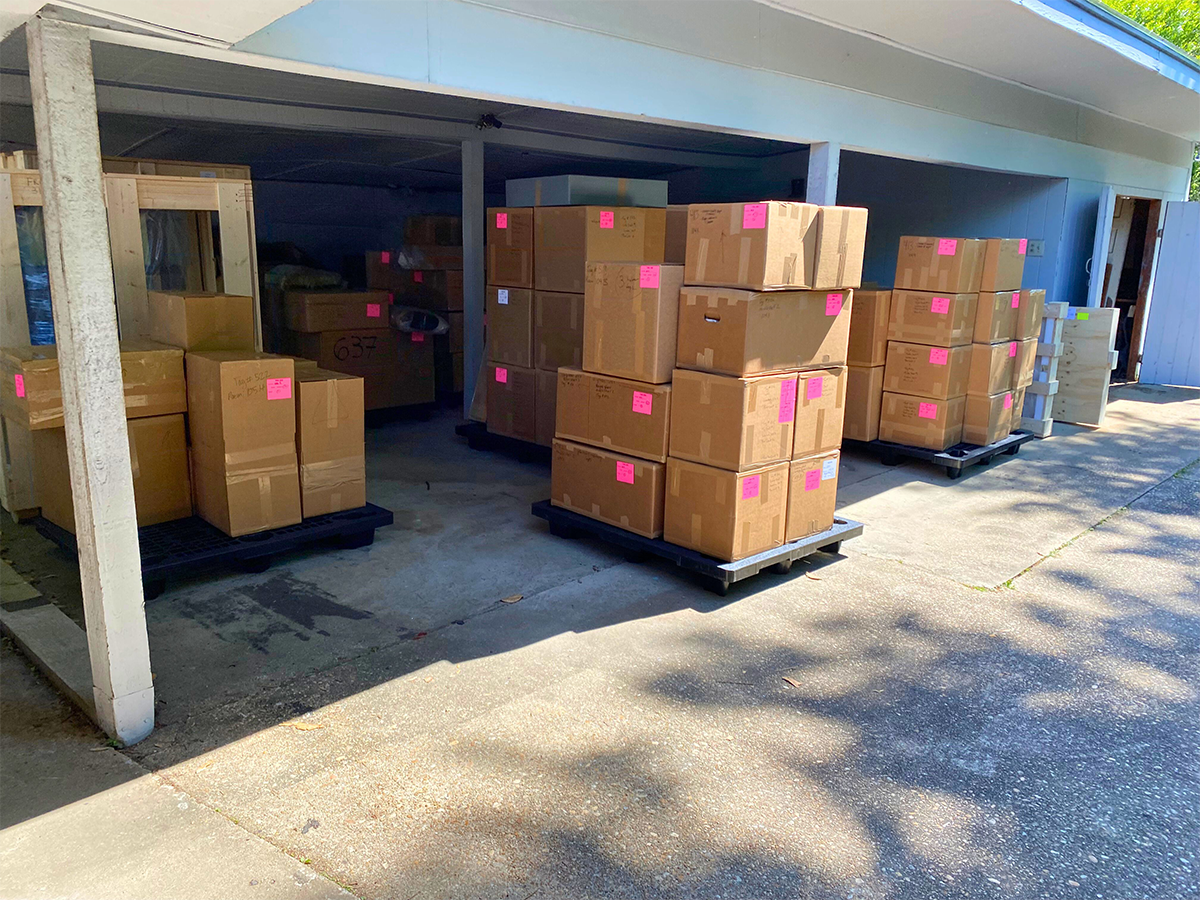 Contents of the Jackson Family Home are packed in boxes and await loading for shipment from Selma, Alabama, to Dearborn, Michigan. / Photograph by Staff of The Henry Ford.
Following the arrival of these materials to Michigan, two-dimensional materials were separated and inventoried as part of The Henry Ford’s Archives and Library collection, located in the Benson Ford Research Center. These materials were then sent to an abatement contractor and gamma irradiated to best preserve them for posterity. This interventive treatment sterilizes and decontaminates potential hazards, without causing any harm to the object. With the materials returned on-site, a processing archivist completed an intensive inventory, intellectually arranging, drafting descriptions, and rehousing the materials to increase accessibility and prepare them for use by researchers and the public.
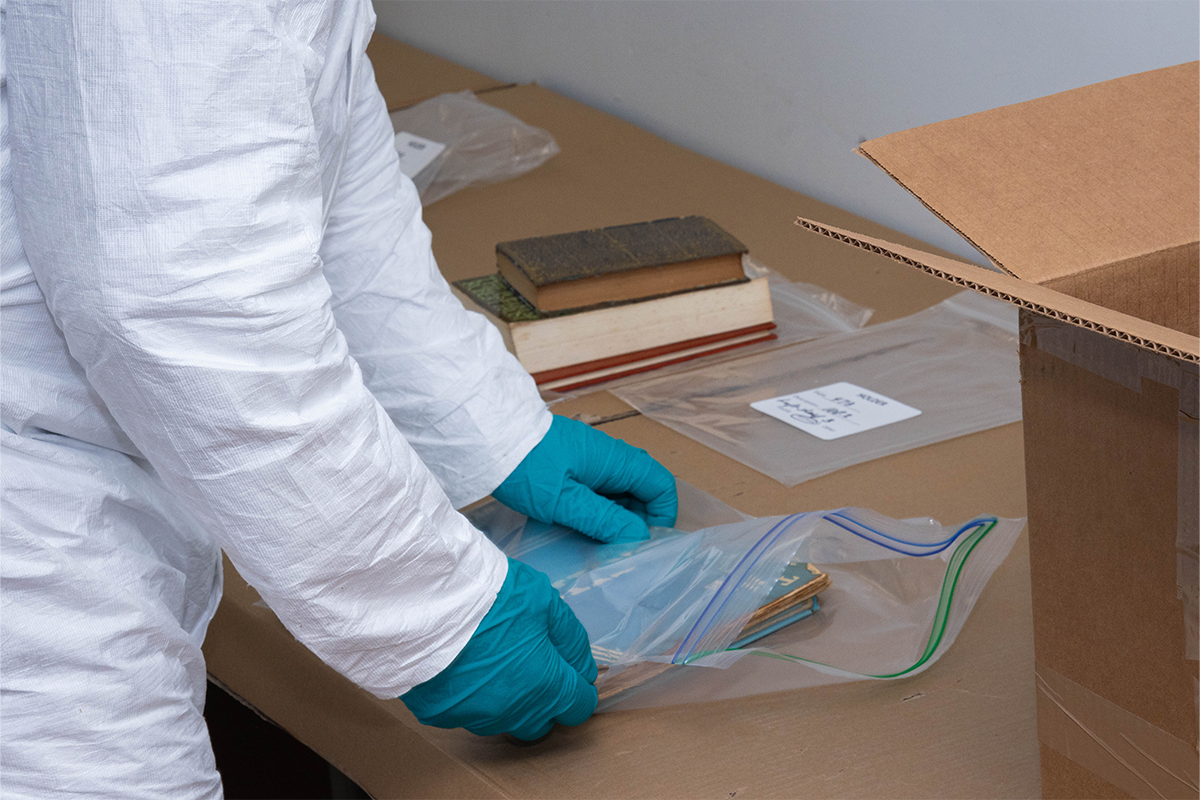 Staff at The Henry Ford organize archive and library materials in preparation for work with an abatement contractor. / Photograph by Staff of The Henry Ford.
Many of these materials are being used to fuel the interpretation and visualization of the Jackson Home for its opening in the summer of 2026.
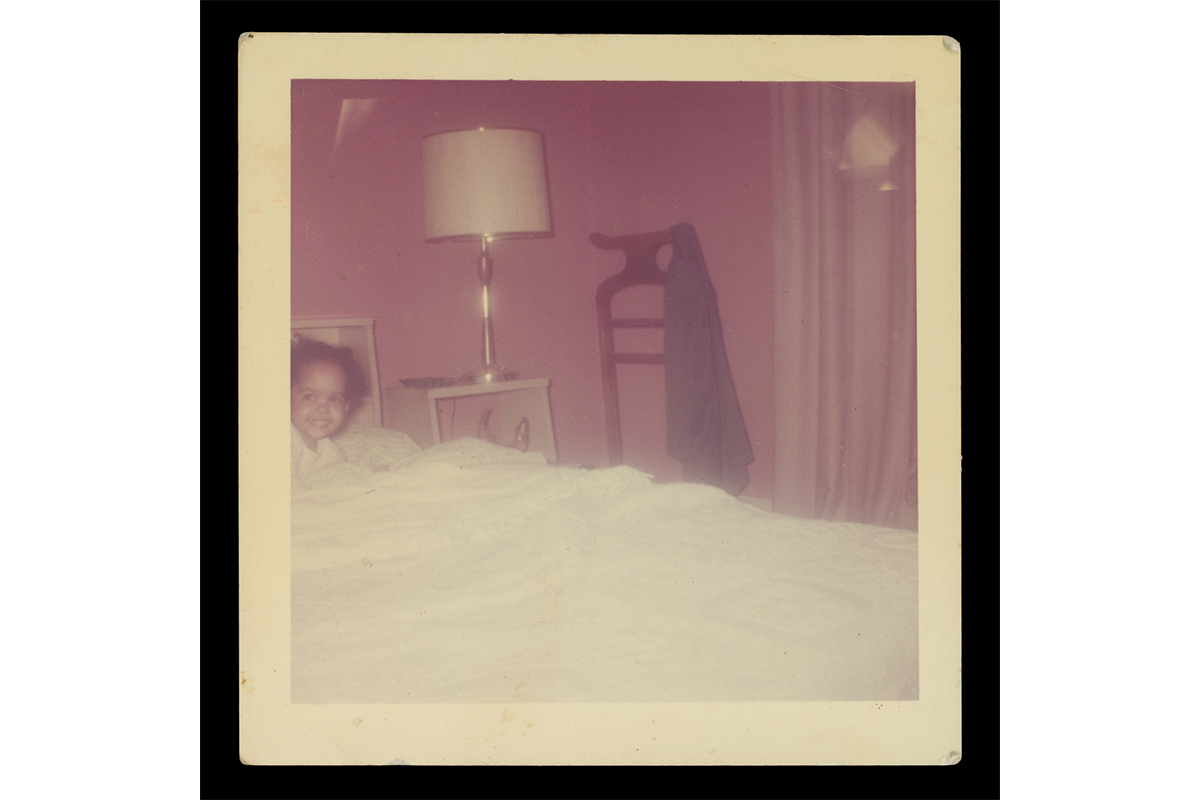 Photograph of Jawana Jackson in the Jackson Family Home. / THF708595
Processing of the three-dimensional artifacts began with unpacking 100 items at a time and assigning a temporary inventory number to each object. This number allows us to track the items as they move through various stages of processing. After inventory, high-resolution reference photographs are captured. This data is uploaded to our digital cataloging system and the items are then transferred to the conservation lab. In April 2023 this phase was completed, but there are several ongoing processing phases that will continue through 2026.
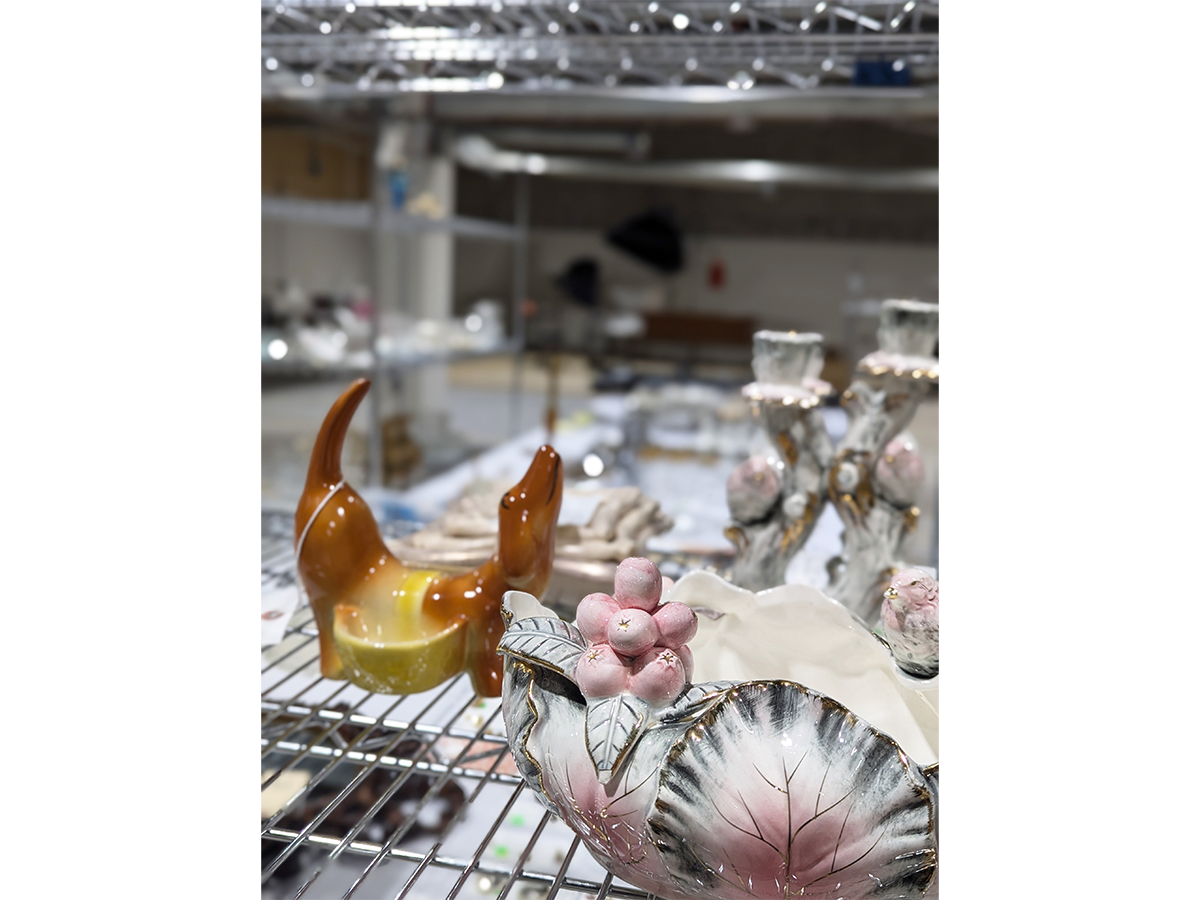 Carts are used to assist in relocating artifacts between stages of processing for the Jackson Home Project. A. L. Hirsch Rover Pottery Dachshund Ceramic Dresser Caddy and United China and Glass Company Pink and White Berries and Bird Leaf bowl are shown being relocated on a cart. / Photograph by Staff of The Henry Ford.
Every artifact from the Jackson Family Home undergoes multiple rounds of cleaning and repair in conservation. The process began when the contents of the home were packed in Selma—where larger items were lightly vacuumed to remove dust. Once on-site at The Henry Ford, each item was thoroughly cleaned and vacuumed during unpacking, providing the first opportunity to check the condition of objects for missing parts or signs of deterioration. Once in the conservation lab, a condition report and treatment plan are created for each object.
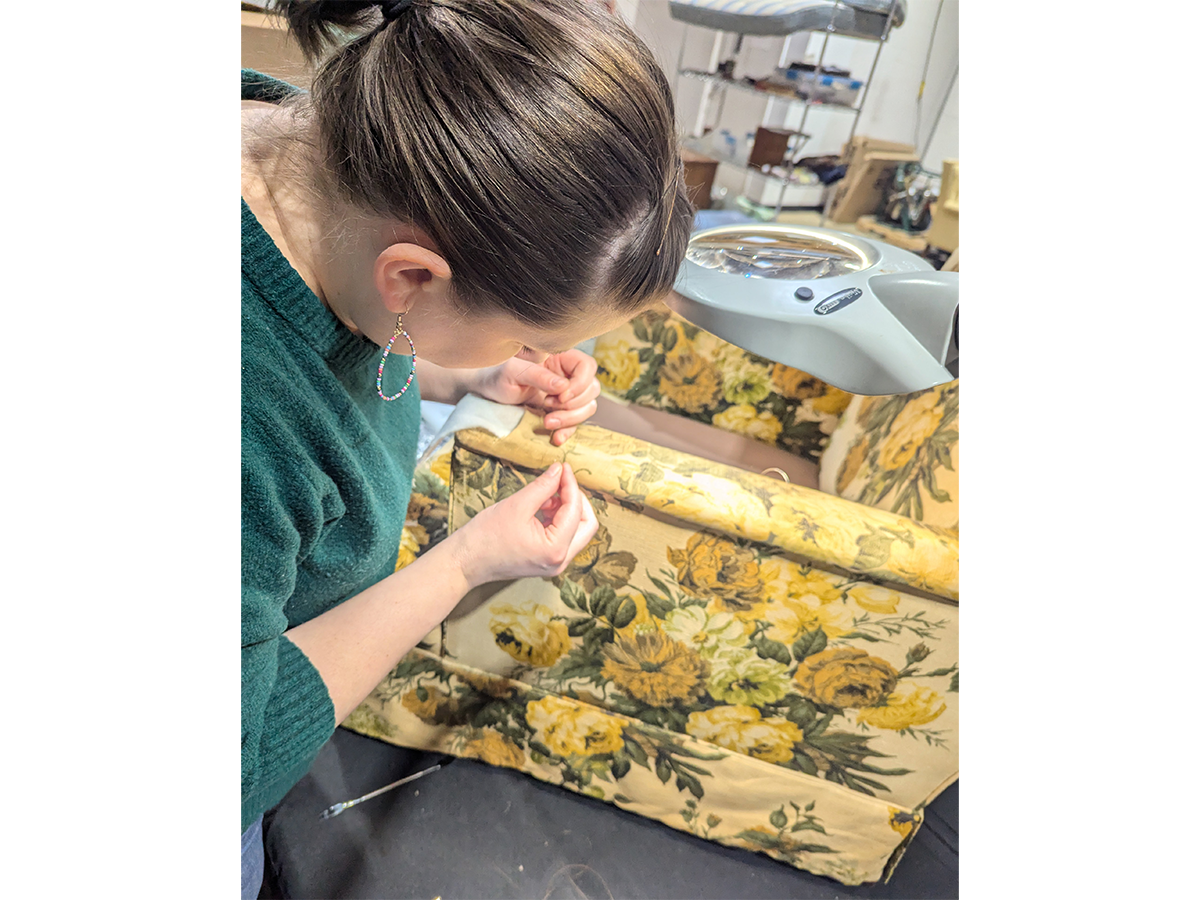 Associate Conservator Kate Herron adds netting to the arms of this Floral Globe Furniture Company armchair, an object used in the Jackson Family Home, for extra stability. / Photograph by Staff of The Henry Ford.
Treatment options can range from light cleaning to restoration or more extensive repairs, depending on the artifact’s condition. Regular meetings with curators at The Henry Ford help determine the appropriate level of cleaning, which items need preservation to address wear or evidence of use, and how each object contributes to the overall narrative.
 Curator of Decorative Arts Charles Sable consults with Conservator Louise Beck on conservation treatment of conservation treatment of a Cosco High chair with steps used in the Jackson Family Home kitchen. / Photograph by Staff of The Henry Ford.
Simple treatments, like wiping down with deionized water or ethanol, are often sufficient for stable items with light dirt. For kitchen equipment, layers of grease and dust are removed. Some artifacts require more complex treatments, including the repair of broken pieces or removal of corrosion from metals. To prevent deterioration, protective coatings like lacquer are used for brass and silver objects, and specific chemical treatments for iron and steel. Once treatment is complete, the object's condition and treatment details are documented in the catalog record, and the objects continue their journey to The Henry Ford’s registrar staff.
 Yellow Cosco Highchair with steps used in the Jackson Family Home, after conservation treatment. / THF803856
The registrar is responsible for research and cataloging each artifact. They build individual catalog records for each object with data such as size, maker, date of creation, and the purpose of the object. Every item is assigned a unique identifier, or an "accession number," that connects that object with a specific record. Accession numbers provide detailed information about the year the object was received into The Henry Ford’s collection, the collection “lot” it is a part of, and the specific registration succession number it is assigned. This unique identification number is attached or physically written on the artifact to ensure it can be traced to its record. Artifacts are labeled in a method that may be removed, if desired or needed down the road, without damage to the object. In addition to the photographic documentation in the collection, this research aids our understanding of what time period(s) the object lived in the Jackson Family Home.
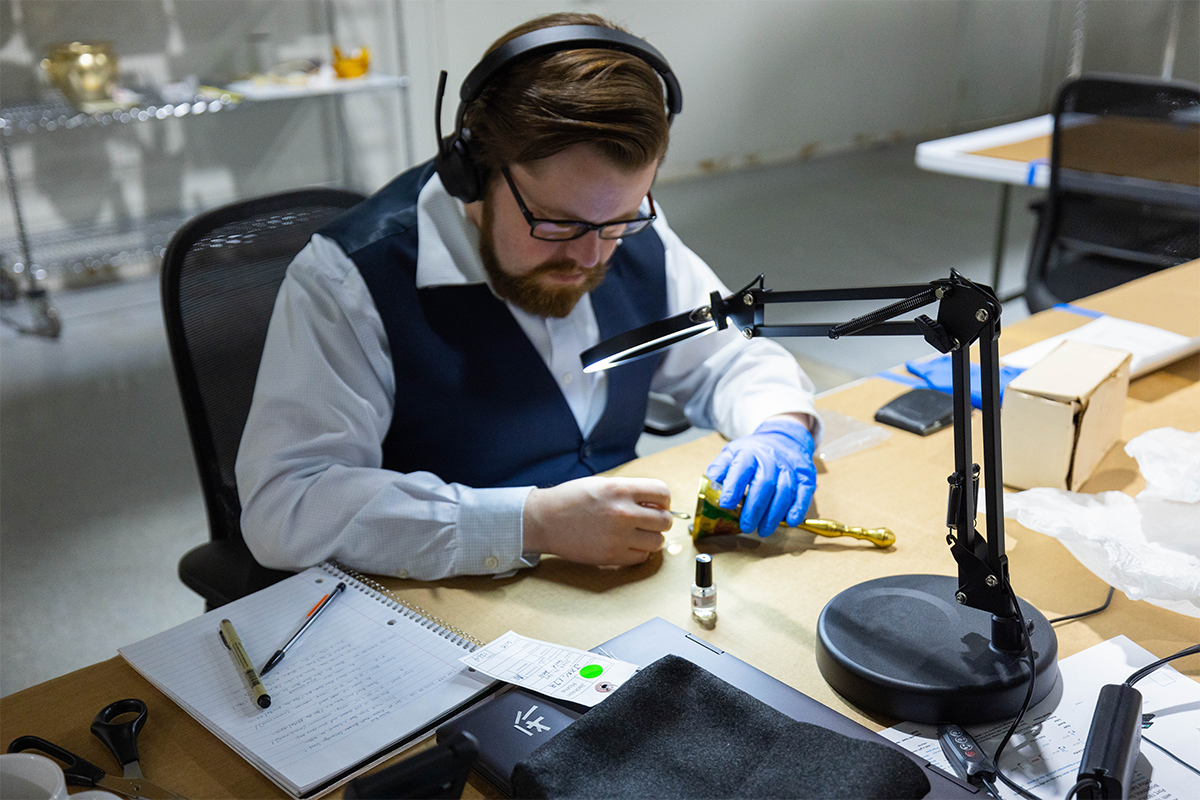 Artifacts in The Henry Ford collection are physically labeled with their accession number. A school bell from the Jackson Family Home is shown being labeled by Collections Specialist-Cataloger Andrew Schneider. / Photo by Staff of The Henry Ford.
The artifact then proceeds to photography for a high-resolution image. In 2026 the digitized objects and images from the Jackson Family Home will become accessible to the public on The Henry Ford’s digital collection, which can be accessed on The Henry Ford's Digital Collections website.
 The Henry Ford Photographer Jillian Ferraiuolo, capturing a photograph of a Breakfront China Cabinet from The Jackson Family Home. Digitizing our collection allows artifacts to be accessible, even when not on exhibition. / Photo by Staff of The Henry Ford.
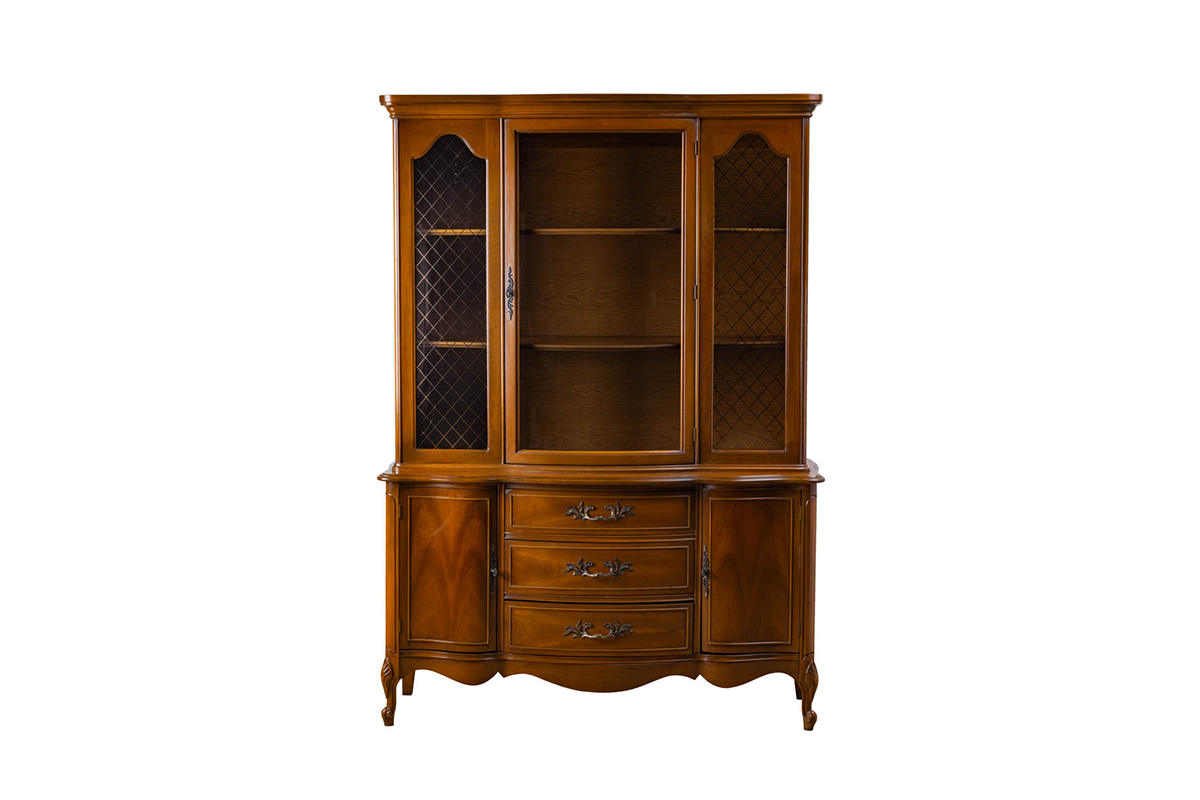 Breakfront China Cabinet. / THF803854
Once processing has concluded, the object is prepared for its new home in the collection, whether that is preparing for handoff to the exhibition team for installation in the Jackson Family Home, used in temporary exhibitions, or moved to storage for future research and opportunities.
This blog was produced by multiple authors: Kristen Hollingsworth, Jackson Home Project Coordinator; Louise Beck, Conservator, Julia DiLaura, Collections Specialist; Ashley Wimbrough, Collections Specialist; Andrew Schneider, Collections Specialist Cataloger; Jack Schmitt, Processing Archivist; and Aidan Thomas, Conservation Specialist at The Henry Ford.
by Kristen Hollingsworth, by Louise Stewart Beck, by Julia DiLaura, by Ashley Wimbrough, by Andrew Schneider, by Jack Schmitt, by Aidan Thomas

Richie Jean Sherrod Jackson at desk. / Photo feature in Black Belt Living, April 2012
Before starting my role as the Processing Archivist for the Jackson Home in 2024 — which would soon find me processing the papers, photographs, and other 2D materials of the Jackson family — I sought out an accessible entry point to serve as my introduction. In the weeks before my start date, I turned to Richie Jean Sherrod Jackson’s memoir, The House by the Side of the Road: The Selma Civil Rights Movement. A swift, engaging read, the book is approachable and informative, detailing Richie Jean's diverse experiences of her upbringing in both the South and the nation’s capital before settling back in Selma, Alabama, and raising a family. Interwoven with her and her family’s personal narratives are stories of the national figures we know and recognize, portraying their individual personalities as well as highlighting the critical roles they played in the Movement as the events of 1965 unfolded in Alabama and across the country.
After reading such an intimate, impactful account, it should not have come as a surprise to me when I began parsing through her papers that Richie Jean had saved so many of her previous drafts. Across some 30 documents, Richie Jean preserved not only the Jacksons’ experience of the events leading up to the 1965 Voting Rights Act, but much of the materials showcasing her writing process as well. As I pored over the collection, I was struck by the ease with which her handwritten notes and outlines flowed into typed drafts with edits in a familiar red pen – a hallmark of many a teacher not to be missed by this lifelong educator.
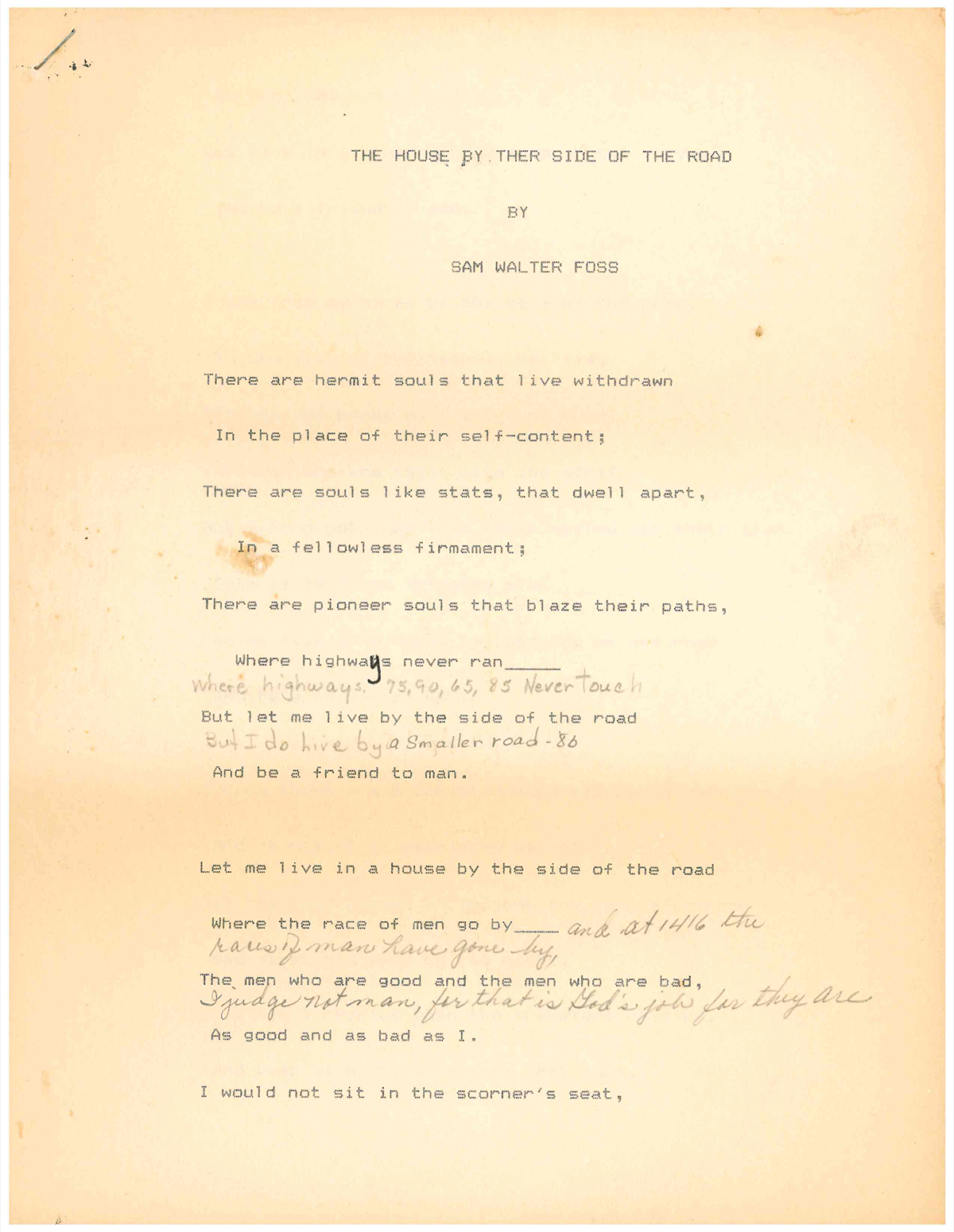
A section of Richie Jean’s favorite poem, Sam Walter Foss’s “The House by the Side of the Road,” intercut with her own verses. / Photo by Staff of The Henry Ford
In dating these documents, we can see that decades passed before the Jacksons began to consider how they would tell their story. One of their earliest creative explorations centers on the 1897 poem for which the book was eventually named: “The House by the Side of the Road” by American poet and librarian, Sam Walter Foss. Here, Richie Jean penned new lines, providing geographic specificity to replace the piece's vaguer verses — lines that better represent her home and the hospitality she provided.
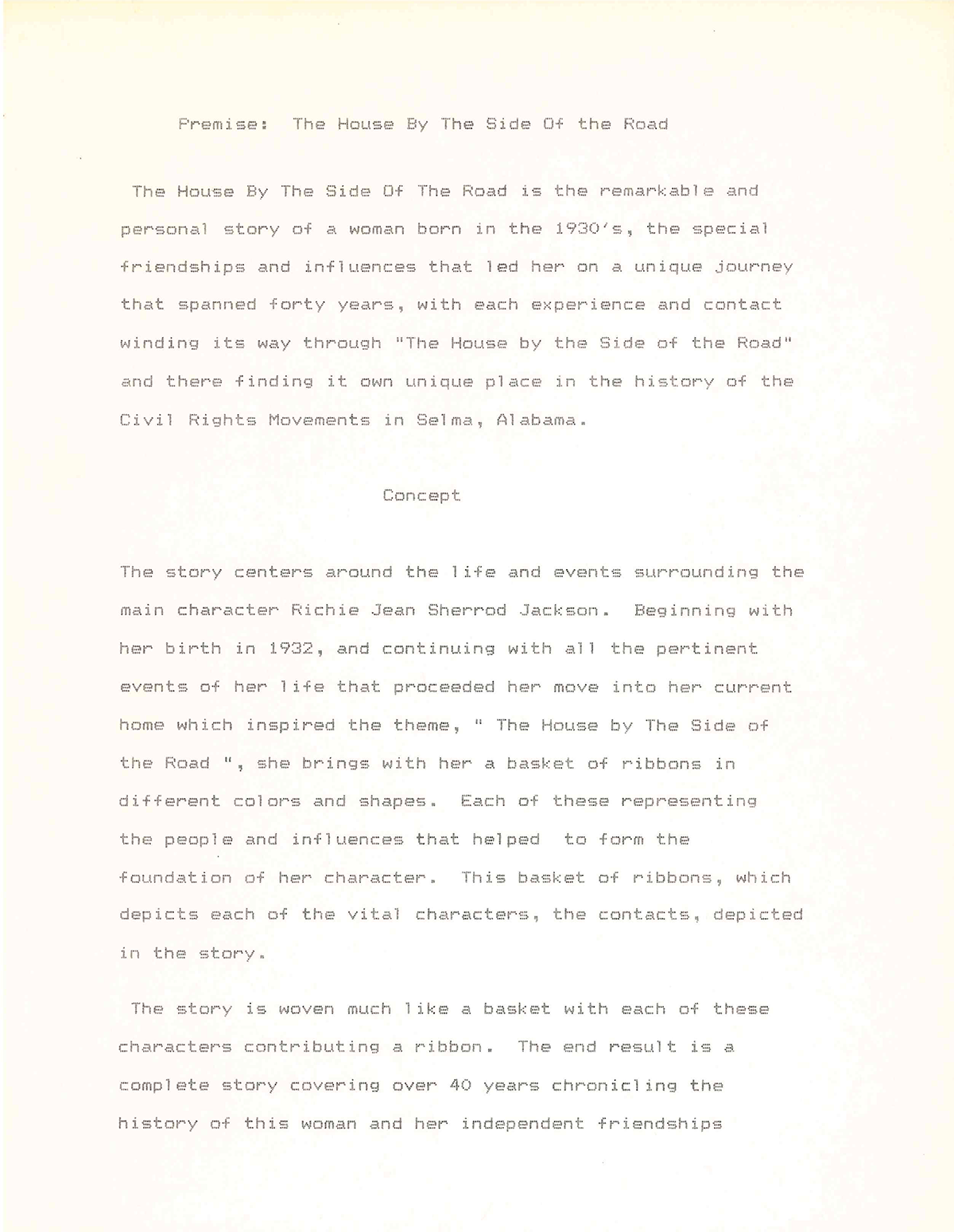
Richie Jean’s draft for a movie or television program based on her life story, 1997. / Photo by Staff of The Henry Ford
Another instance included a premise, structure, and storyline on Richie Jean’s life were it to be adapted for a TV program or movie, featuring a motif of an empty basket slowly filled with ribbons — collecting a ribbon for each influential figure in her life.
But by 1997, we find the project would take its final form as a book, capturing the history of what went on in their home. Richie Jean wrote out details for events and key figures on dozens of subject notecards as the memories of that time came back to her. Text from these notecards often made its way verbatim into early drafts, as she organized her thoughts into one cohesive narrative. It’s from this point that we see the largest leap in time between materials — the manuscripts jump ahead by a decade from 1999 to 2009 before a date is noted again on a draft.
Richie Jean kept copies of all print and email correspondence with her publisher, the University of Alabama Press, beginning in 2007, when she shared her latest manuscript for their consideration. In 2008, the editing process began in earnest, and drafts were tweaked and trimmed as additional perspectives weighed in. Most of the manuscripts in the collection are from this period — roughly 2008 to 2010—as edited drafts were shipped back and forth between their offices in Tuscaloosa and the Jackson home in Selma. Drafts would implement styling changes for consistency, swap one turn of phrase for another, and eventually plug in the final pieces of front matter: title page, table of contents, dedication, acknowledgements, and copyright.
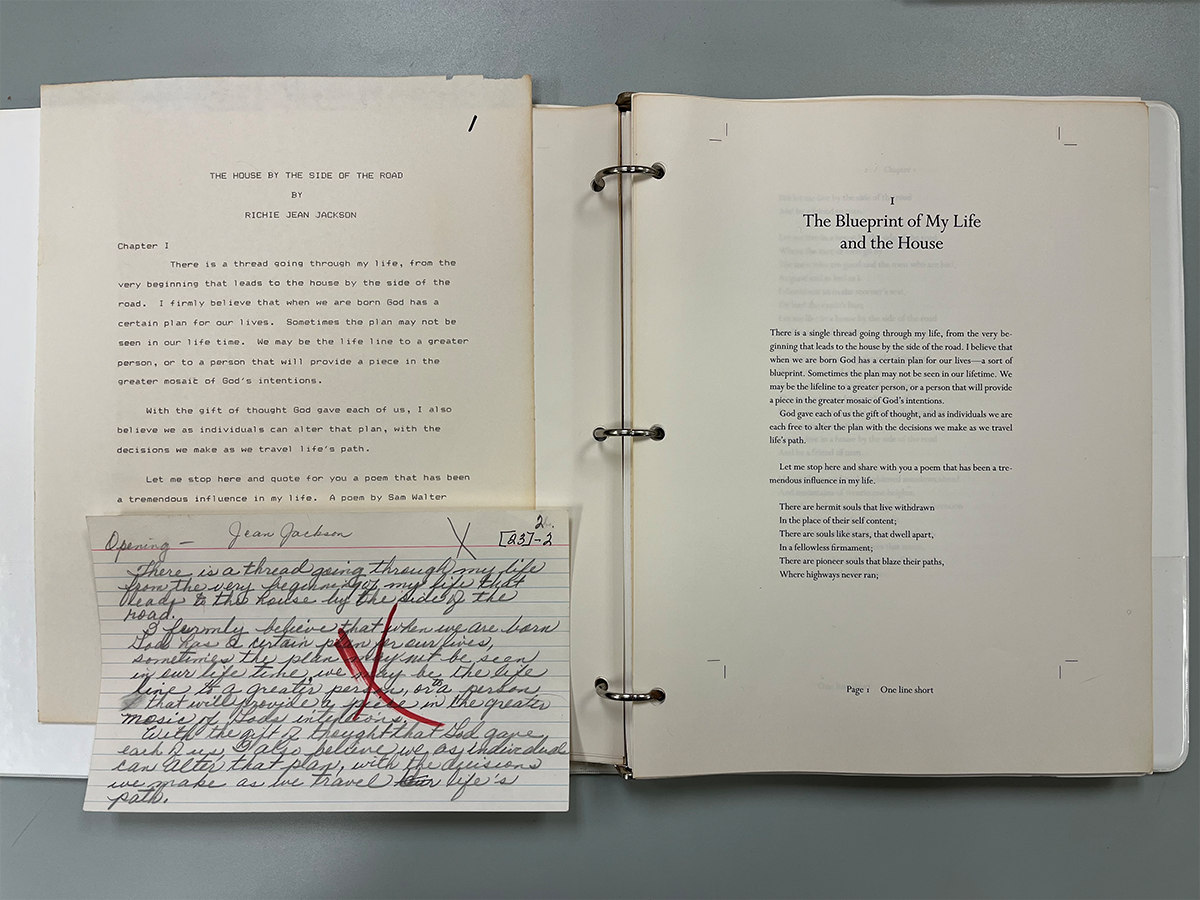
The opening chapter of The House by the Side of the Road, with text remaining consistent from its original handwritten notecard, to an early typed manuscript page, and the final manuscript. / Photo by Staff of The Henry Ford.
The publication of The House by the Side of the Road in 2011 was the culmination of years of effort. So what drove Richie Jean to write it?
The Jacksons had been interviewed many times over the years on their role hosting leaders of the Movement in Selma, but they never sought to leverage those relationships into positioning themselves as leaders and activists. It was only as they saw more and more inconsistencies across other retellings of the history they lived that they were prompted to share their own firsthand account. The cover of The House by the Side of the Road, featuring a photo of daughter Jawana Jackson sitting on the lap of Martin Luther King Jr., made their perspective on the matter abundantly clear — to them, “Uncle Martin” was a friend of the family first, and a national figure second.

The 2015 paperback edition of The House by the Side of the Road alongside the 1965 image featured on its cover of Jawana Jackson and Dr. Martin Luther King Jr. / Photo by Staff of The Henry Ford.
The Jackson family’s story shines a spotlight on ordinary people playing a small role in extraordinary moments in history and reminds us of the impact we all can have as well. As Richie Jean writes, “We cannot all be a Martin Luther King Jr., but each and every one of us can make a positive difference in the lives of our families and the people we meet each day. For you see the dream is still alive.”
Jack Schmitt is a Processing Archivist at The Henry Ford.