
Greenfield Village Buildings
Share
share
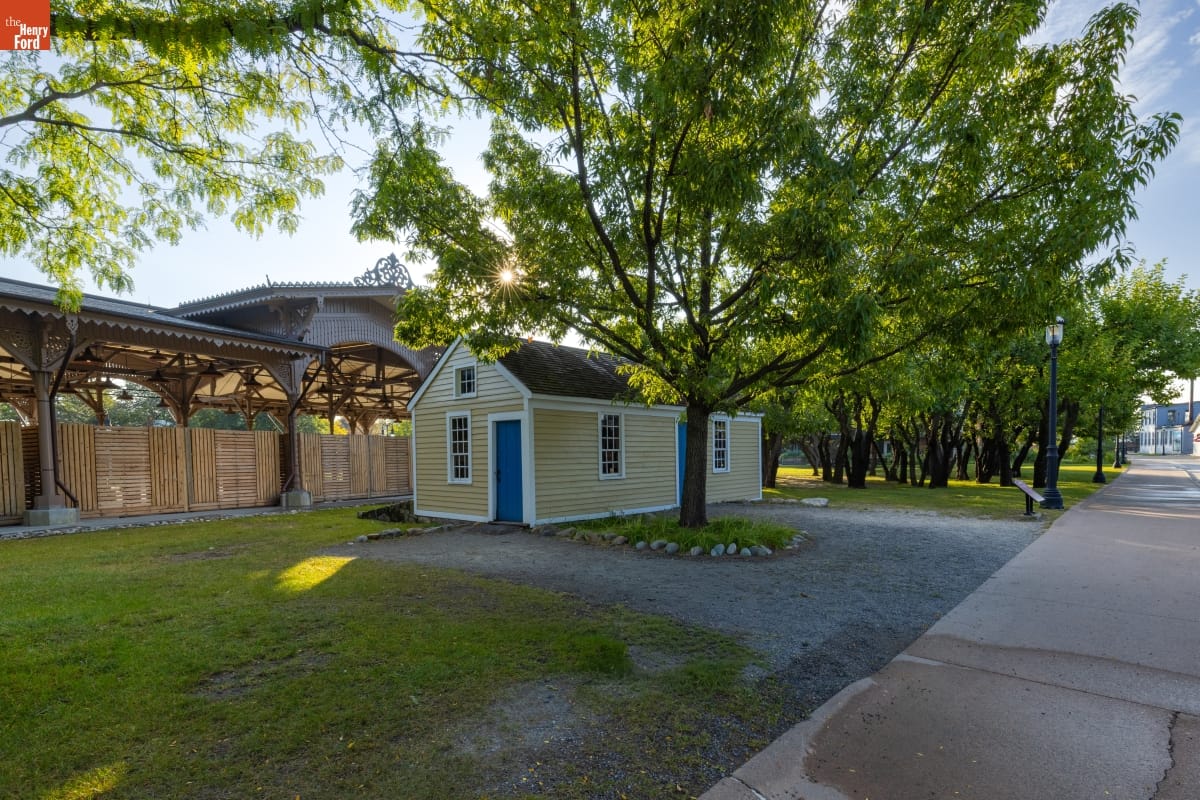
When Henry Ford first brought dozens of historic structures to this 80-acre site nearly a century ago, he saw that rural America was changing forever and city life was on the rise. From his vision of a single place where guests could look backward and forward in time to gain new perspectives, the nation’s first outdoor museum was born. These are the structures and landmarks you'll find in Greenfield Village today.
THF806031
Hanks Silk Mill
As America was taking its first steps towards industrialization, the Hanks family of Mansfield, Connecticut, made early attempts to mechanize the production of silk thread. Rodney Hanks and his nephew Horatio Hanks built this mill in 1810. It was the first silk mill in America, producing some of the first silk with machines that were powered by a waterwheel.
View ArtifactPottery Shop
The Pottery Shop was designed in 1939 by Edward L. Cutler, an architect who helped Henry Ford create his historic village. Designed as a reproduction rice mill to house 19th-century threshing machinery from a South Carolina plantation, the building was repurposed as the Pottery Shop in 1984. Today, visitors view demonstrations of hand-made pottery including salt-glaze and slip wares.
View ArtifactTripp Sawmill
Small sawmills played a fundamental role in rural communities in nineteenth century America, processing locally-logged wood to provide sawn lumber for construction in the immediate area. While many such mills were water powered, this was steam-powered from the outset. It was simple but refined -- a modest, self-sufficient industrial operation (water and fuel was available onsite), comfortably wedded to its rural location.
View ArtifactLoranger Gristmill
Gristmills -- usually among the earliest businesses established in a community -- ground grain harvested by local farmers. This mill, originally located in Monroe, Michigan, was set up to grind both corn and wheat. It incorporates a sophisticated conveyor system, developed by Oliver Evans in the late 1700s, that moves grain through the building to undergo a variety of processes.
View ArtifactGunsolly Carding Mill
John Gunsolly operated this water-powered carding mill as well as a saw and cider mill on the Middle Rouge River near Plymouth, Michigan, beginning in the 1850s. Area farmers brought their wool to this mill to have it carded (combed) so it could be spun into thread.
View ArtifactPrinting Office & Tin Shop
The Printing Office was built in Greenfield Village in 1933. For decades, the building served as a utilitarian print shop for Greenfield Village. At one time, the building housed a recreated 19th-century small town newspaper print shop and tinsmithing studio. Now, only the print shop remains.
View ArtifactSpofford Sawmill
Sawmills were among the first mills in new settlements, supplying lumber for people's homes and barns. Henry Ford had this mill built in Greenfield Village to house early up-and-down sawmill machinery. One of the large beams holding up the building came from a water-powered sawmill that George Spofford operated in Georgetown, Massachusetts, back in the 1600s.
View ArtifactDavidson-Gerson Gallery of Glass
The Henry Ford's glass collection is one of the most comprehensive in the United States, numbering approximately 10,000 pieces. The gallery traces the history of American glass from the 18th century through the present, including works by important artists like Louis Comfort Tiffany and masters of the Studio Glass movement. Built as a machine shop in 1888 in Lapeer, Michigan, this building was moved to Greenfield Village in 1931.
View ArtifactGlass Shop
The Glass Shop was constructed in 1930 to demonstrate the art of glass making as practiced in nineteenth century America. It was modeled after the Boston and Sandwich Glass House, located in Cape Cod, Massachusetts. In 2005, the shop was rebuilt, enlarged and updated with modern equipment. Today, our artisans create up to 10,000 pieces of historic and contemporary Studio Glass annually.
View ArtifactWeaving Shop
The Greenfield Village Weaving Shop demonstrates the evolution of textile production from the colonial home and craft shop, through the Industrial Revolution to commercial factory. Housed in a converted 1840s Georgia cotton mill, the Weaving Shop contains a number of working looms, including one of the few operating mechanical Jacquard looms in North America.
View ArtifactArmington & Sims Machine Shop
This building essentially provides support for a system of shafts and pulleys that distribute mechanical energy to the rows of metal working machine tools arranged along the building's length. The machinists who worked in shops like this could tackle a wide range of jobs. America's nineteenth century machine shops were a training ground for many technological innovators.
View ArtifactThomas Edison's Fort Myers Laboratory
This well-equipped laboratory enabled Edison to carry on his investigations even as he seemed to seek a break from business and other matters. The first building to be completed in Greenfield Village, it had a second experimental life, offering seclusion to a select group of Ford Motor Company engineers tasked with developing the Ford V-8 engine in the early 1930s.
View ArtifactSarah Jordan Boarding House
The Menlo Park complex was an all-male environment; the closest workaday involvement of women -- not forgetting that Edison and several of his personnel were married -- was at the Sarah Jordan boardinghouse. Offering room and board for unmarried employees at the complex, it was operated by Sarah Jordan, a distant relative of Edison's. The house also played host to the experimental lighting system installed throughout Menlo Park in December 1879.
View ArtifactMenlo Park Carbon Shed
Edison's invention of the carbon telephone transmitter in 1877 is what made the telephone commercially practical. This small wooden shed housed a battery of kerosene lamps, kept lit and set to produce carbon soot. The soot was collected and compressed into carbon tablets for telephone transmitters. Edison also used the carbon produced in this shed for various other experiments.
View ArtifactMenlo Park Carpentry Shop
Edison employed skilled woodworkers to make models, miscellaneous components, and patterns for making metal castings -- a great example of the importance of traditional craft to Edison's experimental investigations. The carpentry shop also housed machinery for making gas, used in the laboratory's Bunsen burners and -- prior to his success with electric lighting -- for lighting the complex.
View ArtifactMenlo Park Laboratory
When Edison moved to Menlo Park, New Jersey, in spring of 1876 the laboratory building contained his entire operation -- a handful of collaborators, office, library, and machine shop as well as laboratory. As the scale of Edison's investigations grew so did the complex, but this building -- dedicated to experimental activities -- was always understood to be the heart of the enterprise.
View ArtifactMenlo Park Machine Shop
The presence of a machine shop (and of foreman / head machinist John Kruesi) was fundamental to the success of Menlo Park. This well-equipped facility -- built to replace the small machine shop originally installed in the laboratory -- enabled Edison and his associates to not only rapidly prototype iterations of experimental devices but also facilitate their eventual, profitable manufacture.
View ArtifactMenlo Park Library
This building was built in late 1878 as Edison's work on electric lighting expanded. The first floor provided office space for accounting, bookkeeping, and patent applications; upstairs was a superbly stocked technical library. The building also played another key role: as a reception area for journalists and other visitors it provided a disarming first impression of Edison's success and ambition.
View ArtifactMenlo Park Glass House
Originally built as a photographic studio and drafting room, the glassblowing shop was fundamental to Edison's enterprise. Edison's incandescent lighting experiments ensured that the laboratory had a voracious appetite for glass -- not only for bulbs but also for associated apparatus such as vacuum pumps. Ludwig Boehm, the laboratory's first master glassblower, worked here -- and lodged in the attic space.
View ArtifactThomas Alva Edison Statue, 1949
In 1930 Henry Ford commissioned this larger-than-life statue of his friend and hero, Thomas Edison. Sculptor James Earle Fraser (1876-1953), renowned for his public statues of prominent individuals, made preparatory sketches from sittings given by Edison just before his death in 1931. Fraser did not complete the statue until 1949 - it has since had several homes at The Henry Ford, and is now prominently located in the heart of the Village.
View ArtifactSoybean Lab Agricultural Gallery
Constructed in Greenfield Village, this building was an experimental soybean research laboratory during the 1930s. Henry Ford was looking for ways that farmers could use crops for industrial purposes, especially in the manufacture of car parts. Special equipment was designed here to process soybeans into oil and meal. Today, this building houses agricultural implements from the museum's collections.
View ArtifactFirestone Farmhouse
Benjamin and Catherine Firestone raised their three children in this farmhouse, including tire maker Harvey Firestone. Originally located near Columbiana, Ohio, the 1828 house was updated in 1882 to appear more stylish and up-to-date. The traditional Pennsylvania German layout of the Firestone's farmhouse was transformed, with a central foyer, separate dining room and kitchen, a sitting room, closets, wallpaper, and fancy new furniture.
View ArtifactFirestone Barn
The Firestone barn is a Pennsylvania-German bank barn, an American barn type with Swiss origins. They are called bank barns because the barn is built into a bank, allowing wagons to be driven into the upper floor. Bank barns combined multiple farm functions under a single roof. Livestock were kept in the lower floor, crops on the upper floor.
View ArtifactFirestone Pump House
This is a replica of the Firestone's pump house in Ohio. This small structure sheltered the hand pump mechanism and provided cool water to help preserve perishable food items, such as butter.
View ArtifactFirestone Chicken Shed
This is a replica of the Firestones' chicken house in Ohio. Chickens spend their days in the farmyard, foraging for seeds and bugs for food. They spend their nights on their roosts in the chicken house, which provides warmth, protection from predators, and keeps the eggs in one place, making them easier to gather.
View ArtifactCider Mill
The cider mill building was built at Greenfield Village in 1942 to house the cider-making equipment from Martinsville, Michigan. It is built on a bank, so the apples were brought into the building on the second floor, then fed by gravity to the first floor. The building's design is not based on any specific building.
View ArtifactWilliam Ford Barn
William Ford built this barn near present-day Dearborn, Michigan, in 1863 -- the same year his son Henry was born. Ford mainly used it to store grain and hay, though livestock and tools were occasionally housed in the structure. The barn was moved to The Henry Ford in 1934. Today it's used by Greenfield Village's horses.
View ArtifactRichart Wagon Shop
Wagon makers Robert and William Richart offered many services out of this shop, built in Macon, Michigan, in 1847. In addition to building, painting and repairing wagons, the Richarts fixed tools, sharpened saws and even mended household furniture. The Richarts remained in business for over 50 years. The shop building was moved to Greenfield Village in 1941.
View ArtifactGreenfield Village Town Hall
An iconic sight in New England communities, the town hall was the place where local citizens would come together to participate in town meetings. These buildings also became gathering places for political elections, theatrical performances, and social events. Built in Greenfield Village in 1929, this town hall was patterned after New England town halls of the early 1800s.
View ArtifactJ.R. Jones General Store
James R. Jones was one of nine different proprietors who operated a general merchandise store in this building between 1857 and 1927. From 1882 to 1888, Jones sold products like coffee, sugar, fabric, and shoes. He also boasted the first telephone in town. General stores were organized shopping spaces. Long shelves with groupings of similar products lined each side.
View ArtifactEagle Tavern
This stagecoach tavern was built in 1831 in Clinton, Michigan, 50 miles west of Detroit. Taverns dotted the American countryside during the first half of the 1800s, a period of massive migration, new settlement, and rapid change in a young America. From 1849-1854, farmer Calvin Wood operated this tavern, offering food, drink, and accommodations to travelers who passed through his village.
View ArtifactHearse Shed
This shed, originally built in Newton, New Hampshire, around 1850, was located near the local cemetery. Horse-drawn hearses, usually owned by the local community, were used to carry the coffin during funeral processions through town to the cemetery.
View ArtifactMartha-Mary Chapel
Churches were a center of community life in the 1700s, a place where townspeople came together to attend services and socialize. The Martha-Mary Chapel, with its architecture inspired by New England's colonial-era churches, was built in Greenfield Village in 1929. This chapel was named after Henry Ford's mother, Mary Litogot Ford, and his mother-in-law, Martha Bench Bryant.
View ArtifactSir John Bennett
Sir John Bennett's clock, watch and jewelry store in London, England, originally stood five stories. Mr. Ford was especially attracted to the Gog and Magog figures, who strike the clock. Henry Ford, a watch enthusiast, purchased the building for his historical village in 1928. Village architect Edward Cutler reassembled the structure in a two-story scale, making it compatible with other buildings in the Village.
View ArtifactCohen Millinery
Specialized retail stores like this one served the needs of city dwellers in the late 19th century. During the 1880s, a series of shops selling fancy goods, groceries, dry goods, and flour and feed occupied the building. In the mid-1890s, widow Elizabeth Cohen operated a millinery shop here, offering customers fashionable headwear while supporting her young family. Like other shopkeepers, Mrs. Cohen lived above her store.
View ArtifactWright Cycle Shop
Wilbur and Orville Wright operated their bicycle business in this building from 1897 to 1908 in Dayton, Ohio. The brothers sold and repaired bikes, and they even produced models under their own brands. It was also in this shop that the Wright brothers built their earliest flying machines, including the 1903 Flyer that became the first successful heavier-than-air, powered, controlled aircraft.
View ArtifactWright Home
Though the Wright family moved around, brothers Wilbur and Orville always thought of this house, originally located at 7 Hawthorn Street in Dayton, Ohio, as home. Orville was born here in 1871, and Wilbur died here in 1912. It was also here that the brothers began their serious studies in aviation -- work that led to their successful 1903 Wright Flyer.
View ArtifactWright Brothers Garden Shed
Orville and Wilbur Wright were enthusiastic photographers who took many shots of their family and friends. They also took numerous photos of their gliders and airplanes, and those images remain vital records of the airplane's invention. The brothers developed their glass plate negatives in a darkroom they built in the shed behind the family home.
View ArtifactHeinz House
Enterprising Henry J. Heinz began his successful business by bottling horseradish in the basement of his parents' home in Sharpsburg, Pennsylvania. From this house, he sold a growing variety of pickles and relishes to neighbors before moving his operation to Pittsburgh. This house currently features an exhibit on the H.J. Heinz Company's innovative business practices and marketing techniques.
View ArtifactHerschell-Spillman Carousel
Colorful carousels were at the height of their popularity during the early 1900s and could be found all across America in amusement parks, city parks, and seaside resorts. Built in 1913, this "menagerie" carousel's hand-carved animals include storks, goats, zebras, dogs, and even a frog. Although its original location is uncertain, this carousel operated in Spokane, Washington, from 1923 to 1961.
View ArtifactPhoenixville Post Office
The Phoenixville Post Office, built around 1825 in northeastern Connecticut, was always more than a post office. Under Lorenzo Bullard, who probably built the structure, it was a grocer's and apothecary shop. By 1850 it was the post office and community gathering place for this rural town. It sold stamps and stationery--and was the place to go to talk about local happenings.
View ArtifactScotch Settlement School
Henry Ford attended this one-room schoolhouse from age seven to ten. Because of Ford's fondness for his teacher John Chapman, he not only followed Chapman to Miller School but also brought Chapman's house to Greenfield Village. This school, originally built in 1861 in Dearborn Township, was the first classroom of the Greenfield Village school system Henry Ford started in 1929.
View ArtifactDr. Howard's Office
Alonson Howard practiced medicine in rural Tekonsha, Michigan, starting around the time of the Civil War. He was an "eclectic" physician, combining Western medicine and surgery with the herbal and homeopathic methods popular in the 19th century. This building was the waiting room, office and laboratory for Doc Howard and his patients. He also made herbal medicines here.
View ArtifactGreenfield Village Tintype Studio
Tintypes were a popular type of mid-1800s "wet-plate" photography. This studio was built in 1929 in Greenfield Village and a tintypist and Ford Motor Company employee, Charles Tremear, was hired to create tintypes for Greenfield Village visitors. In this studio, in addition to Village visitors, Tremear made portraits of many celebrities, including Thomas Edison, Joe Louis and Walt Disney.
View ArtifactGrimm Jewelry Store
Englebert Grimm sold and repaired watches, clocks and jewelry in this building. The business was located on Michigan Avenue in Detroit, from 1886 until 1931. Shops like Grimm's prospered in cities, selling mass-produced goods of the newly industrializing society. Grimm and his family lived above the store in comfortable but relatively modest quarters.
View ArtifactOwl Night Lunch Wagon Used by Henry Ford, circa 1890
The Henry Ford's Owl Night Lunch wagon is thought to be the last remaining horse-drawn lunch wagon in America. It served food to nighttime workers in downtown Detroit, and attracted such diverse clientele as reporters, politicians, policemen, factory workers, and supposedly even underworld characters! Among its customers was Henry Ford, a young engineer working at Edison Illuminating Company during the 1890s.
View ArtifactBagley Avenue Workshop
Henry Ford transformed the storage shed behind his family's rented duplex at 58 Bagley Avenue in Detroit into a workshop. Here, in 1896, he built his first car -- the "Quadricycle." In 1933, Ford reconstructed the shed in Greenfield Village. The original shed had been torn down, so he reportedly used bricks from a wall of the Bagley Avenue residence instead.
View ArtifactMiller School
Henry Ford attended Miller School at age nine. He followed a favorite teacher, John Chapman, there from the Scotch Settlement School. The small, one-room building was typical of rural schools throughout the United States in the 1800s. Ford had this replica built in Greenfield Village in the early 1940s.
View ArtifactFord Home
Henry Ford was born in this farmhouse on July 30, 1863. The house stood near the corner of present-day Ford and Greenfield Roads in Dearborn, Michigan. Ford grew up in the house and moved out at age 16 to find work in Detroit. He restored the farmhouse in 1919 and moved it to Greenfield Village in 1944.
View ArtifactHenry Ford Theater (Edsel Ford Workshop)
When Edsel Ford passed away in 1943, Henry and Clara Ford constructed this building to memorialize their son. It was based on a workshop that father and son shared above the garage at the family home in Detroit's Boston-Edison neighborhood, where the Fords lived while Edsel was a teenager. The short posts framing the door are from the original site.
View ArtifactFord Motor Company (Mack Avenue Plant)
Henry Ford's third automobile company, formed in 1903, set up shop in a former wagon factory on Detroit's Mack Avenue. Ford's small crew assembled Model A cars from components made elsewhere. Within 18 months, Ford Motor Company moved to a larger facility on Piquette Avenue. This building is a replica about one-fourth the size of the original Mack Avenue plant.
View ArtifactLuther Burbank Garden Office
Luther Burbank (1849-1926), an American horticulturalist and author, gained a reputation for selective breeding that yielded more than 800 new fruits, vegetables, flowers, and other plants. He opened this Bureau of Information in 1910 at the corner of his 40-acre experimental garden in Santa Rosa to sell seeds and souvenirs. It served various purposes over the years until Burbank's widow offered it to Henry Ford in 1928.
View ArtifactHermitage Slave Quarters
Enslaved African Americans built and lived in these brick quarters on the Hermitage Plantation, located just north of the city of Savannah in a rice-growing region. Owned by Henry McAlpin, in 1850 this prosperous plantation had 200 enslaved workers who lived in about 50 similar buildings. These enslaved workers cultivated rice, and manufactured bricks, rice barrels, cast iron products, and lumber.
View ArtifactHermitage Slave Quarters
Enslaved African Americans built and lived in these brick quarters on the Hermitage Plantation, located just north of the city of Savannah in a rice-growing region. Owned by Henry McAlpin, in 1850 this prosperous plantation had 200 enslaved workers who lived in about 50 similar buildings. These enslaved workers cultivated rice, and manufactured bricks, rice barrels, cast iron products, and lumber.
View ArtifactLuther Burbank Birthplace
Luther Burbank (1849-1926), an American plant breeder, naturalist, and author, was especially noted for his experiments with plants, fruits, and vegetables. He was born in this house, built around 1800 and originally located in Lancaster, Massachusetts. Although he attended local schools there, much of his knowledge about nature and plant life came from reading books at the public library.
View ArtifactRocks Village Toll House
Many early American bridges operated as private businesses. Travelers paid tolls to cross them. Tolls repaid construction costs, funded maintenance, and hopefully produced a profit for owners. Workers at this toll house, built in 1828, collected fares for a bridge across the Merrimack River at Rocks Village, Massachusetts. Henry Ford acquired the building in 1928 and moved it to Greenfield Village.
View ArtifactAckley Covered Bridge
In addition to lending some charm, covering a bridge protects its wooden truss work from weather, extending the structure's service life. Joshua Ackley and Daniel Clouse built the Ackley Covered Bridge in 1832, across Wheeling Creek in southwestern Pennsylvania. Henry Ford acquired the bridge in 1937, when it was scheduled to be torn down, and moved it to Greenfield Village.
View ArtifactCotswold Stable
This barn and stable were part of the Cotswold Cottage original site. The larger portion was the barn, used for storing and threshing grain. The wide doors and high ceilings gave room for threshing with a flail, or storing a cart. The smaller portion was the stable, likely for a cow or ox. The low ceilings keep the stable warmer.
View ArtifactCotswold Cottage
Cotswold Cottage is from the Cotswold Hills in southwest England. The Fords were attracted to the distinctive character of Cotswold buildings, which are characterized by the yellow-brown stone, tall gables, steeply pitched roofs, and stone ornamentation around windows and doors. Several decorative additions were made to the house in England, before dismantling and re-erecting it in Greenfield Village.
View ArtifactGiddings Family Home
John Giddings was a merchant who earned a good living in the West Indies trade. Giddings lived here with his wife and five children. He built this grand house in 1751 in Exeter, New Hampshire. Its plan was typical of upscale New England houses of its time, with a multi-purpose hall and parlor on the first floor and two bedrooms above.
View ArtifactChapman Family Home
During the 1870s, this simple farmhouse was the home of John B. Chapman and his wife Susie. Chapman taught several terms in the one-room schools of his rural community. Young Henry Ford was one of his pupils. Chapman also worked at other tasks for much of the year, as a farmhand and as a cooper, making barrels for local farmers.
View ArtifactCharles Steinmetz Cabin
This cabin was originally located on a steep bank overlooking a tributary of the Mohawk River, just outside of Schenectady, New York. Its simplicity was a contrast to the General Electric laboratories where Steinmetz spent his workweek. It served as a getaway -- for quiet study or writing, but also for more animated weekend camp gatherings for selected friends and associates.
View ArtifactCotswold Forge
This forge belonged to the Stanley family, who were the blacksmiths in the Cotswold village of Snowshill from before 1795. The business passed between family members until it ceased operation in 1909 with the death of Charles Stanley. Blacksmiths made tools and hardware from iron. At the time of the shop's closing, most work was repair of factory-made items.
View ArtifactWilliam Holmes McGuffey Birthplace
This log home is typical of Scots-Irish log structures built in the densely forested area of southwestern Pennsylvania during the late 1700s. Anna and Alexander McGuffey lived here for five years and had three children before moving west to Ohio. Their second child, William Holmes (1800-1873), went on to create the popular Eclectic Readers for frontier schoolchildren.
View ArtifactWilliam Holmes McGuffey Smokehouse
This building is a replica of a shed found on site when Henry Ford's assistants dismantled McGuffey's log home birthplace in southwestern Pennsylvania. While there is no evidence that this was originally a smokehouse, the size and form of the original shed, and the presence of other smokehouses in the area, suggest that this might have been one.
View ArtifactPlympton Home
The Plympton House is one room with a loft. The central circular chimney was constructed first and the rest of the house was built around it. This design offered warmth from the harsh New England winters. The continual need to grow or make many of the things they needed left little time for luxuries for these early colonists.
View ArtifactEdison Homestead
Thomas Edison's great-grandparents fled to Canada after the American Revolution because they had sided with the British. Edison's grandparents started a farm and built this home there. As a boy, Edison enjoyed visiting the farm, where he played in the barn, went swimming, and fished in a nearby river.
View ArtifactWilliam Holmes McGuffey School
The McGuffey School was built in Greenfield Village in 1934, created out of barn logs from the 1790s southwestern Pennsylvania farmstead where textbook author William Holmes McGuffey was born. Children living in frontier communities learned to read in rustic schoolhouses like this one. McGuffey's Eclectic Readers gave them an easy, standardized way to do it.
View ArtifactSounds of America Gallery (Foster Memorial)
This house was originally located in Lawrenceville, Pennsylvania, the town where composer Stephen Foster was born. When it was brought to Greenfield Village in 1934, the home was thought to be Foster's birthplace. Now called The Sounds of America Gallery, it houses a display of musical instruments.
View ArtifactRobert Frost Home
Robert Frost, one of America's greatest poets, had an extraordinary ability to put complex and deeply insightful ideas into everyday language. In the mid-1920s, Frost lived in this house while he was the University of Michigan's first poet-in-residence. Here, located away from the bustle of the Ann Arbor campus, his creative spirit and imagination soared as he wrote poetry and met with students.
View ArtifactFarris Windmill
The Farris windmill is said to be the oldest windmill in the United States. It was built in the mid-1600s and operated in Cape Cod, Massachusetts. The Farris family ran it for three generations, starting in 1782. The wind moved the sails of this windmill to operate the grain milling machinery inside. The stone first floor was added at Greenfield Village.
View ArtifactSwiss Chalet
The Swiss Chalet structure was built in 1935 in Greenfield Village as a watchmaker's workshop where fine watches and clocks were made and repaired. The building is currently used for staff purposes. Henry Ford was fascinated with the craft of watchmaking and tinkered with timepieces throughout his life--he saw this building as a way to share his interest with the public.
View ArtifactAdams Family Home
George Matthew Adams was born in this modest Baptist parsonage in a bustling rural village in 1878. His column "Today's Talk" appeared in newspapers across the country. It was influenced by his religious upbringing, and its inspirational tone appealed to the average American. Adams' father was a Baptist minister, and his parents raised their five children to have strong morals.
View ArtifactNoah Webster Home
Noah Webster and his wife Rebecca had this comfortable New Haven, Connecticut, home built in their later years to be near family and friends, as well as the library at nearby Yale College. While living in this house, Webster published his famous American Dictionary of the English Language in 1828. His dictionary aimed to capture distinctively American words and spellings for the first time.
View ArtifactSusquehanna Dairy
This dairy house stood on Susquehanna Plantation, near the main dwelling house. Here, enslaved African Americans had responsibility for the time consuming tasks of making butter and cheese, an important part of the planters' diet. Besides a dairy, plantation outbuildings typically included slave quarters, tobacco barn, corn house, stable, meat house, poultry house, blacksmith and carpentry shops.
View ArtifactSusquehanna Plantation
Henry Carroll owned this Maryland house on the Patuxent River in the decades before and after the Civil War. Its form -- one room deep with porches -- invited cooling breezes in the warm, humid climate. In 1860, the Carrolls raised tobacco and wheat on their 700-acre plantation. Seventy-five enslaved African Americans provided the skill and labor that supported the Carroll family's comfortable life.
View ArtifactGeorge Washington Carver Cabin
Henry Ford built this cabin in 1942 to honor his friend, agricultural scientist George Washington Carver. The cabin was based on Carver's recollections of the slave cabin in Missouri in which he was born in 1864. Carver spent his career at the Tuskegee Institute in Alabama, advocating for new crops, such as peanuts, that would enrich both Southern farmers and Southern soils.
View ArtifactMattox Family Home
Amos and Grace Mattox -- descended from enslaved African Americans -- raised their two children in this rural Georgia farmhouse during the Great Depression of the 1930s. Amos farmed, cut hair, made shoes, and preached at the local church, while Grace sewed, canned, cooked, and helped needy neighbors. Although life was hard, the family proudly affirmed that there was "always enough."
View ArtifactDaggett Farmhouse
Like other farm families living in northeastern Connecticut in the 1760s, the Daggetts made and grew many of the things they needed. Along with farming, Samuel Daggett was a house builder and furniture maker. The "saltbox" form of this house -- with short roof in front and long in back -- was a typical New England house type of this era.
View ArtifactCotswold Dovecote
Henry and Clara Ford were avid birders and built this dovecote, modeled on one in Chesham, England. Dovecotes, which could only be owned by privileged landlords, were built to attract roosting birds, which helped control insects and provided manure for fertilizer. The nests could be reached from inside the dovecote where the eggs could be gathered, or birds trapped for food.
View ArtifactSmiths Creek Depot
The Smiths Creek Depot stood on the Grand Trunk Western Railway about nine miles southwest of Port Huron, Michigan. The railroad station was a center of 19th-century small-town life. More than a place to catch a train, the depot was where customers sent and received packages and telegrams, caught up on the latest news, and shared gossip.
View ArtifactDetroit Toledo & Milwaukee Roundhouse
Steam locomotives required constant maintenance from an army of skilled and unskilled workers, and the roundhouse is where that work took place. This roundhouse was built in 1884 in Marshall, Michigan, for the Detroit, Toledo & Milwaukee Railroad. Today it services the locomotives and equipment of Greenfield Village's Weiser Railroad.
View ArtifactEdison Illuminating Company's Station A
This power plant is an edited, scaled-down version of the station in Detroit where Henry Ford became Chief Engineer; it is also a setting for one of Edison's most startling electrical devices -- the only surviving "Jumbo" dynamo from Manhattan's Pearl Street Station. During his time working for the Edison Illuminating Company Henry Ford built his first car -- and had his first meeting with Thomas Edison.
View ArtifactLogan County Courthouse
Between 1840 and 1847, Abraham Lincoln tried cases here as a traveling lawyer. Visiting once or twice a year, he worked mostly on cases resolving neighbors' disagreements over land, contracts, and debts. As Lincoln traveled, people got to know him because he always took time to talk to them. This helped him earn votes later when he went into politics.
View Artifact

