
Henry Ford: Model T
Share
share
This Expert Set was compiled in 2013 to commemorate the 150th anniversary of Henry Ford’s birth.
THF90438
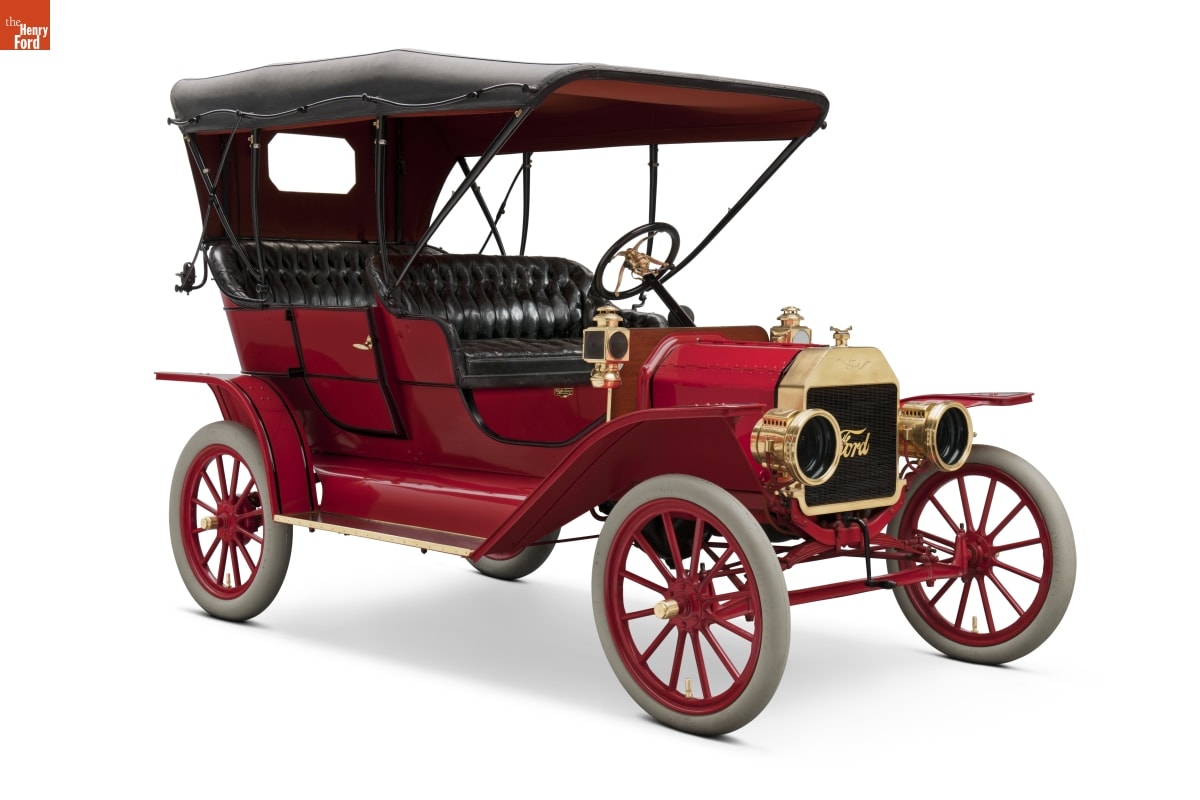
1909 Ford Model T Touring Car
Henry Ford crafted his ideal car in the Model T. It was rugged, reliable and suited to quantity production. The first 2,500 Model Ts carried gear-driven water pumps rather than the thermosiphon cooling system adopted later. Rarer still, the first 1,000 or so -- like this example -- used a lever rather than a floor pedal to engage reverse.
View ArtifactFord "The Universal Car" Sign, 1910-1918
Henry Ford's Model T was the first successful "world car"--a car that could be sold around the world with only minor modifications to its basic platform and parts. This advertising sign boasts the universal appeal of a car made and sold not only in the United States but also in South America, Europe, southern and eastern Asia, and Australia.
View ArtifactIngersoll Milling Machine Used at Ford Motor Company Highland Park Plant, 1912
The Model T's distinction as a landmark car design can be traced in large part to machines like this -- a high capacity precision machine tool that performed just two production steps on the car engine's cylinder block. The Model T as a design achievement is inseparable from many hundreds of engineering, materials, and production innovations.
View Artifact1914 Ford Model T Touring Car, Given to John Burroughs by Henry Ford
This 1914 touring car is one of several Model T automobiles given to naturalist John Burroughs by his friend Henry Ford. Ford Motor Company experienced a milestone year in 1914. The automaker fully implemented the moving assembly line at its Highland Park plant, and it introduced the Five Dollar Day profit-sharing plan for its employees.
View ArtifactPublication, "Ford at the Panama-Pacific Exposition, San Francisco, 1915"
This Ford Motor Company leaflet discusses its exhibit at the Panama-Pacific Exposition, the Model T, and its U.S. factories. The image of the main plant at Highland Park, Michigan, illustrates the comprehensive manufacturing operations. The plant had facilities for casting, machining, stamping, assembly, and shipping. The massive power plant with five smokestacks generated the factory's electricity.
View Artifact1919 Ford Model T Sedan
The Model T's basic design received many updates over the car's 19-year life. Some incorporated mechanical improvements, some responded to growing consumer demands, and some simply reduced costs. The 1919 sedans were the first with electric starters and demountable tire rims. These features were standard on other makes but cost extra on a Ford, keeping the base price low.
View Artifact1924 Ford Motor Company Institutional Message Advertising Campaign, "Organized Economies"
In 1924-25 the Ford Motor Company ran a series of sixteen dramatic advertisements in the Saturday Evening Post and Country Gentleman magazines. Rather than promoting the Model T specifically, the ads aimed to convey the company's scale and philosophy. By this, the fourteenth installment of the series, readers would understand the Model T in the context of the enormity and complexity of the Ford operation.
View Artifact1924 Ford Motor Company Institutional Message Advertising Campaign, "Opening the Highways to All Mankind"
In 1924-25 the Ford Motor Company ran a series of sixteen dramatic advertisements in the Saturday Evening Post and Country Gentleman magazines. Rather than promoting the Model T specifically, the ads aimed to convey the company's scale and philosophy. The final ad of the series emphasizes that the company is a transformative, service oriented, and mission-based organization -- optimistic and future-focused.
View ArtifactAdvertisement for the 1925 Ford Model T, "It is Bringing People Together"
This 1925 Ford Motor Company advertising campaign plays on the Model T's ability to bring people together. Whether carrying worshippers to church, closing the distance between rural neighbors, or widening the world for traditionally home-bound women, the Model T strengthened community ties.
View ArtifactAdvertisement for the 1925 Ford Model T, "Where the Nearest Neighbor May be Miles Away"
This 1925 Ford Motor Company advertising campaign plays on the Model T's ability to bring people together. Whether carrying worshippers to church, closing the distance between rural neighbors, or widening the world for traditionally home-bound women, the Model T strengthened community ties.
View ArtifactHenry Ford and Edsel Ford in Fifteen-Millionth Ford Model T Car on the Last Day of Model T Production, May 26, 1927
On May 26, 1927, Edsel and Henry Ford drove the fifteen-millionth Model T out of Highland Park Plant. This marked the symbolic end of Model T production and Ford Motor Company prepared to start producing the Model A. This image shows Edsel and Henry in the fifteen-millionth Model T, outside the Engineering Laboratory in Dearborn, Michigan.
View Artifact1927 Ford Model T Touring Car, The Fifteen-Millionth Ford
After 19 years and some 15 million cars, Ford Motor Company ended production of its venerable Model T. Company officials designated this car as the Fifteen Millionth and ceremonial "last" Model T. They gathered at Ford's Highland Park plant to watch Henry Ford and Edsel Ford drive it off the assembly line on May 26, 1927.
View ArtifactFord Model T in the Mud during the New York-Seattle Transcontinental Race, 1909
Ford Motor Company promoted its Model T by entering two cars in a 1909 race from New York to Seattle. It was a demanding contest at a time when roads were nearly nonexistent. After 23 days, the #2 Model T won the race. It was later disqualified on a technicality -- but the little Ford had already made big headlines by then.
View ArtifactFamily in Ford Model T in Front of Farmhouse, circa 1910
The Model T was particularly beneficial to farm families. While those in the city had access to railroads and streetcars, or could bicycle on paved roads, the farmer was limited to the distance his horse -- or feet -- could travel. The affordable Model T ended that isolation for good.
View ArtifactFord Model T Chassis Being Lined up outside the Highland Park Plant, circa 1913
Ford Motor Company's Highland Park plant hummed with activity during the 1910s. With the introduction of the moving assembly line, the plant went from building some 200,000 Model Ts in 1913 to more than 820,000 in 1919. Here workers are seen lining up chassis outside the plant for a publicity photo. The final shot showed 1,000 chassis -- one shift's production in 1913.
View Artifact1914 Ford Model T Touring Car Parked on Street
Ford Motor Company built more than 202,000 Model T automobiles in 1914. It was the last year for cherry-wood dashboards, and a cast-iron intake manifold replaced the previous aluminum unit. Behind the scenes, the moving assembly line was fully implemented in all stages of Model T production at Ford's Highland Park plant. Touring car prices started at $490.
View ArtifactSawing Wood Using the Ford Model T Sawmill Conversion, circa 1919
Innovative users adapted the Ford Model T to their needs. The Ford's rear axle powered many types of belt driven machinery. This photograph taken about 1919 shows men preparing to cut wood on a portable sawmill powered by a Model T.
View ArtifactHenry Ford with Ford Model T Car, Buffalo, New York, 1921
When this photo was taken in Buffalo, New York, in 1921, Henry Ford was at the height of his powers. He manufactured the world's bestselling car -- virtually half the cars on the planet were Model Ts. He was among the world's richest men. And he was a folk hero to millions of people.
View ArtifactHenry Ford with Ten-Millionth Ford Model T and 1896 Quadricycle, 1924
In June 1924, the ten-millionth Ford automobile--a Model T, of course--rolled off the assembly line. Ford sent this vehicle on a cross-country tour along the Lincoln Highway promoting the company. This photo shows Henry Ford standing between his factory-made 10-millionth vehicle and his 1896 Quadricycle--the first car Henry made.
View Artifact

