
Most Popular Artifacts during Our Pandemic Closure, 2020
Share
share
In 2020, the novel coronavirus COVID-19 sparked a worldwide pandemic. In response, The Henry Ford closed its doors on March 13 of that year and did not open them again until July 2. During that time, our Digital Collections was the most popular section of our website. Here are the artifacts virtual visitors were browsing most often during our closure, in order of popularity. Do you see patterns?
LeMans06-66_441
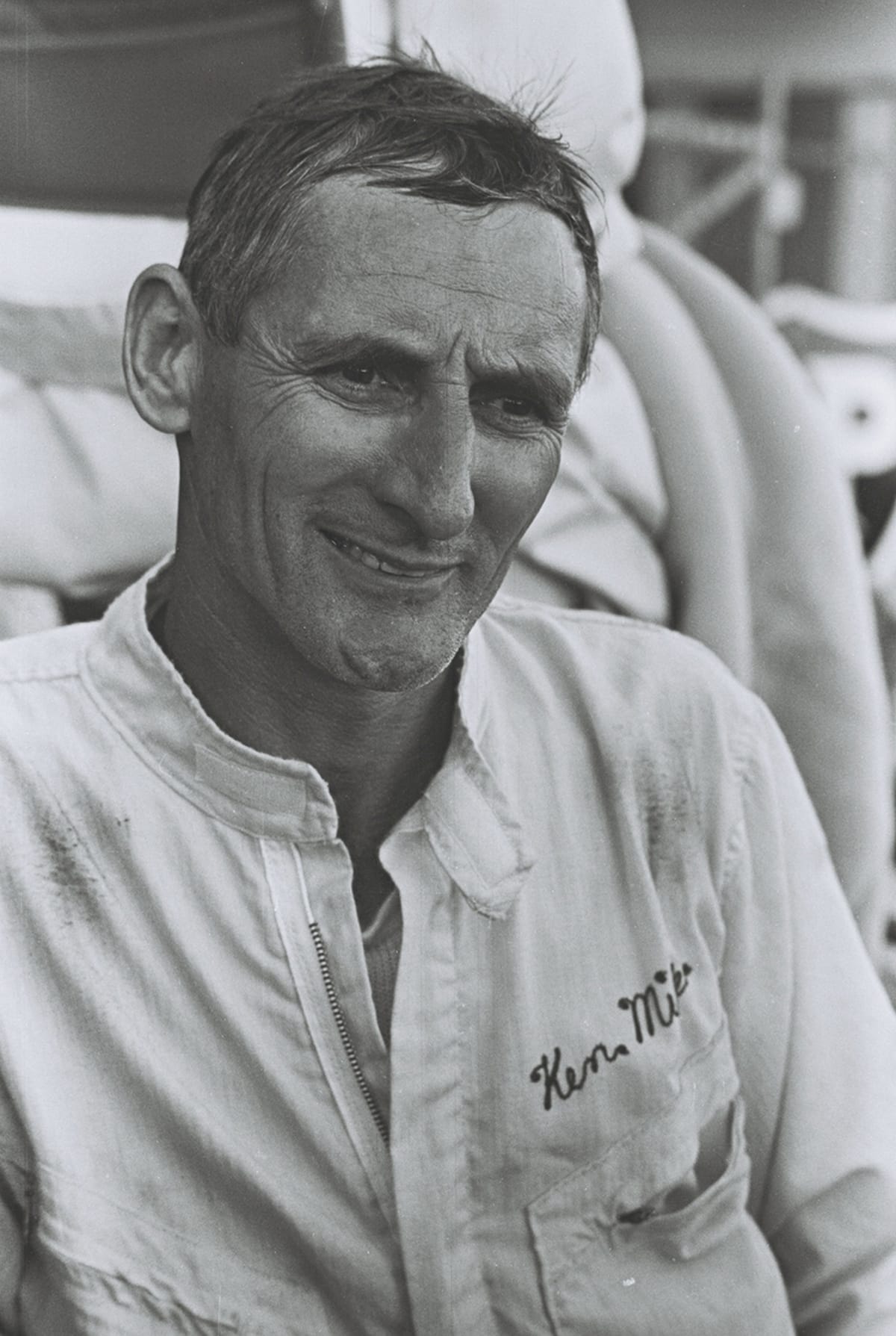
Ken Miles at the 24 Hours of Le Mans Race, June 1966
British-born Ken Miles was a gifted race car engineer and driver. Through his work for Carroll Shelby, Miles got involved in Ford's GT racing program. Miles won the 24 Hours of Daytona and the 12 Hours of Sebring in 1966, and he placed second at Le Mans. Miles died in a crash while testing Ford's J-Car later that year.
View ArtifactButton, "You Are the Spark That Started Our Freedom Movement. Thank You Sister Rosa Parks," circa 1988
On December 1, 1955, Rosa Parks refused to give up her seat to a white man on a bus in Montgomery, Alabama. Her courageous act of protest was considered the spark that ignited the Civil Rights movement. For decades, Martin Luther King Jr.'s fame overshadowed hers. But by the time of this button, Parks was beginning to receive long-overdue recognition.
View Artifact1896 Ford Quadricycle Runabout, First Car Built by Henry Ford
The Quadricycle was Henry Ford's first attempt to build a gasoline-powered automobile. It utilized commonly available materials: angle iron for the frame, a leather belt and chain drive for the transmission, and a buggy seat. Ford had to devise his own ignition system. He sold his Quadricycle for $200, then used the money to build his second car.
View ArtifactCarroll Shelby at the 24 Hours of Le Mans Race, June 1966
Carroll Shelby was brought in to boost Ford's struggling GT racing program in late 1964. Shelby, who'd won Le Mans as a driver in 1959, turned things around. His team reworked the GT40 and, with Ford engineers, replaced its 289-cubic-inch engine with a big 427. Ford swept the Le Mans podium in 1966 by taking first, second and third places.
View ArtifactLetter from Clyde Barrow to Henry Ford Praising the Ford V-8 Car, 1934
On April 13, 1934, Ford Motor Company received this unusual product testimonial. In it notorious bank robber Clyde Barrow extolled the virtues of Ford V-8s as getaway cars. Handwriting analysts have questioned the letter's authenticity, but it is the sort of thing the publicity-seeking Barrow might have written.
View ArtifactSlave Collar, circa 1860
The wealth and power of Southern plantation owners depended upon a large labor force of enslaved people. Slaves known for running away might have had to wear an iron collar like this, for punishment or to prevent them from running away again. The hooks caught on bushes or tree limbs, causing a violent jerking to the individual's head and neck.
View ArtifactRosa Parks Bus
Inside this bus on December 1, 1955, Rosa Parks, a soft-spoken African-American seamstress, refused to give up her seat to a white man, breaking existing segregation laws. The flawless character and quiet strength she exhibited successfully ignited action in others. For this, many believe Rosa Parks's act was the event that sparked the Civil Rights movement.
View Artifact"Whites Only" Drinking Fountain, 1954
From the late 19th through the mid-20th centuries, segregation laws in Southern states separated African Americans and whites in almost every aspect of public life -- from railroad cars and schools to restrooms and drinking fountains. Varying from state to state, these laws were supposed to establish facilities that were "separate but equal." In reality, these were almost never equal.
View ArtifactRocking Chair Used by Abraham Lincoln at Ford's Theater the Night of His Assassination, April 14, 1865
President Abraham Lincoln was sitting in this rocking chair during a production of Our American Cousin at Ford's Theatre in Washington, D.C., when he was assassinated on April 14, 1865. Henry Ford purchased the chair in 1929 for the Museum, where it remains one of the most revered objects associated with the "man who saved the Union."
View ArtifactSlate Pencils, circa 1875
In the nineteenth century, schoolchildren used slates to practice handwriting and arithmetic without wasting precious paper. Slate pencils were made of soapstone or softer pieces of slate rock, sometimes wrapped in paper like this one. Many students remember the sound of the slate pencil -- like nails on a chalkboard. In the late nineteenth/early twentieth century, chalk was used instead.
View Artifact1987 Ford Thunderbird Stock Car, Raced by Bill Elliott
Bill Elliott set NASCAR's all-time speed record with this car when he qualified for the 1987 Winston 500 at Talladega at 212.809 miles per hour. By the 1980s, "stock cars" only looked stock. Underneath this Thunderbird sheet metal is a purpose-built steel tube frame, racing suspension and brakes, and a racing engine that no Ford dealer ever sold.
View ArtifactAllegheny Steam Locomotive, 1941
The Chesapeake & Ohio Railway's massive Allegheny, introduced in 1941, represents the peak of steam railroad technology. Among the largest and most powerful steam locomotives ever built, it weighed 1.2 million pounds with its tender and could generate 7,500 horsepower. Just 11 years later, C&O began pulling these giants from service. Diesel-electric locomotives proved more flexible and less expensive.
View ArtifactMelting Pot Ceremony at Ford English School, July 4, 1917
In 1914 Ford Motor Company established the Ford English School, where the automaker's diverse immigrant employees could learn the English language and take civics lessons in preparation for becoming U.S. citizens. At the graduation ceremony, students wearing clothing from their native countries descended into a large "American Melting Pot" and emerged wearing homogenous suits and waving American flags.
View ArtifactAmana Radarange Microwave Oven, 1975
Amana's Radarange, introduced in 1967, was the first compact microwave oven made for home use. By 1975, when Ed and Flo Harper bought this Radarange as a family Christmas gift, sales of microwave ovens outpaced gas ovens for the first time. The convenient, time-saving microwave oven was becoming a practical necessity for a fast-paced world. People had less time to devote to cooking.
View Artifact1961 Lincoln Continental Presidential Limousine Used by John F. Kennedy
President John F. Kennedy was assassinated in this car on November 22, 1963. The midnight blue, un-armored convertible was rebuilt with a permanent roof, titanium armor plating, and more somber black paint. The limousine returned to the White House and remained in service until 1977. The modified car shows the fundamental ways in which presidential security changed after Kennedy's death.
View ArtifactBruce McLaren, Henry Ford II and Chris Amon at the 24 Hours of Le Mans Race, June 1966
Henry Ford II (center) celebrated with Bruce McLaren (left) and Chris Amon (right) after the two New Zealanders won the 1966 24 Hours of Le Mans in a Ford GT40 Mark II. Ford swept the podium that year, taking second and third places too. It was a milestone victory over Ferrari, the Italian automaker long dominant at the French race.
View Artifact1901 Ford "Sweepstakes" Race Car
This is Henry Ford's first race car. After his first auto company failed, Ford turned to racing to restore his reputation. He raced "Sweepstakes" against Alexander Winton on October 10, 1901, and, to everyone's surprise, the novice Ford beat the established Winton. The victory and resulting publicity encouraged financiers to back Ford's second firm.
View ArtifactCotswold Cottage
Cotswold Cottage is from the Cotswold Hills in southwest England. The Fords were attracted to the distinctive character of Cotswold buildings, which are characterized by the yellow-brown stone, tall gables, steeply pitched roofs, and stone ornamentation around windows and doors. Several decorative additions were made to the house in England, before dismantling and re-erecting it in Greenfield Village.
View Artifact1967 Ford Mark IV Race Car
This car was built to win the 24 Hours of Le Mans. Driven by Dan Gurney and A.J. Foyt, it accomplished that goal in 1967, beating the second-place Ferrari by 32 miles at a record-breaking average speed of 135.48 miles per hour. The Mark IV combined a sophisticated chassis with a big engine based on Ford's V-8 for stock car racing.
View ArtifactHenry Ford's "Kitchen Sink" Engine, 1893
Henry Ford built his first experimental engine using scrap metal for parts. He tested it on the kitchen sink after supper on December 24, 1893. For ignition he ran a wire from the ceiling's light bulb. His wife Clara hand-fed gasoline to the intake valve while Henry spun the flywheel. The engine roared into action, shaking the sink.
View ArtifactDymaxion House
Buckminster Fuller was a multi-disciplinary designer. This house, his re-thinking of human shelter, was rooted in Fuller's understanding of industrial production -- particularly methods developed in the automobile industry and especially those advocated by Henry Ford for whom Fuller had immense admiration. More an engineering solution than a home, the structure was prototyped but never produced.
View Artifact1924 Ford Model T Advertisement, "How Did He Ever Get the Money to Buy a Car?"
In 1923, Ford Motor Company launched the Ford Weekly Purchase Plan in response to the increasing popularity of buying cars on credit. Customers made payments to a bank in the amount of five dollars a week until they accumulated the price of a new Model T. It was unsuccessful because customers could just as easily open their own savings accounts.
View ArtifactFisher-Price Infant Car Seat, 1991
Fisher-Price produced this infant safety seat in 1991. It provided security for the infant while in the car, but also provided convenience for the parent. The seat doubled as an infant carrier. The baby could be transported comfortably and securely in or out of a car with this seat.
View Artifact1972 Lincoln Continental Presidential Limousine Used by Ronald Reagan
President Ronald Reagan was getting into this car when he was shot by John Hinckley on March 30, 1981. The car carried Reagan to the hospital. Presidents Nixon, Ford, Carter, and George H.W. Bush also used this car. In 1982 the front sheet metal was updated, but since a 1982 grille no longer fit properly on the 1972 body, a 1979 grille was used.
View Artifact1903 Ford Model A Runabout
After his first two attempts at commercial automobile manufacturing failed, Henry Ford found success with Ford Motor Company, established in 1903. The new company's first product, the Model A, was conventional by the standards of the day. It featured a two-cylinder engine mounted under the seat and rear wheels driven by a chain.
View Artifact1931 Bugatti Type 41 Royale Convertible
Longer than a Duesenberg. Twice the horsepower of a Rolls-Royce. More costly than both put together. The Bugatti Royale was the ultimate automobile, making its owners feel like kings. Not only did it do everything on a grander scale than the world's other great luxury cars, it was also rare. Bugatti built only six Royales, whereas there were 481 Model J Duesenbergs and 1,767 Phantom II Rolls-Royces.
View Artifact1939 Lincoln Presidential Limousine Used by Franklin D. Roosevelt
This was the first car built expressly for presidential use. It was nicknamed the "Sunshine Special" because President Franklin Roosevelt loved to ride in it with the top down. After the Japanese attack on Pearl Harbor in 1941 the car was returned to the factory where it was equipped with armor plate and bullet-resistant tires and gas tank. The "Sunshine Special" was retired in 1950.
View ArtifactMattox Family Home
Amos and Grace Mattox -- descended from enslaved African Americans -- raised their two children in this rural Georgia farmhouse during the Great Depression of the 1930s. Amos farmed, cut hair, made shoes, and preached at the local church, while Grace sewed, canned, cooked, and helped needy neighbors. Although life was hard, the family proudly affirmed that there was "always enough."
View Artifact1902 Ford "999" Race Car, Built by Henry Ford
Henry Ford hired a fearless bicycle racer named Barney Oldfield to drive "999." Although he had never driven a car, Oldfield learned quickly and won his first competition. He went on to become America's first nationally famous racing hero, known for his thrilling exhibition races and the trademark cigar he chewed to protect his teeth in a crash.
View ArtifactFlow Chart for B-24 Production at the Willow Run Bomber Plant, 1944
During World War II, Ford built 8,685 B-24 Liberator bombers at Willow Run. Fuselages were joined to center wing sections and landing gear, after which the airplanes moved along four parallel assembly lines where noses and tails were added. These lines merged into two for the installation of wingtips, engines, and other components. A single final line handled finishing steps and fueling.
View Artifact1965 Lotus-Ford Race Car
Scotsman Jim Clark won the Indianapolis 500 with this rear-engine car in 1965. After his victory, a traditional front-engine car never won that race again. The Lotus-Ford combined a European Formula One-inspired lightweight chassis with a big Ford V-8 engine. The Lotus-Ford's success effectively killed the traditional Indy roadster and established a new design for American race cars.
View Artifact6000th Ford B-24 in Flight over Detroit, Michigan, September 13, 1944
During World War II, Ford Motor Company built 8,685 B-24 Liberator bomber airplanes at its Willow Run plant, 35 miles west of Detroit. By the spring of 1944, employees on Ford's bomber assembly line could turn out a finished airplane every 63 minutes. Workers completed the 6,000th B-24 in September 1944 -- with considerable fanfare.
View ArtifactToaster, 2013
Starting in the early 1980s--and already established as an internationally recognized architect--Michael Graves began to pursue a parallel career as a product designer. Over the following three and a half decades he and his collaborators designed everything from humble household goods to limited edition luxury items for clients as diverse as Steuben, Alessi, Target, J. C. Penney, and Disney.
View ArtifactParcheesi Game, 1938-1945
Parcheesi is based on Pachisi -- a game that originated in India. Basic game rules have players traveling around the cross-shaped board from start to home. Landing on another players' marker sends that player back to start. American game makers, Selchow and Righter, trademarked the Parcheesi name in 1874 after purchasing the game rights in 1867.
View Artifact1906 Locomobile "Old 16" Race Car
In 1908, driver George Robertson and mechanician Glenn Ethridge took this car to victory in the Vanderbilt Cup, America's first great automobile race. It marked the first time an American-built car won a major international road-circuit race. The Locomobile competed while wearing number 16, and it's been known as "Old 16" ever since.
View ArtifactBrick from Indianapolis Motor Speedway
When Carl Fisher and his partners opened Indianapolis Motor Speedway in 1909, the crushed stone and tar track surface quickly proved too dangerous. Fisher had the entire track resurfaced with 3.2 million paving bricks. The track was fully paved with asphalt by 1961, but a three-foot brick strip -- at the start/finish line -- remains, as does the speedway's nickname: the Brickyard.
View ArtifactKu Klux Klan Robe and Hood, circa 1925
The Ku Klux Klan's robe and hood veiled the organization in secrecy. During the 1920s, the date of this robe, Klansmen hidden behind this regalia could carry out unchecked terror on African Americans, Catholics, Jews, and immigrants. The robe and hood instilled fear on its victims and a sense of power to its wearers.
View Artifact"Photograph of President Lincoln Meeting General McClellan and Staff at Antietam in October 1862"
President Abraham Lincoln visits General George B. McClellan and his officers at Antietam, Maryland. Alexander Gardner made the photograph on October 3, 1862. At the time, this was the main eastern theater of the Civil War. President Lincoln often conferred with his commanders in the field. Lincoln, at 6-feet 4-inches and wearing his distinctive top hat, towers over the officers.
View ArtifactLincoln Motor Company Advertisement Showing Greyhound Hood Ornament, circa 1930
Lincoln Motor Company adopted the greyhound as its corporate mascot in 1925. The swift, graceful animal was a fitting symbol for a company that prided itself on speedy and stylish motor cars. Gorham Manufacturing Company, a silversmithing firm based in New York City, designed the regal hood ornament that crowned Lincoln automobiles through the 1930s.
View ArtifactBoye Needle Company Product Display, circa 1925
Manufacturers frequently made display materials available to retailers to help encourage increased sales of the company's product. This Boye Needle Company product display not only displayed sewing machine needles, shuttles and bobbins in an attractive dispenser, but also included a chart to help determine the appropriate size accessory needed for different makes of sewing machines.
View Artifact1914 Detroit Electric Model 47 Brougham, Personal Car of Clara Ford
Clara Ford, wife of Henry Ford, drove this Detroit Electric. In the years before World War I, many women chose electric cars because they started instantly without hand cranking and had no difficult-to-shift transmission. The superintendent of the Detroit Electric factory employed his daughter, Lillian Reynolds, to sell to women -- including Clara Ford, who drove this car into the 1930s.
View ArtifactAnti-immigrant Ku Klux Klan Creed, circa 1922
Many native-born Americans viewed immigrants with fear at the beginning of the 20th century. Economic instability and social tensions were blamed on foreigners, and the "immigrant problem" became a national focus. This anti-immigrant document released from the Ku Klux Klan announces members' belief in protecting traditional American ideals from immigrants, reflecting the fear that many native-born Americans felt.
View Artifact1919 Ford Model T Sedan
The Model T's basic design received many updates over the car's 19-year life. Some incorporated mechanical improvements, some responded to growing consumer demands, and some simply reduced costs. The 1919 sedans were the first with electric starters and demountable tire rims. These features were standard on other makes but cost extra on a Ford, keeping the base price low.
View ArtifactDrawing of the 1893 Kitchen Sink Engine, "Diagram of 4 Cycle Internal Combustion Engine"
This 1934 diagram uses Henry Ford's experimental 1893 Kitchen Sink Engine to illustrate the operation of a four-stroke internal combustion engine. Stroke one draws air and fuel into the cylinder. Stroke two compresses the air-fuel mixture. In the power stroke, a spark ignites the mixture which forces the piston down, turning the crankshaft. Stroke four pushes exhaust from the cylinder.
View Artifact1932 Ford V-8 Engine, No. 1
Henry Ford and Ford Motor Company revolutionized the auto industry once again in 1932 with the introduction of a low-priced V-8 engine. By casting the crankcase and cylinder banks as a single unit, Ford cut manufacturing costs and could offer its V-8 in a car starting under $500. Ford's original V-8 design remained in production, with modifications, until 1953.
View ArtifactMartha-Mary Chapel
Churches were a center of community life in the 1700s, a place where townspeople came together to attend services and socialize. The Martha-Mary Chapel, with its architecture inspired by New England's colonial-era churches, was built in Greenfield Village in 1929. This chapel was named after Henry Ford's mother, Mary Litogot Ford, and his mother-in-law, Martha Bench Bryant.
View ArtifactWorld War II Poster, "United We Win," 1943
During the Second World War, all of the national governments of the warring nations used poster campaigns to encourage civilian and military support of the war effort. The advertising technique of these posters followed the innovative style developed during the First World War. By appealing to the viewer's emotions this poster helped the U.S. to rally the home front workers and consumers.
View ArtifactHenry Ford II and Anne McDonnell Ford with Daughters Anne and Charlotte, 1944
Henry Ford II, oldest son of Edsel Ford, poses with his first wife, Anne, and their two daughters. In 1945, after receiving special release from the Navy, he took control of the ailing Ford Motor Company and revitalized the automaker. Ford retired as CEO in 1980 but continued to serve on the company's board of directors until his death in 1987.
View ArtifactEmancipation Day, Richmond, Virginia, April 3, 1905
Until Union troops arrived, the Emancipation Proclamation meant little to most slaves in the Confederate States of America. For African Americans living in Richmond, Virginia, the day of Emancipation came on April 3, 1865. The event continued to be celebrated annually on that day into the 20th century. This photograph shows the celebration in 1905, 40 years after the war ended.
View Artifact

