
Parking
Share
share
America's cars symbolize mobility, but they spend 95 percent of their time parked. Storing cars is a longstanding challenge, and every solution brings new problems. Parking lots and structures transform urban and suburban landscapes, parking meters and tickets exasperate city drivers, and residential garages have moved from the back yard onto the house itself. There are as many as a billion parking spots in the United States -- one heck of a lot.
THF212010
Cars Parked on Residential Street, New York State, circa 1915
Curbside parking generally isn't a problem on quiet residential streets, but it can be a nuisance in crowded cities. Parked cars effectively narrow the roadway, which restricts the flow of traffic. Limiting or outright banning curbside parking improves traffic, but it discourages customers from visiting downtown stores and businesses.
View ArtifactFord Model T Automobiles in Henderson, Texas, 1920
Cities have experimented to find optimal parking arrangements. Broad streets have room for cars to park perpendicular to the curb or centerline, while narrow streets are limited to parallel parking along the curb. Angle parking offers a compromise -- room for more cars than parallel parking, and without the need for the tricky driving maneuvers required to back into a spot.
View ArtifactGeneral Motors Publication, "How to Park in a Tight Place," circa 1940
For some drivers, there's no greater terror than parallel parking. It can be a difficult sequence of estimating distances, checking mirrors, shifting between forward and reverse, turning the steering wheel just so -- and then starting all over when the first attempt fails. There's also the stress of avoiding traffic and trying not to block the travel lane for too long.
View ArtifactMan Standing beside a Ford V-8 DeLuxe Tudor Car Parked on a Commercial Street, Dearborn, Michigan, January 1938
Parallel parking can be dangerous, too. Car doors open into oncoming traffic, and drivers and back seat passengers exit cars directly into the roadway. People and doors are at risk of being hit, and oncoming cars may swerve or stop to avoid a collision -- which can lead to sideswipe or rear-end collisions with other vehicles.
View ArtifactFord V-8 Automobiles Parked under a No Parking Sign, 1935
One way to control parking is to prohibit it altogether. There are some places -- bus stops, fire lanes, near fire hydrants -- where that is the only option. But it might also be necessary on narrow streets. In the mid-20th century, many American cities shifted to a system of one-way streets. This encouraged smoother traffic flow and opened room for parking.
View ArtifactPolice Officer on Horseback Showing a Driver the "No Parking" Sign on a Lamp Post, April 1940
In some places, parking is prohibited only at certain times. Prohibitions during the morning and evening rush hours allow maximum space for traffic. Bans on trash collection days enable garbage trucks to access curbside bins. Prohibitions after heavy snowfalls allow plows to move freely. More recently, cities have sometimes banned parking to free up space for dedicated bicycle lanes.
View Artifact"City Garage" Toy, 1910-1940
Parking garages provide another solution to urban parking problems. Early garages sometimes repurposed existing buildings like livery stables or carriage barns. Some had on-site washing, fueling, or servicing facilities. Later garages were specially designed for the task. They featured multiple levels with elaborate ramps between them, and booths from which to collect parking fees.
View ArtifactSign Warning Drivers in the Cimiotti Garage, New York City, circa 1910
Parking garages can also generate complaints -- and not just from the patrons who use them. This sign, photographed in a New York City garage circa 1910, warned drivers against speeding and making excessive noise. Another common complaint is the lack of aesthetic appeal in parking garages, which often stand out from otherwise cohesive urban streetscapes.
View ArtifactPostcard, "Cobo Hall," circa 1960
Architects are increasingly creative about parking cars. Cobo Hall, a convention center and arena complex in Detroit, Michigan, opened in 1960. The facility included a rooftop parking deck with room for 1,200 cars. Today, the complex -- renamed Huntington Place in 2021 -- also includes two underground garages and an adjacent parking structure, with space for more than 4,000 cars altogether.
View ArtifactAutomobile Wheel Lock, circa 1920
Parking a car means leaving it unattended -- and subject to theft. Early auto security generally depended on aftermarket products like this wheel lock. It clamped around the tire and locked through the spokes. Wheel locks weren’t much of a deterrent to determined thieves. They merely had to remove the locked wheel and replace it with a spare.
View ArtifactDual Brand Parking Meter, circa 1948
Carl Magee, a traffic commissioner in Oklahoma City, invented and installed the first parking meter in 1935. Meters allow cities to monetize their limited and desirable on-street parking spots. Parking fees encourage steady turnover, and they provide revenue to municipal governments. It's a dual benefit – the inspiration behind the "Dual" brand name on Magee's meters.
View ArtifactTwin Parking Meter, circa 1938
At heart, parking meters are clocks. Early units like this one required an attendant to periodically wind the mainspring. Inserting coins started the clock timer for a set period. Later units had users wind the mechanism by twisting a knob after depositing coins. When the clock ran out, a "Time Expired" flag sprang up to notify parking-enforcement officers.
View Artifact"The Saturday Evening Post," February 10, 1951
Parking meters have mostly solved, or at least made manageable, urban parking problems. Meters are a boon to parking-enforcement officials and city treasurers, but they're a symbol of tyranny to people who believe that streets are public rights-of-way, and that cites have no authority to charge for their use. Courts have largely upheld the legality of parking meters.
View ArtifactPark-O-Meter Parking Meter, circa 1958
By the 1990s, parking meters were increasingly sophisticated. Some replaced mechanical clocks and pointers with electronic computers and LCD displays. Others were designed to accept credit or debit cards as well as coins. Today there are touchless meters that can be activated from a user's smartphone. These modern meters even send text messages alerting you when time is running short.
View ArtifactMonopoly Game, 1954-1960
Anyone who's played Monopoly will recognize "free parking" as a special privilege. It's one of the few spots a player can land and not have to pay rent to opponents. Free parking became a threat to downtown merchants following World War II. It was a key attraction used to lure postwar customers to suburban malls and shopping centers.
View Artifact"Exciting Northland," circa 1960
Northland Center, which opened in suburban Southfield, Michigan, in 1954, typified the advantages of postwar malls and shopping centers. Automobile access to the complex was easy via freeway. Stores were spacious and airy. And on-site parking spaces were ample and free of charge -- a point emphasized on the first page of this brochure from about 1960.
View Artifact"Park and Shop" Board Game, 1960
Parking and shopping are the name of the game (literally) in this 1960 board game from Milton Bradley. The object is to drive from home to a parking spot, and then complete the errands on your shopping list before your opponents. The typical postwar suburban shopping center provides a perfect setting for the competition.
View ArtifactParking Lot Outside Turn One, Indianapolis Speedway
Big events draw big crowds, and big crowds mean lots of cars. Finding a parking spot is part of the experience for many people who attend sporting events, concerts, festivals, amusement parks, and other large attractions. The 1912 Indianapolis 500 drew an estimated 75,000 spectators. From the looks of this photo, many of them drove to the race.
View ArtifactTicket to Park at Disneyland Auto Park, 1957
After the fun, finding your car in a giant parking lot can be a challenge. Signs with section and row numbers are a common solution. When Disneyland opened in 1955, its 100-acre parking lot labeled its sections with letters. In time, the sections were renamed with easier-to-remember Disney character names like Mickey, Minnie, Goofy, Bambi, and Tinker Bell.
View ArtifactConstruction of Henry Ford Museum Parking Lot, 1936
Ironically, Henry Ford Museum opened in 1929 without a parking lot. Henry Ford intended both the museum and Greenfield Village primarily to serve students at the Edison Institute Schools. But both the museum and village were opened to visitors by popular demand in 1933. A parking lot was added in front of the museum three years later.
View ArtifactParking Attendant and Woman with 1961 Simca Aronde
Traditionally, "valet" referred to a personal attendant. Later, it came to describe a hotel valet who cleaned and pressed clothes for guests. Today, most Americans associate the word with valet parking, where a staff member at an establishment parks your car for you. It's certainly convenient, but valet parking can be nerve wracking for owners of expensive and/or high-performance cars!
View ArtifactRendering of Automobile Dashboard Design Concept
Like "valet," "park" itself has an additional meaning for modern drivers. Many associate it with the "Park" position on an automatic transmission, which engages a mechanical lock to prevent the car from moving. Ford introduced the PRNDL selector layout with its Ford-O-Matic transmission in 1951. This shift sequence became common by 1966, and it became law in 1971.
View Artifact1991 Lincoln Town Car Advertisement Proof Sheet
Reserved parking spots are a considerable perk. Some are set aside by law for drivers with disabilities. Others are reserved for short-term visitors like delivery vehicles or restaurant carry-out customers. At some organizations, a reserved parking spot is a status symbol -- perhaps for a high-ranking official or an "employee of the month" honoree.
View Artifact"Salesmen Parking" Area outside the Ford Rouge Plant Administration Building, Dearborn, Michigan, January 1948
Ford Motor Company reserved close-in spots for sales staff calling at its Administration Building at the Rouge complex in Dearborn, Michigan. Presumably, most salespeople only visited the building for brief meetings, so close and convenient parking was appreciated -- and the spots didn't stay occupied for long.
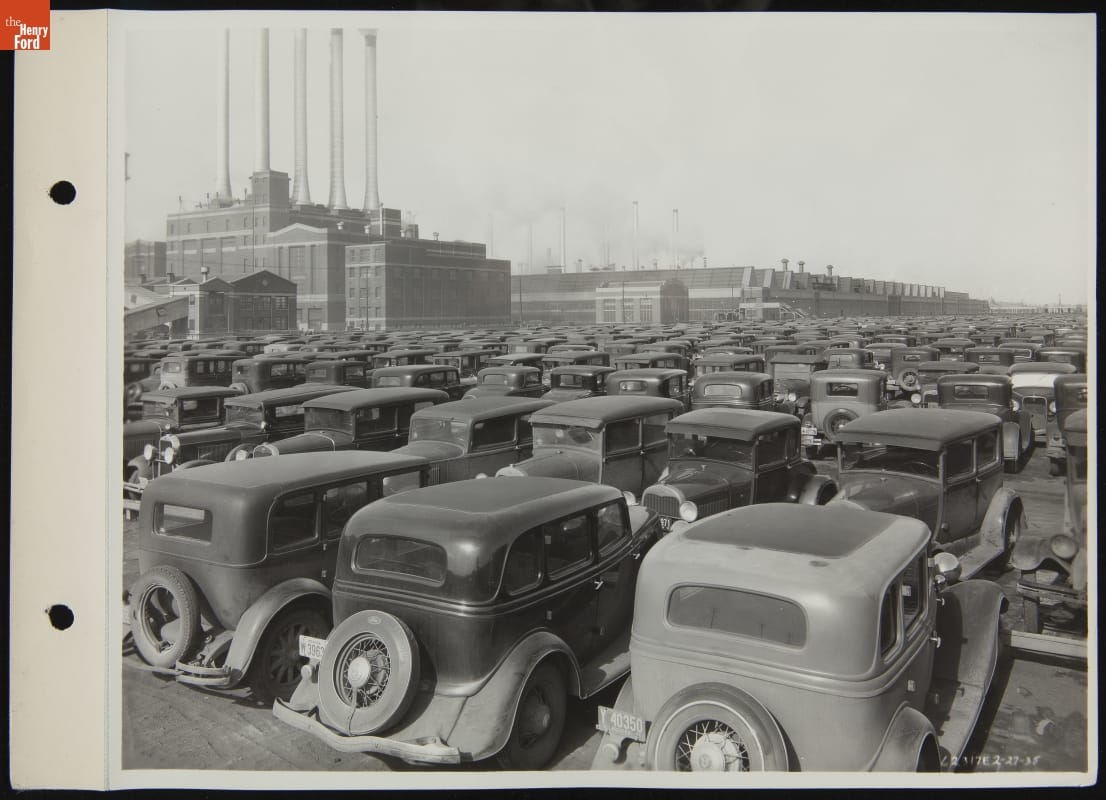
View ArtifactEmployee Parking Lots, Ford Rouge Plant, February 27, 1935
Not surprisingly, many Ford vehicles are parked at the company's Rouge plant in this 1935 photograph. It’s not unusual at an auto plant to see preferential parking spots reserved for "family" vehicles – brands owned by the company that operates the plant. It builds pride in the product, and it might help sell a few more cars too.
View Artifact"Ready to Go to the Picnic," circa 1925
We don't just park when we're out and about. Our cars spend most of their time parked at our homes. By the 1920s, Americans were either converting existing sheds or constructing dedicated garages to house their cars. This stereograph appears to show a detached garage at the end of the family's driveway.
View Artifact1981 Checker Marathon Taxicab
"Big Yellow Taxi" is the title of the popular Joni Mitchell song released in 1970, but casual listeners might know it better by its opening line: "They paved paradise and put up a parking lot." Countless green fields have given way to asphalt lots, and Mitchell's observation remains true: "You don't know what you’ve got till it’s gone."
View Artifact

