
Signs of the Times
Share
share
Brightly-colored outdoor signs, mounted on poles or directly onto the walls of buildings, were intended to capture the attention of passersby. These metal signs, ranging from the 1920s through the 1960s, advertised products and roadside establishments through their clever combination of eye-catching colors, images, lettering, and contrast.
THF104923
Faygo Sign, circa 1950
Faygo, now a nationally franchised brand, was once a local Detroit product. Founded in 1907 by Ben and Perry Feigenson, two Russian immigrants, the company's soft drinks were based on frosting flavors of the baked goods that were the brothers' trained profession. In 1921, the brothers adopted the Faygo brand name. Faygo is credited with coining the word "pop."
View ArtifactFisk "Time to Re-Tire" Sign, 1920-1940
Potential customers seeing this sign at a service station would know that Fisk Tires were sold there. Begun as the Fisk Rubber Company in 1898 and headquartered in Chicopee, Massachusetts, Fisk was one of five tire companies that dominated the American tire industry between 1920 and 1937. Facing competition during the 1930s, Fisk was acquired by U.S. Rubber in 1940.
View ArtifactShell Oil Sign, 1958-1970
In 1904, the Shell Transport and Trading Company (later Shell Oil) adopted the scallop shell as its trademark. Over time, different iterations of the scallop shell corporate logo were developed. By the mid-20th century, it had been stylized, with the bright bold yellow-and-red color scheme that it has today -- beckoning motorists off the highway in the face of steep competition.
View ArtifactSweet Sixteen Sign, circa 1935
Before the days of national brands, locally-made products were advertised in community newspapers, through free giveaways, and by signs like this one -- that were affixed to the front and side walls of stores. The Mathews Company of Detroit, who produced this sign, specialized in the production of metal signs that advertised local products like Detroit-based Sweet Sixteen soda.
View ArtifactMoore's Ice Cream Sign, 1930-1955
Before the days of national brands, locally-made products were advertised in community newspapers, through free giveaways, and by signs like this one -- that were affixed to the front and side walls of stores. The Mathews Company of Detroit, who produced this sign, specialized in producing metal signs that advertised local products like Moore's Ice Cream, made in Atlanta, Georgia.
View ArtifactWaverly Engine Rejuvenation Sign, 1930-1950
Automobile service stations were usually plastered with signs like this one that advertised the many products and services they offered. The Waverly UVX-4 engine rejuvenation was an additive--applied while customers waited--that promised to impart "amazing new life" to their car.
View ArtifactNesbitt's Sign, circa 1950
The Nesbitt Fruit Products Company was founded in 1924. In 1927, the company began producing orange-flavored syrup for soda fountains and, in 1938, the company started bottling it -- featuring 10% California orange juice. Nesbitt's was later franchised to independent bottling companies both nationally and internationally. From Disneyland's 1955 opening into the 1960s, Nesbitt's was the park's "Official" Orange Drink.
View ArtifactKuehmann's Potato Chips Sign, circa 1935
Before the days of national brands, locally-made products were advertised in community newspapers, through free giveaways, and by signs like this one -- that were affixed to the front and side walls of stores. Kuehmann's Original Potato Chips and Butter Pretzels were made in Toledo, Ohio.
View ArtifactBest Western Motel Sign, circa 1950
The Best Western "chain" was created in 1946 by M.K. Guertin of Long Beach, California, who was inspired by the loosely organized motel associations and referral chains that cooperated in upgrades of their properties. But Best Western, run as an incorporated business, was much more successful. Best Western motels, to display a sign like this, abided by agreed-upon standards.
View ArtifactTexaco Sign, 1964
In 1937, Texaco hired visionary industrial designer Walter Dorwin Teague to redesign and modernize its stations. By 1940, Texaco had 500 stations with clean white porcelain, green lines, and bold red stars. Teague's design was a beacon to drivers, promising friendly attendance, quality gasoline, and clean restrooms. This sign was also designed by Teague.
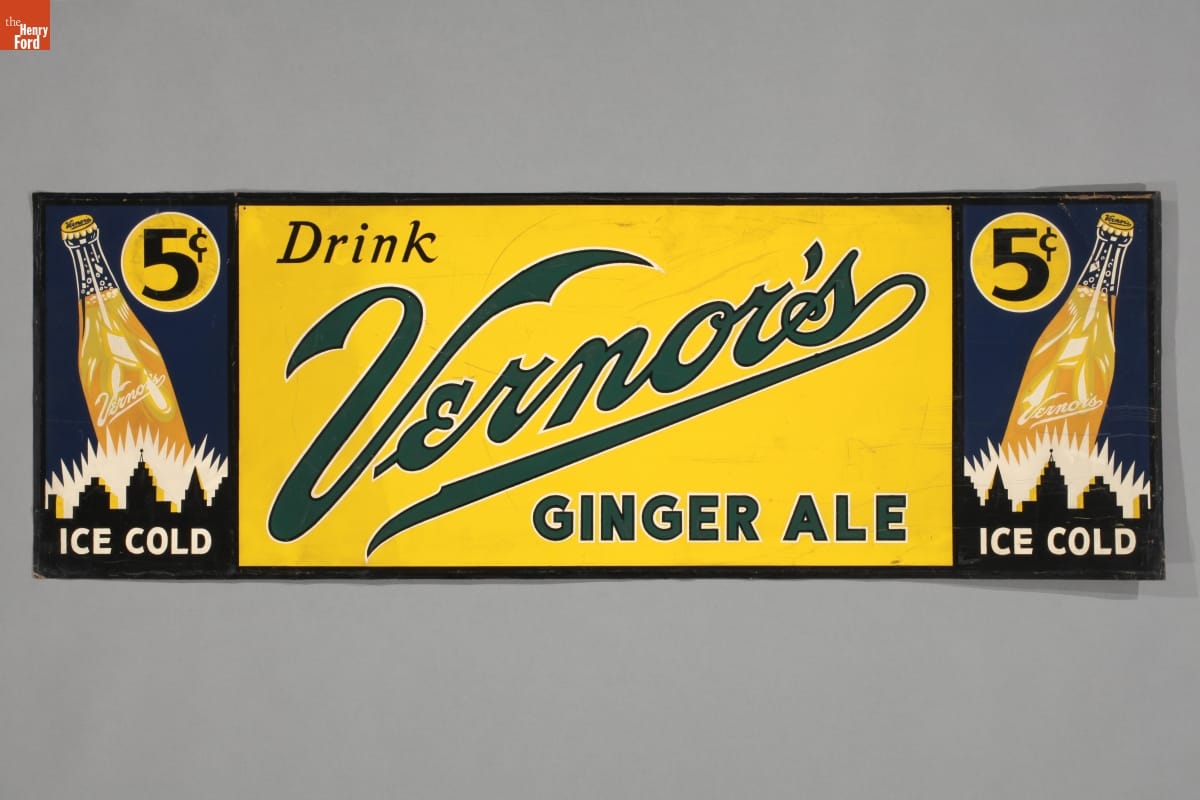
View Artifact"Drink Vernor's Ginger Ale" Sign, 1945-1960
Vernor's is the oldest surviving ginger ale brand in the United States. It was introduced in 1866 by James Vernor, a Detroit pharmacist, who discovered that his concoction took on a unique flavor when aged in a wooden keg. Vernor's was featured at local soda fountains, then franchised to independent bottling companies who promised to adhere to the original recipe.
View ArtifactJustrite Ice Cream Sign, 1930-1955
Before the days of national brands, locally-made products were advertised in community newspapers, through free giveaways, and by signs like this one -- that were affixed to the front and side walls of stores. The Mathews Company of Detroit, who produced this sign, specialized in producing metal signs that advertised local products like Justrite Ice Cream, made in St. Joseph, Missouri.
View ArtifactGreyhound Sign, circa 1946
The Greyhound bus system started in 1914, when founder Carl Eric Wickman had the idea of transporting miners to and from work by bus in the Mesabi Iron Range of northern Minnesota. The business expanded and the company was named Greyhound in 1929. Despite competition, the Greyhound bus system became synonymous with long-distance bus travel.
View ArtifactUncle Dan's Root Beer Sign, circa 1935
Before the days of national brands, locally-made products were advertised in community newspapers, through free giveaways, and by signs like this one -- that were affixed to the front and side walls of stores. The Mathews Company of Detroit, who produced this sign, specialized in the production of metal signs that advertised local products like Detroit-based Uncle Dan's Root Beer.
View ArtifactGlitter Glaze Sign, 1946-1955
Potential customers seeing this sign at a service station would know that Glitter Glaze weatherproofing was sold there. According to a 1946 Popular Mechanics ad, Glitter Glaze was a "brilliant hard durable coating that protects the [car's] finish regardless of climatic conditions." The manufacturer promised that it "contains no wax or grease, and won't chip, crack or peel."
View ArtifactStransdale Ice Cream Sign, 1930-1955
Before the days of national brands, locally-made products were advertised in community newspapers, through free giveaways, and by signs like this one -- that were affixed to the front and side walls of stores. Stransdale "Constantly Superior" Ice Cream was made in Savanna, Illinois.
View ArtifactDr. Sterns' Root Beer Sign, circa 1935
Before the days of national brands, locally-made products were advertised in community newspapers, through free giveaways, and by signs like this one -- that were affixed to the front and side walls of stores. The Mathews Company of Detroit, who produced this sign, specialized in the production of metal signs that advertised local products like Dr. Sterns' Root Beer, based in Albert Lea, Minnesota.
View Artifact

