Posts Tagged by diana "daisy" kelley


On July 14, 1948, Lois Kelley wrote "Dear Mother and Dad - Today is beginning clear, fresh, and cool, and I couldn't be happier because. . ."
Happy because of life on the farm with her husband, Bob, and their young son, Bobby. Happy because of the way the place was responding to their nourishing touch. Happy because of the rabbits and peas and hay, and because "the baby is due in only five weeks."
In 1948, the Kelleys had settled on eleven acres in Rockville, Connecticut. The house, barn, hayfields, and berry patches all needed attention. The work and the record-breaking cold and snow of their first winter hadn’t chilled their enthusiasm for the future. They warmed to the learning and achievements ahead.
 Kelley family farmhouse in Rockville, Connecticut, 1948. / THF723661
In the spring and summer of 1948, in her regular letters to her parents, Lois described learning how to plow a field, milk cows, harvest vegetables, and process meats. As the August birth of their daughter, Diana neared, Lois turned to indoor concerns like pie and shortcake, buying a freezer, making curtains, and increasingly, heating the house.
The Kelleys applied to add expenses for a new furnace to their mortgage. In July 1948, they received word that the request to add the furnace was denied. Undaunted, Lois reflected "all we have to do is ask ourselves whether we'd rather be in the apartment where there's heat and hot water, where dirt doesn't get tracked in, and weeds don't grow—and we feel absolutely blissful about this no matter what it lacks."
By October the Kelleys had a plan for winter. "We have another oil heater now - double burner living room type of a rather old vintage. . . so. . . we have our lovely stove in the kitchen, two double burner heaters (for living room and bathroom), and one single burner heater (for our bedroom). I don't see how we can help but be warm, even if this winter were to be as ferocious as the last. Just the same - I'm going to get Bobby some long-legged underwear - and some for myself too. (Red if possible.) Bob has a couple of sets from the Army.''
 Detail from a letter from Lois Kelley to her parents, September 22, 1948, pg. 1. / THF723677
In February 1949, as the winter bore on, Bob intoned his favorite weather saying: "When the days begin to lengthen, the cold begins to strengthen." The Kelleys layered the home in curtains, storm windows, and insulation, and began to discuss central heat and hot water in earnest.
 Bob Kelley removing his boots near the heating stove in the Kelley house kitchen, Rockville, Connecticut, 1948. / THF723649
Over the winter of 1948-49 the family's finances improved. Thus, the bank approved their furnace loan in late August 1949, but the Kelleys still needed approval from the Veterans Administration (VA) Loan Guaranty Service. Anticipating delays there, the Kelleys would rely on the fireplace, but first they had to repair the chimney. They decided to build a Heatilator—a steel-lined fireplace that circulated heated air.
There were surprises. Lois Kelley recounted these with humor in letters to her parents.
August 26: "Bob started tearing down the plaster around the old chimney, the wainscoting, and the wall where the fireplace is to go. . . After Bob had torn up a few boards and then fell through. . . the sub-flooring, we decided that we need a new floor as well as a new ceiling and walls. . ."
August 29: “We ripped up the remaining floorboards this morning before Bob went to work, and just to make it unanimous, I fell through up to my hip. . . he's busy here now, putting in new joists. . . . One of the old ones practically disintegrated under Bob’s touch yesterday, it was so rotten!
And the chimney!. . . When Bob started to take it down, it split in half and fell, one half falling through the upstairs hall ceiling, and the other half landing on top of the guest bed, clean sheets and all!” The VA assessor chose that moment to arrive for his inspection.
 Charlie Magdefrau replacing floor joists in the Kelley house living room, Rockville, Connecticut, 1949. / THF723664
The fireplace was finished before winter. On October 16, the day after their first test fire, "Bob started a real blaze, took off his shoes and took up the paper."
But delays continued with the furnace, as Lois revealed in her regular letters to her parents. Two days after that cozy fireplace fire, they signed papers for the furnace loan, though it would be five more cold weeks before they heard from the contractor. On November 23 he apologized that the steel strike had delayed a few parts. Midway through December Lois bemoaned that they were "just about due to run out of our cordwood." On the previous Saturday morning, "when we got up there was a skim of ice in the toilet. . . We're really ready for baths!" she complained.
Finally, on December 20, 1949, she exclaimed, "Yes we have heat!" For the first time in over a year, the family could take hot baths or invite overnight guests. Their yearly Christmas card featured the Heatilator with its advertised "Fireplace Charm plus Room Wide Comfort."
 Kelley family Christmas card featuring Bobby hanging his sister's stocking above the Heatilator, December 1949. / THF723655
Having secured some creature comforts at the farmhouse in Rockville, Connecticut, the Kelleys turned their ambitions toward a larger farm. In 1953 they purchased a house constructed in the 1750s, located on Bear Swamp Road in nearby Andover, Connecticut. When they applied for financing, their bank said that it wasn't their "policy to take houses so old or unmodernized." The realtor, who owned an old house himself, helped them find a banker who also liked old houses, and the papers were signed.
 South side of the Kelley family home with ell and vegetable garden in the foreground (positioned where the sun shown most intently), Bear Swamp Road, Andover, Connecticut, 1953. / THF723673
Lois described their new winter preparations in a note to her parents on August 24, 1953. "Since we weren't able to get a heating system from the money derived from the other house, we have bought instead a gas chain saw. We call it our heating system. . ." With no regrets for leaving the Rockville furnace behind, she added, "We may not be as warm this winter as we might be. . . but we are certainly going to have a lot more fun than a furnace and radiators ever gave anyone!"
Wood cutting often took a neighborly tone. "Sunday we went over to the Hetzels' for an eat-and-run breakfast. . . the men all came back to cut wood. . . in return for their day helping us cut wood, we would take Sunday and cut wood for them."
 The Hetzel family visiting the Kelley family, Bear Swamp Road, Andover, Connecticut, 1953. / THF723667
Life on Bear Swamp Road found the Kelleys shuttling between the eighteenth and twentieth centuries. The fireplaces on the central chimney that originally heated the house had been “updated” with layers of brick and plaster. In a move that was typical of the Kelleys, not just resisting but reversing trends of modernization, they began to look behind the walls.
Lois explained in an August 1953 letter: "We worked up our nerve and started chipping away plaster on the long room wall to see how large the fireplace had originally been. It was going to be only a small piece of plaster but by now the whole wall is nearly uncovered…"
By the end of 1953 plaster removal revealed four fireplaces all vented by the central chimney. The Kelleys restored the original cooking hearth and ashlar stone firebox. They heated the house with two cast-iron box stoves, Fire King and Dudley, that burned nearly constantly. Each stove—with their names cast into their sides—seemed to have a personality. Dudley was the "Big Guy!" Eight-year-old Bobby kept the wood boxes filled but Bob emptied them as fast, stoking the stoves.
 Bob Kelley maintaining the heating stove, Dudley, in the Kelley farmhouse, Andover, Connecticut, 1955. / THF723675
The combination of wood stoves and hearth kept the large farmhouse snug. As Lois explained in a letter dated December 21, 1953: "We were tickled with our stoves during the cold snap. At times, although 10-15° outside, it was almost uncomfortably warm in here."
To the Kelleys, the Rockville house with its 1950s conveniences could not compare with the 1750 farm at Bear Swamp Road. Wood heat and the stone hearth were the center of the home and the feature of their 1954 Christmas card, as well as the center of the Kelleys' growing interest in historic preservation which shaped the rest of their lives.
 Christmas Card showing the restored fireplace, Andover, Connecticut, 1954. / THF723671
This article was written by Diana “Daisy” Kelley, Curatorial Research Volunteer, The Henry Ford, with Debra A. Reid, Curator of Agriculture and the Environment, The Henry Ford. The stories and pictures are from the Lois Kelley collection at The Henry Ford.
You can read more about the Kelley family in "Kids on the Farm" and about their stewardship of a sugar bush on their second farm as they supplemented their food supply and farm income in "Maple Trees and Family: A Long-Term Relationship."
Lois and Robert Kelley craved outdoor space and projects to absorb their enthusiasm for life. After World War II they married and invested wholeheartedly in farming, believing it could provide peace of mind and sustenance for the family, with income supplemented by outside work. They bought an 11-acre property in Rockville, Connecticut, and modeled their work on the popular “Have-More” Plan promoted by Ed and Carolyn Robinson of Noroton, Connecticut.
The “Have-More” Plan motto, “A Little Land—A Lot of Living,” captured the farm family’s enthusiasm. At some point, Lois Kelley wrote Ed and Carolyn Robinson, explaining that “Your plan was the inspiration that led us to buy an 11-acre Homestead, complete with cow and chickens. . . . The fact that there is so little work is continually amazing to us, but perhaps it's because we really enjoy doing it. We're an enthusiastic advertisement for your plan.” The Robinsons must have cherished that letter because it appeared in a special issue of Mother Earth News (1, no. 2, 1970) devoted to the 1940s back-to-the-land plan.
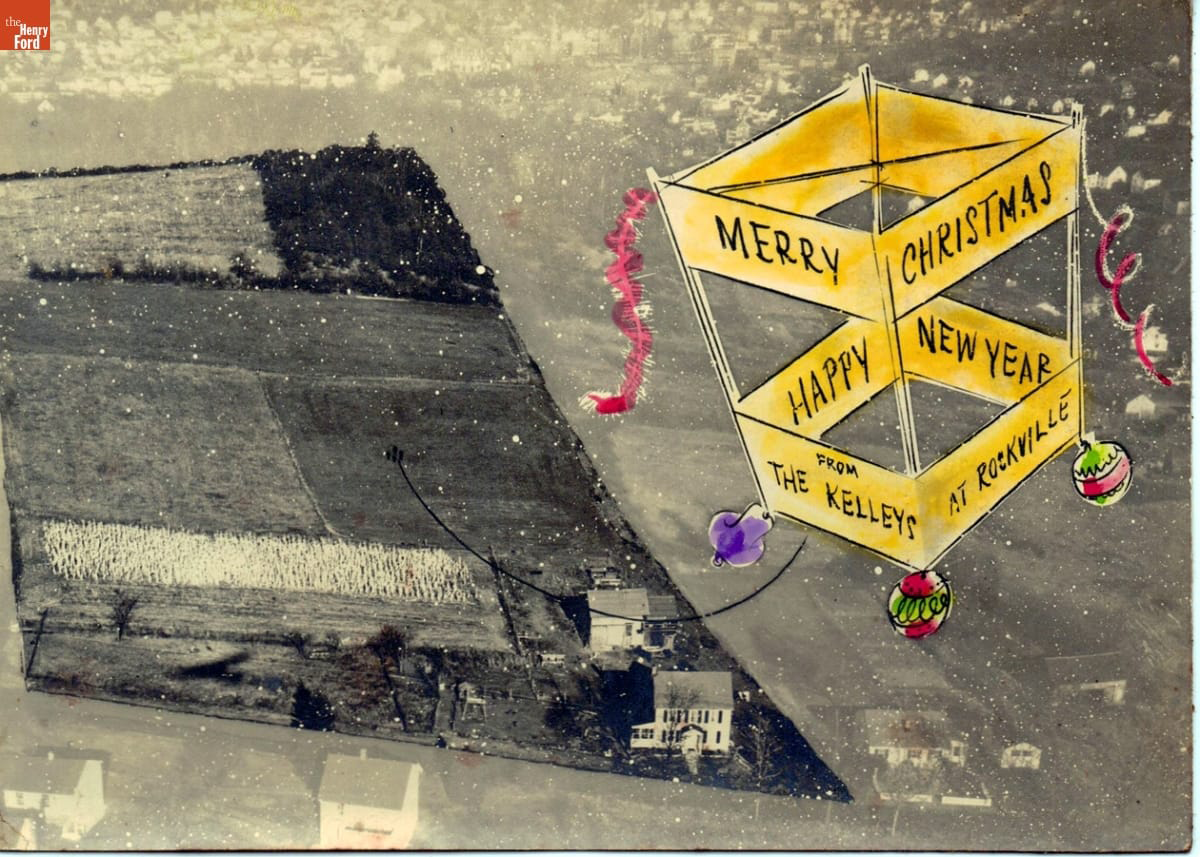 Aerial view of the Kelley farm adapted to a Christmas card / THF720527
The Kelley farm included a house and barn, gardens, apple trees, hayfields, and berry patches, and after mid-1948, two children and dozens of farm animals. The birth announcement that Lois Kelley drew for Diane, her second child, shows the new baby with a calf, a piglet, a duckling, a bunny, and a chick. Lois rued the fact that, try as she might, she couldn't fit a goat kid into the picture.
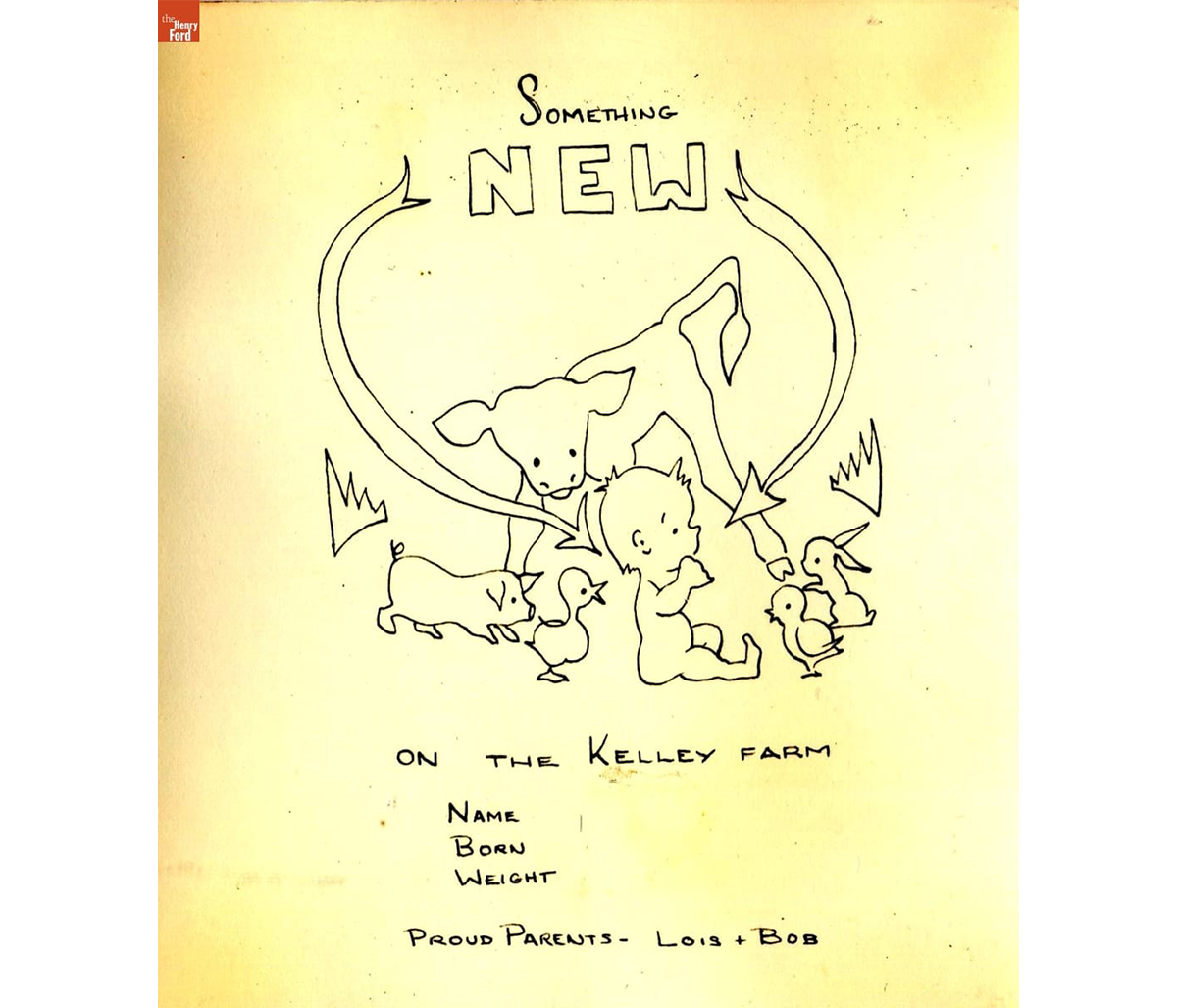 D's birth announcement drawn by Lois Kelley 1948 / THF720614
Diane and her brother Bobby grew up helping in the kitchen, barn, and garden. In a letter to her parents while she was pregnant with Diane, Lois wrote that her three-year-old son Bobby began doing chores. He fed the ducks and gathered eggs with her. The banty hens hid their nests in random places, to search out each morning as if it were Easter. A constant round of eggs incubated into ducklings, goslings, squab, and chicks in the cellar.
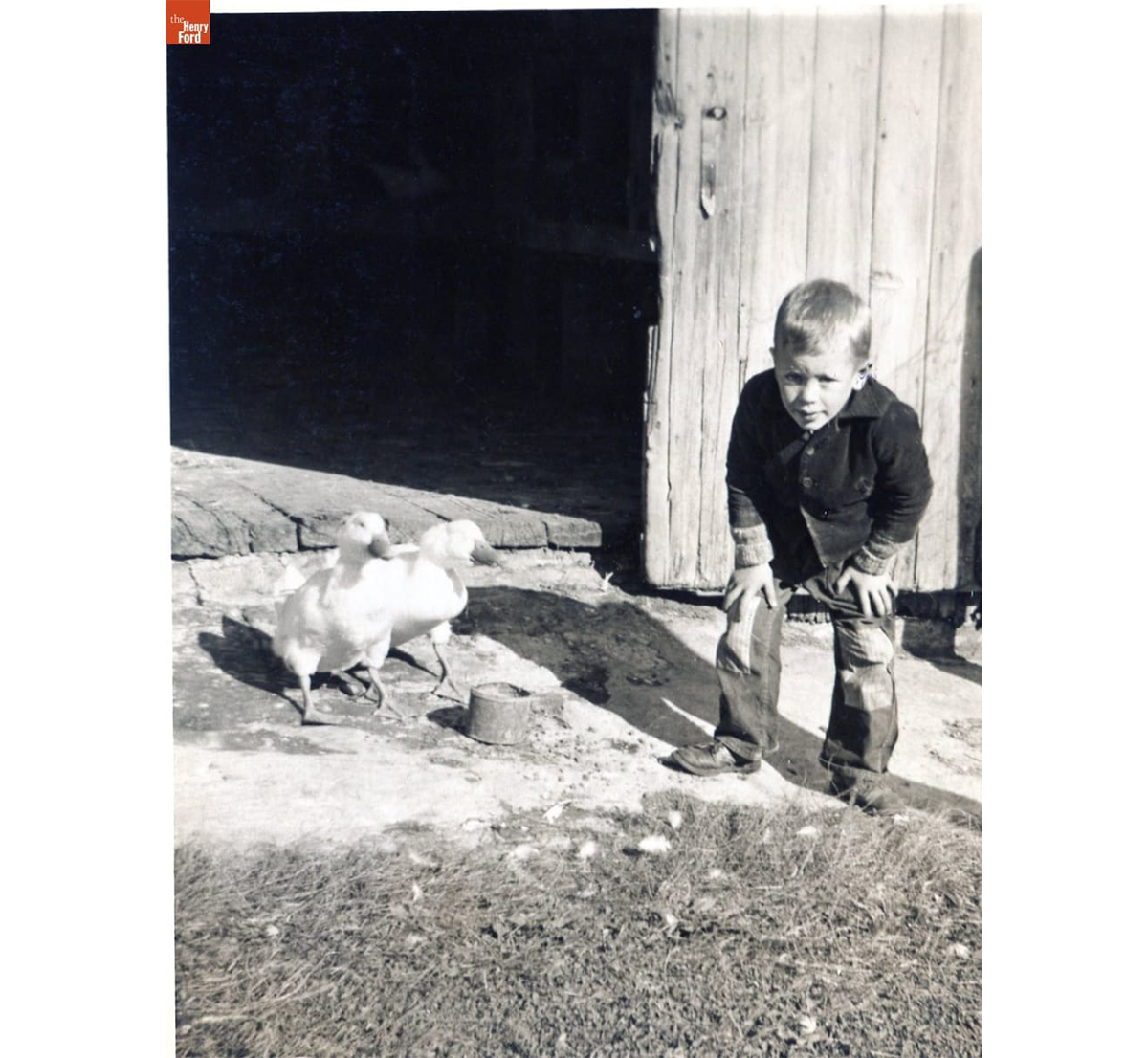 Bobby Kelley with ducks at the Kelley farm barn door, 1948 / THF720525
Each type of bird the Kelleys raised was hatched, fed, housed, and killed at the proper time, then prepared for the freezer or the table. Chickens, especially, fed the Kelley family all summer—broiled, fried, baked, or stewed. Lois wrote to her parents about a summer night when Bob surprised her by arriving home at midnight, bringing his sister and two of her children with him: “Lucky we'd planned on killing a chicken for Sunday dinner! The chicken killing was quite a process. The children watched . . . Bob tied its feet and hung it up instead of letting it flap all over, and later Judy, who's five, said to me, “You know, if Uncle Bob was going to cut my head off, he wouldn't have to tie my feet—I'd hold them still.”
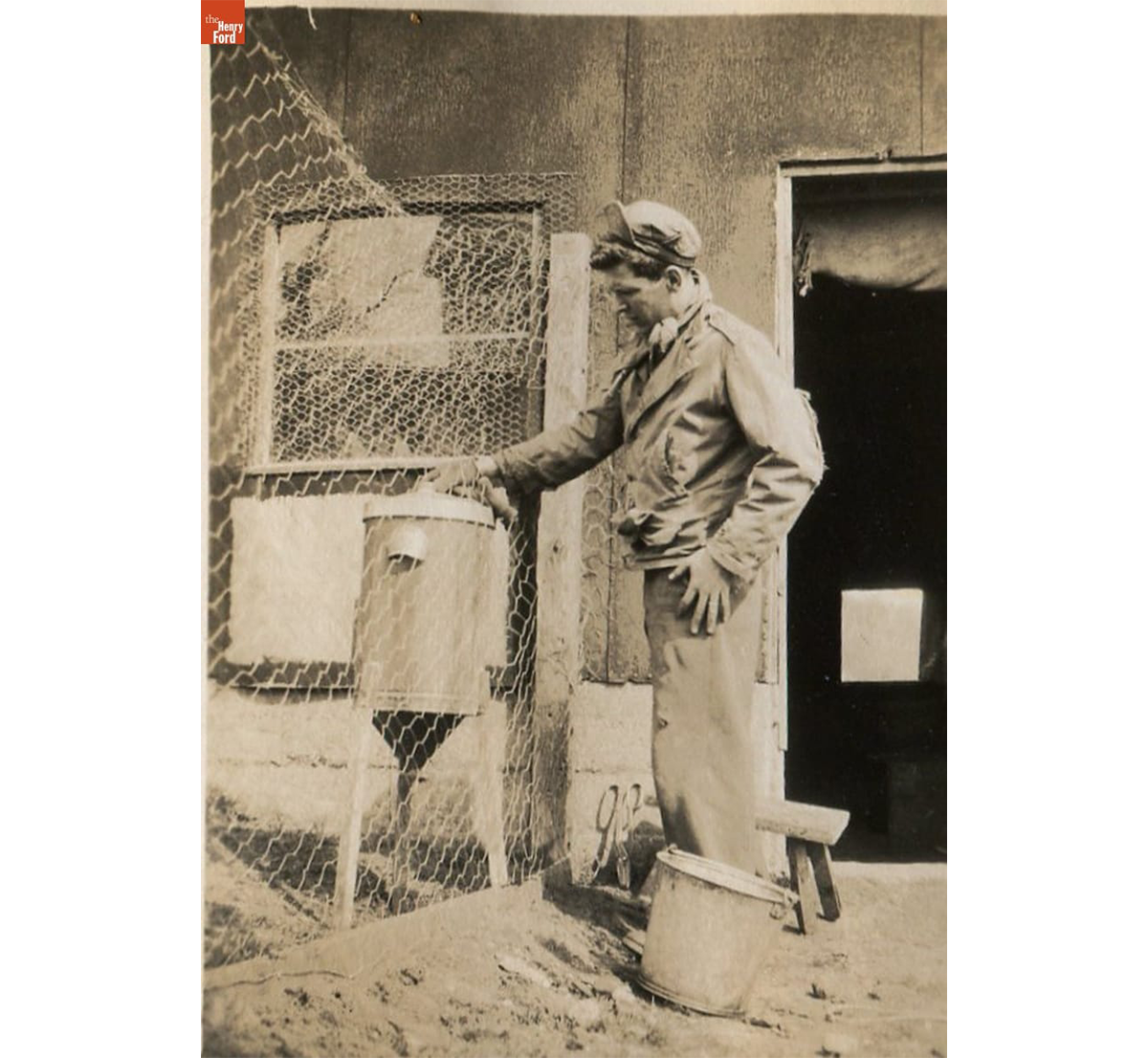 New chicken coop at the Kelley farm with feeder (likely a repurposed cream separator), 1948 / THF720526
The "Have-More" plan made clear that farm families raised livestock to meet their food needs. The Kelley family all pitched in to raise their food supply on their little farm. This included fresh dairy products that Lois poured over berries to make rich desserts that she gloated over, and fresh milk served with eggs and bacon at breakfast. Cow's milk helped fatten the calves and piglets that the family raised throughout the summer. The Kelleys also enriched the garden soil with the organic fertilizer that the livestock generated. This ensured the summer's bounty of vegetables and fruit. Then, in the fall the family had the grown steers and pigs butchered, and they wrapped the meat and stored it in the freezer.
The process began with the arrival of piglets.
The Kelleys secured their first piglets in May 1948. Then, Lois wrote to her parents: “from Pig Heaven, May 3, 1948 . . . our biggest thrill is the pigs. They're well settled, little and white and cute—and one has a black spot and a blackish ear so we can tell them apart.” Bob built a pen with chicken wire and barbed wire, and a three-sided shelter of scrap wood. Lois was gratified that the piglets, though they previously had only nursed from their mother, knew exactly how to “eat like pigs.” She explained to her parents that “They began rooting like old-timers, and the battle they had over a pan of milk was something to see.” She hadn't expected that the pigs would inspire three-year-old Bobby to mimic them. “There he was,” Lois wrote, “on his hands and knees trying to root in the ground with his nose—his mouth full of dirt.”
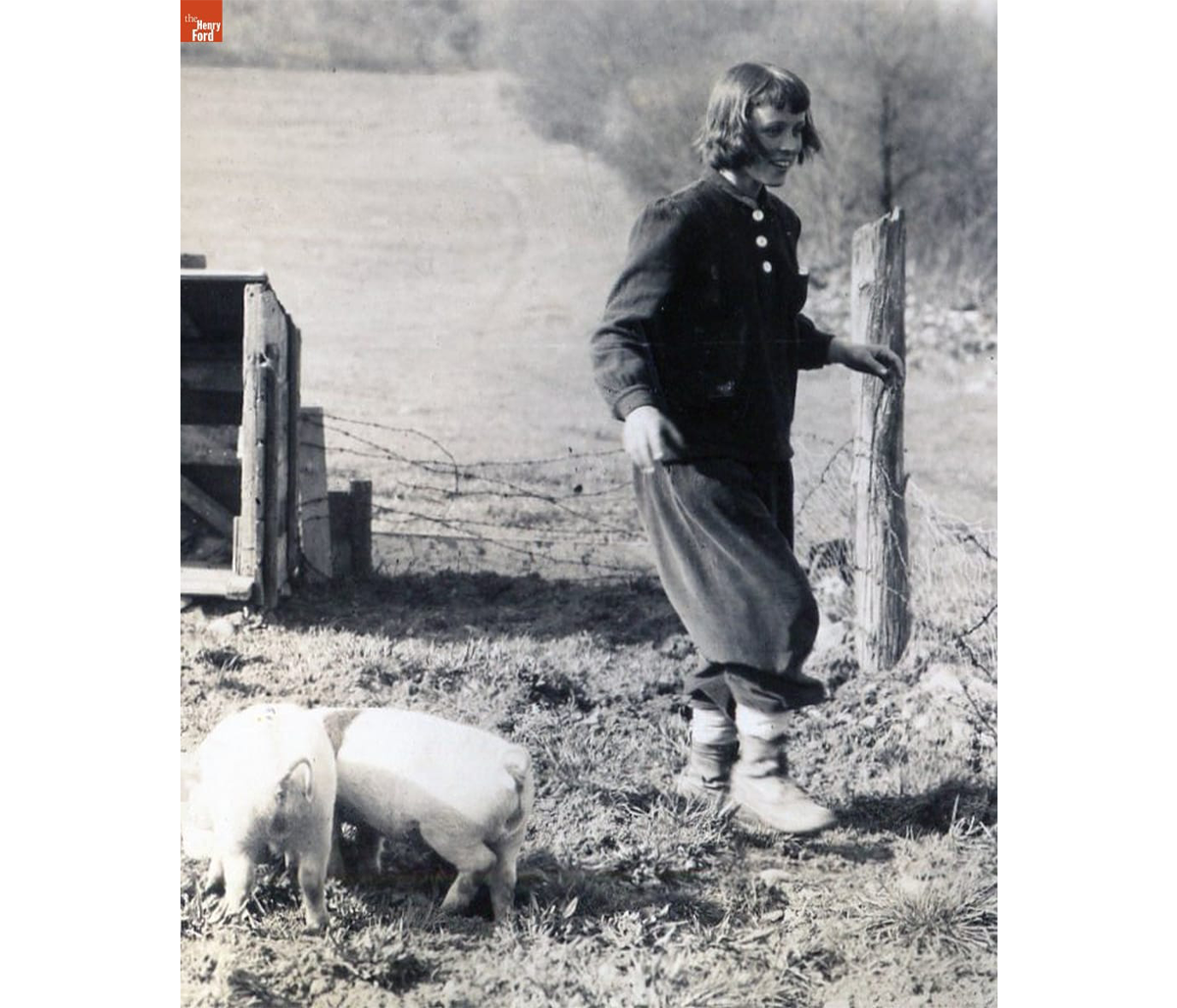 Lois Kelley with the first piglets, 1948 / THF720528
Three weeks later, on May 24, Lois wrote that “The pigs seem to be at least twice the size they were ... Their hide is so tough by now that they don't respond to a good healthy slap, and if they had the least desire, they could be outside their pen in two minutes. . . . It was tough enough to catch them before, and now . . . it would be a job to keep hold.”
In June, barely a month after the piglets arrived, Lois's naivete over their cuteness was over. She explained in a letter to her parents that: “Yesterday the 'black 'pig got out once too often—he'll never do it again. Both nasty animals are now settled in the cellar of the barn where we said it was utter inhumanity to keep an animal. They brought it on themselves, however . . . They're getting awfully heavy to move .. It'll be a relief to the neighbors too, who have helped me catch this one on the several past occasions when it's rooted out.” On October 9, she wrote that feeding them had “become quite dangerous—not that they're ferocious, but they're so eager to be fed that they swing their weight around with a terrible disregard for any one else's rights. I've given up going in—just the noises they make behind that door are enough to terrify me.”
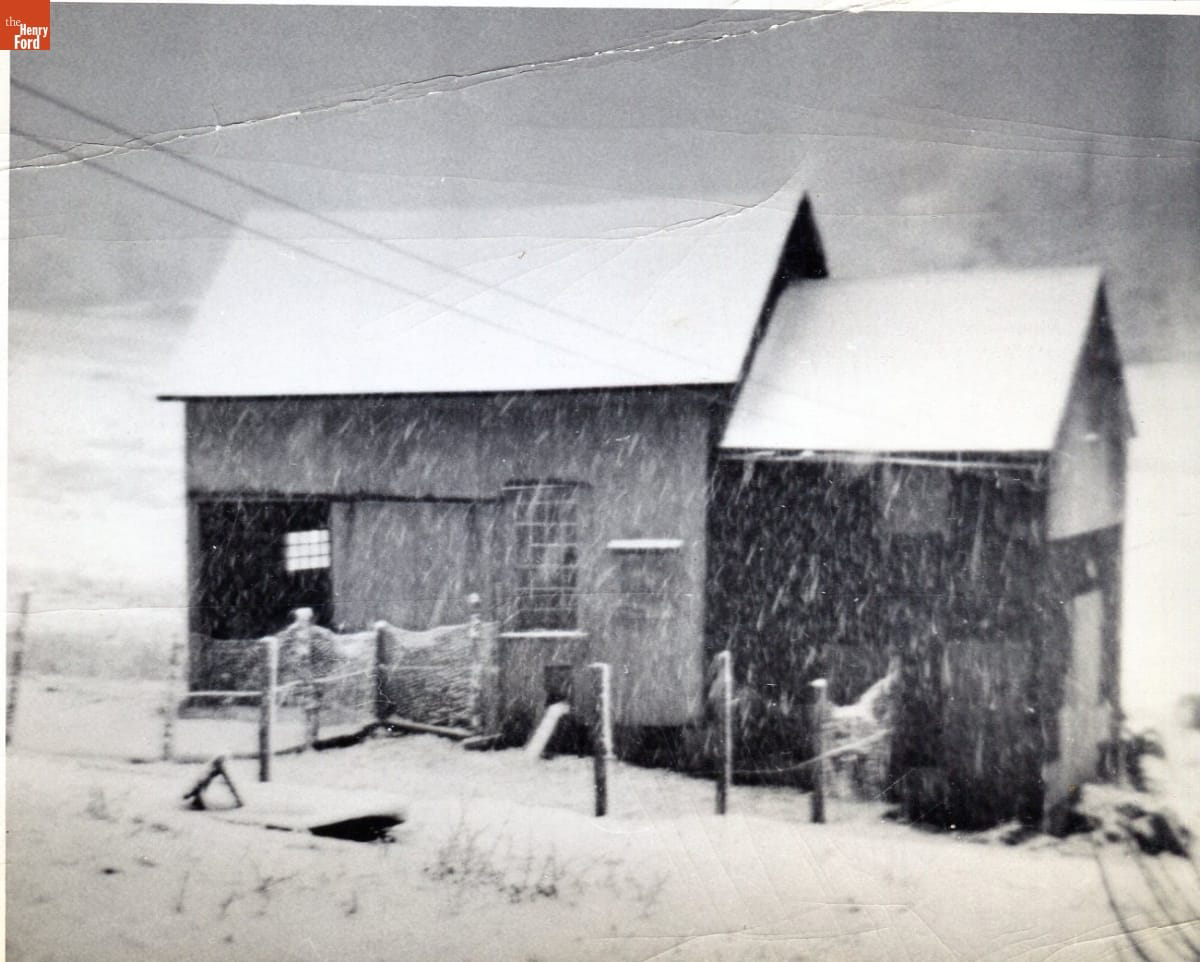 Kelley barn in a Snowstorm, 1948 / THF720523
November 3rd six months from the day the “cute” piglets arrived, they met their fate as provisions for the freezer. Lois wrote that the butcher dispatched them with his .22, bled them, “then drove off with them in his truck to scald, scrape, disembowel and chill them at his place.”
Lois and Bob cut and wrapped the meat from one of the pigs, weighing 154 pounds, and a neighbor took the other in trade for spring plowing. Together, they provided the following (plus sausage, head cheese and lard):
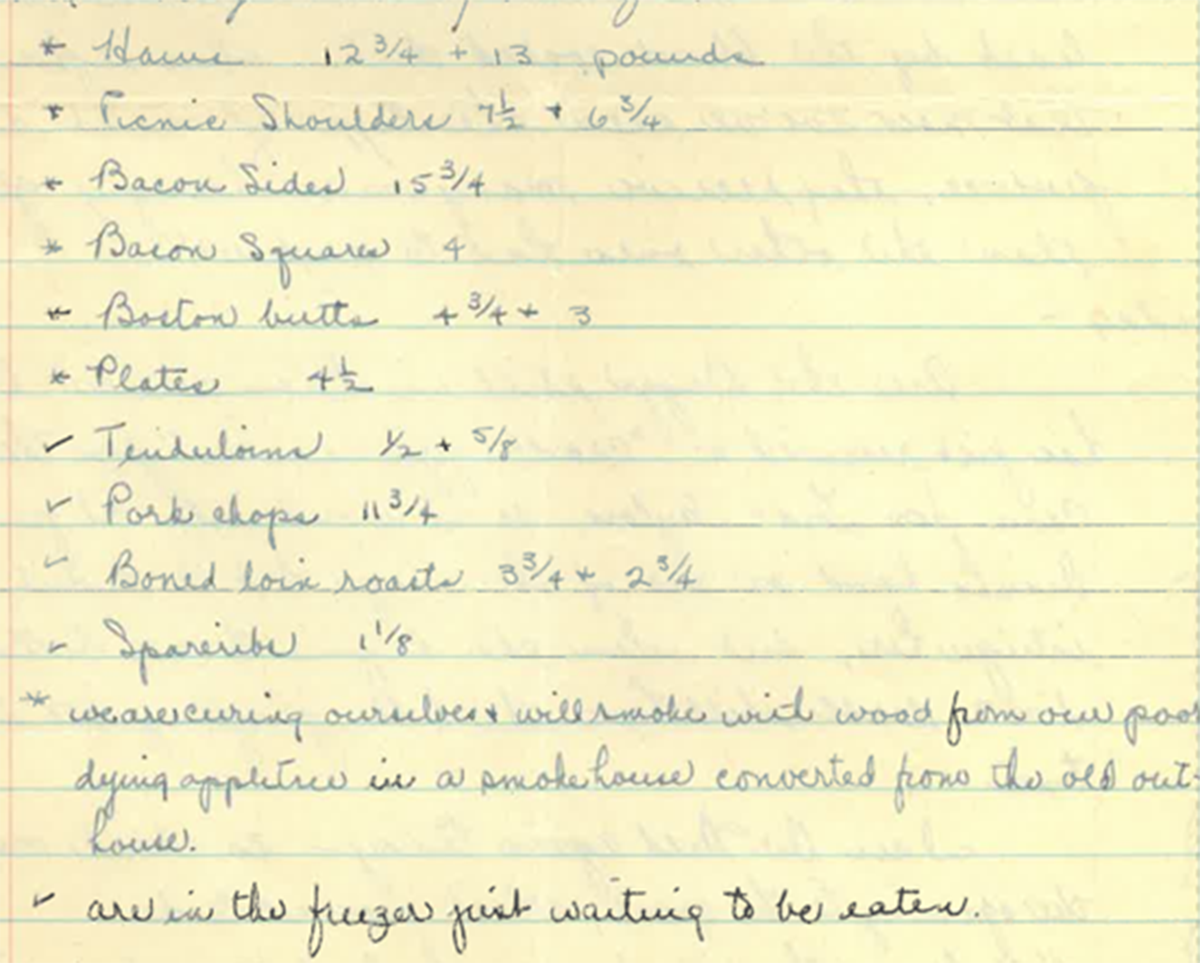 Detail from “Dear Mother and Dad” letter, November 3, 1948 p3. Image provided by Daisy Kelley.
The Kelley family prized the food in the freezer year-round, but the larder took on special meaning for the holidays. In August Lois began dreaming of Thanksgiving dinner. Would she serve turkey, capon, duck, rabbit, or broiled or fried chicken? Corn on the cob, raspberry or strawberry shortcake, tons of vegetables, blueberries, squash, ice cream? Lois's letters tell that when the first Thanksgiving on the farm finally arrived, duck was served. They were the same ducks Bobby had fed daily as part of his chores. “We are proud,” Lois wrote, “that though Bobby took care of them from the time Bob brought them home, he was just as interested in the killing, plucking, and eating of them as the rest of us.”
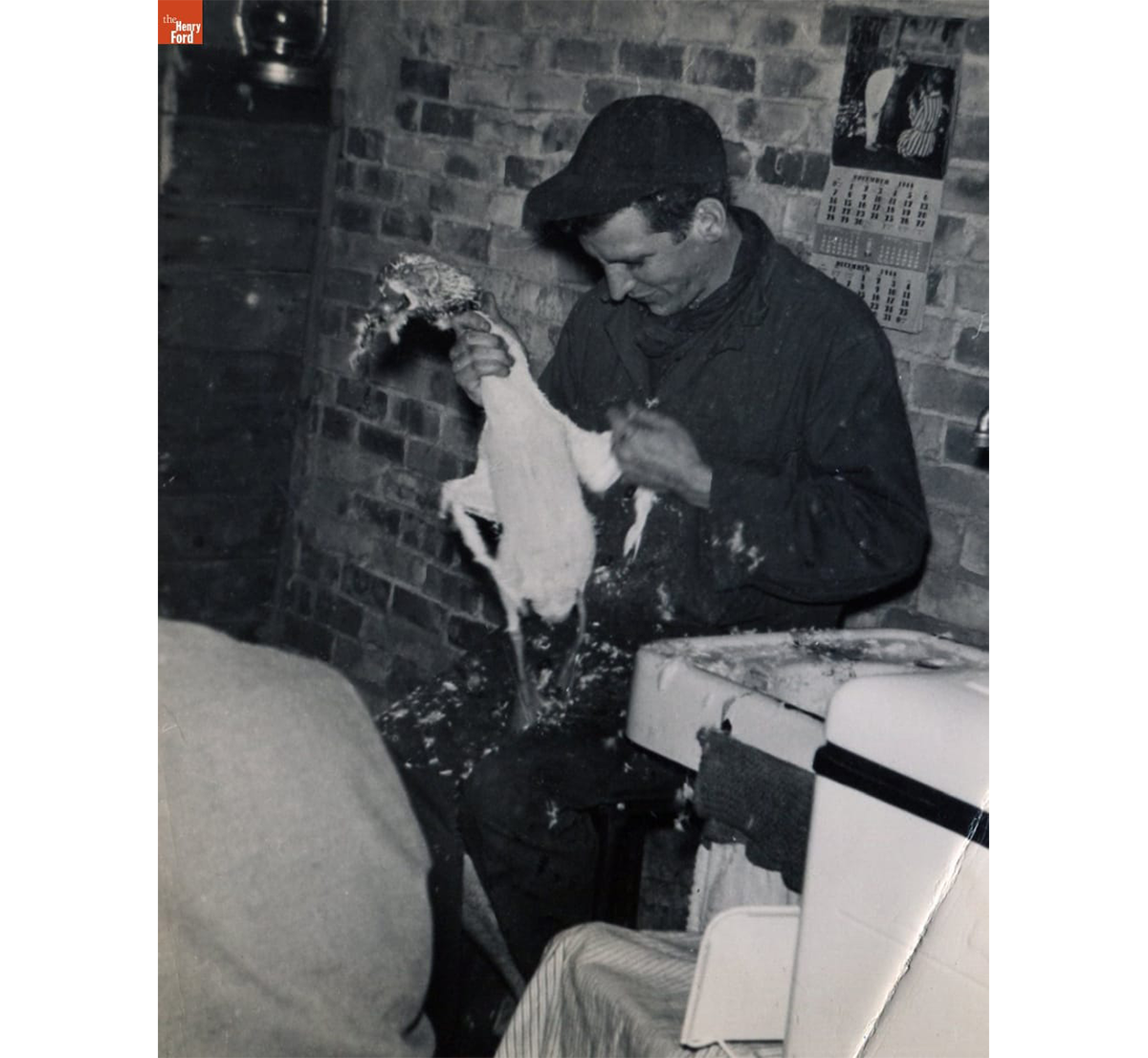 Bob Kelley plucking a duck on the night before Thanksgiving, November 24, 1948 / THF720524
On Christmas Day 1948, Lois and Bob took the first of the hams out of the freezer for dinner, a finale for that year’s pigs and for 1948, the family’s first year raising food on the farm.
This article was written by Diana “Daisy” Kelley, Curatorial Research Volunteer, The Henry Ford, with Debra A. Reid, Curator of Agriculture and the Environment, The Henry Ford. The stories and pictures are from the Lois Kelley collection at The Henry Ford.
You can read more about the Kelley family and their stewardship of a sugar bush on their second farm (another supplement to their food supply and their farm income) in the blog, "Maple Trees and Family: A Long-Term Relationship."