
Desks for Every Need
Share
share
From the earliest writing surfaces, desks evolved into multipurpose workstations, functional storage solutions, and statements of style.
THF128554
Fall Front Desk, 1700-1730
In the early 1700s, prosperous, yet frugal New England merchants showed off their wealth and good taste through functional objects, like furniture. This desk served as place to store important documents and valuables. It has numerous lockable drawers and several secret compartments. The fashionable and expensive walnut burl veneers make this object suitable for display in a parlor, where guests would be impressed.
View ArtifactSecretary Desk, 1720-1780
This 18th-century desk was owned by the Adler family of Frankfurt, Germany. With the rise of the Nazi regime during the 1930s, harassment increased for this Jewish family until, on Kristallnacht in 1938, their home was ransacked. The Adlers managed to leave Germany with only a few possessions. This heirloom became a symbol of the family's survival as they carved out new lives in America.
View ArtifactFall-Front Desk on Frame, 1745-1785
Furniture fashions of this era combined utility, comfort and grace with great success. This simple Queen Anne fall-front desk symbolized the gentility of its owner through its elegant proportions. Likely used in a parlor or a bedroom, the desk may have been used by a man or a woman to compose correspondence or book keeping.
View ArtifactSlant-Front Desk and Bookcase, 1750-1780
American businessmen and merchants in the mid-18th century used secretary desks as home offices. These large desks provide a writing surface, shelves for books and a storage space for papers -- perhaps even a secret drawer for important documents. Placed in a parlor or other public room, this secretary projected the owner's wealth and social status to visitors.
View ArtifactSecretary Desk, 1750-1780
American businessmen and merchants in the mid-18th century used secretary desks as home offices. These large desks provide a writing surface, shelves for books and a storage space for papers -- perhaps even a secret drawer for important documents. Placed in a parlor or other public room, this secretary projected the owner's wealth and social status to visitors.
View ArtifactChild's Fall-front Desk, 1750-1800
Eighteenth-century children had few forms of furniture made specifically for their needs: cradles, highchairs, and perhaps small chairs. This fall-front desk is a rarity. A well-to-do family probably had this made for their young son. Perhaps this boy -- by mimicking his father who sat at a larger version of this desk -- would carry on the family business.
View ArtifactSecretary Desk, 1760-1780
American businessmen and merchants in the mid-18th century used secretary desks as home offices. These large desks provide a writing surface, shelves for books and a storage space for papers -- perhaps even a secret drawer for important documents. Placed in a parlor or other public room, this secretary projected the owner's wealth and social status to visitors.
View ArtifactTambour Desk, by John Seymour, 1795-1805
Tambour desks are an American innovation associated with the father and son cabinetmaking team of John and Thomas Seymour. The Seymours emigrated from England in the 1780s, eventually settling in Boston. They are distinguished by reeded tambours, or panels, covering pigeonholes and drawers, much like later roll-top desks. Combining small size and delicate proportions, Tambour desks were intended for use by women, for correspondence and addressing invitations.
View ArtifactBreakfront Desk and Bookcase, 1800-1820
This large-scale showpiece served as a wealthy businessman's home office in early 19th-century Salem, a town made prosperous by international trade and the whaling industry. The top case held his business ledgers and books. The center drawer in the lower case drops to form a writing surface and essentially becomes a work center, complete with drawers and slots for correspondence.
View ArtifactPortable Writing Desk, Owned by Edgar Allan Poe, 1830-1849
Edgar Allan Poe was an American writer known for poetry and short stories. His mystery stories were innovative in American literature. Poe led an unsettled life traveling up and down the East Coast of the United States, staying in jobs for short periods of time. For someone who earned his living through writing, a portable desk would have been a valued possession.
View ArtifactTable, Used as a Writing Desk by Mark Twain, 1830-1860
This table belonged to Mark Twain (1835-1910), American author and humorist whose real name was Samuel L. Clemens. The author wrote at this table during the later years of his life. Twain's daughter Clara gave it to Henry Ford, along with a portrait of her father.
View ArtifactDesk, 1840-1880
This desk was typical of the kind used in American public buildings in the middle of the 19th century. It might have been used by ticket agents in a railroad station like the rural Smiths Creek, Michigan, depot now in Greenfield Village. The desk resides in the clerk's office where staff likely counted out cash and receipts and performed other important tasks.
View ArtifactPortable Writing Desk, circa 1850
Made of mahogany, ivory, and brass, this portable writing desk has a mechanism for copying text and secret drawers for hiding documents. Thomas Jefferson designed a similar combination portable writing desk and copying press. This may be an example of his design made in England or France, or it may be the product of another clever inventor.
View ArtifactDesk Used in the United States House of Representatives, 1857-1873
This desk and its companion chair (68.127.1) were designed by architect Thomas U. Walter for the United States House of Representatives Chamber in 1857, as part of an expansion of the Capitol. The pieces look impressive--but members of the House complained that they were too cumbersome. Within two years, many of the chairs were sold; by 1873 all of the pieces were removed.
View ArtifactSecretary Desk, circa 1870
Secretary desks are offices and work spaces. They provide a writing surface, storage space and book shelves. But some are much more -- they are symbols of the owner's education, wealth and social status. James Latta -- a Harvard graduate, successful businessman and special commissioner to the 1873 Vienna Exposition -- had this imposing piece of furniture made for his home in Washington, D.C.
View ArtifactAmerican Bell Desk Telephone Set, Used at the Opening of the Boston to Chicago Telephone Line, 1893
This ornate desk telephone was used by Governor William Russell during the opening demonstration of the Boston-Chicago long-distance telephone line. Reporters marveled at how two cities could be "united by a strand of copper, 1200 miles long." This exchange was an early hub of AT&T's long-distance network, allowing a swift collapse of distance through the connecting power of innovative telecommunication.
View ArtifactWestern Electric Telephone Desk Used in Express Office, Lake Linden, Michigan, circa 1895
This telephone desk is the opposite of the mobile, miniature smartphones we take for granted in the 21st century. Its "magneto" required hand-cranking to ring a bell and signal the exchange operator. Every component was separate. Built of hardwood with decorative carving, it served as an attractive piece of furniture--an inviting space to pull up a chair for seated conversation.
View ArtifactWright Family Writing Desk, 1890-1900
This ladies' writing desk is the starting point for a transportation revolution. On May 30, 1899, a Dayton, Ohio, bicycle shop owner named Wilbur Wright sat down at his sister's desk and wrote a letter to the secretary of the Smithsonian Institution. Wilbur's letter sparked a series of events that led to the world's first powered airplane flight in 1903.
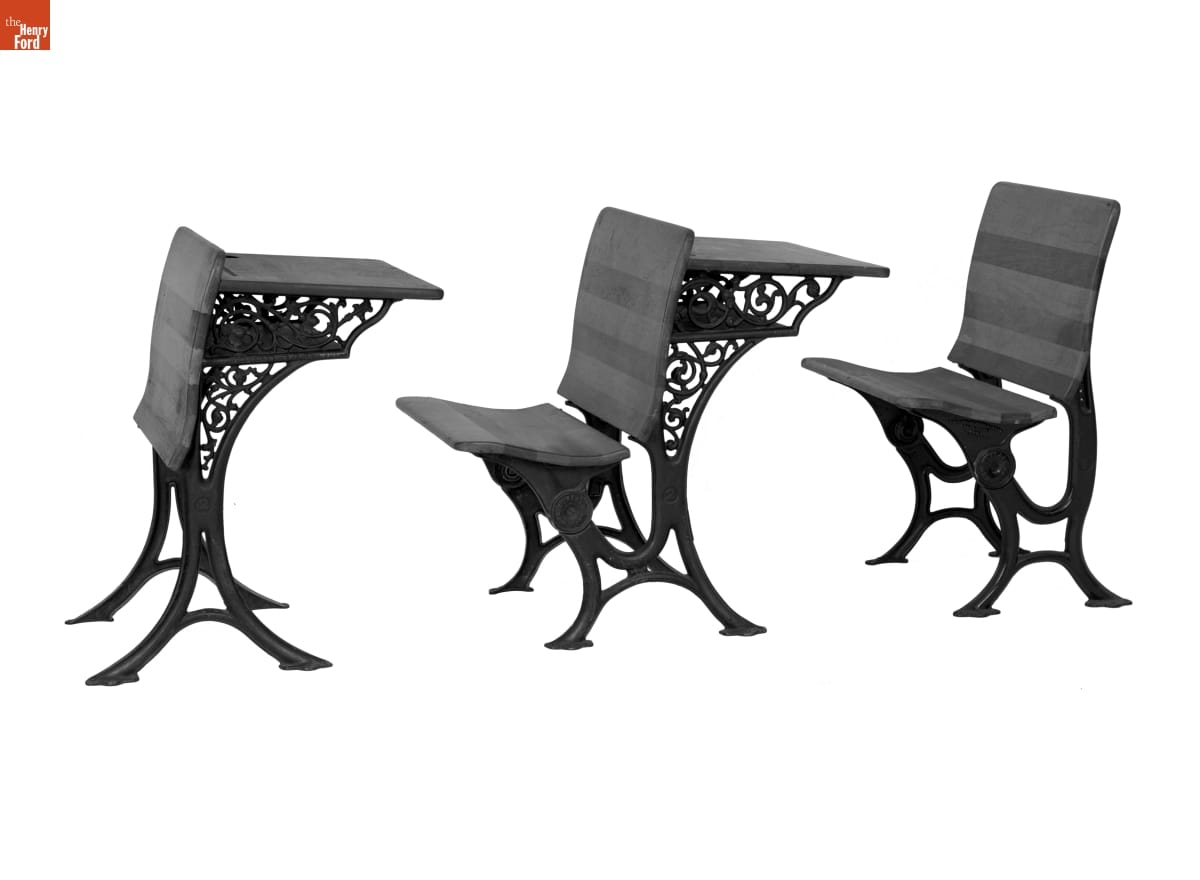
View ArtifactSchool Desks, circa 1900
The importance that nineteenth-century Americans put on the technology of education is indicated by the hundreds of patents on school furniture between 1860 and 1900. Desks designed to be in rows facing the teacher reveal the teacher-centered classrooms of the era. These cast iron and wood school desks and benches were manufactured in Buffalo, New York, in about 1900.
View ArtifactLimbert Library Table, 1905-1915
C. P. Limbert Company created affordable Arts and Crafts furniture for the American middle class. This library table displays the simple form and visible construction techniques emblematic of Arts and Crafts furniture. Unlike doctrinaire Arts and Crafts makers, the company applied mass-production techniques to reduce costs, but still manufactured well-designed and well-made furniture.
View ArtifactPedestal Desk, Used by Henry Ford at his Highland Park Plant Office
This large-scale oak desk was used by Henry Ford in his Highland Park Factory Office. Mr. Ford rarely worked at the desk, preferring to spend his time on the go between factories and a number of Ford office buildings. The office was mainly used to receive visitors and meet with employees.
View ArtifactSlant-Front Desk, 1910-1920
There were five Stickley Brothers: Gustav, Charles, Albert, Leopold and John George. All worked at one time during their careers for three major Stickley family firms, Gustav Stickley's Craftsman Workshops, Leopold and John Georges' L. and J.G. Stickley and Albert's Stickley Brothers. Stickley Brothers produced the largest volume of furniture to the mass market. This desk is illustrated in their 1912 catalogue.
View ArtifactRohde Modular Desk, 1934-1941
In the early 1930s, industrial designer Gilbert Rohde spurred the American furniture industry's transition from historical revivals to a modern aesthetic. Rohde is known for his transformative influence on -- and longtime association with -- Herman Miller Inc., whose name became synonymous with modernism. This desk, part of his popular Laurel series for Herman Miller, was intended for both domestic and commercial purposes.
View ArtifactSchool Desk, Used at the Shrine of the Little Flower Grade School, 1940-1949
This type of desk became the standard for both public and private elementary schools after World War II. Students were responsible for supplying and organizing their school supplies, which were stored under the hinged desk top. These desks continued to be used in classrooms even after dip pens and ink bottles were replaced by cartridge pens and, eventually, ballpoint pens.
View ArtifactDesk, 1947-1957
Drop-Front Desk without Legs, with Light, 1947-1953
Nelson Desk, circa 1958-1968
High Desk from Action Office Series, 1964-1968
Action Office, conceptualized by Robert Propst with final design by George Nelson, was rooted in Propst's research into office function and worker behavior. The system was not a commercial success: manufacturing costs were high, and it was, in Propst's words, "too showy and bright for serious consideration as a middle management tool." Propst went on to design the hugely successful Action Office 2 cubicle-based system.
View ArtifactAction Office Stand-up Desk, Used by D. J. DePree, 1964
Action Office, conceptualized by Robert Propst with final design by George Nelson, was rooted in Propst's research into office function and worker behavior. The system was not a commercial success: manufacturing costs were high, and it was, in Propst's words, "too showy and bright for serious consideration as a middle management tool." Propst went on to design the hugely successful Action Office 2 cubicle-based system.
View ArtifactCommunication Center for Action Office Series, 1964-1967
Action Office, conceptualized by Robert Propst with final design by George Nelson, was rooted in Propst's research into office function and worker behavior. The system was not a commercial success: manufacturing costs were high, and it was, in Propst's words, "too showy and bright for serious consideration as a middle management tool." Propst went on to design the hugely successful Action Office 2 cubicle-based system.
View Artifact

