
The Most Popular Digital Collections Artifacts of 2018
Share
share
During 2018, the artifacts in our Digital Collections were viewed well over a half a million times. The artifacts shown here--representing cars and buildings, photographs and documents, and more--are the most-viewed artifacts of the year. Are your favorites on the list?
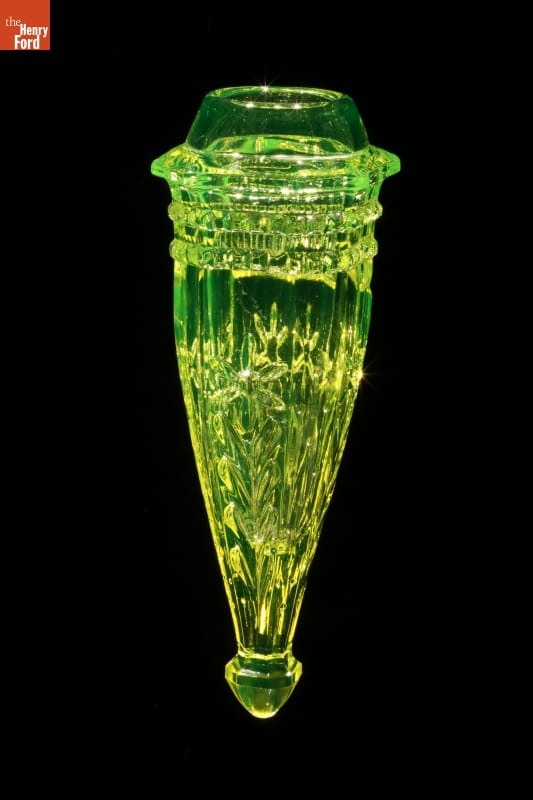
THF150787
Automobile Bud Vase, 1920-1940
Early luxury vehicles sometimes contained bud vases for flowers. The flowers, whether real or silk, freshened up the interior. This pressed glass bud vase from The Henry Ford's 1922 Detroit Electric car has molded flowers on its sides.
View Artifact1896 Ford Quadricycle Runabout, First Car Built by Henry Ford
The Quadricycle was Henry Ford's first attempt to build a gasoline-powered automobile. It utilized commonly available materials: angle iron for the frame, a leather belt and chain drive for the transmission, and a buggy seat. Ford had to devise his own ignition system. He sold his Quadricycle for $200, then used the money to build his second car.
View ArtifactRosa Parks Bus
Inside this bus on December 1, 1955, Rosa Parks, a soft-spoken African-American seamstress, refused to give up her seat to a white man, breaking existing segregation laws. The flawless character and quiet strength she exhibited successfully ignited action in others. For this, many believe Rosa Parks's act was the event that sparked the Civil Rights movement.
View Artifact1901 Ford "Sweepstakes" Race Car
This is Henry Ford's first race car. After his first auto company failed, Ford turned to racing to restore his reputation. He raced "Sweepstakes" against Alexander Winton on October 10, 1901, and, to everyone's surprise, the novice Ford beat the established Winton. The victory and resulting publicity encouraged financiers to back Ford's second firm.
View ArtifactAllegheny Steam Locomotive, 1941
The Chesapeake & Ohio Railway's massive Allegheny, introduced in 1941, represents the peak of steam railroad technology. Among the largest and most powerful steam locomotives ever built, it weighed 1.2 million pounds with its tender and could generate 7,500 horsepower. Just 11 years later, C&O began pulling these giants from service. Diesel-electric locomotives proved more flexible and less expensive.
View ArtifactCotswold Cottage
Cotswold Cottage is from the Cotswold Hills in southwest England. The Fords were attracted to the distinctive character of Cotswold buildings, which are characterized by the yellow-brown stone, tall gables, steeply pitched roofs, and stone ornamentation around windows and doors. Several decorative additions were made to the house in England, before dismantling and re-erecting it in Greenfield Village.
View ArtifactRocking Chair Used by Abraham Lincoln at Ford's Theater the Night of His Assassination, April 14, 1865
President Abraham Lincoln was sitting in this rocking chair during a production of Our American Cousin at Ford's Theatre in Washington, D.C., when he was assassinated on April 14, 1865. Henry Ford purchased the chair in 1929 for the Museum, where it remains one of the most revered objects associated with the "man who saved the Union."
View Artifact1902 Ford "999" Race Car, Built by Henry Ford
Henry Ford hired a fearless bicycle racer named Barney Oldfield to drive "999." Although he had never driven a car, Oldfield learned quickly and won his first competition. He went on to become America's first nationally famous racing hero, known for his thrilling exhibition races and the trademark cigar he chewed to protect his teeth in a crash.
View ArtifactLetter from Clyde Barrow to Henry Ford Praising the Ford V-8 Car, 1934
On April 13, 1934, Ford Motor Company received this unusual product testimonial. In it notorious bank robber Clyde Barrow extolled the virtues of Ford V-8s as getaway cars. Handwriting analysts have questioned the letter's authenticity, but it is the sort of thing the publicity-seeking Barrow might have written.
View ArtifactWright Brothers Home and Cycle Shop, Greenfield Village, 1971
Henry Ford acquired the Wright brothers' home and cycle shop in 1936. He then relocated the buildings from Dayton, Ohio, to his Dearborn, Michigan, museum complex. Ford placed the structures right next to each other in Greenfield Village. In Dayton, the buildings had been located a few blocks apart.
View ArtifactMelting Pot Ceremony at Ford English School, July 4, 1917
In 1914 Ford Motor Company established the Ford English School, where the automaker's diverse immigrant employees could learn the English language and take civics lessons in preparation for becoming U.S. citizens. At the graduation ceremony, students wearing clothing from their native countries descended into a large "American Melting Pot" and emerged wearing homogenous suits and waving American flags.
View Artifact1987 Ford Thunderbird Stock Car, Raced by Bill Elliott
Bill Elliott set NASCAR's all-time speed record with this car when he qualified for the 1987 Winston 500 at Talladega at 212.809 miles per hour. By the 1980s, "stock cars" only looked stock. Underneath this Thunderbird sheet metal is a purpose-built steel tube frame, racing suspension and brakes, and a racing engine that no Ford dealer ever sold.
View ArtifactSouvenir Ticket for A Century of Progress International Exposition, Chicago, Illinois, 1934
World's fairs during the 1930s offered people a prosperous outlook rather than bleak economic realities of the Great Depression -- if they could attend. Images on this ticket book show the buildings of the Chicago's Century of Progress International Exhibition of 1934, highlighted by sun rays.
View Artifact1972 Lincoln Continental Presidential Limousine Used by Ronald Reagan
President Ronald Reagan was getting into this car when he was shot by John Hinckley on March 30, 1981. The car carried Reagan to the hospital. Presidents Nixon, Ford, Carter, and George H.W. Bush also used this car. In 1982 the front sheet metal was updated, but since a 1982 grille no longer fit properly on the 1972 body, a 1979 grille was used.
View ArtifactButton, "You Are the Spark That Started Our Freedom Movement. Thank You Sister Rosa Parks," circa 1988
On December 1, 1955, Rosa Parks refused to give up her seat to a white man on a bus in Montgomery, Alabama. Her courageous act of protest was considered the spark that ignited the Civil Rights movement. For decades, Martin Luther King Jr.'s fame overshadowed hers. But by the time of this button, Parks was beginning to receive long-overdue recognition.
View ArtifactGuide Map and Brochure, "Welcome to Greenfield Village," circa 1968
1961 Lincoln Continental Presidential Limousine Used by John F. Kennedy
President John F. Kennedy was assassinated in this car on November 22, 1963. The midnight blue, un-armored convertible was rebuilt with a permanent roof, titanium armor plating, and more somber black paint. The limousine returned to the White House and remained in service until 1977. The modified car shows the fundamental ways in which presidential security changed after Kennedy's death.
View Artifact1919 Ford Model T Sedan
The Model T's basic design received many updates over the car's 19-year life. Some incorporated mechanical improvements, some responded to growing consumer demands, and some simply reduced costs. The 1919 sedans were the first with electric starters and demountable tire rims. These features were standard on other makes but cost extra on a Ford, keeping the base price low.
View Artifact1927 Ford Model T Touring Car, The Fifteen-Millionth Ford
After 19 years and some 15 million cars, Ford Motor Company ended production of its venerable Model T. Company officials designated this car as the Fifteen Millionth and ceremonial "last" Model T. They gathered at Ford's Highland Park plant to watch Henry Ford and Edsel Ford drive it off the assembly line on May 26, 1927.
View ArtifactLetter to Henry Ford from the Wife of an Assembly Line Worker, 1914
Letter written to Henry Ford from the wife of an assembly line worker, January 23, 1914. The woman writes asking Henry Ford to investigate the situation on the assembly lines in the factories with regard to working conditions. She is angry about the treatment her husband receives on the job.
View ArtifactFord Home
Henry Ford was born in this farmhouse on July 30, 1863. The house stood near the corner of present-day Ford and Greenfield Roads in Dearborn, Michigan. Ford grew up in the house and moved out at age 16 to find work in Detroit. He restored the farmhouse in 1919 and moved it to Greenfield Village in 1944.
View ArtifactMcDonald's Restaurant Sign, 1960
In 1948, the McDonald brothers transformed their Southern California drive-in restaurant with their radical new "Speedee Service System"--assembly-line production of a limited menu at drastically reduced prices. Richard McDonald created this sign design in 1952. In 1955, milkshake machine salesman Ray Kroc franchised the McDonald's concept--prompting numerous imitators and ultimately turning America into a "fast food nation."
View ArtifactMartha-Mary Chapel
Churches were a center of community life in the 1700s, a place where townspeople came together to attend services and socialize. The Martha-Mary Chapel, with its architecture inspired by New England's colonial-era churches, was built in Greenfield Village in 1929. This chapel was named after Henry Ford's mother, Mary Litogot Ford, and his mother-in-law, Martha Bench Bryant.
View Artifact1903 Ford Model A Runabout
After his first two attempts at commercial automobile manufacturing failed, Henry Ford found success with Ford Motor Company, established in 1903. The new company's first product, the Model A, was conventional by the standards of the day. It featured a two-cylinder engine mounted under the seat and rear wheels driven by a chain.
View ArtifactFord Home (Henry Ford's Birthplace) at Its Original Location, Dearborn, Michigan, 1923-1926
Henry Ford began restoration of his Dearborn, Michigan, birthplace in 1919. He repaired or replaced the farm buildings and filled the small, white clapboard house with original or similar furnishings he remembered from his boyhood. He dedicated the restoration to the memory of his beloved mother, Mary Litogot Ford, who died in 1876. In 1944, the house and outbuildings were moved to Greenfield Village.
View ArtifactHenry Ford's "Kitchen Sink" Engine, 1893
Henry Ford built his first experimental engine using scrap metal for parts. He tested it on the kitchen sink after supper on December 24, 1893. For ignition he ran a wire from the ceiling's light bulb. His wife Clara hand-fed gasoline to the intake valve while Henry spun the flywheel. The engine roared into action, shaking the sink.
View ArtifactAyer's Cathartic Pills, 1853-1900
Nineteenth-century entrepreneurs promised cures with patent medicines. Some of these concoctions, however, contained harmful ingredients or ingredients used in unsafe quantities -- the industry was unregulated and manufacturers were secretive about their recipes. Beginning with the Pure Food and Drug Act of 1906, national legislation increasingly prohibited misleading health claims and required manufacturers to list their product's contents.
View Artifact1965 Ford Mustang Convertible, Serial Number One
It's an old auto industry cliche -- "you can't sell a young man an old man's car, but you can sell an old man a young man's car." It's also true. The sporty Mustang was a young man's -- and woman's -- car. The under-30 crowd loved it. But older people also bought them, often as a second car. The Mustang hit a sweet spot in the market, appealing to a wide range of buyers.
View ArtifactNew Holland TR70 Axial Flow Combine, 1975
Engineers designed the TR70 as a compact machine suitable for hilly terrain. The twin rotors (TR) shelled corn or threshed grain and moved it through the combine's body. Setting the rotors at an angle (axial) shortened the machine. Farmers changed the front-end attachment to harvest corn, beans, or wheat. Stencils on this prototype, exhibited at trade shows, explained additional features.
View ArtifactFirestone Farmhouse
Benjamin and Catherine Firestone raised their three children in this farmhouse, including tire maker Harvey Firestone. Originally located near Columbiana, Ohio, the 1828 house was updated in 1882 to appear more stylish and up-to-date. The traditional Pennsylvania German layout of the Firestone's farmhouse was transformed, with a central foyer, separate dining room and kitchen, a sitting room, closets, wallpaper, and fancy new furniture.
View ArtifactPixar Image Computer II (P-II), circa 1987
Pixar is celebrated for its animation--but the company's origins began with computer hardware. In 1984, they created the Pixar Imaging Computer (PIC)--a groundbreaking device aimed towards high-end graphics and animation. The PIC was used within medical and scientific industries--and for the iconic ballroom scene in Disney's Beauty and the Beast. This improved PII was released in 1987.
View ArtifactFirst Ford Model T Production Card, September 27, 1908
This is the Ford Motor Company record of the very first Model T, which was assembled on September 27, 1908, at the Piquette plant in Detroit. The production card lists it as Model 2090, car #1. It had 4 cylinders, 2 levers (the second for reverse), and 2 foot pedals. About 1,000 of these early Ts were produced.
View ArtifactPocket Watch, 1850-1875
Pocket watches were the first mechanical devices to catch Henry Ford's fancy. He made his first successful repair at the age of 13, when he removed the casing on schoolmate Albert Hutchings's watch and extracted a sliver from the works. Hutchings's family donated this watch, believed to be the original, to the Henry Ford Museum in 1933.
View Artifact1909 Ford Model T Touring Car
Henry Ford crafted his ideal car in the Model T. It was rugged, reliable and suited to quantity production. The first 2,500 Model Ts carried gear-driven water pumps rather than the thermosiphon cooling system adopted later. Rarer still, the first 1,000 or so -- like this example -- used a lever rather than a floor pedal to engage reverse.
View ArtifactNewspaper Article, "Henry Ford Gives $10,000,000 in 1914 Profits to His Employes"
When Henry Ford introduced the moving assembly line in 1913 he loved it but his employees didn't. The work was boring and relentless, and worker turnover was high. To get workers to stay, Henry more than doubled their pay, from $2.34 per day to $5 per day. It was headline news in Detroit and around the country.
View ArtifactPerfection Smokeless Oil Heater, 1920-1935
1906 Locomobile "Old 16" Race Car
In 1908, driver George Robertson and mechanician Glenn Ethridge took this car to victory in the Vanderbilt Cup, America's first great automobile race. It marked the first time an American-built car won a major international road-circuit race. The Locomobile competed while wearing number 16, and it's been known as "Old 16" ever since.
View Artifact1931 Bugatti Type 41 Royale Convertible
Longer than a Duesenberg. Twice the horsepower of a Rolls-Royce. More costly than both put together. The Bugatti Royale was the ultimate automobile, making its owners feel like kings. Not only did it do everything on a grander scale than the world's other great luxury cars, it was also rare. Bugatti built only six Royales, whereas there were 481 Model J Duesenbergs and 1,767 Phantom II Rolls-Royces.
View Artifact1952 Wienermobile
Carl Mayer, nephew of the company's namesake, created the first Oscar Mayer Wienermobile in 1936. In the years since, more than a dozen Wienermobiles have promoted the brand at stores, parades and festivals. Spokesman George Molchan, portraying the character "Little Oscar," traveled with the Wienermobile from 1951 to 1987. Today the vehicles are accompanied by brand spokespeople and drivers known as "Hotdoggers."
View Artifact1906 Ford Model N Runabout
Two-seater runabouts like this 1906 Ford Model N were favored by middle-class Americans who could afford one. They were fast and rugged. Most runabouts featured one- or two-cylinder engines and bicycle-style chain drives. But this Ford Model N offered four cylinders and a shaft drive, plus it cost less. At $500, it became the bestselling car in America.
View Artifact1965 Goldenrod Land Speed Race Car
On November 12, 1965, Goldenrod streaked across Utah's Bonneville Salt Flats at 409.277 miles per hour, setting a new land speed record for wheel-driven cars. Builders Bob and Bill Summers powered Goldenrod with four massive Chrysler V-8 engines. Although other car builders copied its sleek design, Goldenrod held the record until 1991.
View ArtifactVan Cleve Bicycle, Made by the Wright Brothers circa 1896
Wilbur and Orville Wright established their first bicycle shop in 1892. They started building their own bikes in 1896. Van Cleve bicycles -- named for Wright family ancestors -- used high-grade materials, and they featured special oil-retaining wheel hubs and coaster brakes of the brothers' own design. The Wrights built each bike to order, hand-making parts with basic tools.
View ArtifactChecking on Ford Employees Home Conditions, Views from "Factory Facts From Ford," 1917
Beyond revolutionizing America's industrial production, Henry Ford and other managers at Ford Motor Company instituted a wide-reaching corporate welfare program that opened up the most intimate and personal details of employee's personal, family, and financial life to investigators from the Sociological Department. After the announcement of the $5 per day profit sharing plan in January 1914, Henry Ford wanted to ensure that employees, many of whom were non-English speaking immigrants, did not squander the funds. To this end, the Ford Sociological Department was created to investigate and monitor the personal and work lives of employees to the extent that investigators (later called Advisors) conducted home visits, checked bank deposits, and monitored children's school attendance as well as divorce filings. In addition, the Sociological Department advisors provided hygiene instruction, financial and legal advice, and worked with the English School to teach Ford's immigrant workers English.
View ArtifactMenlo Park Laboratory
When Edison moved to Menlo Park, New Jersey, in spring of 1876 the laboratory building contained his entire operation -- a handful of collaborators, office, library, and machine shop as well as laboratory. As the scale of Edison's investigations grew so did the complex, but this building -- dedicated to experimental activities -- was always understood to be the heart of the enterprise.
View Artifact1965 Lotus-Ford Race Car
Scotsman Jim Clark won the Indianapolis 500 with this rear-engine car in 1965. After his victory, a traditional front-engine car never won that race again. The Lotus-Ford combined a European Formula One-inspired lightweight chassis with a big Ford V-8 engine. The Lotus-Ford's success effectively killed the traditional Indy roadster and established a new design for American race cars.
View ArtifactSwift & Company's Meat Packing House, Chicago, Illinois, "Splitting Backbones and Final Inspection of Hogs," 1910-1915
At this meat packing operation, a conveyor moved hog carcasses past meat cutters, who then removed various pieces of the animal. To keep Model T production up with demand, Ford engineers borrowed ideas from other industries. Sometime in 1913 they realized that the "disassembly line" principle employed in slaughterhouses could be adapted to building automobiles -- on a moving assembly line.
View ArtifactHerschell-Spillman Carousel
Colorful carousels were at the height of their popularity during the early 1900s and could be found all across America in amusement parks, city parks, and seaside resorts. Built in 1913, this "menagerie" carousel's hand-carved animals include storks, goats, zebras, dogs, and even a frog. Although its original location is uncertain, this carousel operated in Spokane, Washington, from 1923 to 1961.
View ArtifactWorkers Installing Tires on Ford Model T Assembly Line at Highland Park Plant, circa 1925
Ford constantly tweaked Model T assembly lines at its Highland Park plant for efficiency. In 1914, wheels and radiators were conveyed to a platform and slid down ramps for installation on the same line. By 1925, wheels (with tires already mounted and inflated) were conveyed directly to workers, who installed them on both sides of the chassis at once.
View ArtifactSlate Pencils, circa 1875
In the nineteenth century, schoolchildren used slates to practice handwriting and arithmetic without wasting precious paper. Slate pencils were made of soapstone or softer pieces of slate rock, sometimes wrapped in paper like this one. Many students remember the sound of the slate pencil -- like nails on a chalkboard. In the late nineteenth/early twentieth century, chalk was used instead.
View ArtifactHenry Ford's Private Railroad Car "Fair Lane," 1921
By 1920, Henry and Clara Ford found it increasingly difficult to travel with any degree of privacy. They purchased a private railcar and named it Fair Lane. The car had four private rooms, an observation lounge, a dining room, and a fully equipped kitchen. It could accommodate eight passengers. The couple made over 400 trips using Fair Lane before selling the passenger car in 1942.
View Artifact

