
The Most Popular Digital Collection Artifacts of 2017
Share
share
We add thousands of artifacts to our Digital Collections every year--and every year, these digital artifacts receive thousands of views. Here are the 50 artifacts that were viewed the most in our Digital Collections in 2017, including a variety on display in the Museum and the Village, a few not currently on exhibit, and a number featured on The Henry Ford's Innovation Nation. Are your favorites included?
THF134576
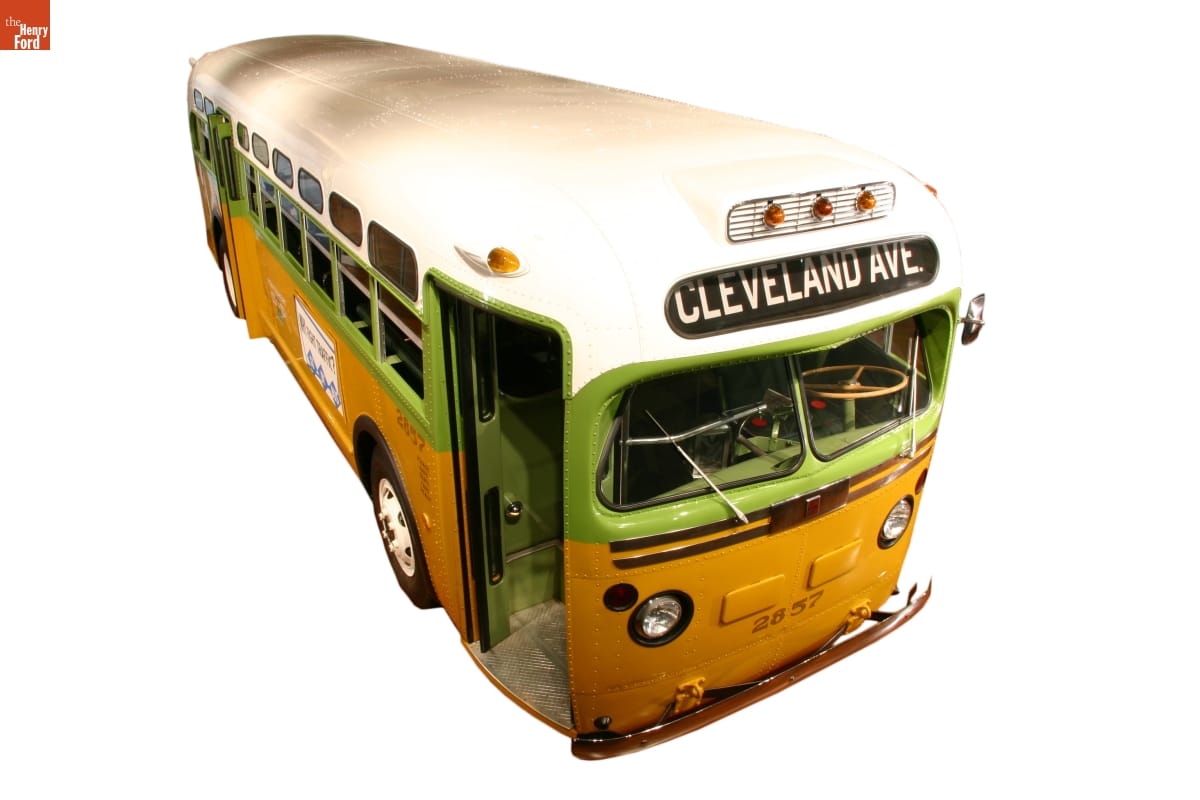
Rosa Parks Bus
Inside this bus on December 1, 1955, Rosa Parks, a soft-spoken African-American seamstress, refused to give up her seat to a white man, breaking existing segregation laws. The flawless character and quiet strength she exhibited successfully ignited action in others. For this, many believe Rosa Parks's act was the event that sparked the Civil Rights movement.
View Artifact1896 Ford Quadricycle Runabout, First Car Built by Henry Ford
The Quadricycle was Henry Ford's first attempt to build a gasoline-powered automobile. It utilized commonly available materials: angle iron for the frame, a leather belt and chain drive for the transmission, and a buggy seat. Ford had to devise his own ignition system. He sold his Quadricycle for $200, then used the money to build his second car.
View Artifact1901 Ford "Sweepstakes" Race Car
This is Henry Ford's first race car. After his first auto company failed, Ford turned to racing to restore his reputation. He raced "Sweepstakes" against Alexander Winton on October 10, 1901, and, to everyone's surprise, the novice Ford beat the established Winton. The victory and resulting publicity encouraged financiers to back Ford's second firm.
View Artifact1987 Ford Thunderbird Stock Car, Raced by Bill Elliott
Bill Elliott set NASCAR's all-time speed record with this car when he qualified for the 1987 Winston 500 at Talladega at 212.809 miles per hour. By the 1980s, "stock cars" only looked stock. Underneath this Thunderbird sheet metal is a purpose-built steel tube frame, racing suspension and brakes, and a racing engine that no Ford dealer ever sold.
View Artifact1965 Ford Mustang Convertible, Serial Number One
It's an old auto industry cliche -- "you can't sell a young man an old man's car, but you can sell an old man a young man's car." It's also true. The sporty Mustang was a young man's -- and woman's -- car. The under-30 crowd loved it. But older people also bought them, often as a second car. The Mustang hit a sweet spot in the market, appealing to a wide range of buyers.
View ArtifactMelting Pot Ceremony at Ford English School, July 4, 1917
In 1914 Ford Motor Company established the Ford English School, where the automaker's diverse immigrant employees could learn the English language and take civics lessons in preparation for becoming U.S. citizens. At the graduation ceremony, students wearing clothing from their native countries descended into a large "American Melting Pot" and emerged wearing homogenous suits and waving American flags.
View ArtifactCotswold Cottage
Cotswold Cottage is from the Cotswold Hills in southwest England. The Fords were attracted to the distinctive character of Cotswold buildings, which are characterized by the yellow-brown stone, tall gables, steeply pitched roofs, and stone ornamentation around windows and doors. Several decorative additions were made to the house in England, before dismantling and re-erecting it in Greenfield Village.
View ArtifactAllegheny Steam Locomotive, 1941
The Chesapeake & Ohio Railway's massive Allegheny, introduced in 1941, represents the peak of steam railroad technology. Among the largest and most powerful steam locomotives ever built, it weighed 1.2 million pounds with its tender and could generate 7,500 horsepower. Just 11 years later, C&O began pulling these giants from service. Diesel-electric locomotives proved more flexible and less expensive.
View ArtifactGuide Map and Brochure, "Welcome to Greenfield Village," circa 1968
Wright Brothers Home and Cycle Shop, Greenfield Village, 1971
Henry Ford acquired the Wright brothers' home and cycle shop in 1936. He then relocated the buildings from Dayton, Ohio, to his Dearborn, Michigan, museum complex. Ford placed the structures right next to each other in Greenfield Village. In Dayton, the buildings had been located a few blocks apart.
View Artifact1961 Lincoln Continental Presidential Limousine Used by John F. Kennedy
President John F. Kennedy was assassinated in this car on November 22, 1963. The midnight blue, un-armored convertible was rebuilt with a permanent roof, titanium armor plating, and more somber black paint. The limousine returned to the White House and remained in service until 1977. The modified car shows the fundamental ways in which presidential security changed after Kennedy's death.
View Artifact1931 Bugatti Type 41 Royale Convertible
Longer than a Duesenberg. Twice the horsepower of a Rolls-Royce. More costly than both put together. The Bugatti Royale was the ultimate automobile, making its owners feel like kings. Not only did it do everything on a grander scale than the world's other great luxury cars, it was also rare. Bugatti built only six Royales, whereas there were 481 Model J Duesenbergs and 1,767 Phantom II Rolls-Royces.
View Artifact1902 Ford "999" Race Car, Built by Henry Ford
Henry Ford hired a fearless bicycle racer named Barney Oldfield to drive "999." Although he had never driven a car, Oldfield learned quickly and won his first competition. He went on to become America's first nationally famous racing hero, known for his thrilling exhibition races and the trademark cigar he chewed to protect his teeth in a crash.
View Artifact1927 Ford Model T Touring Car, The Fifteen-Millionth Ford
After 19 years and some 15 million cars, Ford Motor Company ended production of its venerable Model T. Company officials designated this car as the Fifteen Millionth and ceremonial "last" Model T. They gathered at Ford's Highland Park plant to watch Henry Ford and Edsel Ford drive it off the assembly line on May 26, 1927.
View Artifact1967 Ford Mark IV Race Car
This car was built to win the 24 Hours of Le Mans. Driven by Dan Gurney and A.J. Foyt, it accomplished that goal in 1967, beating the second-place Ferrari by 32 miles at a record-breaking average speed of 135.48 miles per hour. The Mark IV combined a sophisticated chassis with a big engine based on Ford's V-8 for stock car racing.
View ArtifactMartha-Mary Chapel
Churches were a center of community life in the 1700s, a place where townspeople came together to attend services and socialize. The Martha-Mary Chapel, with its architecture inspired by New England's colonial-era churches, was built in Greenfield Village in 1929. This chapel was named after Henry Ford's mother, Mary Litogot Ford, and his mother-in-law, Martha Bench Bryant.
View ArtifactVan Cleve Bicycle, Made by the Wright Brothers circa 1896
Wilbur and Orville Wright established their first bicycle shop in 1892. They started building their own bikes in 1896. Van Cleve bicycles -- named for Wright family ancestors -- used high-grade materials, and they featured special oil-retaining wheel hubs and coaster brakes of the brothers' own design. The Wrights built each bike to order, hand-making parts with basic tools.
View ArtifactMenlo Park Laboratory
When Edison moved to Menlo Park, New Jersey, in spring of 1876 the laboratory building contained his entire operation -- a handful of collaborators, office, library, and machine shop as well as laboratory. As the scale of Edison's investigations grew so did the complex, but this building -- dedicated to experimental activities -- was always understood to be the heart of the enterprise.
View ArtifactMap Showing Layout of Greenfield Village, Dearborn, Michigan, 1947
By 1947, Henry Ford had assembled a collection of nearly 90 historic and reproduction buildings in Greenfield Village. Ford had established the Edison Institute as a teaching institution in 1929, but relented to public demand and began admitting visitors in 1933. This map shows some efforts to accommodate increasing attendance figures, including a gatehouse, lunch wagon, and rest rooms.
View ArtifactPixar Image Computer II (P-II), circa 1987
Pixar is celebrated for its animation--but the company's origins began with computer hardware. In 1984, they created the Pixar Imaging Computer (PIC)--a groundbreaking device aimed towards high-end graphics and animation. The PIC was used within medical and scientific industries--and for the iconic ballroom scene in Disney's Beauty and the Beast. This improved PII was released in 1987.
View Artifact1914 Ford Model T Touring Car, Given to John Burroughs by Henry Ford
This 1914 touring car is one of several Model T automobiles given to naturalist John Burroughs by his friend Henry Ford. Ford Motor Company experienced a milestone year in 1914. The automaker fully implemented the moving assembly line at its Highland Park plant, and it introduced the Five Dollar Day profit-sharing plan for its employees.
View ArtifactTattoo Flash Portfolio, circa 1918
Tattoos communicate stories. Their content ranges from deeply personal and traditional--to regrettable and frivolous. In the early 1900s, "Professor" Waters apprenticed as a tattoo artist in carnivals and New York's Bowery District. He ran a successful supply shop in Detroit (1918-1939), patenting the standard "two-coil" tattoo machine in 1929. Designs from his flash sheets continue to inspire tattooists today.
View Artifact1973 FMC 2900R Motorhome, Used by Charles Kuralt for CBS "On The Road" Television Show
This FMC motorhome carried a three-man TV crew on America's back roads, where they took time "to meet people, listen to yarns, and feel the seasons change." The CBS-produced show, On the Road, featured Charles Kuralt's superbly crafted stories about ordinary people who were often quite extraordinary. It was a novel idea that lasted 27 years, from 1967 to 1994.
View Artifact1939 Sikorsky VS-300A Helicopter
Igor Sikorsky, as a young man in Russia, tried unsuccessfully to build a helicopter in 1909. He went on to build fixed-wing aircraft but returned to helicopters in 1938. Within three years, he had developed the first practical helicopter in the United States: the VS-300A.
View ArtifactFordlandia Time Clock, Destroyed in the Riot of December 1930
In 1928, Henry Ford established Fordlandia in the Brazilian rainforest to supply rubber for automobile production. Ford hired indigenous workers to clear the forest, plant rubber trees and build infrastructure. Though he paid good wages, Ford also imposed foreign work traditions and behavioral restrictions which the workers resented. Workers revolted against Ford's managers on several occasions during the first years of operations.
View ArtifactLetter from Clyde Barrow to Henry Ford Praising the Ford V-8 Car, 1934
On April 13, 1934, Ford Motor Company received this unusual product testimonial. In it notorious bank robber Clyde Barrow extolled the virtues of Ford V-8s as getaway cars. Handwriting analysts have questioned the letter's authenticity, but it is the sort of thing the publicity-seeking Barrow might have written.
View ArtifactLetter to Henry Ford from the Wife of an Assembly Line Worker, 1914
Letter written to Henry Ford from the wife of an assembly line worker, January 23, 1914. The woman writes asking Henry Ford to investigate the situation on the assembly lines in the factories with regard to working conditions. She is angry about the treatment her husband receives on the job.
View ArtifactRocking Chair Used by Abraham Lincoln at Ford's Theater the Night of His Assassination, April 14, 1865
President Abraham Lincoln was sitting in this rocking chair during a production of Our American Cousin at Ford's Theatre in Washington, D.C., when he was assassinated on April 14, 1865. Henry Ford purchased the chair in 1929 for the Museum, where it remains one of the most revered objects associated with the "man who saved the Union."
View Artifact1965 Lotus-Ford Race Car
Scotsman Jim Clark won the Indianapolis 500 with this rear-engine car in 1965. After his victory, a traditional front-engine car never won that race again. The Lotus-Ford combined a European Formula One-inspired lightweight chassis with a big Ford V-8 engine. The Lotus-Ford's success effectively killed the traditional Indy roadster and established a new design for American race cars.
View ArtifactHenry Ford's "Kitchen Sink" Engine, 1893
Henry Ford built his first experimental engine using scrap metal for parts. He tested it on the kitchen sink after supper on December 24, 1893. For ignition he ran a wire from the ceiling's light bulb. His wife Clara hand-fed gasoline to the intake valve while Henry spun the flywheel. The engine roared into action, shaking the sink.
View Artifact1972 Lincoln Continental Presidential Limousine Used by Ronald Reagan
President Ronald Reagan was getting into this car when he was shot by John Hinckley on March 30, 1981. The car carried Reagan to the hospital. Presidents Nixon, Ford, Carter, and George H.W. Bush also used this car. In 1982 the front sheet metal was updated, but since a 1982 grille no longer fit properly on the 1972 body, a 1979 grille was used.
View Artifact1928 Ford 4-AT-B Tri-Motor Airplane, "Floyd Bennett," Flown Over the South Pole by Richard E. Byrd
The Ford Tri-Motor was the most popular airliner of the late 1920s and early 1930s. Its rugged dependability led Richard Byrd to choose a Tri-Motor for his attempt to be the first person to fly over the South Pole. On November 28-29, 1929, Byrd and a crew of three achieved that goal in this plane.
View ArtifactTest Tube, "Edison's Last Breath," 1931
This test tube was one of several that Charles Edison noticed standing open in a rack in the bedroom in which his father had just died in 1931. The attending physician was asked to seal the tubes, one of which Charles later sent on to Henry Ford who kept it with other Edison mementos at his home, Fair Lane.
View ArtifactLetter from Thomas Edison to Henry Ford, February 13, 1915
Herschell-Spillman Carousel
Colorful carousels were at the height of their popularity during the early 1900s and could be found all across America in amusement parks, city parks, and seaside resorts. Built in 1913, this "menagerie" carousel's hand-carved animals include storks, goats, zebras, dogs, and even a frog. Although its original location is uncertain, this carousel operated in Spokane, Washington, from 1923 to 1961.
View ArtifactMcDonald's Restaurant Sign, 1960
In 1948, the McDonald brothers transformed their Southern California drive-in restaurant with their radical new "Speedee Service System"--assembly-line production of a limited menu at drastically reduced prices. Richard McDonald created this sign design in 1952. In 1955, milkshake machine salesman Ray Kroc franchised the McDonald's concept--prompting numerous imitators and ultimately turning America into a "fast food nation."
View Artifact1903 Ford Model A Runabout
After his first two attempts at commercial automobile manufacturing failed, Henry Ford found success with Ford Motor Company, established in 1903. The new company's first product, the Model A, was conventional by the standards of the day. It featured a two-cylinder engine mounted under the seat and rear wheels driven by a chain.
View ArtifactShort Biography of Ford Motor Company Employee James O'Connor, circa 1943
This short biography reveals James O'Connor's history with the Ford Motor Company. After starting work in a paint shop at a young age, O'Connor progressed through the employment ranks to become the final assembly line foreman in the "B" Building of the Ford Rouge Plant.
View Artifact1906 Locomobile "Old 16" Race Car
In 1908, driver George Robertson and mechanician Glenn Ethridge took this car to victory in the Vanderbilt Cup, America's first great automobile race. It marked the first time an American-built car won a major international road-circuit race. The Locomobile competed while wearing number 16, and it's been known as "Old 16" ever since.
View ArtifactVine Quilt by Susan McCord, 1880-1890
Indiana farmwife Susan McCord made this stunningly beautiful quilt -- indisputably her masterpiece. This trailing vine design is a McCord original. McCord pieced together printed and solid cotton fabric scraps to create the over 300 leaves on each of the thirteen vine panels. McCord used variations of this vine in the borders of several quilts. But McCord's vine design is rendered to perfection in this work of genius.
View ArtifactHermitage Slave Quarters
Enslaved African Americans built and lived in these brick quarters on the Hermitage Plantation, located just north of the city of Savannah in a rice-growing region. Owned by Henry McAlpin, in 1850 this prosperous plantation had 200 enslaved workers who lived in about 50 similar buildings. These enslaved workers cultivated rice, and manufactured bricks, rice barrels, cast iron products, and lumber.
View ArtifactSarah Jordan Boarding House
The Menlo Park complex was an all-male environment; the closest workaday involvement of women -- not forgetting that Edison and several of his personnel were married -- was at the Sarah Jordan boardinghouse. Offering room and board for unmarried employees at the complex, it was operated by Sarah Jordan, a distant relative of Edison's. The house also played host to the experimental lighting system installed throughout Menlo Park in December 1879.
View ArtifactHighland Park Plant Engine- Generator, 1915-1916
Ford's Model T mass production system would not have been practical without electricity; by 1919 nine of these Ford-designed hybrid internal combustion/steam engines generated the power needed by the Highland Park plant's assembly lines and associated machinery. By 1926 the engines were rendered obsolete when electricity was fed from the power plant at Ford's River Rouge plant ten miles away.
View ArtifactMemorandum from Ernest Kanzler to Henry Ford regarding Replacing the Model T, 1926
In January 1926, Ernest Kanzler wrote this eight-page memorandum to Henry Ford. In it Kanzler detailed his reasoning for replacing the aging Model T. While many other executives, including Ford's son, Edsel, secretly agreed, Henry resisted. Kanzler was forced out -- although the following year the last Model T rolled off the assembly line and was replaced with the new, modern Model A.
View ArtifactNoah Webster Home
Noah Webster and his wife Rebecca had this comfortable New Haven, Connecticut, home built in their later years to be near family and friends, as well as the library at nearby Yale College. While living in this house, Webster published his famous American Dictionary of the English Language in 1828. His dictionary aimed to capture distinctively American words and spellings for the first time.
View ArtifactHenry Ford's Private Railroad Car "Fair Lane," 1921
By 1920, Henry and Clara Ford found it increasingly difficult to travel with any degree of privacy. They purchased a private railcar and named it Fair Lane. The car had four private rooms, an observation lounge, a dining room, and a fully equipped kitchen. It could accommodate eight passengers. The couple made over 400 trips using Fair Lane before selling the passenger car in 1942.
View Artifact1950 Lincoln Presidential Limousine Used by Dwight D. Eisenhower
This massive convertible Lincoln was built for President Harry S Truman in 1950, but it is most associated with Truman's successor Dwight D. Eisenhower, who used the car from 1952 until 1960. Eisenhower added the distinctive plastic "bubble top." Presidents John F. Kennedy and Lyndon B. Johnson also used this car as a spare until its retirement in 1967.
View ArtifactFord Home (Henry Ford's Birthplace) at Its Original Location, Dearborn, Michigan, 1923-1926
Henry Ford began restoration of his Dearborn, Michigan, birthplace in 1919. He repaired or replaced the farm buildings and filled the small, white clapboard house with original or similar furnishings he remembered from his boyhood. He dedicated the restoration to the memory of his beloved mother, Mary Litogot Ford, who died in 1876. In 1944, the house and outbuildings were moved to Greenfield Village.
View Artifact"Brewster" Chair, 1969
In 1970, the Henry Ford Museum purchased what was believed to be a rare and remarkable 17th century armchair. In 1977, a story broke about a woodworker who attempted to demonstrate his skill by making a similar chair that would fool the experts. Analysis proved the Museum's chair was the woodworker's modern fake. Today, the Museum views the chair as an educational tool. Does it fool you?
View Artifact1965 Goldenrod Land Speed Race Car
On November 12, 1965, Goldenrod streaked across Utah's Bonneville Salt Flats at 409.277 miles per hour, setting a new land speed record for wheel-driven cars. Builders Bob and Bill Summers powered Goldenrod with four massive Chrysler V-8 engines. Although other car builders copied its sleek design, Goldenrod held the record until 1991.
View Artifact

