
The Patent Process
Share
share
United States patent applications have included small models, diagrams, and written descriptions detailing the operation of an invention. These materials helped explain an inventor’s idea and protect it from competitors. They also informed the final patent, awarded after careful and sometimes lengthy review by the U.S. Patent Office. Here is a selection of patent models and documents from The Henry Ford’s digital collections.
THF152239
Patent Model of Miners' Candle Holder, 1874
From 1790 to 1880, the U.S. Patent Office required applicants to submit a miniature model along with diagrams and written descriptions detailing the operation of their invention. Patent models could be no larger than 12" by 12" by 12". Though they were usually not operational, these models helped explain an inventor's idea and protect it from competitors.
View ArtifactPatent Model of Sholes & Glidden Typewriter, 1874-1878
From 1790 to 1880, the U.S. Patent Office required applicants to submit a miniature model along with diagrams and written descriptions detailing the operation of their invention. Patent models could be no larger than 12" by 12" by 12". Though they were usually not operational, these models helped explain an inventor's idea and protect it from competitors.
View ArtifactSelden Road-Engine Specifications, U. S. Patent Number 549,160, November 5, 1895
George Selden conceived -- but didn't build -- a gasoline-powered self-propelled vehicle in 1877. Selden, a patent attorney, shrewdly waited until 1895 to receive a patent on the idea -- long enough for the automobile industry to emerge and his patent to become valuable. After an eight-year legal fight led by Henry Ford, Selden's broad patent claim was severely restricted in 1911.
View ArtifactPatent Model of Land Roller, 1867
From 1790 to 1880, the U.S. Patent Office required applicants to submit a miniature model along with diagrams and written descriptions detailing the operation of their invention. Patent models could be no larger than 12" by 12" by 12". Though they were usually not operational, these models helped explain an inventor's idea and protect it from competitors.
View ArtifactPatent Model of Edison's Electrographic Vote Recorder and Register, His First Patent, 1869
Edison received a patent for this electrographic vote recorder in 1869. Legislative bodies could record votes accurately and instantaneously with his device. Edison's invention stirred little interest and was never manufactured. The invention's significance, however, should not be overlooked. This was the first of Edison's 1093 U.S. patents and in a way marks the start of his inventive activity.
View ArtifactPatent Model of Kerosene Lamp, 1867
From 1790 to 1880, the U.S. Patent Office required applicants to submit a miniature model along with diagrams and written descriptions detailing the operation of their invention. Patent models could be no larger than 12" by 12" by 12". Though they were usually not operational, these models helped explain an inventor's idea and protect it from competitors.
View ArtifactUnited States Patent for Subscription Television Decoder Unit, June 27, 1961
Phonevision, the first subscription television system, allowed people to watch popular Hollywood films at home. To order a film, viewers called an operator, who would send a signal over the telephone and into a descrambling unit on top of the television. While a few extra steps were involved, Phonevision was similar to today's web-based "on-demand" streaming services.
View ArtifactPatent Model of Railroad Signal Lantern, 1867
Flags and lanterns were the primary means of communication between conductors, brakemen, and engineers on American railroads. Different movements and colors indicated different instructions as crews assembled and operated trains. Lanterns with red globes typically were used to signal a train to stop at places like "flag" stations -- where trains did not regularly halt -- and crossings with other railroad lines.
View ArtifactPatent Model of Match Safe, 1877
From 1790 to 1880, the U.S. Patent Office required applicants to submit a miniature model along with diagrams and written descriptions detailing the operation of their invention. Patent models could be no larger than 12" by 12" by 12". Though they were usually not operational, these models helped explain an inventor's idea and protect it from competitors.
View ArtifactPatent Model of Edison's Universal Stock Printer, circa 1872
Thomas Edison's reputation was initially established through his work in telegraphy, particularly on stock tickers -- telegraphs that printed real-time financial information. While he did not invent the stock ticker, his improvements -- particularly those related to synchronizing multiple units -- were a great commercial success. Edison's experience with telegraphy infrastructure, and his approach to continually refining his designs, was foundational for his later successes.
View ArtifactPatent, "Programmed Article Transfer," 1961
With this patent for the first digitally operated programmable robotic arm, George Devol revolutionized manufacturing. His "Programmed Article Transfer" method was key to the development of Unimate -- the world's first industrial robot. Devol designed these rugged units to perform repetitive, arduous and hazardous tasks. The first Unimate was installed in a General Motors plant in 1961.
View ArtifactModel of Logging Bobsled, circa 1900
Though the U.S. Patent Office no longer required patent models after 1880, many hopeful applicants continued to submit them, along with diagrams and written descriptions detailing the operation of their inventions. These miniature models were usually not operational, but they helped explain inventors' ideas and protect them from competitors.
View ArtifactPatent Model of Lard Lamp, 1855
From 1790 to 1880, the U.S. Patent Office required applicants to submit a miniature model along with diagrams and written descriptions detailing the operation of their invention. Patent models could be no larger than 12" by 12" by 12". Though they were usually not operational, these models helped explain an inventor's idea and protect it from competitors.
View ArtifactPatent Model of Edison & Pope Printing Telegraph, 1870
Stock tickers are telegraphs that printed real-time financial information. Edison made several improvements to these devices; he was interested in finding a way to synchronize multiple units. This model contains a unison stop device that allowed all stock tickers in a circuit to be brought into phase with a stock ticker in a central office.
View ArtifactElijah McCoy: Specification for Improvement in Apparatus in Oiling Slide Valves, Filed March 12, 1887
Canadian-American inventor Elijah McCoy developed a mechanical lubricator to oil the slide valves on a steam locomotive. McCoy's device automatically supplied measured amounts of oil to the valve, reducing the need for crews to lubricate it manually. McCoy received a patent on his invention in 1872. He refined the device many times. This patent is for an 1887 modification.
View ArtifactPatent Model of Edmondson's Circular Calculating Machine, 1883
Mechanical calculators used gears, cogs, levers, and rotating drums to solve mathematical problems indirectly. While Edmondson's Circular Calculator was rugged and reliable, its "stepped drum" system required people to slide plates and levers, making it difficult to master and time-consuming to operate. By the late 19th century, improved adding machines became popular, helping to reduce the common errors of human calculation.
View ArtifactPatent Model of Marine Signal Lantern, 1863
This marine lantern was designed to burn oil. An opaque metal shade could be moved to expose and block its glow. Moveable red and green glass shades are its most innovative feature, which served two purposes. They allowed the lantern to act as a communications device, to send messages between ships--and as an anchor light, to avoid collisions between vessels.
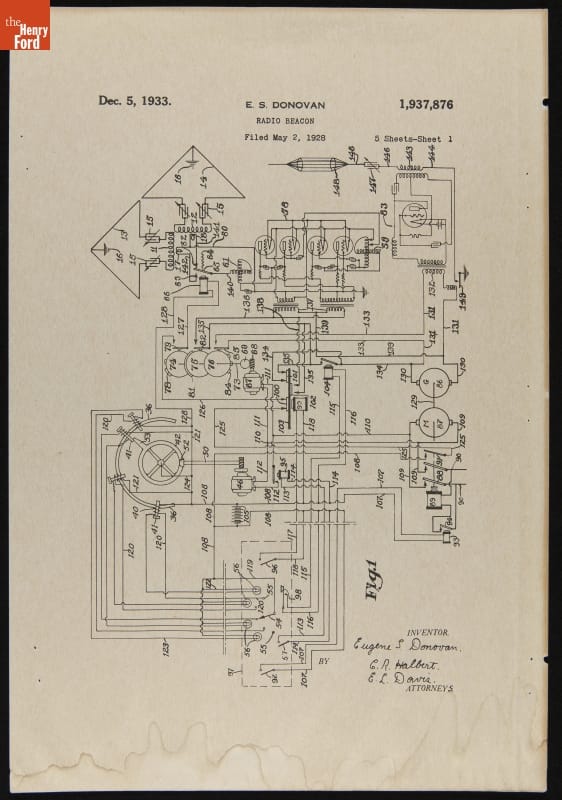
View ArtifactDiagram for Radio Beacon Patent, #1,937,876, Granted December 5, 1933
The radio beacon may be Henry Ford's most important contribution to aviation. Early pilots depended on landmarks, preventing reliable navigation in bad weather. Ford's engineers developed a radio beacon that simultaneously transmitted the Morse code letter "A" (dot-dash) in one direction and the letter "N" (dash-dot) in another. The pilot steered until the separate signals merged into a steady hum.
View ArtifactPatent Model of Edison's Automatic Telegraph, 1879
This patent demonstrated the recording and transmitting of Morse code messages. A cardboard disc was placed on top of a rotating plate with spiral grooves. Indentations were embossed onto the cardboard by a needle powered by an electromagnet. These indents formed a recorded message, which could then be transmitted—without needing an operator—to several stations, saving labor.
View ArtifactPatent Model of Argand Lamp Burner, 1855
Nineteenth century inventors constantly sought to create more efficient lighting technology, leading to improved patents such as this Argand burner. This principle forced air through the center of a hollow wick tube, allowing for a more complete combustion and a longer burning period. This burner would fit into a lamp hung from a ceiling.
View Artifact

