Monthly Archives: October 2015


Digitizing what one of our curators refers to as “the bottomless pit of wonderfulness” results in some strange, and often highly entertaining, adventures. One such recent project, undertaken to accompany an upcoming story in The Henry Ford Magazine, had us combing through our holdings for artifacts that some might consider trash. One item we heartily enjoyed working on was this collection of animal bones and teeth retrieved from the original site of Firestone Farm, and stored in our archives in a box labeled “loose items.” Other similar items we’ve just digitized include fragments found at Henry Ford’s birthplace, as well as some of the “mute relics” that Henry Ford had retrieved from the original site of Thomas Edison’s Menlo Park, New Jersey, laboratory (and which were previously exhibited in Greenfield Village). Visit our digital collections to find more artifacts you might call trash—or treasures—and keep your eye out for our magazine to see which “trashy” artifacts made the cut.
Ellice Engdahl is Digital Collections & Content Manager at The Henry Ford.
by Ellice Engdahl, The Henry Ford Magazine, digital collections

 Almost exactly two years ago, The Henry Ford embarked on a project to identify, conserve, photograph, catalog, rehouse, and make available online at least 1,000 items from our communications collections. This project was made possible through a generous $150,000 Museums for America grant (MA-30-13-0568-13) from the Institute of Museum and Library Services, or IMLS. Though we will continue to work on some straggler artifacts that have not yet made it through the entire process, the grant officially ended on September 30, with a total of 1,261 artifacts available online. One of the very last artifacts to be added during the official grant period was this computer trainer, used in the metro Detroit area in the 1960s to teach students to operate computers, a skill increasingly needed in the American workforce. You can see some of the other artifacts that worked their way through the IMLS grant process by browsing our digital collections for such communications-related artifacts as typewriters, radio receivers, phonographs, amplifiers, cameras, motion-picture cameras, mimeographs, and magic lanterns, among many others. We extend our thanks once again to IMLS for enabling us to make these significant collections accessible to everyone.
Ellice Engdahl is Digital Collections & Content Manager at The Henry Ford.
communication, technology, computers, IMLS grant, digital collections, by Ellice Engdahl

Over the weekend of September 26-27, 2015, the 6th annual World Maker Faire was hosted at the New York Hall of Science. Much like Maker Faire Detroit at The Henry Ford, New York’s Faire benefited from an added sense of shared history that comes from producing such an event on the grounds of a museum. Maker demonstrations, workshops, and displays were set up outdoors, on the former grounds of the 1964 World’s Fair—an event that was full of technological spectacle. And inside the Hall of Science, modern-day Makers found communal space alongside the museum’s interactive demonstrations about space exploration, biology, mathematics, and much more. The continuum of the importance of the technology of the past—in tandem with the anticipative futures of the Maker Movement—was substantial and exciting to witness. Continue Reading
music, technology, computers, radio, video games, events, by Kristen Gallerneaux, making

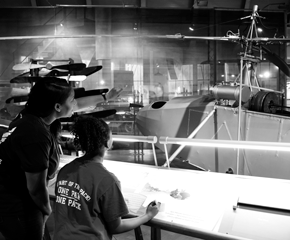
The Douglas DC-3 ranks with the Model T Ford and the Volkswagen Beetle as one of the great engineering designs of the twentieth century. The aircraft was safe, reliable, economical, and did more than any other single airplane to make commercial aviation a viable industry.
Ironically, the story of the DC-3 began with a famous airline crash. In 1931, a Fokker tri-motor operated by Transcontinental & Western Air (TWA) went down, killing all seven people on board, including famed University of Notre Dame football coach Knute Rockne. When an investigation of the crash revealed that the wood wing of the Fokker was weakened by rot, airlines began scrambling to replace wood-framed planes with all-metal ones. TWA asked several manufacturers for proposals for a new, all metal airplane, with two or three engines, weighing no more than 14,200 pounds, able to carry at least 12 passengers at 150 miles per hour, with a range of 1,080 miles. Douglas Aircraft, which had previously concentrated on military planes, proposed a twin-engine aircraft that they called the Douglas Commercial Number 1, or simply DC-1. TWA chose the Douglas design, but before it went into production an improved version was developed, called the DC-2. Continue Reading
California, 20th century, 1930s, travel, Heroes of the Sky, Henry Ford Museum, by Bob Casey, airplanes

Today organizations across the country are honoring manufacturing with Manufacturing Day, a day celebrating modern manufacturing. There are more than 2,000 events to choose from. We tell the story of manufacturing through our Ford Rouge Factory Tour experience and the artifacts within our collections. If you're curious to learn more about Henry Ford and manufacturing, take a look at this collection of blog posts and videos.
- Ford's Five-Dollar Day
- Activating Today's Maker Community
- #1 Cars at The Henry Ford
- A Technical Look at the 2015 North American International Auto Show
- Ford Methods and the Ford Shops
Lish Dorset is Social Media Manager at The Henry Ford.