Monthly Archives: September 2017


The Canadian Model T Assembly Team wowed Old Car Festival crowds by putting together a working chassis in less than 10 minutes.
Our 67th annual Old Car Festival is in the books – and it was one for the books this year. Postcard-perfect weather, a host of new activities and hundreds of vintage automobiles from motoring’s first decades made this one of the most exciting Greenfield Village car shows in recent memory. This yellow 1921 Lincoln, from the Cleveland History Center, is believed to be the earliest surviving Lincoln motor car.
Lincoln took center stage as our featured marque. It was 100 years ago that Henry Leland left Cadillac to form what would become his second automobile company, named for the first president for whom he voted. We had a number of important Lincolns on hand. From The Henry Ford’s own collection was the circa 1917 Liberty V-12 aircraft engine (Lincoln’s first product) and the 1929 Dietrich-bodied convertible. Our friends at the Cleveland History Center’s Crawford Auto-Aviation Collection brought something very special: a 1921 Model 101 believed to be the oldest surviving Lincoln automobile. The earliest cars, like this red 1903 Ford Model A runabout, line up for their turn at Pass-in-Review.
Automotive enthusiasts had their pick of activities. There were the cars, of course, spread chronologically throughout the village. There were the Pass-in-Review parades, in which our expert narrators commented on participating vehicles as they drove past the Main Street grandstand. There were the car games, and continuing demonstrations by the Canadian Model T Assembly Team, in Walnut Grove. There were bicycle games near (appropriately enough) Wright Cycle Company. And there were presentations on various auto-related topics in Martha Mary Chapel and the Village Pavilion. Old Car Festival welcomed a few genuinely rare cars in addition to the wonderfully ubiquitous (Ford, Chevrolet, Dodge Brothers) and downright obscure (Crow, Liberty, Norwalk). Rarities this year included a 1913 Bugatti Type 22 race car (said to be the oldest Bugatti in North America) and a 1914 American Underslung touring car (purportedly the last vehicle produced by the company). Staff presenters and show participants alike dressed in period clothing, adding to the show’s atmosphere.
But this year, the cars were only the beginning. Greenfield Village hosted activities and historical “vignettes” keyed to each decade represented in the show. Aging Civil War veterans reminisced about Shiloh and Gettysburg at the Grand Army of the Republic encampment. Farther into the village, doughboys and nurses commemorated the centennial of America’s entry into the Great War. Sheiks and Shebas danced the Charleston at the bandstand near Ackley Covered Bridge. Southern blues resonated through the Mattox Home, evocative of the Great Depression’s bleakest years. Perhaps the most popular vignette, though, was the 1910s Ragtime Street Fair occupying the southern end of Washington Boulevard. Great food, games and dancing filled the street, all set to music provided by some of the most talented piano syncopators this side of Scott Joplin. It’s magical when the sun sets and the headlamps turn on, like those on this 1925 Buick Master 6 Touring.
Longtime show participants and visitors will tell you that the highlight comes on Saturday evening. As the sun sets in the late-summer sky, drivers switch on (or fire up) their acetylene, kerosene and electric headlamps for the Gaslight Tour through Greenfield Village. Watching the parade, it’s hard to tell who enjoys it more – the drivers and passengers, or the visitors lined up along the route. This year’s tour was capped by a fireworks display at the end of the night.
It was a special weekend with beautiful automobiles, wonderful entertainment and – most of all – fellowship and fun for those of us who love old cars. Congratulations to the 2017 Old Car Festival Award Winners.
Matt Anderson is Curator of Transportation at The Henry Ford.
Michigan, Dearborn, 21st century, 2010s, Old Car Festival, Greenfield Village, events, cars, car shows, by Matt Anderson
Henry Ford used wireless radio to communicate within Ford Motor Company (FMC) starting after October 1, 1919. This revolutionary new means of communication captured Ford’s interest because it allowed him to transmit messages within his vast operation. By August 1920, he could convey directions from his yacht to administrators in FMC offices and production facilities in Dearborn and Northville, Michigan. By February 1922, Ford’s railroad offices and the plant in Flat Rock, Michigan were connected, and by 1925, the radio transmission equipment was on Ford’s Great Lake bulk haulers and ocean-going vessels. Historian David L. Lewis claimed that “Ford led all others in the use of intracompany radio communications” (The Public Image of Henry Ford, 311).
Ford Motor Company also used radio transmissions to reach external audiences through promotional campaigns. During 1922, FMC sales branches delivered a series of expositions that featured Ford automobiles and Fordson tractors. An article in Motor Age (August 10, 1922) described highlights of the four-month tour of western Oregon:
“The days are given over to field demonstrations of tractors, plows and implements, while at night a radio outfit that brings in the concerts from the distant cities and motion pictures from the Ford plant, keep an intensely interested crowd on the grounds until the Delco Light shuts down for the night.”
The Ford Radio and Film crew that broadcast to the Oregon crowds traveled in a well-marked vehicle, taking every opportunity available to inform passers-by of Ford’s investment in the new technology – radio – and the utility of new FMC products. Ray Johnson, who participated in the tour, recalled that he drove a vehicle during the day and then played dance music in the evenings as a member of the three-piece orchestra, “Sam Ness and his Royal Ragadours.”

Ford and Fordson Power Exposition Caravan and Radio Truck, Seaside, Oregon, 1922 . THF134998
In 1922, Intra-Ford transmissions began making public broadcasts over the Dearborn’s KDEN station (call letters WWI) at 250-watts of power, which carried a range of approximately 360 meters. The radio station building and transmission towers were located behind the Ford Engineering Laboratory, completed in 1924 at the intersection of Beech Street and Oakwood Boulevard in Dearborn.

Ford Motor Company Radio Station WWI, Dearborn, Michigan, March 1925. THF134748
Staff at the station, conveying intracompany information and compiled content for the public show which aired on Wednesday evenings.

Ford Motor Company Radio Station WWI, Dearborn, Michigan, August 1924. THF134754
The station did not grow because Ford did not want to join new radio networks. He discontinued broadcasting on WWI in early February 1926 (The Public Image of Henry Ford, 179).
Ford did not discontinue his intracompany radio communications. FMC used radio-telegraph means to communicate between the head office in Dearborn and remote locations, including, Fordlandia, a 2.5-million-acre plantation that Ford purchased in 1927 and that he planned to turn into a source of raw rubber to ease dependency on British colonies regulated by British trade policy.
Brazil and other countries in the Amazon of South American provided natural rubber to the world until the early twentieth century. The demand for tires for automobiles increased so quickly that South American harvests could not satisfy demand. Industrialists sought new sources. During the 1870s, a British man smuggled seeds out of Brazil, and by the late 1880s, British colonies, especially Ceylon (today Sri Lanka) and Malaysia, began producing natural rubber. Inexpensive labor, plus a climate suitable for production, and a growing number of trees created a viable replacement source for Brazilian rubber.
British trade policies, however, angered American industrialists who sought to establish production in other places including Africa and the Philippines. Henry Ford turned to Brazil, because of the incentives that the Brazilian government offered him. His goals to produce inexpensive rubber faced several hurdles, not the least of which was overcoming the traditional labor practices that had suited those who harvested rubber in local forests, and the length of time it took to cultivate new plants (not relying on local resources).
Ford built a production facility on the Tapajós River in Brazil. This included a radio station. The papers of E. L. Leibold, in The Henry Ford’s Benson Ford Research Center, include a map with a key that indicated the “proposed method of communication between Home Office and Ford Motor Company property on Rio Tapajos River Brazil.” The system included Western Union (WU) land wire from Detroit to New York, WU land wire and cable from New York to Para, Amazon River Cable Company river cable between Para and Santarem, and Ford Motor Company radio stations at each point between Santarem and the Ford Motor Company on Rio Tapajós. Manual relays had to occur at New York, Para, and Santarem.

Map Showing Routes of Communication between Dearborn, Michigan and Fordlandia, Brazil, circa 1928. THF134693
Ford officials studied the federal laws in Brazil that regulated radio and telegraph to ensure compliance. Construction of the power house and processing structures took time. The community and corporate facilities at Boa Vista (later Fordlandia) grew. By 1931, the power house had a generator that provided power throughout the Fordlandia complex.

Generator in Power House at Fordlandia, Brazil, 1931. THF134711

Power House and Water Tower at Fordlandia, Brazil, 1931. THF134714
Lines from the power house stretching up the hill from the river to the hospital and other buildings, including the radio power station. The setting on a higher elevation helped ensure the best reception for radio transmissions.

Sawmill and Power House at Fordlandia, Brazil, 1931. THF134717
Workers built the radio power house, which held a Delco Plant and storage batteries, and the radio transmitter station with its transmission tower. The intracompany radio station operated by 1929.

Radio Power House, Fordlandia, Brazil, 1929. THF134697

Radio Transmitter House, Fordlandia, Brazil, 1929. THF134699

Storage Batteries in Radio Power House, Fordlandia, Brazil, 1929. THF134701

Delco Battery Charger for Radio Power House, Fordlandia, Brazil, 1929. THF134703

Radio Power House Motor Generator Set, Fordlandia, Brazil, 1929. THF134705
The radio power house is visible at the extreme left of a photograph showing the stone road leading to the hospital (on an even higher elevation) at Fordlandia.

Stone Road Leading to Hospital, Fordlandia, Brazil, 1929. THF134709

Radio Transmitter Station, Fordlandia, Brazil, 1929. THF134707
Back at FMC headquarters in Dearborn, Ford announced in late 1933 that he would sponsor a program on both NBC and CBS networks. The Waring show aired two times a week between 1934 and 1937, when Ford pulled funding. Ford also sponsored World Series broadcasts. The most important radio investment FMC made, however, was the Ford Sunday Evening Hour, launched in the fall of 1934. Eighty-six CBS stations broadcast the show. Programs included classical music and corporate messages delivered by William J. Cameron, and occasionally guest hosts. Ford Motor Company printed and sold transcripts of the weekly talks for a small fee.
On August 24, 1941 Linton Wells (1893-1976), a journalist and foreign correspondent, hosted the broadcast and presented a piece on Fordlandia.

Program, "Ford Summer Hour," Sunday, August 24, 1941. THF134690
Linton Wells was not a stranger to Henry Ford’s Greenfield Village, he and his wife, Fay Gillis Wells, posed for a tintype in the village studio on 2 May 1940.

Tintype Portrait of Linton Wells and Fay Gillis Wells, Taken at the Greenfield Village Tintype Studio, circa 1940. THF134720
This radio broadcast informed American listeners of the Fordlandia project, in its 16th year in 1941. Wells summarized the products made from rubber (by way of an introduction to the importance of the subject). He described the approach Ford took to carve an American factory out of an Amazonian jungle, and the “never-say-quit” attitude that prompted Ford to re-evaluate Fordlandia, and to trade 1,375 square miles of Fordlandia for an equal amount of land on Rio Tapajós, closer to the Amazon port of Santarem. This new location became Belterra. Little did listeners know the challenges that arose as Brazilians tried to sustain their rubber production, and Ford sought to grow its own rubber supply.
By 1942, nearly 3.6 million trees were growing at Fordlandia, but the first harvest yielded only 750 tons of rubber. By 1945, FMC sold the holdings to the Brazilian government (The Public Image of Henry Ford, 165).
The Ford Evening Hour Radio broadcasts likewise ceased production in 1942 after eight years and 400 performances.
Learn more about Fordlandia in our Digital Collections.
Debra A. Reid is Curator of Agriculture and the Environment; Kristen Gallerneaux is Curator of Communication and Information Technology; and Jim Orr is Image Services Specialist at The Henry Ford.
Sources
- Relevant collections in the Benson Ford Research Center, The Henry Ford, Dearborn, Michigan.
- Grandin, Greg. Fordlandia: The Rise and Fall of Ford’s Forgotten Jungle City. Picador. 2010.
- Lewis, David L. The Public Image of Henry Ford: An American Folk Hero and His Company. Detroit, Michigan: Wayne State University Press, 1976.
- Frank, Zephyr and Aldo Musacchio. “The International Natural Rubber Market, 1870-1930.″ EH.Net Encyclopedia, edited by Robert Whaples. March 16, 2008.
South America, 20th century, 1940s, 1930s, 1920s, technology, radio, Michigan, Henry Ford, Fordlandia and Belterra, Ford Motor Company, communication, by Kristen Gallerneaux, by Jim Orr, by Debra A. Reid
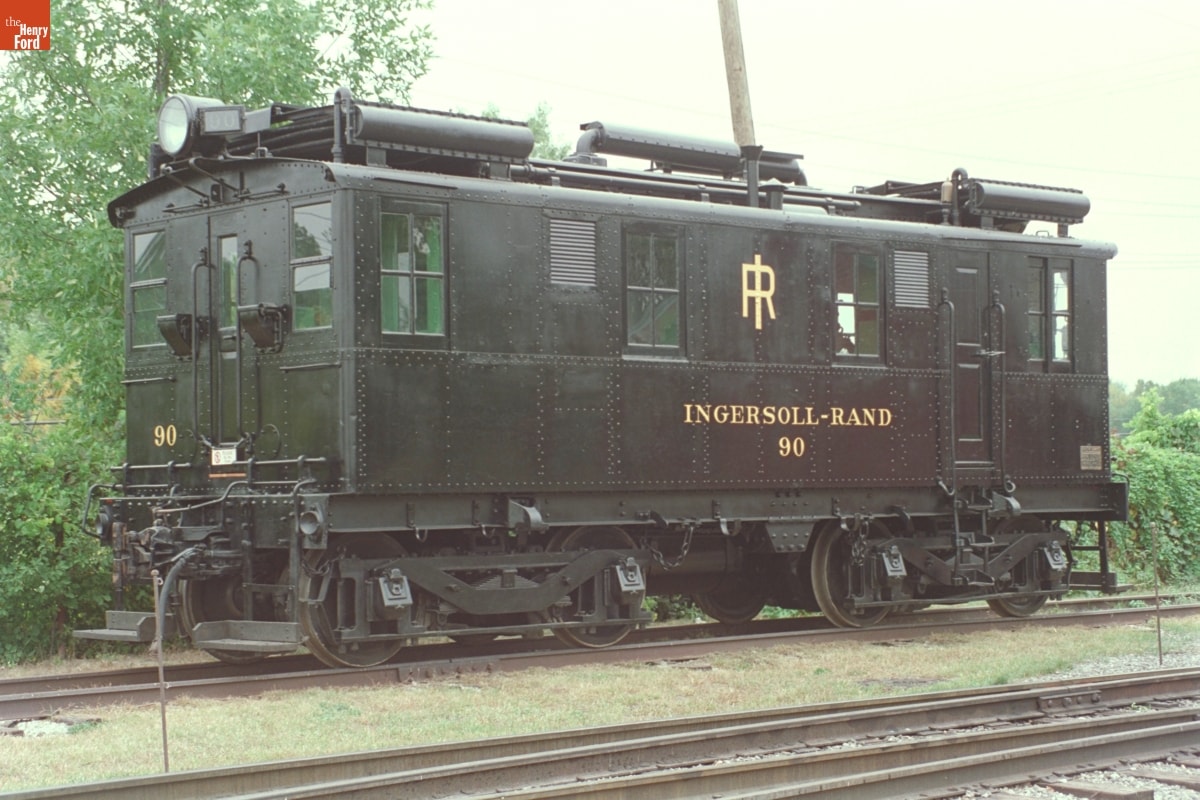
Tucked away among the rolling stock and locomotives on display in Henry Ford Museum of American Innovation is an unassuming piece of railroad equipment, modest and apparently devoid of style or character. This little locomotive is one of the most significant items in the collection. It is one of the first locomotives to successfully use internal combustion instead of steam as its power source.
The decline of steam
By the mid-1920s the design and development of steam locomotives had become rigorous and scientific. The dominance of steam, however, was being challenged. Could the internal combustion engine with its higher efficiency, ease of operation, and reliance on cheap fuel become an alternative power source for railroad operations? Smoke abatement rulings in Chicago and New York City provided a further incentive for researching alternatives to steam power.
Success with internal combustion
General Electric's internal combustion engine/railroad interests dated back to 1904. However, by 1920 they had not developed a suitable engine. In late 1923, the Ingersoll-Rand Company successfully developed a locomotive to General Electric's specifications. Over the next 13 months it was tested on 10 different railroad systems. Its success led to a production run of variant engines that ended in 1937 when Ingersoll-Rand withdrew from the locomotive-building field.
Cheaper than steam
The American Locomotive Company supplied the car bodies for these early locomotives. Assembly took place at the General Electric plant in Erie, Pennsylvania. Ingersoll-Rand supplied the engines, building their sales pitch around low operating cost. Number 90, the sixteenth unit built, was delivered in December 1926 and used as a promotional demonstrator, switching in Ingersoll-Rand's Phillipsburg, New Jersey, plant rail yards.

Ingersoll-Rand's Number 90 Diesel-Electric Locomotive, Phillipsburg, New Jersey, probably 1926. THF271020
Efficient design
Number 90's blunt appearance hardly suggests speed or glamour, but compared to steam locomotive switchers its angular outline appears neat and businesslike. The operator's positions -- located at either end -- are clean and tidy, partitioned from the heat of the engine, located in the center of the car. The locomotive's operation is streamlined even if its style is minimal. Subsequent collaborations between industrial designers and railroad companies produced locomotive designs that would further emphasize Number 90's utilitarian appearance.
The job of the switcher
Switchers worked out their years in dirty yards assembling the freight trains that were as much a part of the railroad experience as the fastest overnight express. Number 90 continued in use as a switcher in the Ingersoll-Rand plant until the late 1960s by which time the diesel revolution that it had helped begin had swept steam power aside in the United States.
Maker: General Electric/Ingersoll-Rand/American Locomotive Company
Engine: 6-cylinder diesel
Horsepower: 300 @ 550 rpm.
Displacement: 5655 cu. in.
Generator: 200 kilowatts, 600 volts
Traction motors: 4 @ 95 horsepower each
Weight: 60 tons
Tractive effort: 36,000 lbs.
Speed: 30 mph.
Gift of Ingersoll-Rand Company
Marc Greuther is Chief Curator and Senior Director of Historical Resources at The Henry Ford.
Additional Readings:
- Newcomen Engine, circa 1750
- The Ingersoll-Rand Diesel-Electric Locomotive: Boxy but Significant
- Westinghouse Portable Steam Engine No. 345
- 1927 Plymouth Gasoline-Mechanical Locomotive
New Jersey, railroads, power, Pennsylvania, Henry Ford Museum, by Marc Greuther, 20th century, 1920s

Writer demonstrating proper posture and hand-holding position, c. 1800. THF286087
In her recent article, “Cursive: Dead or Alive?” (The Henry Ford Magazine, June-December 2017), author Anne Trubek asserts that, today, cursive writing “is becoming retro-cool, more interesting precisely because its utility has largely passed.”
Indeed, the importance of penmanship—as cursive writing was once called—has radically declined as part of school curricula in recent years. It is no longer required in most states’ Common Core standards—due to increased technology use, the rejection of repetitive drills as teaching tools, and the higher importance placed on reading and math in government-issued tests. However, not everyone agrees that eliminating it from the curriculum is desirable, arguing that mastery of cursive writing helps with hand-eye coordination, long-term memory, problem-solving, and idea generation.
The heated debate about the need for young people to learn cursive writing—or not—raises the question of how we got here. In fact, the story of handwriting in America is one of continual adaptation to technological and social change, and in no small part the influence of two innovators whose names have been largely forgotten today—Platt Rogers Spencer and Austin Norman Palmer.

A trained engrosser transcribed the original 1776 version of this document—the Declaration of Independence—from Thomas Jefferson’s handwritten draft. THF92259
In the 1700s, as more people learned to read and printed materials became more available, reading became a desirable skill. But writing? That was reserved exclusively for the wealthy and for those whose profession required it—like merchants, bookkeepers, legal clerks, and engrossers (those trained to transcribe the final draft of a document in a large, clear hand).
Handwriting in those days was tedious and difficult, including learning how to fashion quills from goose feathers, mix ink, rule lines on paper, and use the ink-filled quill without spotting or smudging the paper.
Writing became a more widely accepted and embraced skill during the early 1800s, as self-trained writing masters traveled around the country offering courses of instruction. In more populated urban areas, they offered private writing courses in what were in essence the first business colleges.

To motivate students, teachers often bestowed awards for good penmanship, like this 1877 example. THF286089
In small towns and villages, writing masters taught the rudiments of handwriting to students in the growing number of common, or public, schools. Learning to write came to be considered as important a skill as reading and arithmetic for schoolchildren (actually, boys) in preparation for their future roles in industrial America.

The word “Penmanship” on the cover of this 1867 Spencerian writing book exemplifies that very writing method. THF286020
One particular writing master, Platt Rogers Spencer, would become so successful that his approach to handwriting almost completely dominated penmanship education during the post-Civil War period. Spencer realized that, to truly influence how most Americans learned to write, he needed to go right to the source. So he brought penmanship lessons directly to teacher-training schools. From there, the popularity of his writing method spread to public and private education at all levels—from business colleges down to primary schools. So pervasive and dominant was his influence that Spencer became known as the “Father of American Handwriting.”

This fancy trade card gives an idea of the level of expertise in penmanship that students of the Toledo Business College would attain. THF225626
Spencer’s unique approach to handwriting reduced the alphabet to a few elemental principles, equating each letter—and parts of each letter—to natural forms like waves, sunbeams, clouds, and leaves. In this way, he could claim that his approach was not just a series of mechanical movements but also a “noble and refining art.” At the same time, his handwriting lessons emphasized order and precision. With students from different walks of life—rural and urban, rich and poor, obedient and unruly, foreign- and American-born—all practicing exactly the same lessons, Spencer could claim that learning his handwriting method would mold America’s young people into reliable citizens and obedient future workers.

The Ford Motor Company logo is an example of Spencerian writing, which Henry Ford learned in school. THF104934
Spencerian became the dominant handwriting method in America from the 1860s into the early 1900s. It seemed to fit everything that Americans strived for. That was, until penmanship entrepreneur Austin Norman Palmer came along, claiming that Spencerian handwriting was all wrong for Americans. He argued that Spencerian script was too ornate, too meticulous, too slow, too tiring, even too feminine. What Americans wanted and needed, he argued, was a “plain and rapid” style adapted to “the rush of business,” a style that was masculine and unsentimental.

As shown in this 1920s language composition book, students learning the Palmer method were taught to pride themselves on their penmanship, which was considered a judge of good character. THF247435
Palmer introduced a new approach—one which forced the muscles to move in certain patterns—over and over and over, with the idea that the muscles would imprint the memory of these movements into the brain and become habit. Though the approach was radically different, Palmer’s goal—like Spencer’s—was ultimately about social control. Disciplining the body, he asserted, would also force students to conform to the conventions of society. He came down particularly hard on left-handedness, which he considered deviant, and he insisted that left-handers learn to write with their right hand.

Students of Henry Ford’s Edison Institute school system hard at work practicing their writing skills, 1944. THF126142
The Palmer method began displacing the Spencerian method of handwriting by the 1890s and, by the second decade of the 1900s, millions of Americans had become “Palmerized.” In truth, given the limited resources and lack of teacher training in many communities—as well as negative attitudes by both teachers and students toward the rigorous requirements of this method—the Palmer method was not strictly enforced in most school systems and it was often combined with other handwriting methods.

This type of school desk, made in the 1940s but used well into the 1960s, contains a hole for an ink bottle to be used with a dip pen. THF158363
Paralleling new studies in child psychology and new approaches to childhood education, two trends emerged in the 1900s. First was the realization that young children simply did not possess the motor skills to learn cursive writing, leading to a new emphasis on learning printing first and cursive writing later. Second, a new attitude emerged that writing could be more than a mechanical movement—it could become an outlet for self-expression.

The brightly colored images on this early 1970s school box, used for holding writing implements and other school supplies, were inspired by those of Peter Max and other psychedelic designers of the era. THF169170
Coinciding with these trends were new forms of technology—from typewriters to word processors to personal computers—that, by the end of the century, displaced the need for handwriting in our society. Meanwhile, ink-dipped steel pens of the early 1900s were replaced by ballpoint and rollerball pens later in the century, and by Smartphones and iPads today.
As Americans, we tend to romanticize and revive that which we have lost. So it comes as no surprise that, as computers have replaced the necessity of handwriting, so handwriting has become an art, a craft, the province of “makers”—equated with creativity and self-expression.
We’ll see what lies in store for handwriting into the future.
For further reading on this topic, take a look at, Handwriting in America: A Cultural History (by Tamara Plakins Thornton, New Haven, CT: Yale University Press, 1996).
Donna Braden is Curator of Public Life at The Henry Ford and handwrote this blogpost—believing that putting pen to paper helps her think more creatively than typing on a computer keyboard.
by Donna R. Braden, teachers and teaching, school, communication, education

It’s Back to School season—ads for clothing and school supplies are everywhere. The first day of school has meant many things to the generations of kids who have shared this experience. Excitement, curiosity, wariness--and for some of the first timers among us—perhaps even a bit of fear. Along with the first day of school often came fresh new school supplies: crayons with pointy tips, pencils with pristine erasers, and even a new schoolbag or backpack. And for many, it meant getting a brand new outfit to wear on that all-important first day of school.
 Megan Mines donned this plaid Kelly green dress and headed off to her first day of kindergarten in Warren, Ohio in 1980. She was a little wary of the plunge into the unknown world of kindergarten—what would it be like? Megan also wore the dress for her school photo later that year.
Do you remember your first day of school—kindergarten or any other year? What was it like? And what did you wear?